Burnout isn't a personal flaw—it's a system metric. 🚒🚑
If crews can’t predict when their shift ends or get true recovery time between high-acuity calls, retention drops.
Modern Fire/EMS leadership means fixing the operational schedule, not just offering a wellness app.
As fire and emergency responders, whether you're tackling a multi-alarm fire, studying for a promotion exam, or getting ready for a much-needed weekend off, The Energy Drink provides the killer flavors and clean, sustained energy you need.
https://t.co/CtRLXdpVkn
Is there a correlation between PFAS and Amyotrophic Lateral Sclerosis, or ALS? In my latest article, I explain how it is likely and why the topic requires continued attention, especially within the military and fire service communities.
https://t.co/iPoN3A6EXk
Trust, yet verify. One must authenticate the veracity of any rumor prior to its circulation; otherwise, one is complicit in the propagation of misinformation.
While criticisms, positions, and opportunities may change, one's authentic self remains constant and within one's dominion. It is imperative to maintain one's true identity, rather than conforming to the expectations of others to fulfill their desires.
I was assigned to Cannon AFB between 1991 and 1995 as a firefighter. The entire time I was there, we (the fire department) discharged AFFF (Aqueous Film Forming Foam) every day, up and down the flightline, in the fire training area, and various locations in between for training or during operational checks of the crash trucks. Before 1991, the same played out for decades all because firefighters were told, since it was invented in the 1960's, that AFFF was just soap and water and was perfectly safe.
So much AFFF was discharged at Cannon AFB that it seeped into the aquifer that supplies drinking water to the base and the surrounding community to include the nearby Highland Dairy Farm. As a result, the aquifer became significantly polluted and every individual who drank the water, unknowingly consumed toxic chemicals, i.e. PFAS.
For the four years I was at Cannon AFB, I and other firefighters not only contributed to the pre-existing pollution, but drank contaminated water. I suppose that's why I personally have significant levels of PFAS in my blood to this day; so much that when I eventually die, my blood will still contain elevated levels of various PFAS compounds.
The results of the NMED 79-page study are alarming to most, however, I am not surprised considering what I personally know was done that contributed to the pollution. Of the 638 blood samples taken, 99.7% detected PFAS, with 14 participants having levels greater than 20ng/mL.; and if I were part of the NMED study, I would be number 15.
My PFOS levels, one of the PFAS compounds detected at Cannon AFB, today, 30-years since I left Cannon AFB, are 22.8ng/mL. I can only imagine how high my levels were in 1995 when I left the base.
The DoD, in particular the Air Force knew that AFFF was toxic. Declassified military documents revealed the Air Force conducted tests in the 1970's that showed high fish kill rates and tumors in lab animals when exposed to AFFF. Despite their being aware of the health hazards associated with PFAS, the DoD and the Air Force said nothing, instead allowing firefighters to continue using AFFF recklessly.
Today, many military firefighters who were convinced that AFFF was safe, are experiencing medical illnesses to include but not limited to: various forms of cancer, high cholesterol, high triglycerides, diabetes, neuropathy, and memory loss. And what is the DoD doing, little to nothing; not even giving those of us who are sick an apology for lying to us all those years. Sadly, many who just wanted answers to why they became sick, have died, never knowing it was the military they proudly served that knowingly harmed them.
https://t.co/NAnYT999Qv
Firefighters, the sky is not falling, calm down.
The recent announcement of in-person course cancellations at the National Fire Academy (NFA) has caused a social media uproar, with many claiming that leadership development throughout the fire service will be negatively impacted.
The fire service, like it or not, is a business. Businesses routinely undergo internal and external evaluations or audits to ensure their products are being manufactured and delivered cost-effectively. This often necessitates difficult decisions such as organizational restructuring, policy revisions, and procedural updates.
It is likely that such evaluations or audits will result in the modification or elimination of some NFA courses and the dismissal of instructional staff. These are common business practices that effective fire service leaders should readily acknowledge. For those who object to the NFA cancellations, it is reasonable to inquire whether they would consider conducting similar evaluations or audits within their own fire departments.
To those who assert that the NFA course cancellations will have a detrimental effect on the fire service, it is important to consider alternative sources of leadership or fire service training. The NFA should not be considered the sole source of training. Successful businesses do not rely on a single source for leadership development. If they did, they would risk developing a narrow-minded approach to management and problem-solving.
The fire service must avoid falling into the trap of believing that the NFA is the "standard" and that only its "leadership development" or other fire service training is acceptable. Such a mindset is closed-minded and detrimental.
Fire service leaders, both career and volunteer, should seek out leadership development courses and skills from successful business leaders and organizations. They should actively engage in networking opportunities with each other, independent of the NFA. Firefighters must be able to adapt swiftly to ever-changing environments, including self-rescue when necessary. With NFA courses being paused or cancelled, fire service leaders must proactively seek out alternative solutions to navigate this new environment.
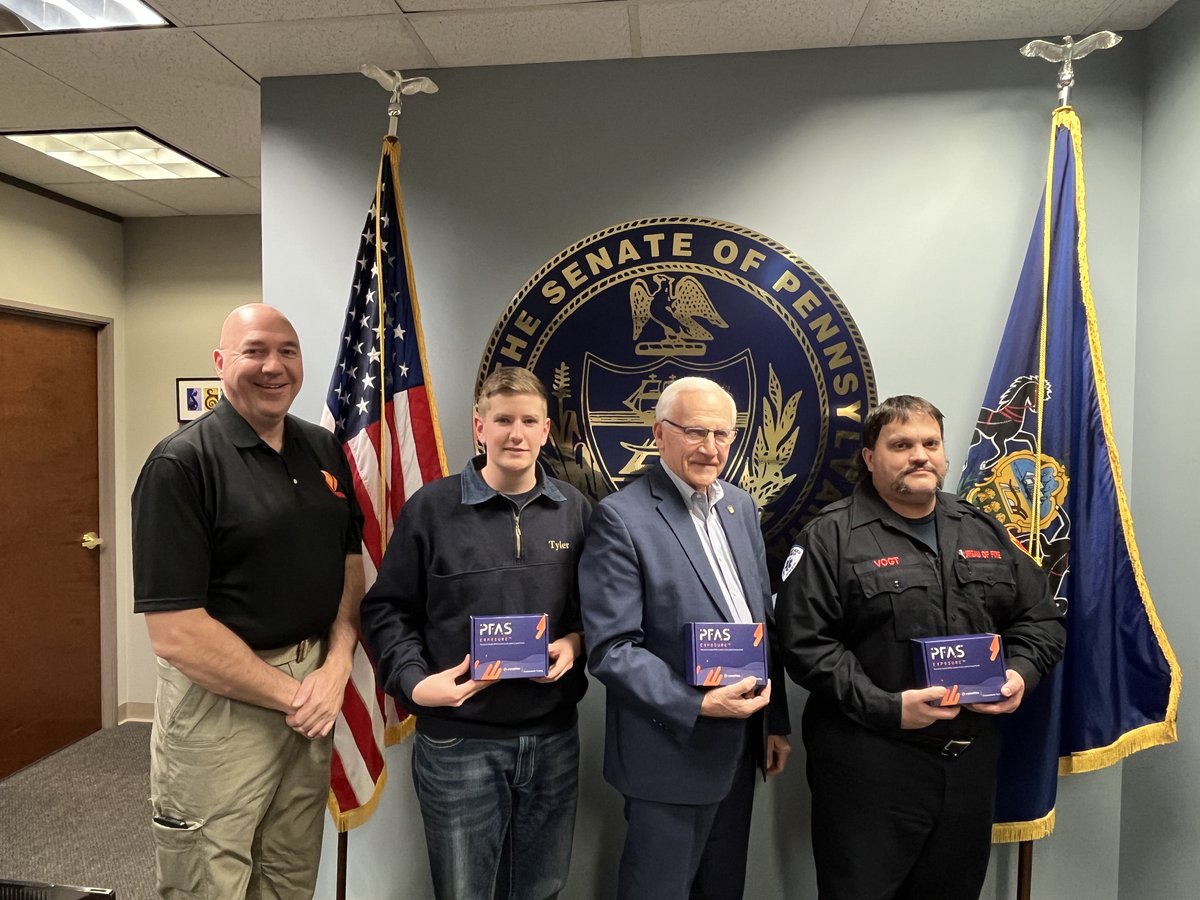
As an advocate for firefighter health and safety, I was honored to bring PFAS Blood Testing to Lycoming County, PA firefighters for the first time. Together, participants learned about the health risks of PFAS and how to manage occupational exposure for themselves and their departments.
Pennsylvania Legislator Hosts Grassroot PFAS Blood Test Project in Lycoming County.
Kevin Ferrara, AFSO21
Senator Gene Yaw (R-District 23) and two firefighters from Lycoming County recently participated in the region's first ever microsampling project to determine if firefighters have been exposed to Per- and Polyfluoroalkyl Substances, also known as PFAS.
PFAS consist of a group of approximately 12,000 man-made chemicals that are considered persistent due to their inability to break down easily. These “forever chemicals” have been detected in the environment and in most, if not all Americans due to their widespread use in consumer products like non-stick cookware, personal care products (shampoo, dental floss, cosmetics, sunscreen), cleaning products, stain resistant fabrics, carpeting, food packaging, bottled water, firefighting foams, and firefighting turnout gear.
Spearheaded by Kevin Ferrara, a nationally recognized subject matter expert on firefighter occupational exposure to PFAS, and CEO of Advisers to Fire Service Organizations (AFSO21), the project’s main goal is to determine what PFAS chemicals participants may have been exposed to and how much, and to provide participants with information on known and potential health risks associated with PFAS.
The self-administered/collected, finger-stick style blood test was created by Eurofins Scientific, a world leader in food, environment, pharmaceutical and cosmetic product testing, discovery pharmacology, forensics, advanced material sciences, and in agroscience Contract Research services.
Unlike other PFAS blood tests that require approximately 10mL (milliliter) of whole blood to be collected via needle by a healthcare technician and test for 6 to 9 PFAS compounds, the at-home finger-stick style test used in this project collects just 30uL (microliter) of capillary blood onto four small Mitra, similar in appearance to a cotton swab, and tests for 16 PFAS compounds. In comparison, 1,000 microliters is equal to 1 milliliter.
After sending off their test kits via FedEx, participants are expected to receive their PFAS blood test results in a few weeks at which time they will reengage with Kevin Ferrara to discuss their test results and determine what steps may be necessary to prevent further exposure.
It is predicted that approximately 70% of firefighters will at some point in their service be diagnosed with occupational cancer; therefore, project participants wish to express the importance of this grassroot project and hope it will encourage other firefighters throughout Pennsylvania to be tested for PFAS and create policies and procedures to manage exposure.
If you’d like to know more about firefighter occupational exposure to PFAS, please visit AFSO21 at https://t.co/c8oHPzCTep
@arff6312 Brad, no such database exists that I know of. However, I've been conducting a survey of firefighter PFAS blood test results for the past three years and the data shows nearly all participants have been exposed to several PFAS compounds, the most common PFOA, PFOS and PFHxS.