#CountryDuty
Breaking News:
Cape Town Marathon has been awarded the 8th Abbott World Marathon Major Status!
Africa’s 1st Major!
Kudos to everyone involved in making this happen!
Allegedly Forex Robot scammer John ghatti ( Rhulani Nkuna ) owes Bidvest Bank over R400k and you know what's funny in 2023 he claimed his got a networth of $10 million 😭😭😭🤣🤣🤣
This post was inspired by a discussion I had last night in a WhatsApp group with a colleague about housing.
Houses in Cape Town are now out of reach for many ordinary South Africans because of wealthy Europeans and Americans who have made the city their retirement home. You now find houses in prime Cape Town areas that were selling for around R4 million in 2008 selling for R20 million or more today.
The same phenomenon is happening in Harare. Houses that were selling for around US$60,000 in 2001 or 2002 are now selling for around US$600,000 or more in some areas. In Harare, part of this has been driven by the Chinese factor.
Chinese buyers have been snapping up houses in the capital, and the phenomenon has become so big that some major estate agents now advertise on Harare billboards in Mandarin (Chinese). Chinese buyers pay cash and there is no chain of waiting for them to sell another property.
Ordinary Zimbabweans have been priced out of the market, except for those in big business or those with access to serious foreign currency.
The same thing happened in London with Russians and wealthy Arabs from the Middle East. They snapped up properties and pushed prices beyond the reach of many ordinary Londoners. For some of them, London property was not even a home, it was simply a place to store money.
A property that was worth around £500,000 in 2000 can easily be worth £2 million or more today, depending on the area, while prime London homes have risen even more sharply.
Canada saw the same phenomenon with mainly Indian buyers and acted. The Canadian government introduced a ban stopping non-Canadians from buying residential property in many parts of the country. The law came into effect on 1 January 2023 and was later extended to 1 January 2027.
It applies to people who are not Canadian citizens or permanent residents, and to some companies controlled by non-Canadians. Canada decided that homes should be used to house people who live there, not simply as storage units for foreign money.
While Canada chose to restrict foreign purchases of residential property, Britain took a different approach. Rather than banning foreign buyers, it increased the taxes they pay. Foreign buyers in England pay a surcharge on top of the standard Stamp Duty Land Tax rates, and those purchasing additional properties or second homes face further surcharges.
The result is that overseas investors and second-home buyers contribute significantly more tax when acquiring property.
Britain also requires many large housing developments to include affordable housing as part of the planning process, it is called social housing. Through planning obligations, developers are required to set aside a proportion of new homes for people who cannot afford market prices.
The exact percentage varies from one local authority to another, but the principle is that private development should also help meet social housing needs.
Perhaps African countries affected by this can study the British approach. Rather than banning foreign buyers outright as Canada did, governments could impose higher taxes on foreign purchasers and luxury property acquisitions, then ring-fence those revenues for affordable housing programmes.
In that way, foreign investment would still be welcomed, but part of the wealth it generates would be used to help ordinary Africans access decent housing.
Yesterday, did you not say that the issue of generals being requested to come to a meeting by the President this weekend was a lie? So, is it a coincidence that today the President is with the generals in public today?
Did you also hear about the secret meeting that happened yesterday?
LIMPOPO-BORN ENTREPRENEUR EXPANDS INTO MALAWI WITH A $300 MILLION GOLD MINING INVESTMENT
Meet Matome Sefalafala, the founder and Director of Falaz Mineral Resources. Born in Lebowakgomo, Limpopo, he is steadily building a mining and logistics empire across Southern Africa.
Despite facing criticism and challenges along the way, Matome has created employment opportunities for more than 500 people. His business interests span gold mining, refining, logistics, property, and hospitality.
He recently launched Bakone Mining & Refineries in Johannesburg and is expanding operations into Zambia, Zimbabwe, and Malawi. Through a strategic partnership with a major Chinese company, he is also developing investment projects across Africa.
His logistics division operates more than 40 cross-border side tipper trucks servicing the mining sector in Zambia and beyond.
Now, in partnership with Malawi’s mining authorities, he is establishing a new gold mining operation in Malawi backed by a $300 million investment. He is also the owner of Lavida Lifestyle Centre in Lebowakgomo.
When asked about his vision, Matome said his mission is simple: “To multiply wealth, share wisdom, and create employment opportunities for Africans.”
A young South African entrepreneur proving that African dreams can become African success stories.
❤️ DEAR BLACK CHILD: YOUR DREAMS ARE VALID. YOUR DREAMS ARE POSSIBLE
The Omni Golf Collection Cup tees off today on the Fields Ranch East in WGT, and the prizes are as real as the competition. 🏆
🚨 Compete for a 2-night stay + golf at Omni Hotel & Resort Frisco - Home of the PGA of America
🔗 See Tournament Rules in bio
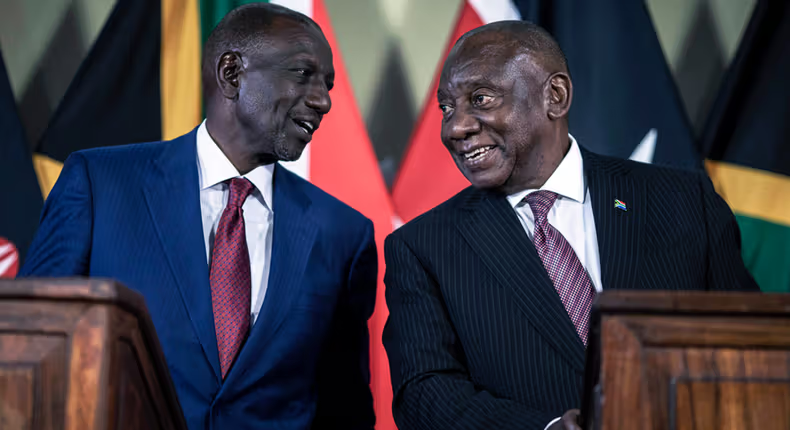
South Africa🇿🇦, Kenya🇰🇪 strike 6 new deals that could reshape trade across Africa
South Africa🇿🇦 and Kenya🇰🇪 have signed six new cooperation agreements aimed at unlocking trade, improving transport links, and boosting skills development, in a move that could strengthen economic integration between two of Africa’s most influential economies.
𝗪𝗘 𝗛𝗘𝗔𝗥 𝗧𝗛𝗔𝗧 𝗣𝗥𝗘𝗦𝗜𝗗𝗘𝗡𝗧 𝗠𝗡𝗔𝗡𝗚𝗔𝗚𝗪𝗔 𝗔𝗦𝗞𝗘𝗗 𝗧𝗢 𝗠𝗘𝗘𝗧 𝗥𝗘𝗧𝗜𝗥𝗘𝗗 & 𝗖𝗨𝗥𝗥𝗘𝗡𝗧 𝗚𝗘𝗡𝗘𝗥𝗔𝗟𝗦 𝗧𝗢𝗗𝗔𝗬.
We hear that President Mnangagwa has asked to meet retired and current generals again today. This will be the third meeting they will have in the past month.
It is good for the Commander-in-Chief to meet his generals, especially when a potential national security threat is developing around the Constitutional Amendment Bill 3. As I have said before, CAB3 lacks institutional support from the most important institutions: the military and ZANU PF structures, because it was not passed by Congress; and government itself, because it is being pushed by a parallel cabinet that was created by-past the real Cabinet.
We hope the parties find common ground and the civilian leadership shows nation-building leadership to avert a leadership vacuum that may need to be filled by the military.
The only problem with Mnangagwa trying to remove Chiwenga after he passes the constitutional amendment—assuming it survives court challenges—is that the Chinese and Russians have made it clear they want Chiwenga. Secondly, who else has the prerequisite institutional support in ZANU PF and the army to be saluted by the army, other than Chiwenga or maybe PV Sibanda?
Temba Mliswa has been campaigning for Chiwenga’s removal for a while, as has Kuda Tagwirei. But the reason Chiwenga has not been removed is that he has a solid support base in the military and among other liberation fighters waiting their turn in ZANU PF.
I don’t think removing Chiwenga—when he is the one who brought Mnangagwa back from exile after Mugabe and ZANU PF removed him, and to whom Mnangagwa promised succession—would leave Mnangagwa politically secure. It could make him vulnerable to a Mugabe-style removal.
Additionally, the success of CAB3, which would assure Chiwenga’s removal, would likely trigger further purges of military leaders to eliminate Chiwenga loyalists and could lead to Chiwenga’s own elimination. This puts the military and Chiwenga on dead ground, and from that position they have no choice but to fight for survival.
For us civilians, such an outcome also means a national security threat. Our military would be weakened further as its leadership ranks would be populated by young generals without 1980s training or battle experience in Mozambique, the Congo, Angola, Sudan, and Somalia.
Having said that, CAB3 still needs to be passed by Parliament, signed into law by the President, and survive court challenges before we talk about what comes after.