We’re building something new 🚀
Alongside the AI Physicist, we’ve been working on Theo Collaborator, a research workflow system designed around how scientific work actually happens.
We’ve just opened the waitlist for early access 👀 https://t.co/qekRSZmFGS
What can neuroscience teach us about building physical theories? 🧠 Our talk with Alexei Koulakov explores that question through three ideas:
👀 https://t.co/m7axPPzAem
Earlier this week, Automated Conjecturing with TxGraffiti by FirstPrinciples Member of Technical Staff, Randy Davila, was published in the Annals of Mathematics & Artificial Intelligence.
We've just shared a short piece with more context on how these systems approach mathematical discovery.
🔗https://t.co/j4rHvpe4kB
#AI #Conjecturing #Math
Now on YouTube 👀 Nathan Kutz on automated model discovery
Using SINDy + neural nets to recover governing equations from data with noise, multiple scales, or incomplete observations.
https://t.co/G6xzZ5qYNu
#AI#AIforScience
As we build the AI Physicist, we’ve been testing what actually improves scientific reasoning in language models. In our latest lab notes, we share early results across fine-tuning, RL with verifiable rewards, synthetic reasoning traces, and multi-model systems.
🔗 https://t.co/iVVhUr2kDZ
#AI #Physics #AIforScience
New Anthropic research: Emotion concepts and their function in a large language model.
All LLMs sometimes act like they have emotions. But why? We found internal representations of emotion concepts that can drive Claude’s behavior, sometimes in surprising ways.
Worth a look 🧐 Emergent Social Intelligence Risks in Generative Multi-Agent Systems
The authors show that familiar social pathologies (ex. collusion, conformity) can emerge in multi-agent systems, and aren’t prevented by agent-level safeguards alone. 🔗 https://t.co/AG8eHjZ5Sd
#Research #MultiAgent #AI
Now on YouTube 👀 In this FirstPrinciples Talk, Juan Felipe Carrasquilla Alvarez, Associate Professor at ETH Zürich, explores how models inspired by natural language processing can be applied to quantum many-body physics. Watch the full talk 🎥 https://t.co/ZB1TRUD4le
#Quantum #Physics #Webinar
The authors of AI for Science Needs Scientific Alignment propose a new field for “scientific alignment.”
The idea is to build AI systems that optimize for traceability, self-consistency, and interpretability while supporting how science is actually practiced.
This mirrors discussions we’ve had at FirstPrinciples. That is, not just building AI that can do science, but AI aligned with how science is done. 👀
🔗https://t.co/5lNYA1SupJ
📖 https://t.co/bLWHEgWIEB
#AIforScience
In case you missed it, we published our Talk with Fabian Ruehle last week.
'Symbolic Regression, Sparsification, and Kolmogorov-Arnold Networks' explores how KANs enable more interpretable neural networks. Watch the full talk ▶️
https://t.co/urScprN4UH
#AI#neuralnetwork #aiforscience
We’re working toward an ambitious goal: building an AI Physicist that can help develop a framework unifying (or transcending) quantum mechanics and general relativity by 2035.
We know timelines don't guarantee outcomes, but it’s our way to prioritize the right problems and coordinate effort. If you're interested, follow along 🔗 https://t.co/GdlIUVyFBn
#AI #Physics #AIforScience
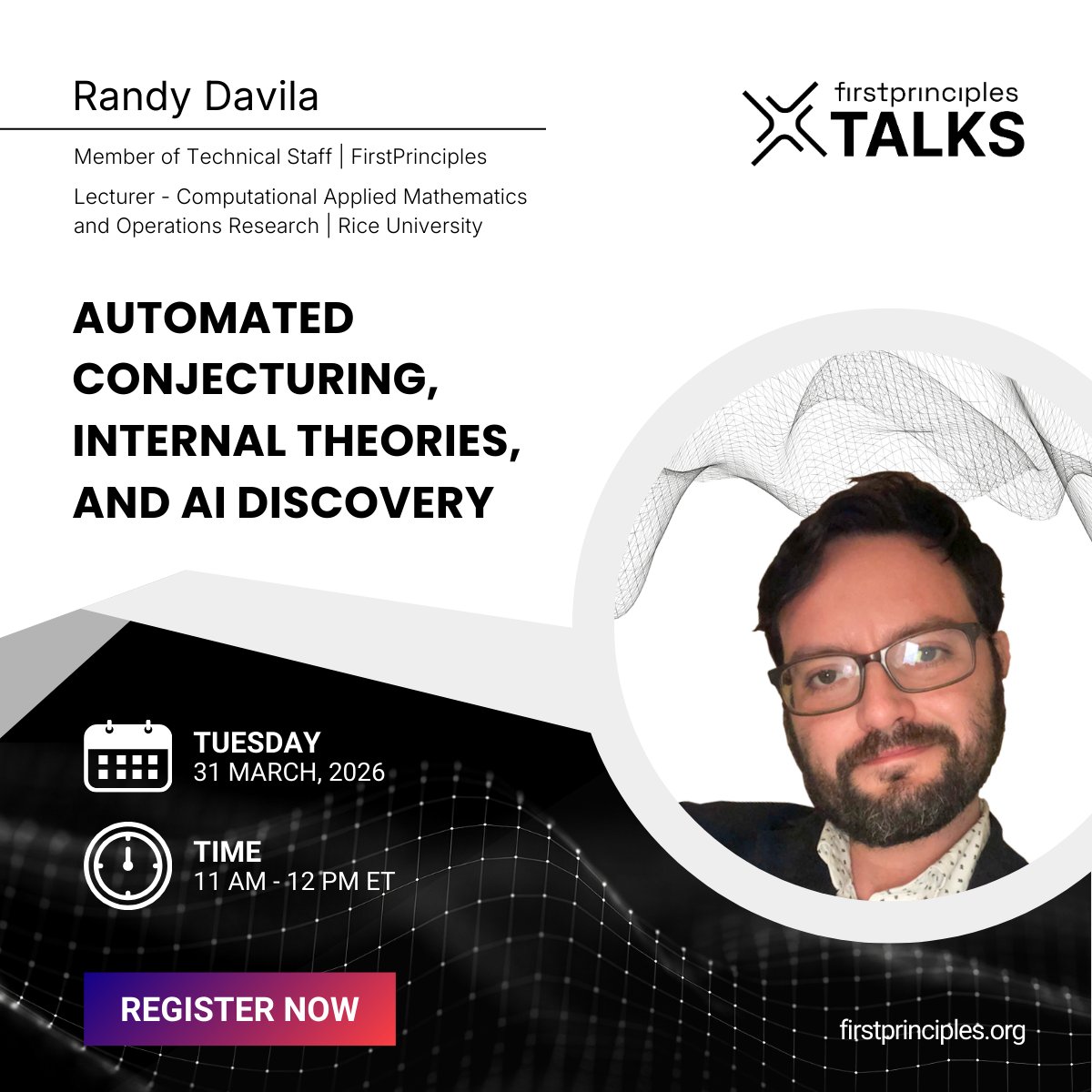
Upcoming Talk: Automated Conjecturing, Internal Theories, and AI Discovery
In this Talk, Randy Davila will introduce Graffiti3, a system designed to generate interpretable mathematical conjectures. We hope you’ll join us 🔗 https://t.co/q04GJIoWM9
#Conjecturing#Math
In this FirstPrinciples Talk, Tom Hope presents systems that use scientific literature as structured input for hypothesis generation and idea discovery.
Projects like Scimon, Scideator, and CHIMERA explore how AI can recombine concepts from papers to surface new research directions while addressing how we evaluate the novelty of ideas. ▶️https://t.co/3zzBq3KtHR
#AIforScience #AI
What if we could build a model that predicts physics the way LLMs understand language?
In this FirstPrinciples Talk, Florian Wiesner introduces the General Physics Transformer (GPhyT), an early step toward a physics foundation model that learns dynamics from simulations and infers governing laws from just a few timesteps.
🔗https://t.co/sQCIQJW5vj
#Physics #AI
We’re pleased to welcome Yang-Hui He to the FirstPrinciples Scientific Advisory Board.
A leading voice in AI for mathematics, Yang will help guide the development of Theo, the AI Physicist, particularly in mathematical and symbolic reasoning.🔗 https://t.co/Ul77smckm1
#AI #Physics
FirstPrinciples is hiring 🚀 As we continue building the AI Physicist, we’re looking to grow our team across development, product, and technical roles. Help us build what's next: https://t.co/I5WYArZ5bh
AI is transforming astrophysics, but models trained on simulations or past data often struggle when applied to new observations.
In this FirstPrinciples Talk, Aleksandra Ćiprijanović (Fermilab) discusses domain shift, robustness, and uncertainty in scientific ML as well as how to improve generalization.
Watch 📽️: https://t.co/Y44633xnJ5
#Astrophysics #MachineLearning
FirstPrinciples Talks are now on YouTube, starting with
'Accelerating Discovery in Collider Physics with Foundational Models' by Vinicius Mikuni.
In this Talk, Vinicius introduces OmniLearn, a foundational model for collider physics that:
• Cuts reconstruction compute costs
• Enables full uncertainty quantification
• Supports model-agnostic new physics searches
📽️ https://t.co/GcJKpEfkh7
#AI #AIforScience #Physics
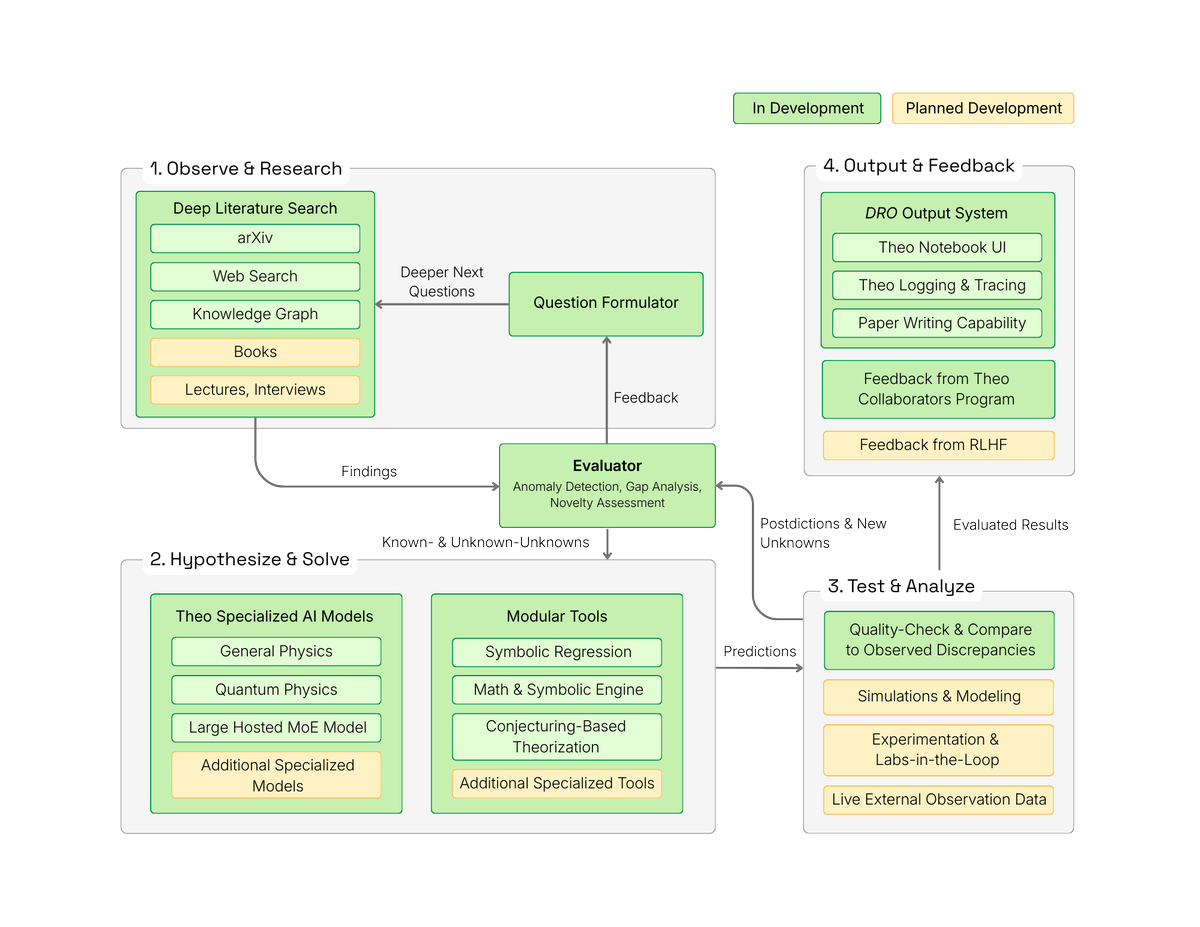
Allow us to (re)introduce what we’re building: Theo, the AI Physicist.
Modular by design, Theo is being built to progress through the scientific method. To participate reliably (and openly) alongside the scientific community, we aim to have Theo produce transparent outputs that can be challenged and extended upon.
We’re building AI for science, in service of shared understanding. If that’s a future you care about, we invite you to be part of it. 💡 https://t.co/10uaydmueH
#AI #AIforScience #Physics