Theo now connects to Hugging Face 🤗
Research often depends on data and models that sit behind access controls. Now, you can load your Hugging Face assets straight into the Theo Sandbox!
See Theo work on your problem: https://t.co/TXelSJY2xN
We’ve launched our new website 🚀 Theo is the AI Platform for R&D teams where your data, the world’s research, and your choice of models and tools, are all available on one platform built for verifiable scientific work.
Check it out: https://t.co/j5fBD8oUhJ
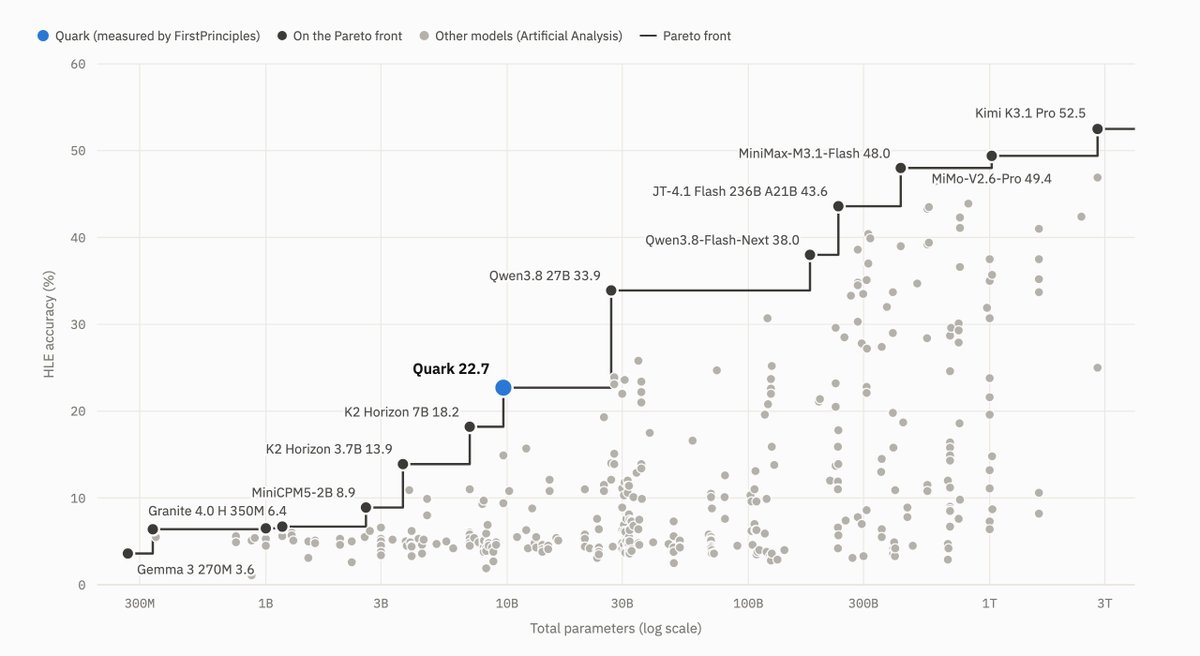
Introducing Quark, a 9B reasoning model for physics, science, and math from our model training team, now on @huggingface 🤗
Fine-tuned from Qwen3.5-9B, it scores 87.4 on GPQA Diamond (up from 81.6) and is small enough to run locally. We’d welcome people trying it on problems we haven’t!
https://t.co/4ZnzIBZxHp
Theo just got two new integrations!
You can now sync your Zotero library and bring papers into a research session for processing and choose which Github repositories Theo can access to ask about code, issues, and pull requests, with references back to the source. You can also explore commit history and compare branches or versions through chat.
Read the full release notes for all of the recent updates: https://t.co/L0O4qmcByd
Theo v1.0 just launched, and if you're curious about how it works, we're running a live demo tomorrow from 2-3pm ET. See you there!
https://t.co/83cT2H5w9a
Today we're launching Theo v1.0, a platform for researchers working with complex ideas and evolving workflows.
It was built out of conversations with researchers facing a shared frustration that no single platform let them work from first idea through to final result. Explore your next idea with Theo: https://t.co/Kbe2chhTMF
#aiforscience #research
New preprint: "Symmetry Descent in M-theory, Part I," by Pinak Banerjee, Subham Roy, and our own Staff Physicist Xingyang Yu.
The paper constructs a 12D bulk theory for M-theory, a first step toward understanding symmetry descent in M-theory-engineered QFTs.
Also a first for us: Xingyang's first paper using Theo for manuscript prep. 🔗 https://t.co/lmv4c4ZF6W
A new preprint from FirstPrinciples’ Randy Davila and Gerard Milburn (@nqcc_official ) suggests that when a massive particle's superposition falls apart on its own, it comes down to geometry. It also suggests the classic "collapse signature" researchers look for could be mimicked by ordinary noise. 👀
Produced using Theo Conjecture in collaboration with the authors. Read the full preprint 🔗 https://t.co/UKFP5aJ0kP
Next Thursday, we're hosting our first live demo! Join us as we walk through a workflow in Theo Collaborator's adaptive research environment. 💡 https://t.co/oIWPIY53Dy
In 1989, Erdős and Staton predicted a graph calculation could exactly predict prime distribution, tied to the Riemann zeta function. Our automated conjecturing system, Theo-Conjecture, just proved them right.
Read the article: https://t.co/n2I9ooo43K
Manuscript: https://t.co/ml2lWBYQIu
For our next First Principles Talk, Joshua Foster (Assistant Professor, UW-Madison) joins us to explore the search for axion dark matter, one of the best-motivated candidates for what makes up most of the matter in our universe, and the lab experiments now underway to detect it. 🔎
Register to join us: https://t.co/riYL2Zp7LP
#AI4Science is becoming one of the defining themes at leading AI conferences. Join our next First Principles Talk with Nikolaos Vasiloglou, VP of Research at RelationalAI, as he explores the latest AI4Physics trends from NeurIPS, ICLR, and ICML
Register join us! 📅 https://t.co/riYL2Zp7LP
FirstPrinciples began to advance our understanding of the universe through new ways of doing science. That work led to Theo, the AI Physicist, and now, to two structures to carry that work forward.
FirstPrinciples, a product-led, research-driven company 🔗 https://t.co/TJOfmYaqtg
FirstPrinciples Foundation, a non-profit organization helping researchers use AI for new approaches to discovery 🔗 https://t.co/4KzM7RFgmB
We’re building something new 🚀
Alongside the AI Physicist, we’ve been working on Theo Collaborator, a research workflow system designed around how scientific work actually happens.
We’ve just opened the waitlist for early access 👀 https://t.co/qekRSZmFGS
What can neuroscience teach us about building physical theories? 🧠 Our talk with Alexei Koulakov explores that question through three ideas:
👀 https://t.co/m7axPPzAem