🚨HYPERLIQUID FINALLY HAS AN ECOSYSTEM TOKEN THAT BUYS ITSELF!
From this morning’s research call.
Kinetiq is the liquid-staking layer on Hyperliquid. That is not the trade.
The trade is KIP-5. Buybacks used to pay sKNTQ stakers. Now purchased kinetiq:native goes to Hyperliquid’s Assistance Fund, the same burn address $HYPE uses.
Most protocol revenue buys the token. So do validator commissions and their cut of Markets and Launch.
Elysium is Kinetiq’s planned L2 next to HyperCore. Gas is $HYPE. It is supposed to be faster than HyperEVM. Half of sequencer fees would buy kinetiq:native. Mainnet is not live yet.
Revenue is still about $100k a week, mostly from staking. The bid is the burn and the L2, not today’s fees.
Holding $HYPE is still the safest trade. kinetiq:native is a satellite. Small bag, sell back into $HYPE later. Not a forever hold.
Source: internal research call, September 23
🚨JUPITER JUST OPENED THE PERPS BOOK!
@JupiterExchange turned on new perp markets in beta this morning.
Until today the core book was three names: SOL, ETH, wrapped BTC. That is why volume died after 2025.
Last year perps did over $250 billion of volume and carried most of the profit when Jupiter printed about $183 million of gross profit.
Half of protocol revenue still buys solana:JUPyiwrYJFskUPiHa7hkeR8VUtAeFoSYbKedZNsDvCN. Perps was the fat fee line. More pairs is how that line gets volume again.
🚨RAYDIUM ALREADY RAN. THE REST OF SOLANA SHOULD FOLLOW!
From this morning’s research call.
solana:4k3Dyjzvzp8eMZWUXbBCjEvwSkkk59S5iCNLY3QrkX6R already pumped on LaunchLab flow. The trade now is the lagging Solana names catching up.
Jupiter is where a lot of Solana volume already routes. Graphite is next: more launches, more fees, more solana:JUPyiwrYJFskUPiHa7hkeR8VUtAeFoSYbKedZNsDvCN buybacks. Long range, 3-day breakout already live.
solana:jtojtomepa8beP8AuQc6eXt5FriJwfFMwQx2v2f9mCL broke out yesterday. Jito sits on Solana blockspace. Tips and MEV flow through it when the chain is busy. Alpenglow makes the chain faster. It starts rolling around September 28 and should be live in October. More activity on Solana is the Jito bet.
Kamino is the third. New CEO, tokenization, people talking. No buybacks on solana:KMNo3nJsBXfcpJTVhZcXLW7RmTwTt4GVFE7suUBo9sS is the knock.
Source: internal research call, September 21
🚨BITCOIN JUST TOOK $83,000!
Up about 3.4%.
That is the level that kept failing. September 3 tagged the same zone and got sold. Glassnode had the ceiling in the $83k-$86k band.
A daily close above $83k is the actual test.
Last week had the Clarity miss, a Fed hike, and a dip toward $75k. bitcoin:native shrugged it and climbed back through $80k into this push. ETF flow flipped from midweek outflows to buying into Friday.
$83k is the door on this bounce. If $83k holds, the next fight is $90k.
If it wicks and closes back under, this is another failed test of the same wall.
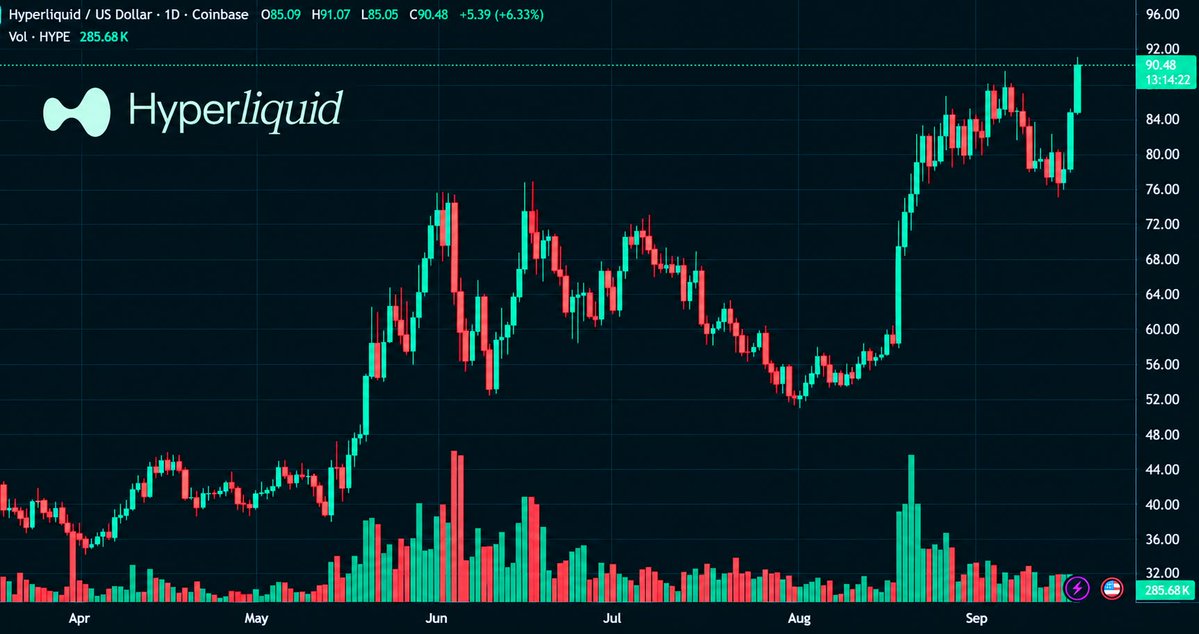
🚨THAT CALL JUST GOT PAID! HYPERLIQUID HITS A NEW ALL TIME HIGH!
Two days after we said Clarity is dead and the next trade is SEC and CFTC rules, both agencies moved.
The SEC opened limited onchain stock trading. The CFTC said software that only passes an order to a registered futures firm does not have to register as a broker.
hyperliquid:native just printed a new all time high, ethereum:0x232ce3bd40fcd6f80f3d55a522d03f25df784ee2 is following close!
🚨CLARITY IS DEAD FOR NOW. THE NEXT TRADE IS SEC AND CFTC RULES!
That was the read on this morning’s research call.
The Senate miss puts the bill on ice. What the desk is watching next is agency-level market-structure rules from the CFTC and SEC. Some Kraken people think those can land today. Earlier talk was by Friday or early next week.
Those rules would be narrower than a Clarity-style statute. Not automatically worse. Specific product and venue rules from the two agencies can still be useful, and they were likely coming after a bill anyway.
The part that matters for trading is perpetual futures. If the agencies write how those markets can operate in the U.S., the venues already running that product are the ones in the blast radius.
ethereum:0x232ce3bd40fcd6f80f3d55a522d03f25df784ee2 is the cleaner short-term name if Robinhood is the hook. Vlad had just teed that up. The other piece is that Lighter CEO Vladimir Novakovski sits on the CFTC’s Innovation Advisory Committee.
hyperliquid:native is the one with more existing CFTC political cover, including the Politico reporting and Trump mentioning Hyperliquid.
The longer risk is the one Clarity was supposed to fix. Agency rules can be unwound by the next administration.
Names that already have approvals should be fine. New entrants would have a harder time.
Source: internal research call, September 16
🚨DERIVE IS THE OPTIONS INCUMBENT. SYN IS THE CHEAP TICKET!
From this morning’s research call.
Derive’s impressive run continues.
It’s the bigger, established onchain options venue. ethereum:0x0f2d719407fdbeff09d87557abb7232601fd9f29 is the cheaper way to get the same theme.
Derive is the book that already exists, still the volume leader in tracked onchain options.
About 35% of fees go to weekly buybacks.
ethereum:0x0f2d719407fdbeff09d87557abb7232601fd9f29 is the leftover 2021 bridge token. The options product is Hypercall. It hedges off Hyperliquid perps, so it does not have to rebuild a book from scratch.
@CryptoHayes bought about $2.2 million of ethereum:0x0f2d719407fdbeff09d87557abb7232601fd9f29 in June and framed Hypercall as a Deribit-style book inside Hyperliquid.
ethereum:0x0f2d719407fdbeff09d87557abb7232601fd9f29 around $0.17 and a $43 million cap. Roughly 8-10× cheaper than $DRV.
An options beta without Derive’s multiple, ethereum:0x0f2d719407fdbeff09d87557abb7232601fd9f29 is the asymmetric ticket.
Source: internal research call, September 17
🚨$5 TRILLION JPMORGAN: CLARITY IS NOT FULLY DEAD. THE YEAR-END WINDOW IS EXTREMELY NARROW!
JPMorgan analysts, in a research note after Tuesday’s Senate miss.
The bill failed a procedural vote. That is not the same as a funeral. They still call it “not fully dead.”
What they do say is the clock. Congress adjourns at year-end. The window to pass anything before then is “extremely narrow.”
So the next stretch, in their view, is SEC and CFTC rulemaking.
Agency rules can still write market structure.
They also flagged the catch: those rules are less durable than a law Congress actually passes.
Source: JPMorgan research note
🚨CLARITY IS DEAD FOR NOW. THE NEXT TRADE IS SEC AND CFTC RULES!
That was the read on this morning’s research call.
The Senate miss puts the bill on ice. What the desk is watching next is agency-level market-structure rules from the CFTC and SEC. Some Kraken people think those can land today. Earlier talk was by Friday or early next week.
Those rules would be narrower than a Clarity-style statute. Not automatically worse. Specific product and venue rules from the two agencies can still be useful, and they were likely coming after a bill anyway.
The part that matters for trading is perpetual futures. If the agencies write how those markets can operate in the U.S., the venues already running that product are the ones in the blast radius.
ethereum:0x232ce3bd40fcd6f80f3d55a522d03f25df784ee2 is the cleaner short-term name if Robinhood is the hook. Vlad had just teed that up. The other piece is that Lighter CEO Vladimir Novakovski sits on the CFTC’s Innovation Advisory Committee.
hyperliquid:native is the one with more existing CFTC political cover, including the Politico reporting and Trump mentioning Hyperliquid.
The longer risk is the one Clarity was supposed to fix. Agency rules can be unwound by the next administration.
Names that already have approvals should be fine. New entrants would have a harder time.
Source: internal research call, September 16
🚨CLARITY FAILED 49-50. THE CATALYST IS GONE. THE BILL IS NOT DEAD!
@SantimentData’s deep dive on the September 15 vote.
Cloture on the Clarity Act failed 49-50. It needed 60. That was a vote to start debate, not final passage.
Bitcoin started selling before the result. It tagged about $79,500 on September 14, then was near $75,900 later on the 15th, down about 4%. Coinbase and Circle each dropped around 9%.
Social volume around Clarity blew past the May committee vote. The crowd talks louder when a catalyst dies than when a bill merely advances.
Their split is simple. Nothing new was banned. ETFs, stables, and agency rulemaking are still there. What left is the fast path to a law that is harder to reverse.
GENIUS failed cloture once in 2025 and came back 11 days later.
Tillis voted no so he could move to reconsider. The bill is technically alive.
Source: https://t.co/JqVVbSShTj
🚨ETH ON EXCHANGES IS DOWN 73% FROM THE 2020 PEAK!
@SantimentData has the exchange balance at 6.06 million $ETH.
That is down from 22.9 million at the June 2020 high. A 73% drop in the coins that are easiest to dump.
They are leaving for staking, ETFs, treasuries, and long-term custody. Validators lock more of it to run the network.
Santiment’s read is bullish on the supply side. Demand does not have to explode. When less $ETH sits next to the sell button, smaller buying waves can move price harder.
Source: https://t.co/kJiz7Ca8ZV
🚨STANDARD CHARTERED: ARBITRUM TO $10. ABOUT 70X FROM HERE!
Geoff Kendrick, the bank’s global head of digital assets research, in a new coverage note.
$ARB is around $0.14. The path in the note starts at $0.50 by the end of 2026, then $10 by the end of 2030.
Kendrick calls Arbitrum “the blockchain for TradFi” and “hugely undervalued.” The bank’s line is that markets still price it like a cheap L2, not like infrastructure with similar economics to Ethereum or Solana.
The near-term proof is Robinhood Chain, launched on Arbitrum’s stack on July 1. Kendrick expects it to generate about $5 million of fees for Arbitrum in September. That is more than five times the run-rate before launch.
When others build on the stack, Arbitrum takes a rolling 10% of net protocol revenue.
Standard Chartered still uses its $4 trillion tokenized-asset forecast by end-2028, from about $340 billion now.
Source: Standard Chartered research note, Geoff Kendrick
🚨BIS: YIELDS CLIMBED. RISK APPETITE IS STILL RESILIENT!
The Bank for International Settlements, in its Quarterly Review today.
No stress showing. Risk appetite is still “remarkably resilient.”
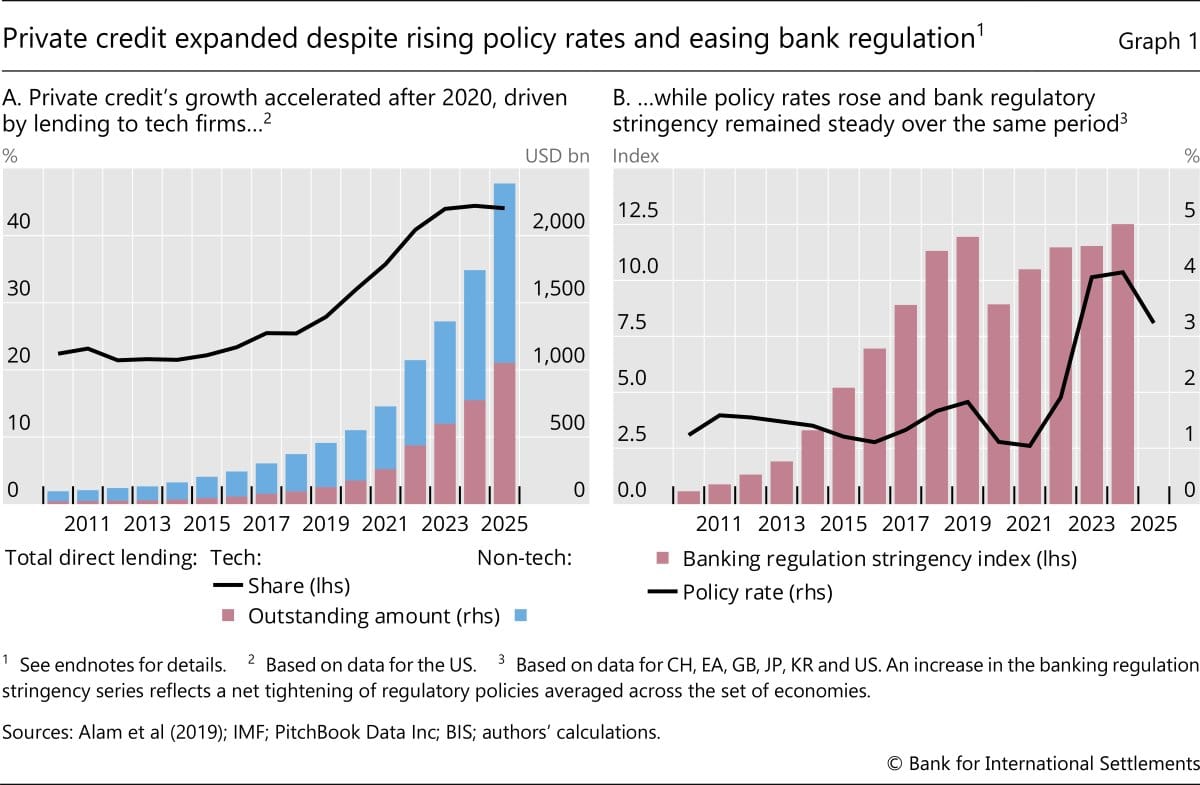
Under that, the AI rally looks more fragile. Investors are less sure the next wave of spend pays. Big U.S. tech leverage is still rising.
AI firms have issued hundreds of billions in debt. BIS says that may be lifting government yields too.
Tech’s share of private credit went from $22 billion in 2010 to over $1 trillion by 2025. A lot of the new loans are off balance sheet and circular.
Whether the resilience lasts if yields keep rising is the question they leave open.
Source: https://t.co/WHEYjyTJuX
🚨$900 BILLION BERNSTEIN: CLARITY HAS MORE ROOM THAN THE MARKET IS PRICING!
Bernstein, in a research note today.
Analysts say there may be more progress on the Clarity Act than markets expect after Republicans’ latest concessions. Tuesday’s Senate cloture vote is the test.
Any positive surprise is “definitely not priced in.” They say crypto is positioned bearishly into the vote.
Sens. Lummis, Boozman, and Scott put out a final draft.
They say it takes 126 Democratic-requested changes, including ethics language that tracks most of the Tillis-Gallego proposal and gives state attorneys general a role.
Lummis says Trump agreed to those restrictions.
Cloture is not passage. It takes 60 votes just to proceed. Republicans hold 53 seats.
Source: Bernstein research note
🚨90% ODDS ON A WARSH HIKE. TRUMP ALREADY SAID HE WILL NOT LIKE IT!
The Financial Times says stubborn inflation has put Kevin Warsh and Donald Trump on a collision course this week.
Inflation has not given Warsh the improvement he said he needed to skip a move. Economists told the paper the Fed’s credibility is on the line if it does not raise on Wednesday.
That would be the first hike in three years, weeks before the midterms.
Trump wants lower rates. On Sunday he said the U.S. should have “the lowest interest rate in the world.”
NEC director Kevin Hassett said if it is a hike, the president is “not going to be super happy about it.”
Warsh is four months into the job Trump gave him.
The August inflation report flipped a lot of Wall Street from hold to hike. Odds of a rise went from about 50% at the start of last week to almost 90% on Friday.
Source: https://t.co/kIrFV0hpYV
🚨IF THE FED HIKES NEXT WEEK, HISTORY SAYS IT WILL NOT STOP AT ONE!
WSJ chief economics correspondent @NickTimiraos.
A hike next week is all but priced. First one in three years.
Almost nobody at the Fed thinks a quarter-point dents inflation by itself. So a hike would mean the level of rates is wrong. One move does not fix that.
They rarely act until they think more is coming. Since the 1990s, a one-and-done hike happened once, in 1997.
Former Fed vice chair Richard Clarida, now at Pimco: if they hike next week, more follow.
Friday’s August inflation print was firmer than expected. That ended the close call. Markets now price at least three hikes through next June, up from two.
Source: https://t.co/fWdcvnlmGV
🚨BOFA: 30-YEAR AT A 2007 HIGH AND NOBODY IS PANICKING. THAT IS THE RISK!
Bank of America strategists Jared Woodard and Michael Hartnett, in a research note.
U.S. equity funds lost $14.2 billion over the past three weeks. Largest outflow since January, per EPFR data.
Global stock-fund inflows slowed to $7 billion a week, from $52 billion in July.
No panic yet. Oil is above $100. The 30-year yield is the highest since June 2007. The Fed is still talking a data-dependent hike.
“Blasé markets” and “bravado policy” are “a recipe for volatility,” they wrote. Markets stop panicking when policymakers start panicking. They see neither.
The S&P has been stuck since the record about a month ago. Midterms, Iran, and AI spend are what they say is pushing people to the sidelines.
Source: Bank of America research note, Woodard and Hartnett
🚨THE DEBASEMENT TRADE JUST GOT ANOTHER BUYBACK TO CHEW ON!
Former IMF chief FX strategist @RobinJBrooks on Substack.
Treasury printed a larger-than-scheduled buyback for Sep 10. Long yields rose anyway.
Markets now treat those operations like a yield cap. They are testing how far the U.S. will go. Same thing happened after the Aug 19 upsizing.
The dollar fell with it. Platinum jumped 4.5%. Silver rose more than 2%. Gold was up 1%.
Japan already ran this play. You can hold bond yields down. You cannot hold the currency at the same time.
He is not calling a crash. He is saying every extra cap gets tested, and that path hits the dollar.
Source: https://t.co/JnhYte6eL7
🚨ETF DEMAND FLIPPED. $21.9 BILLION IN 30 DAYS, ALMOST ALL OF IT WAS FIVE DAYS!
@cryptoquant_com says the ETF bid is back, with a catch.
$BTC is at $78.4K. ETF holders’ cost basis is about $72-73K. Price is back above it. ETF MVRV is about 1.07.
The 30-day netflow print is +$21.9 billion.
About $19.6 billion of that came in Aug 17-21, when price jumped from the low $60Ks toward $80K.
Coinbase premium’s 30-day average also flipped from about -$100 to around +$30.
Close to 90% of the headline flow is those five days.
When they roll off the window, the number can drop without anyone selling.
Hold $72-73K with fresh daily inflows and they call it reaccumulation. Lose that line and the signal fades.
Source: @cryptoquant_com
🚨BULLISH: PRICE RAN TO $80K. SELLERS DID NOT SHOW UP ON EXCHANGES!
CryptoQuant analyst @Woo_Minkyu.
Bitcoin closed Sep 8 at $78,450 after the bounce off about $60,000 this summer.
Large spot-exchange deposits did not come with it.
The top-10 daily inflow print was 5,442 bitcoin:native. That was 4.4 times the prior day, but only 5.1% above the 30-day average.
The seven-day average is 4,678 bitcoin:native, still below several peaks from earlier this year.
So this looks like deposits snapping back to normal, not coins lining up to sell.
The warning would be that seven-day average rising and staying high while price rolls over. That is not the print yet.
Source: https://t.co/2uUfD0sqGE