The IPO that launched at the peak of the Dot-Com Bubble
On March 2, 2000, a company called Palm went public.
The IPO price was $38.
Within hours, it traded as high as $165.
Investors went crazy.
At its peak:
- Palm was worth more than McDonald's.
-Palm was worth more than General Motors.
It gets even crazier.
Palm was still 94% owned by its parent company, 3Com.
Yet the market valued Palm so highly that it was effectively saying the rest of 3Com was worth less than zero.
That is how irrational markets become near a major top.
Then what happened?
- Eight days later, the Nasdaq topped.
- Palm lost more than 90% of its value.
- Ten years later, the entire company was sold for a fraction of its peak valuation.
The lesson is simple:
The crowd confuses popularity with value.
And Palm is not the only example.
Since then:
- Meta fell 54% after listing.
- Uber fell 70%.
- Snap fell 72%.
- Robinhood fell 82%.
- Rivian fell 89%.
- Coinbase fell 92%.
- The pattern never changes.
The most hyped listings attract the most emotional buyers.
But there is an important second lesson.
The companies were not the problem.
The entry price was.
- Meta became one of the best performers of the decade.
- Coinbase later made new all-time highs.
- Uber multiplied several times from its lows.
The launch buyers and the bottom buyers bought the same companies.
One group paid for the hype.
The other got paid for their patience.
The crowd chases attention.
Patience chases value.
First the hype.
Then the valuation.
$STRC
The warning was there months ago.
Now the pressure is starting.
Now the panic is starting.
Every bear market has a victim.
- Mt. Gox
- FTX
- Next?
The crowd never sees it coming.
The crowd always believes this time is different.
The crowd always believes the biggest player is safe.
History says otherwise.
The bear market is not finished.
It is still searching for its victim.
#DXY
The Dollar is waking up.
That is not good news for risk assets.
A rising DXY means:
- Money leaves stocks.
- Money leaves crypto.
- Money moves back into cash.
The chart is speaking.
And it is telling me that a major risk-off event is approaching.
The crowd watches price.
I watch liquidity.
DXY up.
Assets down.
First the Dollar.
Then the sell-off.
Last bear market had FTX.
This bear market may have Saylor.
For more than a week, $STRC has been trading away from its $100 peg.
Saylor has been fighting to bring it back.
So far, the market is not cooperating.
Every bear market eventually produces a victim.
- 2022: FTX.
- 2026: ?
At the top, the crowd always believes one narrative is untouchable.
One company.
One trade.
One person.
Then reality arrives.
The bigger the confidence, the bigger the shock when it breaks.
I am watching Saylor very closely.
The crowd sees the strongest man in Bitcoin.
I see the market testing him.
First the confidence.
Then the stress.
#FOMC
Interesting development in rate expectations.
The market is not pricing any rate hikes for this FOMC meeting.
The market is not pricing any rate hikes for July either.
But look further out:
- September rate hike odds have risen to 27%.
- October rate hike odds have risen to 33%.
- December rate hike odds have risen to 42% for a 0.25% increase.
- December rate hike odds have risen to 15% for a 0.50% increase.
And yet:
- Around 40% of the market still expects rates to remain unchanged through December.
That tells us something important.
The market is slowly starting to price inflation risk.
But the crowd still believes rate cuts are the story.
The gap between expectation and reality is where the opportunity sits.
The crowd sees a pivot.
I see higher-for-longer.
First the inflation.
Then the repricing.
#Bitcoin
Interesting observation.
Everyone watches the MA200.
Everyone knows it is one of Bitcoin's most important indicators.
But history tells a different story.
- Bitcoin does not bottom at the MA200.
- Bitcoin bottoms below the MA200.
- Every major bear market bottom formed roughly 30% below it.
If history repeats once again:
- The current MA200 points to a downside target near 43k.
That falls directly inside my CBB Zone.
The crowd sees support.
I see unfinished business.
First the capitulation
Then the bottom
Stock Market 1974: The Crash That Started After the Oil Embargo Ended
Most investors believe the market crashed because of the Oil Embargo.
That is only half the story.
The biggest crash happened after the Oil Embargo ended.
And that is the lesson.
1. The Embargo Was Only The First Shock
An Oil Embargo means oil supply is restricted from reaching the market.
In 1973:
- Around 5-7% of global oil demand was affected.
- The disruption lasted roughly 5 months.
- The S&P 500 fell around 20%.
Most investors think this was the real damage.
It wasn't.
It was only the first shockwave.
2. The Real Crash Started When The Crisis Ended
The Oil Embargo officially ended in March 1974.
The crowd expected relief.
The crowd expected recovery.
The crowd expected markets to move higher.
Instead, the opposite happened.
From the moment the embargo ended:
- The S&P 500 entered its real collapse.
- The market lost another 40%.
This is the part most investors never understand.
The crash did not happen during the embargo.
The crash happened after it ended.
3. The Market Was Pricing The Damage
Ending the embargo did not remove the damage already done.
By then:
- Inflation had surged.
- Energy costs had exploded.
- Consumers were under pressure.
- Economic growth had slowed.
The headline was bullish.
The economy wasn't.
The market eventually recognized the damage and repriced it.
Even more interesting:
Oil did not collapse after the embargo ended.
Oil continued to rise for years.
The market was falling while energy was repricing higher.
4. Is History Repeating?
In 1973:
- 5-7% of global oil demand was affected.
- The disruption lasted roughly 5 months.
- The market eventually suffered one of the worst crashes since the Great Depression.
Today:
- A much larger share of global oil flows has been under pressure for months.
- Stocks are making new highs.
- Investors are once again pricing in a soft landing.
- The crowd believes the end of the crisis solves the problem.
That is exactly what investors believed in 1974.
The lesson is simple:
The end of a crisis does not erase the damage caused by the crisis.
The crowd sees the end of the event.
I see the beginning of the repricing.
First the shock.
Then the realization.
#XLE
Accumulation zone: $47-50
Buy orders are waiting.
My view remains unchanged:
- Bullish on oil.
- Bullish on energy.
- Bearish on the crowd’s expectations.
The market is still underestimating the impact of the energy shock.
That changes over time.
Not overnight.
I am happy to give this trade weeks to play out.
The Energy sector will be one of the biggest winners of the next phase.
The crowd chases headlines.
I follow the flows.
#Bitcoin
The moment everyone starts talking about "the bottom being in"...
The bottom usually isn't in.
I remember 2022 very clearly.
When Bitcoin made its final move down to 16k:
- The crowd gave up.
- X gave up.
- Bottom callers gave up.
- Even people who bought 20k-24k capitulated.
Suddenly the narrative changed.
- "Bitcoin is dead."
- "Sell now."
- "Wait for a lower entry."
That was the sentiment at the actual bottom.
While the crowd was selling, I was buying.
- 16k.
- 17k.
- 18k.
That was the bottom I had been waiting for.
Today I see the opposite.
People are already talking about the bottom being in.
People are already looking for the next bull run.
That is not how major bottoms usually form.
My view remains unchanged:
- The bottom is not in.
- Bitcoin goes lower.
- Current moves are normal fluctuations within the bear market.
There is no need to overthink every candle.
There is no need to trade every move.
For now:
Lean back.
Stay patient.
Let the cycle play out.
First the capitulation
Then the bottom
#Bitcoin
Reminder:
The bottom is no longer far away.
But the bottom is not in.
Many traders hear "close" and think:
- Next week.
- A 5% drop.
- A quick flush.
That is not what I mean.
My framework remains unchanged:
- Bitcoin moves below 60k.
- The final bottom forms in the 40k-50k region.
- The timeline remains roughly 2-4 months.
The market is entering the final phase of the bear market.
Not the final days.
The final phase.
The short opened remains active.
Most traders think in candles.
I think in cycles.
First the capitulation
Then the bottom
#Bitcoin
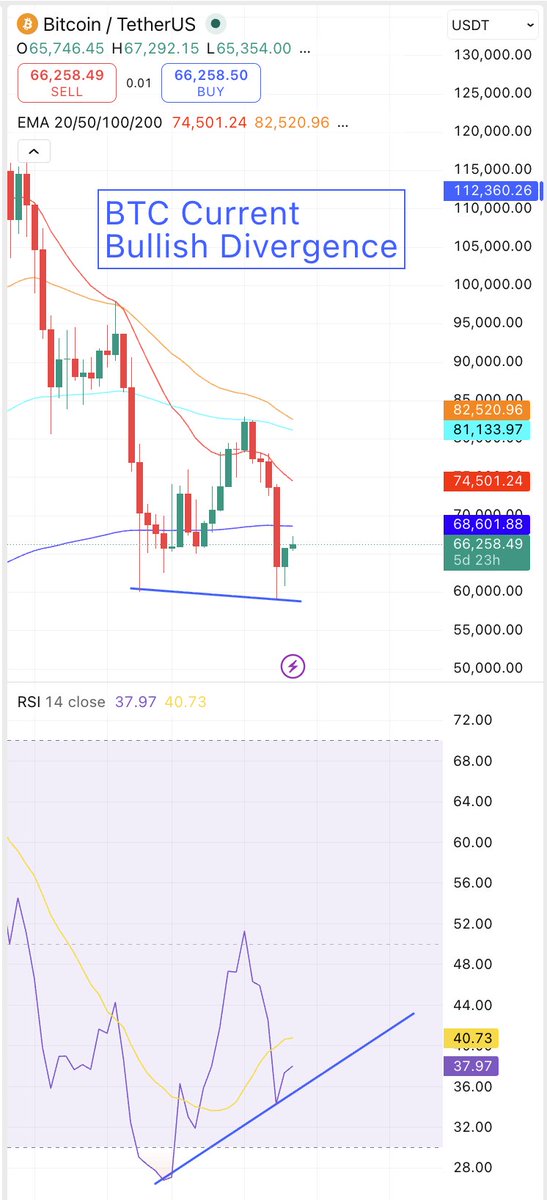
Interesting observation.
Right before the 2022 capitulation event, Bitcoin started forming a bullish divergence on the weekly chart.
Many traders saw the signal and bought.
What happened next?
- Bitcoin did not bottom.
- The final capitulation arrived.
- Panic selling followed.
- Many buyers sold at a loss just before the real bottom formed.
Today, we are seeing the same setup again.
- Bitcoin is forming a weekly bullish divergence.
- Buying pressure is returning.
- Bottom callers are becoming more confident.
The crowd sees a bottom.
I see a warning.
A bullish divergence does not create a bottom.
It often appears before the final capitulation.
That is exactly what happened in 2022.
And that is exactly what I expect now.
The chart is not telling me to buy.
The chart is telling me to prepare.
I remain focused on the final capitulation event and the CBB Zone.
First the capitulation
Then the bottom
#ETH
I am not shorting here.
My target remains the 2200 region.
- No chasing.
- No guessing.
- No emotional trades.
Bitcoin is doing exactly what I expected at 60k.
- Sideways action.
- Fake pumps.
- The crowd buying the "bottom."
If Ethereum reaches 2200, I will short.
Not before.
First the liquidity
Then the move
The market didn't crash during the Oil Embargo.
It crashed after it ended.
Most investors don't understand this.
In 1973:
- Around 5-7% of the world's oil demand was cut off.
- The supply shock lasted roughly 5 months.
- The S&P 500 dropped around 20% during the first shockwave.
The crowd thought the damage was done.
It wasn't.
The Oil Embargo officially ended in March 1974.
That is when the real crash began.
Over the next 6 months, the S&P 500 lost another 40%.
Why?
Because the embargo was never the full story.
The real damage had already moved through the economy.
- Inflation had risen.
- Input costs had exploded.
- Consumers had weakened.
- Growth had slowed.
The market only understood the damage after the crisis appeared to be over.
Now look at today.
- Around 20% of world oil demand has been affected.
- The disruption has lasted around 4 months.
- Markets are still making new highs.
- Investors are pricing in a soft landing.
- Powell already warned about inflation pressure in the last FOMC speech.
- Japan is preparing to raise rates to the highest level in 30 years.
- Another FOMC meeting is coming this Wednesday.
The crowd sees the end of the crisis.
I see the delayed damage entering the market.
Shorting a top is never easy.
- Tops form during optimism.
- Tops form during uptrends.
- Tops form while the crowd is still bullish.
You don't need the perfect entry.
You need the right thesis.
First the shock.
Then the realization.
#Bitcoin – What's Next?
The First Signal Weekly Report
TA • Liquidity • Psychology
The Big Picture
- My view remains unchanged.
- Moves between 60k and 64k do not matter.
- Moves between 60k and 68k do not matter.
- The focus remains on the macro move into the 40k-50k region.
I call this the CBB Zone.
Confirmed BlackRock Bottom.
In my view, this phase is still 4-5 months away.
What we are seeing now is exactly what Stage 5 should look like.
- Sideways action.
- Frustrating price movement.
- Traders losing patience.
None of this changes the positioning.
- The shorts remain open.
- No adjustments.
- No overtrading.
A day trader worries about every 2-3% move.
I don't.
- The goal is not to trade every swing.
- The goal is to capture the cycle.
- Patience remains the trade.
The aSOPR Signal
One metric I am watching closely is aSOPR.
Adjusted Spent Output Profit Ratio.
In simple terms, it shows whether Bitcoin holders are selling at a profit or a loss.
Right now something important is happening.
- Holders who bought at 70k, 80k, 90k and higher are starting to realize losses.
- For the first time in this bear market, meaningful capitulation is beginning.
This is exactly what I have been waiting for since Stage 4.
Short-term holders are finally starting to give up.
However:
- We have not seen true capitulation yet.
In every previous bear market:
- 2018
- 2022
- Earlier cycles
The bottom formed after one final extreme loss event.
One moment.
One wave of panic.
One capitulation.
That is the event I am still waiting for.
The realization phase has started.
The capitulation phase has not.
The CBB Thesis
My thesis remains unchanged.
The final Bitcoin bottom forms in the BlackRock Zone.
The region where the BlackRock ETF launched in early 2024.
- 40k-50k remains the target zone.
- September-October 2026 remains the preferred timeline.
- The CBB remains the architecture of the final flush.
Stage 5 Progress
We are still in the early phase of Stage 5.
Capitulation has not happened.
My expectation:
- More movement between 58k and 68k.
- Short squeezes.
- Long traps.
- Violent moves in both directions.
This is what I expect over the next 1-3 weeks.
The longer Bitcoin moves sideways, the larger the eventual capitulation.
The larger the capitulation, the cleaner the bottom.
Calendar This Week
The major event is the FOMC meeting on June 17.
Markets are currently expecting:
- A dovish tone.
- Future rate-cut signals.
My view:
The market will not receive the dovish outcome it is expecting.
Key events:
- Retail Sales – June 16
- FOMC – June 17
- Initial Jobless Claims – June 18
Expect volatility around the FOMC statement and press conference.
My expectation remains:
More weakness in stocks.
More weakness in crypto.
First the capitulation
Then the bottom
My plan has not changed.
- My Bitcoin short remains open.
- Cash remains king.
I have no interest in taking profits here.
I have no interest in buying Bitcoin here.
Why?
Because the downside is not complete.
My accumulation phase begins in August-September.
That is when I will start taking profits on shorts and preparing for the next cycle.
Until then, my job is simple:
- Hold the shorts.
- Hold the cash.
-Stay patient.
Most traders lose money because they feel the need to do something every day.
I don't.
Sometimes the highest-paying trade is doing nothing.
First the capitulation.
Then the bottom.
What we need to know about #BTC ?
So far, the market has followed it closely.
Today, we are in Stage 5.
What does that mean?
- Most of the damage is already done.
- The panic phase is behind us.
- The market becomes slow and frustrating.
- Volatility disappears.
- Traders become exhausted.
This is where people lose patience.
Not because of fear.
Because of boredom.
The final stage comes later.
For now, the market is doing exactly what bear markets always do.
First the panic.
Then the boredom.
#BTC
The lower the timeframe, the bigger the moves look.
But zoom out.
On the daily chart, almost nothing has changed.
In fact:
- A bearish flag is forming.
- Price remains inside the same range.
- This is still sideways action.
Many traders make the same mistake.
- They focus on the 5-minute chart.
- They ignore the daily chart.
- They mistake noise for a trend.
Sometimes consolidation happens on small timeframes.
Sometimes it happens on large timeframes.
Either way, it is still consolidation.
My view remains unchanged:
- The bear market is not over.
- Bitcoin is going below 60k.
- The next range will form between 48k and 58k.
For now:
- Hold the shorts.
- Stay patient.
- Don’t overtrade.
Bitcoin has always worked this way.
- The big move happens in a few days.
- Then weeks or months of sideways action follow.
Respect the chart.
Trade the market.
Don’t let the market trade you.
First the liquidity.
Then the move
#SNDK
I am adding Sandisk to my short portfolio using 2x leverage.
The reason is simple:
- RSI is near extreme levels.
- Weekly RSI is approaching 99.
- A massive bearish divergence has formed on the weekly chart.
- Price continues higher while momentum weakens.
That combination rarely ends well.
I am not interested in chasing strength at these levels.
I am interested in positioning for the reversal.
The crowd sees momentum.
I see exhaustion.
First the euphoria.
Then the correction.