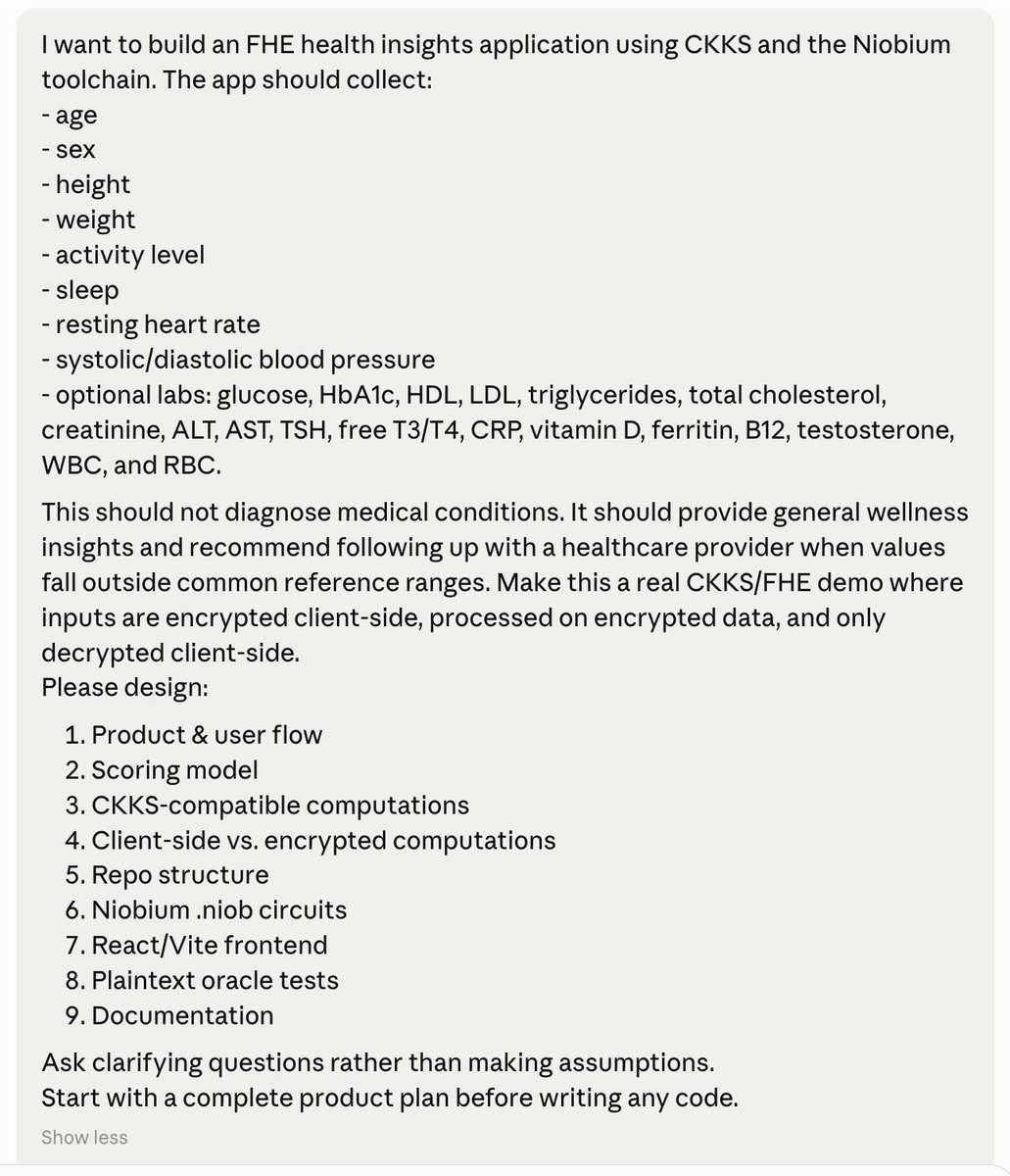
🚨 New #TGIFHE
For OpenAI Build Week, our MBA intern Sarah built StealthMatch, an FHE demo, using Codex.
Founders rank investors and grants. Raise targets, runway, and conflict lists stay encrypted with CKKS the whole time.
Runs on CPU, a simulator, or Niobium FPGAs via The Fog™.
https://t.co/9ukaPz4zwX
Most people think encryption works because nobody knows how it works.
On the contrary, all of the algorithms and research are public. The security lives in the math.
Our latest FHE 101 post talks through how that math works.
https://t.co/OrkeG7nslx
A preliminary draft went up on the IACR ePrint archive last week claiming a quantum algorithm that could break the lattice-based math underlying post-quantum encryption and every practical FHE scheme, including the ones our hardware accelerates, no matter how large the keys.
Four days later, Aparna Gupte, Seyoon Ragavan and Mark Zhandry published a proof that it can't recover even one bit of a secret key better than a random guess.
Our CTO @DaveArcher37468 on what happened:
https://t.co/Mq4oQbNR5Z
Google Security featured four private inference applications in its new post on HEIR.
We worked on two of them.
Credit card fraud detection with Hardshell, and anomaly detection over encrypted network traffic using Kitsune.
Glad to be building alongside Google as more FHE makes its way out of the lab.
https://t.co/JUgLQtHfDQ
Are you 34 and don’t want people to know you still sleep with a nightlight?
I made an application that uses encrypted computation (FHE) to see if you qualify for peak-time rebates without revealing your energy usage to the utility. Still a demo. would love any feedback! Link 👇
FHE is easier to understand when you can watch it work.
This week’s #TGIFHE: Offmeter, built by Brad Levergood.
It privately determines whether a household qualifies for a peak-hours energy rebate using its 24-hour smart-meter profile.
Encrypt the data, compute eligibility on ciphertext, decrypt only on the client.
Run it yourself ↓
https://t.co/56X10usO68
Most people probably don’t realize how much data gets collected on them just from leaving the house. You should be able to go for a run without having your face and movements tracked across multiple cameras and stored in systems you know nothing about. Excuse the hot take, but that should probably bother us way more than it does
Our marketing intern wanted spending insights without letting anyone see her bank transactions.
So she built CipherSpend.
Full spending analysis on encrypted transactions.
Built with our FHE Application Design Agent.
Open source:
https://t.co/QYfV4v4yBf
#TGIFHE
@NiobiumInc I built this because I wanted spending insights without anyone seeing my transactions.
Good news: privacy is solved.
Bad news: I now have detailed, mathematically verified proof of my own spending habits.
financial responsibility is still a work in progress
We gave our FHE Design Agent a plain XGBoost diabetes model and a privacy requirement.
About an hour later: a working encrypted application. 45,895 records scored under encryption, zero decision flips vs plaintext, full verification reports.
Watch the 5-minute demo ⬇️
Bletchley Park turned codebreaking from an art practiced by a few into a repeatable process, then handed the mechanical parts to machines.
We are applying the same lesson to the opposite problem: building encrypted applications. This time the machine works for the encryptor.
Read the post: https://t.co/frJTajurO1
Most pet adoption checklists ask for a lot of personal information.
What if you could get matched without anyone seeing your answers?
Furever Home uses FHE to score your adoption readiness while your responses stay encrypted the entire time.
Here’s a quick walkthrough of how it all works. 🐶��
Could you adopt a husky? A parrot? Find out without telling anyone your business.
For this week's #TGIFHE, our intern Sarah Zhu built Furever Home, an adoption readiness check that runs entirely on encrypted answers. The service computing your score never sees them. Only you can decrypt the result.
Live demo: https://t.co/qxA2r9c1hn
Repo: https://t.co/3SG5kVc4Ju
A few weeks ago, I had zero coding experience.
Yesterday, VitalVault, an FHE health demo I built using @NiobiumInc’s open-source tools, was mentioned by @theneurondaily.
Pretty surreal.
https://t.co/QwFW36R4JE
What happens when a marketing intern with no coding or cryptography experience gets access to FHE tools?
VitalVault: an end-to-end CKKS health demo built by Leila Bond. The evaluator only sees ciphertext.
First drop in #TGIFHE, our Friday demo series: https://t.co/uSCyReGAs5
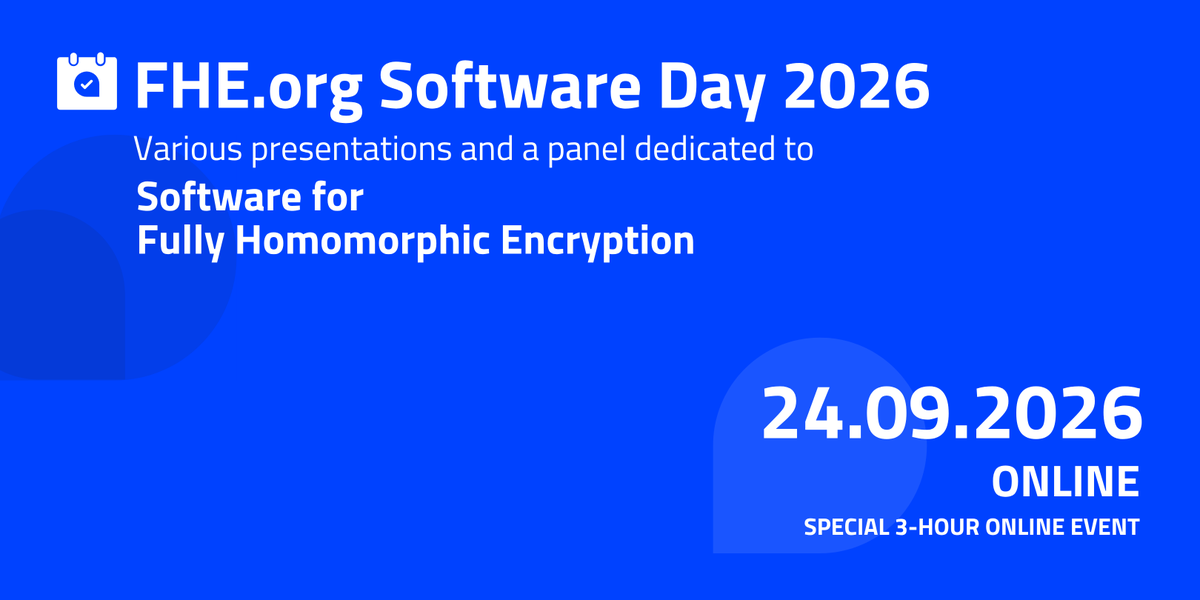
Introducing a special edition meetup: @fhe_org Software Day scheduled for Thursday, September 24th at 6pm~9pm CEST (Paris, FR).
This special edition meetup will feature speakers (tbd) and additional panelists (tbd) with a focus around topics in FHE Software.
The event will comprise four talks split into two sessions of two, and a separate panel session. Each talk will be 25 minutes, with a short time for questions. The panel session will be guided with some initial questions from the host, before moving to an audience-based question and answer session.
#FHE #SoftwareDay2026 #homomorphicEncryption
Congratulations to our CTO, @DaveArcher37468, on being named Program Chair for @fhe_org 2027 alongside Dr. Rachel Player.
Well deserved recognition for decades of contributions to cryptography and privacy-preserving computing.
Congratulations to both chairs! 👏
https://t.co/NE6MmDAN4m
Every privacy technology asks you to trust something.
TEEs ask you to trust the hardware.
MPC asks you to trust the participants to stay connected.
FHE asks you to trust the math.
They all make tradeoffs. What matters is knowing what you’re trusting, what it costs you, and whether those assumptions actually hold up.
@DaveArcher37468's latest: https://t.co/FXuUp42Lgq