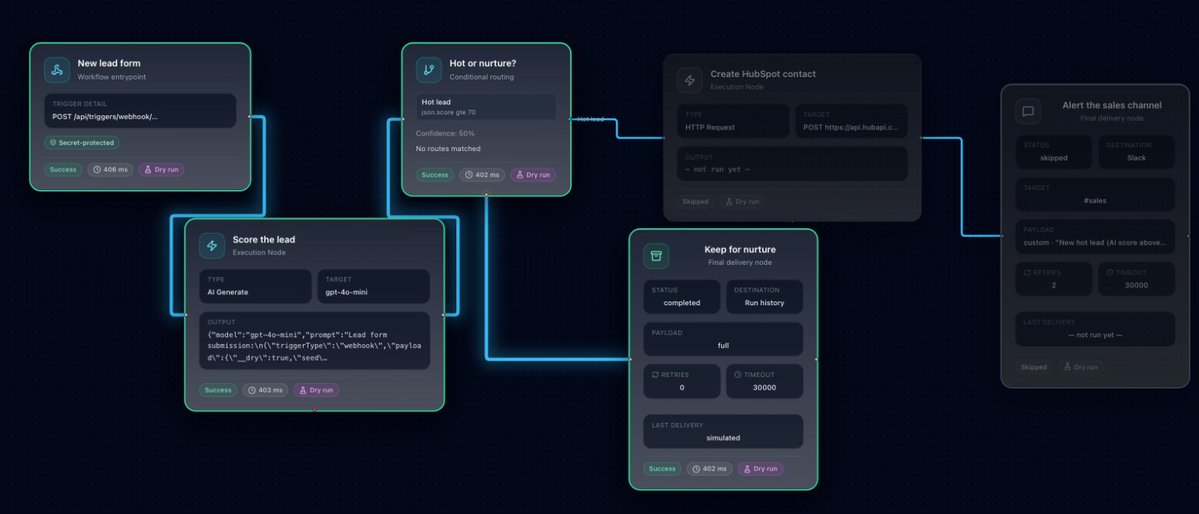
Most automation tools bill you per task and let AI act without asking.
Fluxo Flow does neither:
→ Dry Run any workflow free (nothing sends)
→ a person approves risky steps
→ AI on your own key, at cost
→ flat plans, not per task
Free plan, no card.
The demo always shows the happy path.
Production invoices you from the error handler.
Retry, alert, trace. Build the failure path first, and the happy path stops being scary.
Metered pricing doesn't just cost more as you grow. It changes what you build.
A 10-step lead qualification flow bills 10x a 1-step one, so you cut the steps that actually matter just to keep the number down.
Fluxo Flow is flat priced: workflows and seats, never tasks.
The fastest way to lose a retainer isn't a broken workflow. It's a shared login.
When five clients sit in one account, nobody can tell whose run sent that email.
Fluxo Flow gives each client its own workspace.
Your AI workflow doesn't need fewer approvals, it needs one place to put them.
Email, Slack and a spreadsheet means the risky step gets approved twice or not at all.
One queue where a person approves, edits or rejects before the run continues turns the check into a routine.
Per-task pricing doesn't bill you for the automation. It bills you for making it good.
Each step that handles an edge case adds cost, so you cut the step. Then the workflow is worse.
Fluxo Flow charges by workflows and seats.
An API renames one field and the whole workflow dies.
That's not a logic bug. It's a runtime with no step trace and no error handler, so you never learn which node ate the wrong shape.
Building Fluxo Flow so the trace shows you instead of guessing.
Your first live run shouldn't be the test.
Dry Run simulates every step in the browser, no side effects and no AI provider call, so you find the broken branch before a customer does.
That's one of the things I'm building into Fluxo Flow.
Handing a client a login to your own automation account isn't a handover.
It's a support call where you're both guessing which workflow fired.
Each client in their own workspace, own credentials, own run history. Boring handover, short support call.
Your workflow didn't break because the API payload changed.
It broke because nothing told you which step ate the wrong shape.
Building Fluxo Flow around step-by-step traces and error handlers, not bolted on after the first crash.
The real reason people stay on Zapier isn't the price. It's the rebuild.
The bill doubled and they still opened the tab and closed it.
I'm building Fluxo Flow so the import is best effort and tells you what didn't carry over.
Invoices don't need more AI. They need someone to look at the one that doesn't match before it goes out.
That's the reason I'm building Fluxo Flow: a review queue where a person approves, edits or rejects before the run continues.
A workflow that fails quietly is worse than one you never turned on.
You find out from a customer, not from the tool. Then you open it and get a red X and no clue which step broke.
A per-step trace turns that mystery into something you can actually read.
Per-task pricing quietly edits your workflow for you.
Step 5 stops feeling worth it. The dedupe goes. The second validation goes.
You ship a worse automation because the billing unit made you trim the parts that mattered.
Nobody demos error handling.
A workflow runs fine until a payload shifts, then it dies and you can't tell which step ate it.
Step trace plus error handlers. That's the point of Fluxo Flow.
A payload changes shape and the whole workflow dies.
That's not your logic failing, it's a runtime with no step trace and no error handler. You end up babysitting the thing that was meant to save you time.
Building Fluxo Flow so the trace shows which node ate it.
Every automation demo shows the happy path.
The bill comes due in the error handler, the retry, and the alert that tells you a step failed instead of failing quietly.
Building Fluxo Flow so error handlers and step-by-step traces are built in, not bolted on.
Every automation stack starts as a spreadsheet and a cron job.
That works right up until the cron dies on a Sunday and nobody finds out until a client asks where their report went.
AI that acts without asking isn't automation. It's a liability with a cron schedule.
Route the risky steps to a human. Let the boring 90% run untouched.
Client automation projects rarely fail on the build. They fail on the handoff.
One workspace shared by every client means a webhook can hit the wrong account, and the trace can't tell you whose run it was.
Scope the workspace before you scope the workflow.
Zapier vs Make is an argument about tasks vs credits.
Both are meters. The question that actually matters is whether your bill moves every time your volume does.
That's why I'm building Fluxo Flow on workflows and seats, not runs.