At Flower AI Summit 2026, Flower Labs' own Charles Beauville introduced Flower Agents and Project Kaya, and made a case for what separates a good agent from a great one.
His framework: a good agent needs context, access, and control.
Context so it understands the task. Access so it can act on it. Control so it can actually be trusted in production.
But a great agent needs one more thing: collaboration.
Isolated agents break down the moment a problem crosses team or organizational boundaries.
Flower Agents are built to work together across those boundaries, without breaking privilege isolation, and without any new infrastructure. SuperGrid already provides the orchestration, communication, isolation, and auditability needed to run collaborative agents by design.
Project Kaya has already been deployed internally at @flwrlabs, triggering @github fixes from Slack, creating Notion docs from live context, and running federated analytics in natural language across a federation of organizations.
The full talk is coming to @YouTube soon.
Join the waitlist. See link in thread.
Collaborative AI needs a new stack. At Flower Labs, our mission is to advance collaborative superintelligence: AI systems that can learn, adapt, and act together across real-world boundaries.
We see 3 building blocks:
First, a next-gen AI platform. Collaboration needs to be a first-class capability at the platform layer, so teams, devices, data owners, and organizations can participate without forcing everything into one centralized environment.
Second, a frontier training pipeline. State-of-the-art models increasingly need to learn from data that is geographically and institutionally distributed. The infrastructure has to meet data where it lives.
Third, collaborative AI agents. The next step for agentic AI is not just more agents in one system, but agents that can operate across organizations and still coordinate effectively.
Find out more on https://t.co/raqeS2lssP
The space economy had a big week recently, with @SpaceX's IPO drawing attention to just how much infrastructure is heading off-planet. Against that backdrop, it felt worth revisiting a quieter milestone @flwrlabs reached with @Starcloud_ earlier this year.
Working together, the teams fine-tuned a Vision Transformer directly on an operational @Starcloud_ satellite, using Flower's decentralized AI framework. The model adapted in orbit to classify satellite imagery, including urban areas, forests, lakes, and other land cover, processing the data where it was generated rather than sending it back to Earth first.
Space environments come with intermittent connectivity, constrained bandwidth, and almost no ability to intervene directly once a workload is running. Those are exactly the conditions that centralized, cloud-dependent training pipelines struggle with, and exactly the conditions decentralized AI is designed for.
Telemetry confirmed the workload executed as intended. The result itself is modest in scope, but it's a useful data point: AI models can be trained and adapted directly on real, operational satellites, not just simulated ones. Over time, that kind of capability could support faster disaster response, better maritime monitoring, and satellites that interpret their own sensor data more autonomously.
Details on the collaboration with @Starcloud_ in blog post: https://t.co/OhKECe5oiG
Andrew Ng's: "AI is the new electricity", is usually read as a prediction about scale. But the more important lesson is about infrastructure.
Electricity didn't transform the world when every factory ran its own isolated generator. The real unlock was the grid: a system that let energy move, connect producers and consumers, and turn isolated infrastructure into something collaborative.
Computing followed the same arc. Mainframes were powerful but closed. The internet changed that by establishing shared standards and enabling open, networked systems.
AI is at the same inflection point. Most AI today still runs in isolated silos: centralized data, centralized compute, centralized models, closed systems.
The next step is a grid for AI. One where organizations, devices, data, and models can collaborate without centralizing everything in one place.
That is what we're building, read more on our website: https://t.co/raqeS2lssP
Forest monitoring is a federated learning problem when the data lives across countries.
Flower Hub’s @johannes/forest-monitoring-example (created by Johannes Schumacher) is a Flower / @PyTorch app for a regression task: modeling forest timber volume from satellite time series data.
You can start in simulation mode with flwr run --stream, then move the same app toward deployment mode without changing the code.
If you work on distributed ML systems, this is a practical example of how Flower turns a research workflow into something reusable.
Explore the app on Flower Hub: https://t.co/ZlcQsaBBgO
Flower Labs is partnering with @BCPlatforms to bring federated AI into trusted research environments (TREs).
@BCPlatforms' TRE, BC Mosaic, gives healthcare organizations governed, secure access to distributed clinical, genomic, and real-world data. With Flower SuperGrid now integrated, those same environments can be used to train and validate machine learning models across institutions, without moving the data that sits behind them.
This is important, because the barrier to multi-site AI development in healthcare is rarely data availability. It's the overhead of legal alignment, governance coordination, and building new infrastructure for every collaboration. By deploying Flower SuperGrid within an existing TRE, organizations can participate in federated learning using the controls and workflows already in place.
The integration is also timed to the European Health Data Space (EHDS). As institutions across Europe prepare for EHDS, trusted research environments are becoming a foundational layer for secondary data use. Connecting them for federated model development (at scale, under local data control), is exactly what this partnership enables.
We're excited to be partnering with @BCPlatforms. If you're interested in learning more, check out https://t.co/raqeS2lssP or reach out to us here.
The Flower community deserves a shoutout!
Flower is built for federated/collaborative AI, and we want to express our deep gratitude to everyone who builds on and contributing to Flower. It only becomes stronger because people keep reading, testing, contributing, and sharing what they build.
Thank you to everyone who has contributed to Flower in any form, from code and baselines to feedback and shared learning.
If you want to explore Flower and the community behind it, start here: https://t.co/raqeS2lssP
The top five things we heard before @flwrlabs launched Lizzy:
1. Form a consortium before building.
2. Wait until the EU/UK AI strategy is clearer.
3. It’s too late for Europe to build AI at the frontier.
4. Sovereign AI doesn’t make sense. We’ll always have access to US models.
5. You’ll never build a genuinely frontier-quality model anyway.
We built Lizzy anyway. From scratch.
This is the team that did it.
Best domestic UK model to date. Top EU performance on our first try. Open-weight. 10k downloads since March. Brand new way to train, invented at Flower.
#5 sounds like a skill issue.
Back in March, @flwrlabs released Lizzy: a sovereign UK LLM trained from scratch and released with open weights on @huggingface. Right out of the gate, it outperformed comparable-sized models from Mistral, and it has continued to improve since then.
With the US government and Anthropic restricting access to Fable 5, AI sovereignty no longer feels theoretical. It feels practical.
How much control do we really have over the models we are planning to depend on?
Too often, sovereign AI is treated as aspirational. Something coming soon, but not now. I am glad we acted early. Lizzy is already built, tested and in use.
And we are only getting started.
Sovereign AI can seem unnecessary, right up until a moment like Friday, when access to the latest frontier model is no longer guaranteed.
At Flower AI Summit 2026, @nicospinu (Founder at AI4Cosmetics) showed how FL-CHEMSAFE used Flower for toxicology safety assessment.
The pilot covered 3 concrete workflows: (1) Horizontal federated learning for skin sensitization, using federated averaging via Flower, (2) vertical federated learning for mutagenicity, with CNN models trained in a simulated setup, and (3) federated analytics for thermal permeability, using histograms and aggregation with or without noise.
Her work focuses helping toxicology teams work through data gaps, conflicting in silico predictions, and fragmented datasets without moving proprietary data out of their infrastructure.
Watch the whole talk here: https://t.co/ETzCid0U69
"I am very optimistic that true European sovereignty is possible, but only if Europe is bold enough to forge its own path." -- @daniel_janes in an interview with Kristina Behrend at PINKTUM.
https://t.co/QDfy5u6gqh
AI sovereignty is not isolation. It is collaboration on your own terms.
In a new interview with PINKTUM, our CEO and co-founder @daniel_janes explains why the next chapter of AI will not be defined by a few centralized systems, but by sovereign AI networks: federated, collaborative, and built around the knowledge that makes each organization unique.
At Flower, we are building the infrastructure for this future: AI grids that allow organizations to adopt AI without giving up control of their data, expertise, and processes.
Europe has a clear opportunity here. Not by copying centralized AI platforms, but by building the infrastructure for collaborative, sovereign intelligence.
Link to the full interview in the thread below.
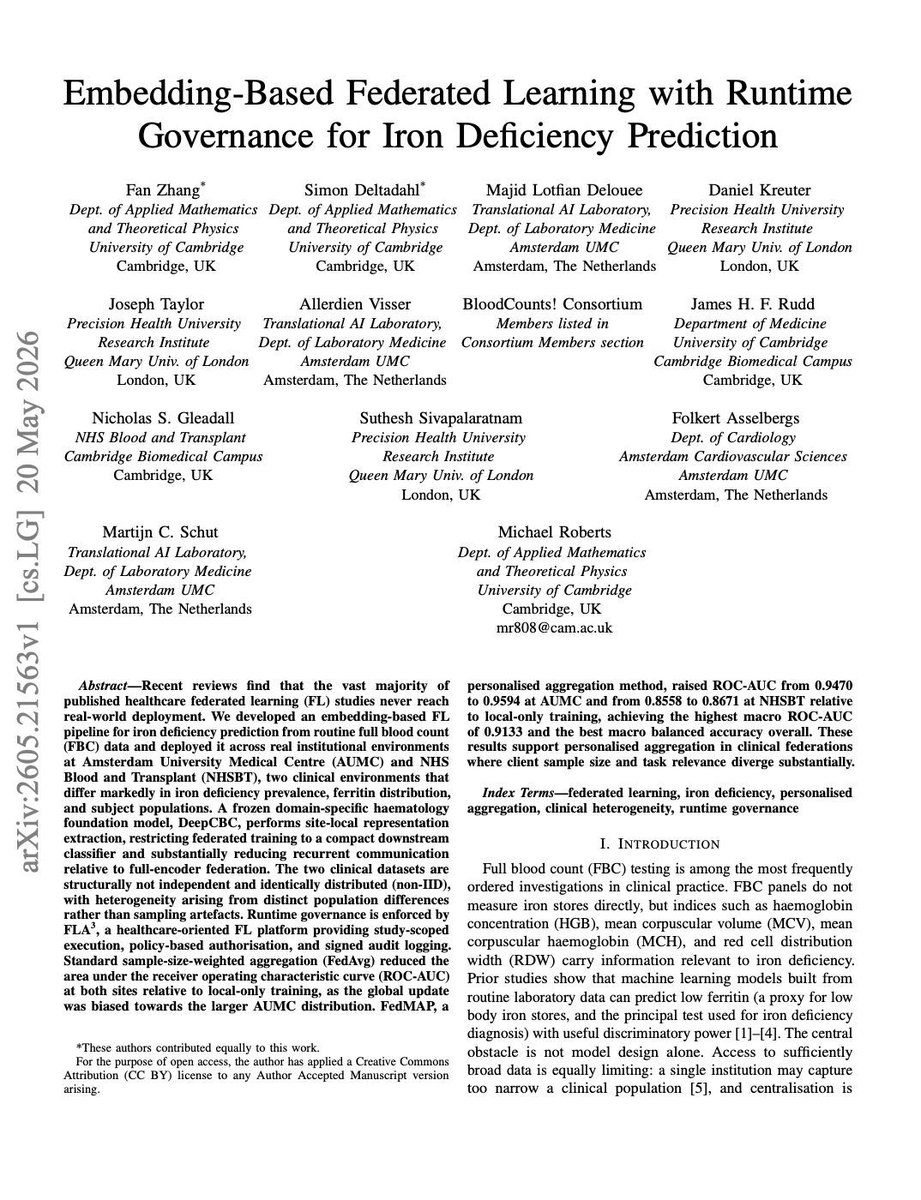
A 7x gap in iron deficiency prevalence between 2 clinical environments. Same disease, same diagnostic test, completely different patient populations.
Researchers from @Cambridge_Uni (study led by Fan Zhang), @amsterdamumc (AUMC), @NHSBT, @QMUL, and BloodCounts! consortium deployed a federated iron deficiency prediction pipeline across 2 live clinical environments without raw patient data leaving either institution.
NHSBT's donor population had 19.5% iron deficiency prevalence. AUMC's hospital population had 2.8%. Different workflows, different ferritin distributions, different case severity. Standard federated averaging saw the larger site and weighted toward it, and performance dropped at both.
FedMAP fixed this by weighting aggregation on task relevance rather than sample count. ROC-AUC improved at both sites over local-only training. The deployed classifier was ~40k parameters; the foundation model stayed frozen and local, keeping communication overhead minimal.
The system ran on FLA3, built on Flower, with deny-by-default runtime governance enforced through XACML policies and a signed audit log. That enforcement, not just documentation of governance, was what made cross-border deployment between Dutch and UK regulatory frameworks possible.
Worth reading if you are thinking seriously about what it takes to move healthcare FL into production: https://t.co/vGriBXuTml
Sign up on https://t.co/raqeS2lssP to get started today.
Flower v1.31.0, shipped on June 8, sets up the infrastructure for agentic AI on SuperGrid.
This release prepares support for Flower Agent and lays the foundation for running it on SuperGrid, while also adding new SuperGrid guides for Flower CLI usage and running apps on SuperGrid.
It also introduces an Executor Abstraction for SuperExecs, so task selection is separated from how tasks are launched across subprocesses, containers, @kubernetesio pods, and other managed runtimes. On the reliability side, cleanup and startup are safer, with stronger handling for concurrent nodes, messages, and runs.
For teams building federated and distributed AI systems, this is the kind of release that reduces friction now and makes the next workflows easier to stand up.
Read the changelog here: https://t.co/GdBy4WtDcu or reply with questions.
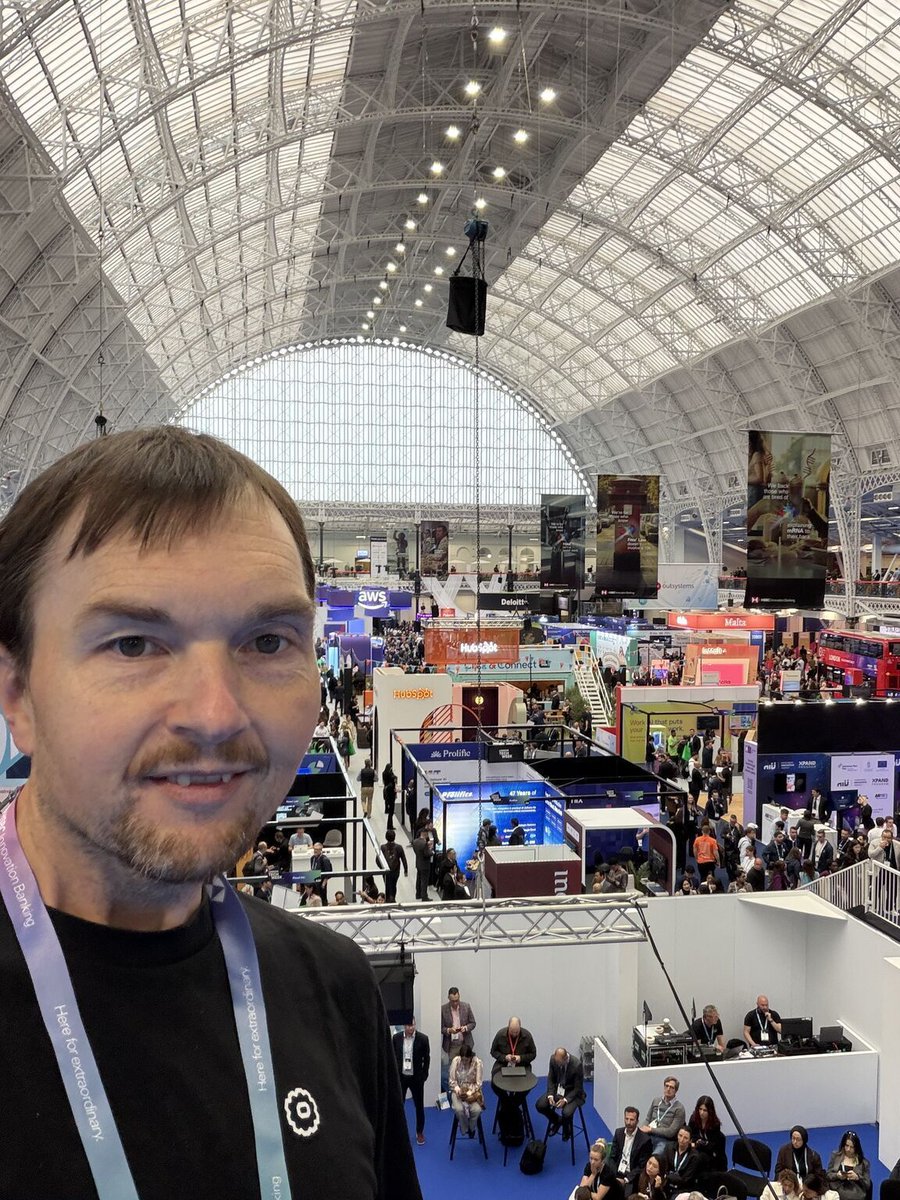
Flower Labs is at London Tech Week 2026, booth 345, June 8–10.
@niclane7, Pedro Mesa, @jafermarq, and @chongshenng are on the ground this week. Come talk to them about collaborative AI, federated learning, and what it actually takes to train on data that can't leave its source.
If that's a problem you're working on, we'd like to meet you.
Flower Labs is at London Tech Week 2026. Come find us at booth 345.
We're here to talk about the problems that actually slow enterprise AI down: making the most of data that can't be centralized, deploying models across distributed infrastructure, and building agents that work in production.
If you're working on any of those challenges, we'd like to meet you.
@chongshenng@niclane7@jafermarq Pedro Mesa
We're thrilled to be speaking at London Tech Week 2026 (@LDNTechWeek) alongside some of the most consequential voices in tech.
@niclane7 (CSO at Flower Labs) will be on stage sharing what we see as the next frontier for AI: collaboration. Collaborative AI is a fundamentally different architecture, reshaping how AI is built and used across agents, models, evals, and infrastructure. A key benefit is data access. Today, only a tiny fraction of the world’s data, including enterprise data, is ever used by AI. Most remains locked behind privacy constraints, regulatory boundaries, and organizational walls.
At Flower Labs, we’re building AI that unlocks this data safely and at scale, driving meaningful improvements in capability and accuracy.
We're grateful to share the stage with so many brilliant minds driving the future of tech forward, including @AravSrinivas (Co-Founder & CEO, @perplexity_ai), @FabianHedin (Co-Founder & CTO, @lovable), Dr. @LisaSu (Chair & CEO, @AMD), and many others.
See you in London. June 8 - 10.
Running LLMs locally will become a lot more common and usable. Hardware improvements paired with model efficiency improvements (like the recent Gemma 4) will eventually lead to a tipping point.
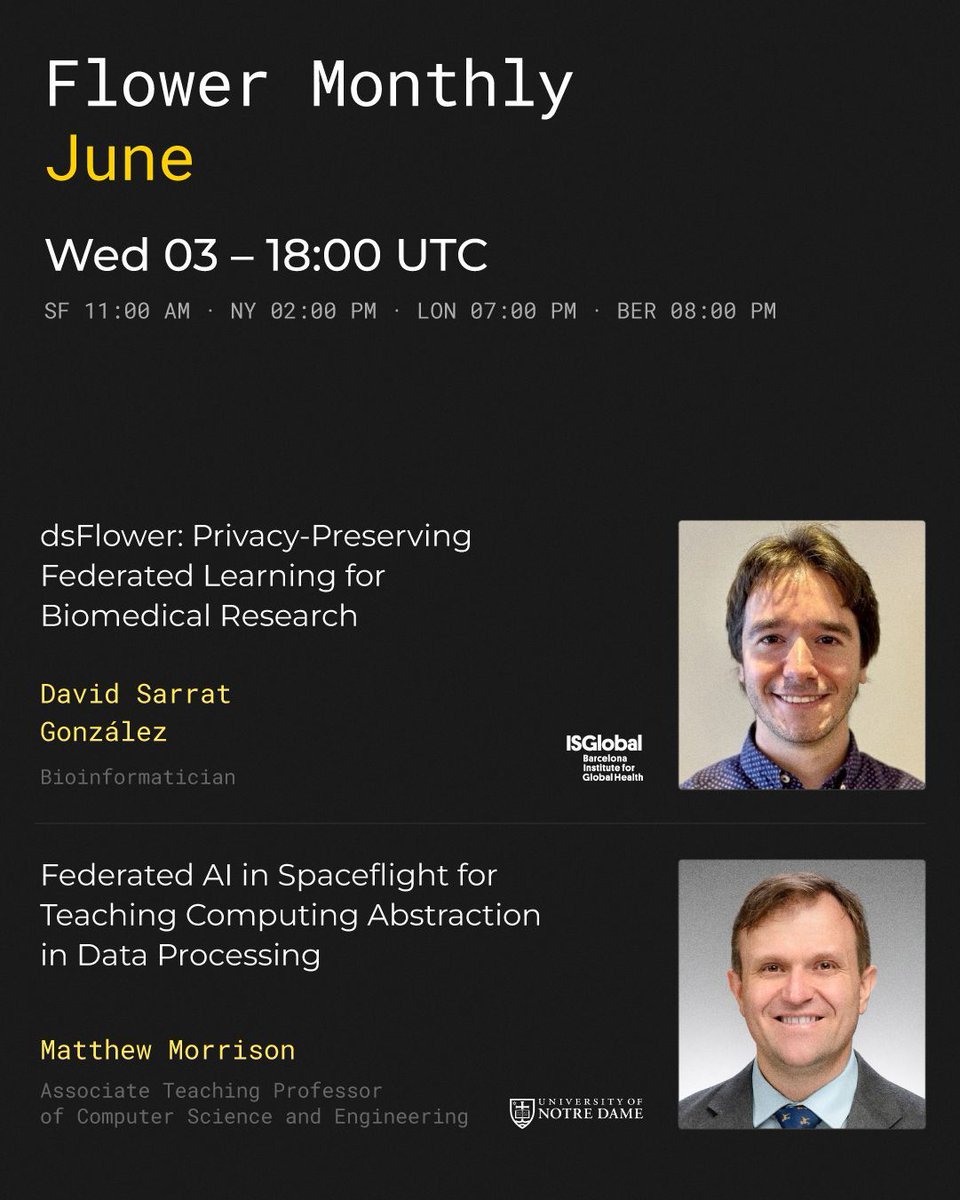
Join us tomorrow for @flwrlabs Monthly June, featuring talks on real-world federated learning ranging from biomedical research to spaceflight.
"dsFlower: Privacy-Preserving Federated Learning for Biomedical Research"
David Sarrat González
Bioinformatician, @ISGLOBALorg
"Federated AI in Spaceflight for Teaching Computing Abstraction in Data Processing"
Matthew Morrison
Associate Professor, @NotreDame
Date: Wednesday, June 3
Time: 18:00 UTC
SF 11:00 AM · NY 2:00 PM · LON 7:00 PM · BER 8:00 PM
More information available here: https://t.co/A2XTmoI6vD
In a federation of 100 hospitals, who reviews the code running on each node?
Self-review does not scale, and one organization reviewing for everyone creates a single point of control. Neither model fits how federated AI actually operates.
Flower Hub now includes App Verification: a decentralized trust model that separates publication from verification, and lets each organization decide whose review it trusts.
Here is how it works.
Developers publish a Flower App Bundle (FAB) to Flower Hub, independent reviewers inspect it and sign it, and those signatures are published as verifiable metadata alongside the app. SuperNode operators define a trusted-entities list, and only apps signed by reviewers on that list are allowed to run.
Here's an example to sign a specific version using Flower CLI:
flwr app review @flwrlabs/demo==1.2.0
Signatures are tied to specific app versions, so what was reviewed is exactly what gets executed. No unverified code touches sensitive data, and trust policies are consistent across the federation and enforceable by default.
The second image shows the model clearly: independent reviewers, verified app metadata, and trust policies enforced at the SuperNode level. Different organizations can trust different reviewers. The hub distributes both the app and the verification metadata but does not impose a single global policy.
App signing and verification are available now in preview on Flower Hub. Read full blog by Mohammad and Yan to learn more: https://t.co/2quh9owlUr