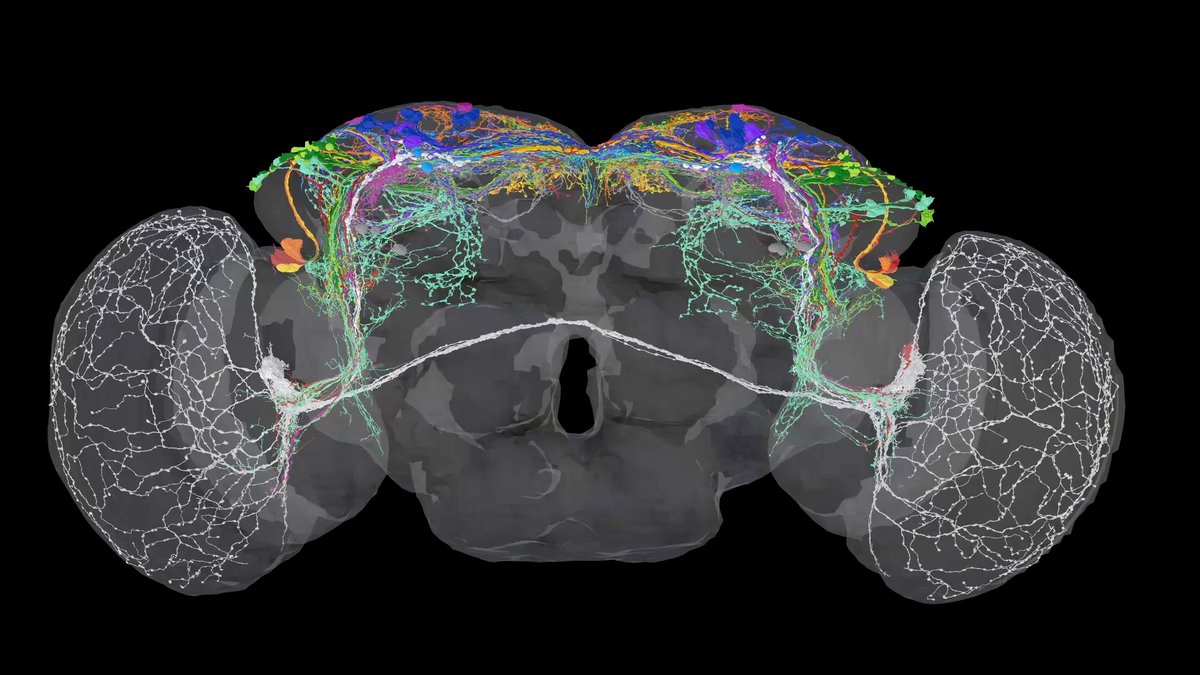
Check out our revised manuscript on the Drosophila circadian clock @FlyWireNews connectome. Packed with more neurons and analyses @nils_reinhard@FlyNeuro https://t.co/hEpG2eluRi
New paper 🚨 from the lab in collaboration with @JPPaluzzi lab. Postdoc @gera_jayati's first project from the lab on the discovery of the receptor for the fly anti-diuretic hormone, ITP. Check out the 🧵for more info (1/n) https://t.co/ZyfycK4du0
Interested in Unpaired group of proteins (Upds) in flies? Check out our latest review on Leptin and cytokine like signaling in Drosophila!! A big thanks to @zandawala for his constant support and guidance 🥂🎉🎊
Congratulations to @philip_suess for successfully defending his thesis titled "Unraveling the regulatory mechanisms of pupal diapause termination". Many thanks to the opponent Christian Wegener @FlyNeuro and the committee Noushin Emami, Martin Andersson and Richard Walters.
Controlling arms and legs requires feedback from position/movement sensors (proprioceptors). But how is feedback flexibly tuned to match behavior? In our new preprint, we reveal how the motor system tunes proprioceptive feedback in Drosophila 🧵 https://t.co/RDdBWEHXq2
New lab preprint on modulation of #Drosophila insulin producing cells (IPCs). How do single-cell transcriptomic analyses compare with Gal4-based expression mapping? Are IPCs really a homogenous population of 14 cells? 🧵 (1/n) https://t.co/A6fVwjhf26
Preprint 🚨
Everybody, put your cakes down! It’s time to talk about aminergic and peptidergic modulation of Insulin-Producing Cells (IPCs) in Drosophila.
I am over the moon to share our preprint today! 🤩
https://t.co/lhlV80klg6
(1/n)
Check out this new preprint from @jan_ache and @zandawala labs on #Drosophila insulin-producing cells. See the 🧵 by co-first author @TinaHeld4 for more details.
Very excited to share our latest pre-print on the modulation of Insulin-Producing Cells in #Drosophila, conveniently unpacked for you in this🧵by @TinaHeld4, who spearheaded the project alongside @rituja14 and our collaborator & neighbor @zandawala.
--> https://t.co/BAv3tcQmVN
Very excited to share our latest pre-print on the modulation of Insulin-Producing Cells in #Drosophila, conveniently unpacked for you in this🧵by @TinaHeld4, who spearheaded the project alongside @rituja14 and our collaborator & neighbor @zandawala.
--> https://t.co/BAv3tcQmVN
Sign-up to present in our symposium (16-17) "Neuropeptide signalling in insects: diverse and pleiotropic actions" @ice2024kyoto_jp in Kyoto, Japan. We have an exciting line-up of speakers: @JPPaluzzi@laurabduvall@jan_ache and others not on X. https://t.co/0n42YZYXJl
The proceedings of the 7th biennial meeting of the North American Society for Comparative Endocrinology will be published as a special issue in General and Comparative Endocrinology. Deadline to submit is 12/31/2023.
More info here:
https://t.co/Km06dwOkgn
Let's try this again - look's like twitter can't handle the video 😂. Really excited to share the lab's first Drosophila paper and it's a big one. Check out our preprint https://t.co/Z1oI59uICG where we present the complete neural connectome of an animal circadian clock
We all are happy and proud and congratulate Francesca Sara Colizzi for her great defense of her PhD thesis on the characterization of the circadian clock and neuropeptides in aphids. Well done dottoressa Sara and all the best for the PostDoc! @GSLSUniWue@Uni_WUE
Data suggest that the circadian clock aligns daily oscillations of transport lipids to the anabolic siesta phase, with a strong influence of light on phase and modality. Check out here open access:
https://t.co/umoP3NDtXV
Our SFB1047 "Insect timing" offered a perfect umbrella to cooperate with the Pharmaceutical Biology in the Biocenter. Combined expertise allowed us to characterise the daily cycling of transport #lipids and their dependence on the #circadian clock in #Drosophila.
Helfrich-Förster lab on a roll. Check out this new paper by PhD student Giulia Manoli in collaboration with @zandawala and Yoshii labs on clock-related proteins and neuropeptides in Drosophila littoralis, a model for diapause. https://t.co/4NznlPrIJ5
Hot off the press! Check out this comprehensive review on the circadian and photoperiodic clock of the pea aphid by Sara Colizzi from the Helfrich-Förster lab. https://t.co/qvc0G6iESc