Comrades, we have an email subscription option.
Get an email whenever we publish a new blog (and only then, no other stuff)!
Please share widely so we can stay connected with our readers.
Solidarity, AND see you on the other side,
Your FocaalBlog gang
https://t.co/RXmPfABXVJ
The latest instalment of the Sensing (In)Security feature: Zoha Wassem describes the online and offline materiality of Pakistan's growing digital authoritarianism. https://t.co/f7JaJNBMyn
Some reflections on the afterlives of the massive 2025 student protests in Indonesia, by Iqra Anugrah and Rachma Luftiny Putri.
https://t.co/gkSWY3mhSZ
Khalid Syaifullah & Wardatul Adawiah show how the recent devasting floods in Indonesia are rooted in the country's history of colonial extractivism. https://t.co/6Ma79mnLFa
Ana Ivasiuc discusses how the police's racialization of sight and smell in the Roma camps at the periphery of Rome "fabricate (in)security, rendering the Roma as dangerous subjects to be perpetually governed.” https://t.co/l6fROogIO3
Erella Grassiani and Nir Gazit discuss the two aspects of sensorial warfare in Palestine and Israel: intentional use of weapons that attack the sense and the sensorial byproducts of militarization.
https://t.co/8CcM6uJrqb
The greening of Norwegian ships depends on precarious workers in Turkish shipyards. Ståle Knudsen gives a summary of a longer report he wrote on the #greentransition in the Norwegian maritime sector and what should be done to ensure workers' rights. https://t.co/6aRXw0peF5
Safety gadgets aesthetically enact a sense of security. Alice McAlpine-Ridell describes these devices and how residents of #Brooklyn, #NYC make use of them. https://t.co/y7TB80dtLy
Maja Sisnowski talks about how the smell of food and the gut feeling of health and welfare workers helps with securing emergency shelters in Germany.
https://t.co/XDYuc3bU7o
The latest instalment in the Dipohoorn and Salem edited Sensing (in)security feature:
Laust Lund Elbek writes about how the tacit knowledge described as 'the police nose' works in Denmark and the way in which it conceals structural biases. https://t.co/3mtv0mgSIt
The security of residential buildings in urban Brazil reveals layered social, gendered, and racial hierarchies. Durão & Heil on the colonial and neoliberal legacies structuring the life of workers providing (more-than-)security to condos residents https://t.co/xJWYjRFYNl
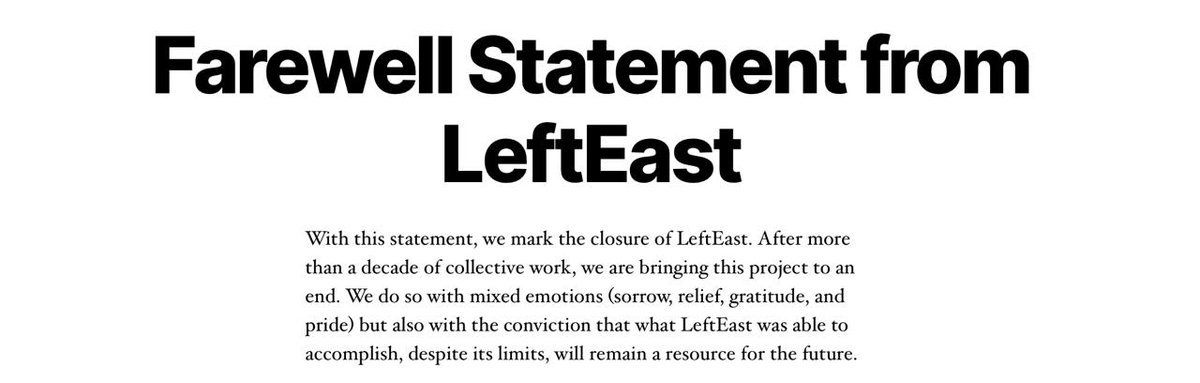
The project, in which I have participated from the very start—though not actively, especially in recent years—has come to an end. I think it was an important point of convergence for the intellectual left from Eastern Europe and left a rich archive. A new project is coming soon: redder, more eastern, more organized, reflecting the evolution of the left in the region and the trends that will define the global future.
LeftEast was born 13 years ago. 1679 articles, 663 authors, and 8 summer schools later, it is coming to an end. Thank you to all who contributed! And no farewells from us: in the next couple of weeks we'll be announcing its successor projects!
https://t.co/qIcQljzi9I
Aaron Kappeler highlights the internal and external contradictions of the Venezuelan socialist project and how Maduro's leadership gave the US the opportunity to put an end to it. https://t.co/ZjFf5YKV5N
New post: Bjørn Enge Bertelsen discusses how banging pots at night became a form of secure collective resistance in the context of violent clashes over the contested 2024 Mozambican elections that lead to 400 dead and thousands of injured. https://t.co/XTZMamrw29
Drawing from research with the Akwesasne and her recent experience as a US citizen, Beatrice Jauregui describes a growing sense of insecurity taking hold of those who thought were immune up until now to border security politics. https://t.co/UjTqDhd3qr
Jolien van Veen discusses how a religious centre inhabited by Afro-Brazilian spirits provides a sense of atmospheric security in one of Rio de Janeiro's violent ridden neighborhoods.
https://t.co/mbvrO7a9UZ
‘To sense (in)security is to inhabit a world where matter, technology, and emotion converge.’ We are rolling out a new feature on how the materiality and ideology of (in)security is sensed, edited by Tessa Diphoorn and Tomas Salem https://t.co/OoYJv1Jdzu
Oane Visser discusses the presence of food movements at #COP30, showing how their presence in and on the streets next to the conference changed in the past years. https://t.co/iAjOkvwVEH