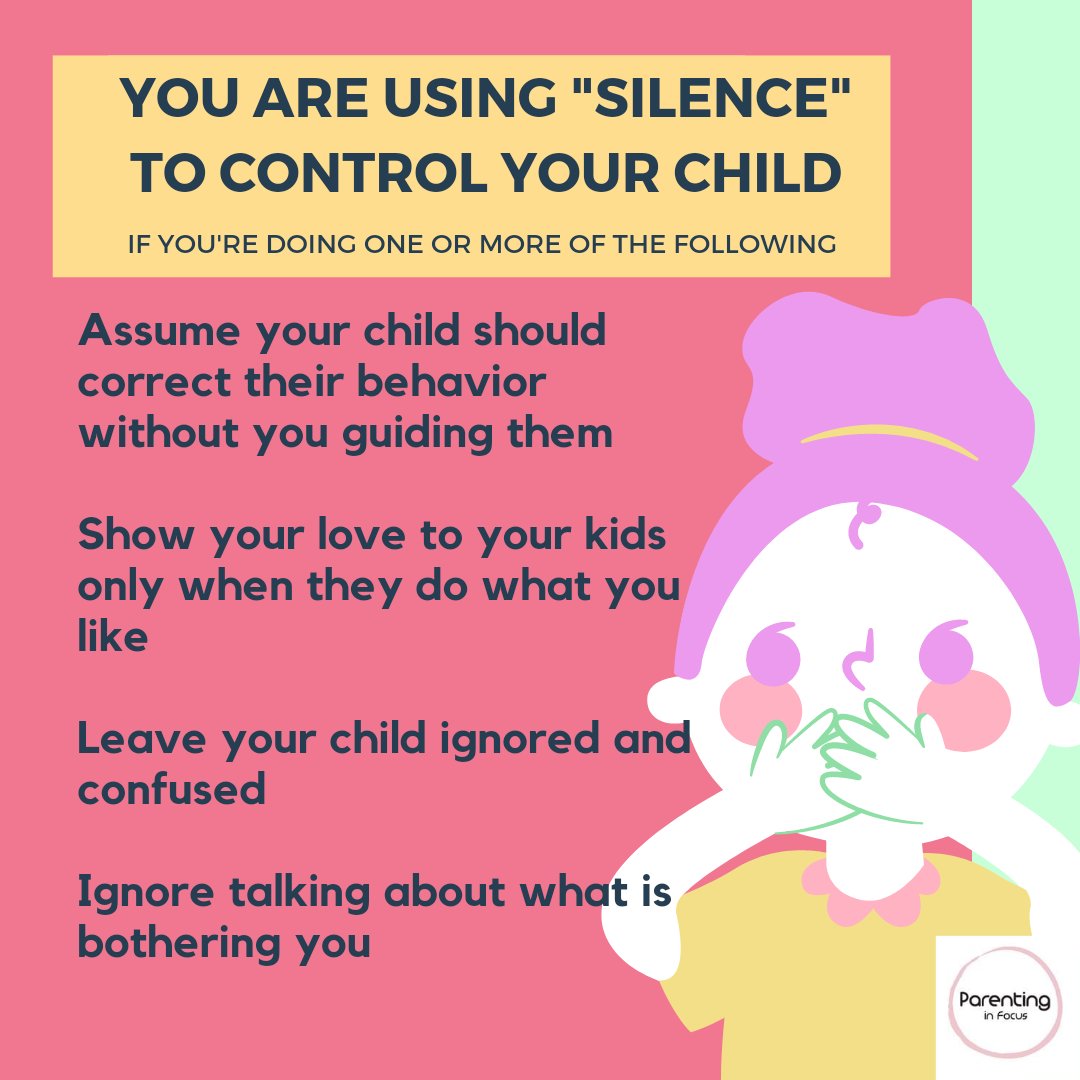
Relationships Australia practice specialist Kerri James says that when parents resort to the #silenttreatment, “they convey to the child that they are very distressed and that the child has hurt them. The other part is they probably think it’s better to withdraw than to lash out"
#silenttreatment is abuse: emotional, mental and psychological abuse. When we ignore our #Children, we make them feel insignificant, like their words don’t matter; their choice doesn’t matter; their opinion doesn’t matter.
Often times, in the attempts to encurage our children to eat #healthy, we unknowingly commit some common mistakes which may have the opposite effect.
https://t.co/8yz92OGoCN
#commonfeedingmistakes
9. Depriving kids of all #SWEETS
Such a step may lead your child to view candies and #desserts as the #forbiddenfruit. Even if they may not be craving such, the refusal to have access to them will lead to see it as something much more #valuable.
#commonfeedingmistakes
8. Every #meal should include #vegetables
Not really. If we are being #honest, vegetables don’t really top the list of most people’s #favorite#Food item. While vegetables are important, it is not necessary they be included in every meal
#commonfeedingmistakes
5. Not asking children to stick to a #schedule#Children may learn to eat out of #habit, instead of hunger. Children fail to understand what #Hunger means since they are given the authority to snack at times they see feasible and munch on whatever they are allowed to.
4. Keeping your #baby#clean during eating
Many parents may may prefer to feed bites to their toddler with a spoon and clean their face after every bite. The child then becomes particular with what they eat, as they will be focusing on staying neat instead of eating.
2. Blaming your child for their #foodchoices
Children develop #foodpreferences in the first 2 years. During this time if the child is exposed to strong tastes like salt and #processed sugar, replacing it with natural taste may become an issue.
#commonfeedingmistakes
1. Pushing your child to #eat more.
According to a 2007 study in Appetite, 85% of parents tried to get their kindergarten children to eat more using words of praise or #pressure.
83% of children ended up eating more than they might otherwise have.
#commonfeedingmistakes
Having a comprehensive knowledge about a #healthydiet may be possible. However, implementing it may be a different story altogether.
#commonfeedingmistakes
When it comes to learning anything, #Children look at their #Parents. Hence, when we #model with strong and clear #boundaries for ourselves as an individual, we allow our children to pick up the same characteristic for themselves as well.
#parentalboundaries
#Boundaries are a measure of #selfesteem. These are the safe and reasonable rules that a person makes for their well-being, and for others to behave around them.
#parentalboundaries