A few years ago we had a small team of us visit Kailash Eco Village in Portland, Oregon. It is a truly remarkable example of Urban #permaculture in action. Part of our #ProjectLichen designs came from this visit and we are also very inspired by Retrosuburbia from Holmgren.
I'm afraid that this is why the US administration wants to shut down ocean observations: they don't want the people to know what is happening in our oceans, as it does not fit their ideology and the interests of their fossil fuel industry funders.
https://t.co/G1E5zXdyid
This is currently John Deere's largest and most powerful tractor, producing up to 913 hp from an 18-liter engine. John Deere describes it as the flagship of the 9RX line. �
Recent reports place the base price at approximately US$1.23 million before options. � and diesel needed!
*BRITISH WRITER PENS THE BEST DESCRIPTION OF TRUMP*
Someone asked "Why do some British people not like Donald Trump?" Nate White, an articulate and witty writer from England wrote the following response:
A few things spring to mind. Trump lacks certain qualities which the British traditionally esteem. For instance, he has no class, no charm, no coolness, no credibility, no compassion, no wit, no warmth, no wisdom, no subtlety, no sensitivity, no self-awareness, no humility, no honour and no grace – all qualities, funnily enough, with which his predecessor Mr. Obama was generously blessed.
So for us, the stark contrast does rather throw Trump's limitations into embarrassingly sharp relief.
Plus, we like a laugh. And while Trump may be laughable, he has never once said anything wry, witty or even faintly amusing – not once, ever.
I don't say that rhetorically, I mean it quite literally: not once, not ever. And that fact is particularly disturbing to the British sensibility – for us, to lack humour is almost inhuman.
But with Trump, it's a fact. He doesn't even seem to understand what a joke is – his idea of a joke is a crass comment, an illiterate insult, a casual act of cruelty. Trump is a troll. And like all trolls, he is never funny and he never laughs; he only crows or jeers.
And scarily, he doesn't just talk in crude, witless insults – he actually thinks in them. His mind is a simple bot-like algorithm of petty prejudices and knee-jerk nastiness. There is never any under-layer of irony, complexity, nuance or depth. It's all surface.
Some Americans might see this as refreshingly upfront. Well, we don't. We see it as having no inner world, no soul. And in Britain we traditionally side with David, not Goliath. All our heroes are plucky underdogs: Robin Hood, Dick Whittington, Oliver Twist. Trump is neither plucky, nor an underdog. He is the exact opposite of that. He's not even a spoiled rich-boy, or a greedy fat-cat. He's more a fat white slug. A Jabba the Hutt of privilege.
And worse, he is that most unforgivable of all things to the British: a bully. That is, except when he is among bullies; then he suddenly transforms into a snivelling sidekick instead.
There are unspoken rules to this stuff – the Queensberry rules of basic decency – and he breaks them all. He punches downwards – which a gentleman should, would, could never do – and every blow he aims is below the belt. He particularly likes to kick the vulnerable or voiceless or female – and he kicks them when they are down. So the fact that a significant minority – perhaps a third – of Americans look at what he does, listen to what he says, and then think 'Yeah, he seems like my kind of guy' is a matter of some confusion and no little distress to British people, given that:
• Americans are supposed to be nicer than us, and most are.
• You don't need a particularly keen eye for detail to spot a few flaws in the man.
This last point is what especially confuses and dismays British people, and many other people too; his faults seem pretty bloody hard to miss.
After all, it's impossible to read a single tweet, or hear him speak a sentence or two, without staring deep into the abyss. He turns being artless into an art form; he is a Picasso of pettiness; a Shakespeare of shit. His faults are fractal: even his flaws have flaws, and so on ad infinitum. God knows there have always been stupid people in the world, and plenty of nasty people too. But rarely has stupidity been so nasty, or nastiness so stupid. He makes Nixon look trustworthy and George W look smart. In fact, if Frankenstein decided to make a monster assembled entirely from human flaws – he would make a Trump.
Weed killer Roundup is being sprayed in record amounts in California’s forests
The forest floor was nothing but patches of brown. No ferns, no brush, no flowers, and definitely no wildlife. Everything was dead except for rows of hand-planted baby trees.
https://t.co/OvUoakPy7e
Water is not a commodity. It is a birthright. It belongs to the earth, to other species, and to future generations. No corporation has the right to control it.
This sums up our Fabaceae Food Forest work so well. After a lighter than normal precipitation over Winter. We still have intense verdant plant growth all around and deep rooted resilience as we move toward mid-Summer with no external irrigation so far. #ProjectLichen evolved.
The Fabaceae Food Forest; first the Favas fed emerging Bumble Bee queens and Mason Bees. The Brassicas continued the feast.
Before a single seed was saved, the system had already produced one of its most valuable yields:
Thousands of pollinator meals!
https://t.co/75ASo6MMCi
And our current industrial food systems are completely dependent on #FossilFuels which is a truly devastating mistake. This was one of our guiding principles in creating #ProjectLichen.
A hybrid #seed is bred in a laboratory. A landrace is shaped by a landscape.
Years of observation.
Thousands of pollinator visits.
Countless seed selections.
#ProjectLichen supports Landrace growing because resilience emerges from diversity, not uniformity.
The benefits of #hugelkultur cannot be overstated. This one we created was in a small urban garden in Eugene, OR. We are also using 3 Sisters (beans, corn, squash) and in 16ft x 6ft we evolved a lot of #food and #seeds. #ProjectLichen scaling evident.
A few months ago these were simply seeds.
Now they are:
shading soil,
feeding pollinators,
generating protein,
fixing nitrogen,
producing seed,
and preparing future fertility.
That is an extraordinary amount of ecological work from a handful of planted fava beans. #ProjectLichen
If all the #lithium mines on Earth disappeared tomorrow, civilization would face enormous challenges.
If all viable seeds disappeared tomorrow, civilization would cease.
This is at the core of our #ProjectLichen work; ongoing.
This morning I arrived at a simplistic question for myself. "How can I be going to a local supermarket in late May, 2026 and still find 🍐 Pears for sale?" Then a nearby tree helped me by telling her story of real life. Overall, let's get real via #ProjectLichen.
#ProjectLichen
Not supernatural.
Simply the subtle intelligence of living systems moving through water, soil, seeds, air, and time.
Life is listening and Mother Earth enfolds and nurtures all of our work. We are coming home.
https://t.co/D93p6ThmGN
The title of this article is a little misleading as The Fabaceae Food Forest “Concept” it is now a reality under our feet and in some cases, over our heads. The aims are to create moisture retaining and fertile foodscapes.
https://t.co/if2TKSQWhF
While everyone argues about data centers and water, California almonds quietly use up to 80x more, AND the whole industry only survives because of trucked-in "livestock"...
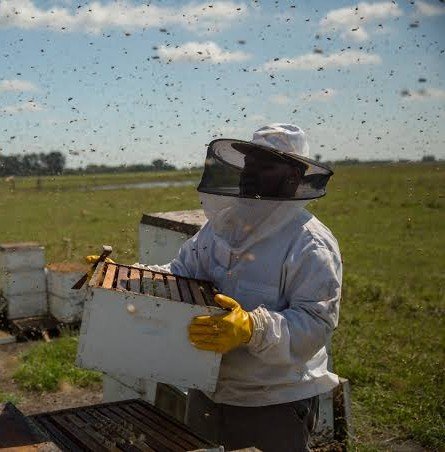
Every February, beekeepers transport nearly every commercial honeybee colony in the United States (around 2.8 million hives) to California to pollinate almonds.
It's the largest "managed-pollination" event on the planet. Almonds cover 1.4 million acres and need bees to pollinate so they set nuts.
So why do we need to truck them in? Well, almonds are grown in huge monoculture orchards, meaning the native bee species are all but eradicated...there's nothing for them to eat most of the year.
To fix the problem WE created, we ship in bees from across the country. I interviewed the creator of the 2019 documentary The Pollinators, which followed this migration and brought a lot of this story into public view.
First off, honeybees aren't native to North America. They were brought from Europe in the 1600s. The "bee crisis" you read about, with national colony losses around 55% last year and some commercial keepers losing 60 to 70% in a single season, is happening to a managed, introduced species.
It's a livestock collapse driven by long-haul transport, pesticide exposure at bloom, hives packed together spreading mites and viruses, and a monoculture diet.
Meanwhile, North America has roughly 4,000 native bee species. Most are solitary, don't make honey, don't sting, and quietly pollinate everything from squash to blueberries.
Research out of UC Davis and UC Berkeley has been direct about this: when blue orchard bees, bumble bees, and other natives forage alongside honeybees in almond orchards, fruit set goes UP, not down.
The presence of wild bees changes how honeybees move through the trees and makes the honeybees themselves more effective pollinators.
So the fix isn't more honeybee hives. It's hedgerows, wildflower strips, bare ground for ground-nesting bees, and uncut field edges, aka habitat for the natives who were doing this work long before we started trucking in livestock.
Honeybees are livestock. Native bees are the wildlife, and we should be planting to include them in our agriculture.
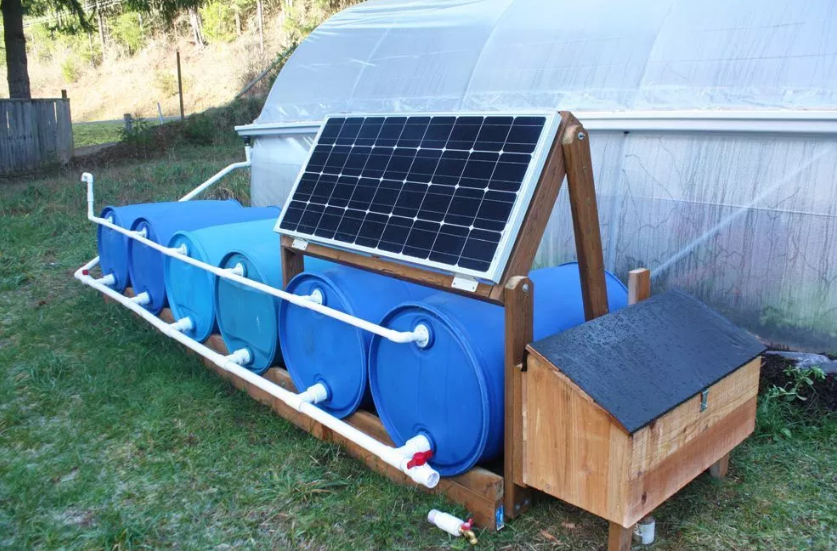
We designed and built this polytunnel back in 2014, in Oregon. It features 330 gallons of #water storage capacity and irrigation powered by a solar panel and batteries and is now part of our #ProjectLichen and like #ProjectLichen can be scaled up.
More of the same? Actually "Same Of The More!" Clearing a path today to our next planting area, nestled between two large Comfrey plants. That is my size 12 boot. This Brassica stood around 5ft 6" tall from root tip to flower tip. These are helping sulfur via #ProjectLichen