Singapore's median income was $500 a year when Lee Kuan Yew became prime minister. It is over $60,000 today.
He ran the country for 31 years, jailed his own ministers for corruption, and refused to pick capitalism, socialism, or any other ideology.
His book explaining every decision is $18 on Amazon.
Almost none of the Western leaders who have visited Singapore in the last twenty years have read a single page of it.
He was 35 when he took office in 1959. Singapore had 1.5 million people, no natural resources, no army of its own, no fresh water, and no consensus on which of four languages to speak. Half the population lived in slums. Malaria was endemic. Most educated citizens were leaving for the UK or Australia.
Every foreign expert told him to pick a side. Adopt Western liberal democracy. Adopt Chinese-style command economy. Adopt British socialism. Adopt Japanese industrial policy.
He refused all four.
Instead he wrote down every rule that worked and threw out any rule that did not, regardless of which ideology it came from.
Merit for every hire. English as the working language. Home ownership for as many citizens as possible. Anti-corruption laws that jailed his own ministers when caught. A currency board that took inflation off the table. No debt to the IMF. No sacred political theory. Sunday mornings walking the streets, personally, looking at what was broken.
McKinsey now charges governments millions of dollars a year to explain a version of the same framework.
"I have never been a prisoner of any theory. What guides me are reason and reality."
That is Lee Kuan Yew when journalists asked if he was capitalist or socialist. He was neither. He picked whatever worked, kept it while it worked, and threw it out the second it stopped.
Singapore now holds the strongest passport in the world, top-ranked schools, and a corruption score lower than Switzerland's. A $1,000 stake in the country's trajectory at his inauguration would be worth roughly $170,000 today.
The book is called "From Third World to First." It is $18 on Amazon.
The playbook is free. The willingness to run a country, or a company, or a life on reason and reality instead of on ideology is a much rarer commodity than talent.
@mendatrades "A stop loss should be placed in an area where retail traders are most likely taking profits."
Your chart has parameters called "greed emotion."
These two things confuse traders a lot and is not in any way helpful.
This confused me for years and years.
Itinerary today:
12:00 – 3:00 PM
Lecturing on 1-CCISD on market structure & direction + Q&A
When Kenyans were shitting on this, South Africans saw the value… and opened the door.
It’s 9 AM. I’m walking through the neighbourhood. Nobody has told me to “go back to your country.”
They actually like the accent.
Sometimes the warmest welcome isn’t from home.
The Law of Detachment is one of the most underrated skills in trading.
Most traders are attached to the outcome of every single trade.
They need this trade to win.
They need to recover a loss.
They need to make money today.
That attachment creates fear, hesitation, revenge trading, and overtrading.
Professional traders think differently.
They are detached from the outcome of any one trade because they know one trade means nothing.
Their focus is simple:
• Follow the plan.
• Manage risk.
• Let probabilities play out.
A losing trade doesn't make you a bad trader.
A winning trade doesn't make you a genius.
Your job is not to predict every move.
Your job is to execute your edge consistently.
The moment you stop trading for money and start trading your process, your psychology changes completely.
Detach from the result.
Attach to the process.
That's where consistency begins.
1.A 45 minute engulfing off an FVG.
Another continuation breaker engulfing off an FVG.
Entry at open of the breaker.(Brown line)
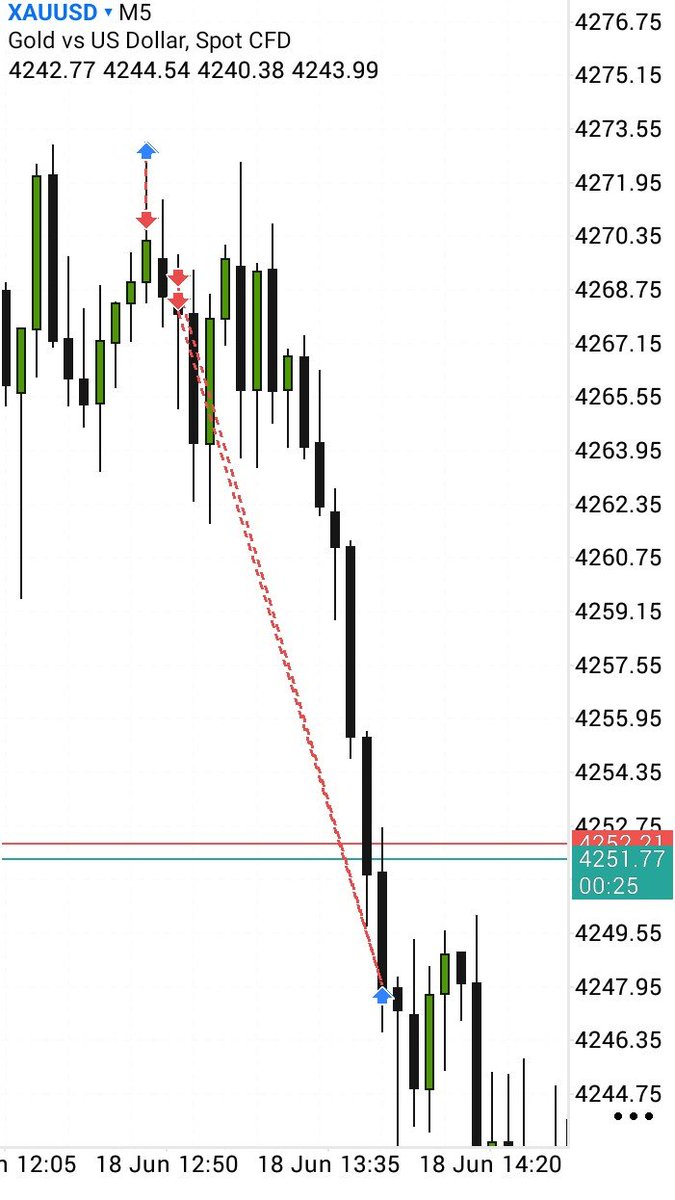
2.Execution with sell limits.
1.For a Breaker to be valid,IT MUST ORIGINATE FROM A FAIR VALUE GAP.
2.For an Engulfing to be valid,it MUST ORIGINATE:
-From a Fair Value Gap.
-From a Breaker Originating from a FAIR VALUE GAP.
June will close right at or near the high of month…
That’s what trends do…
Go look at your daily chart and note how every bullish day closes strong right at the daily high…
Same with the last monthly candle.
I was saying this last week as price was falling & everyone was looking for their bearish SMT.
That’s just another one of my many tricks I learned from chart time.