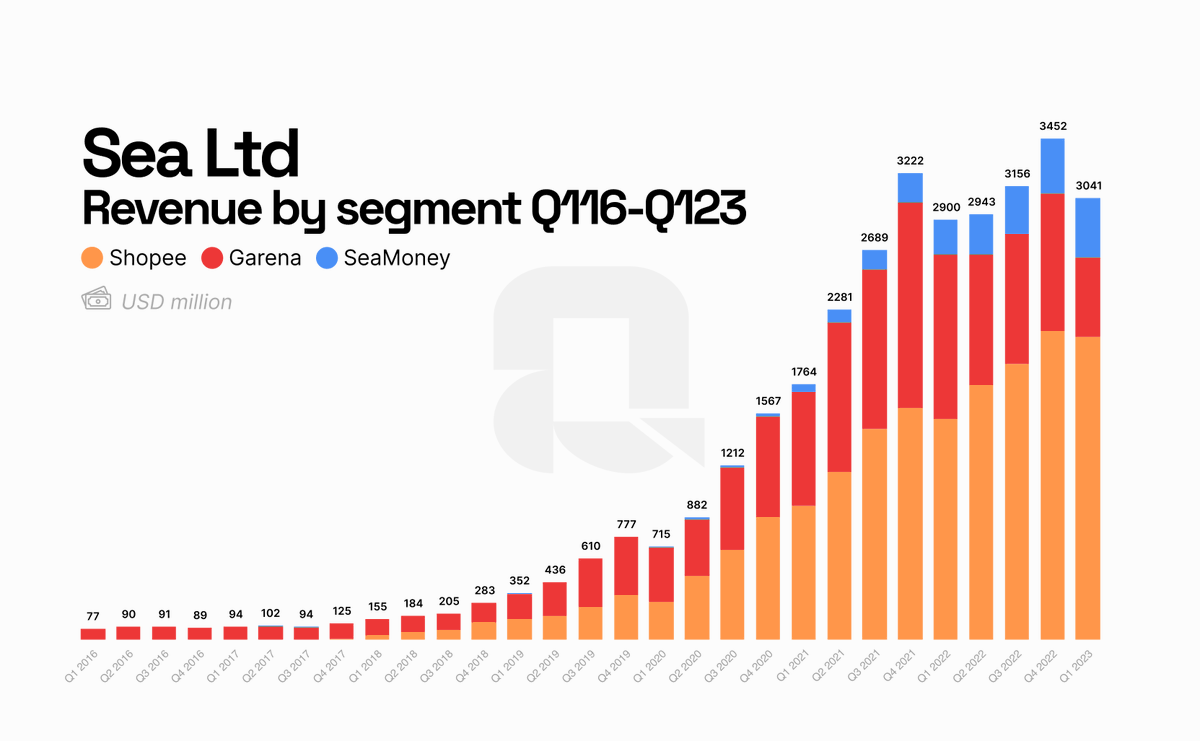
Sea Limited $SE 2Q26 Earnings
- Rev $7.8b +48% ↗️🟢
- GP $3.6b +47% ↗️🟢 margin 45.6% -24 bps ↘️🔴
- Adj EBITDA $917m +11% ↗️🟡 margin 11.8% -399 bps ↘️🔴
- EBIT $650m +33% ↗️🟢 margin 8.4% -92 bps ↘️🔴
- Net Inc $458m +11% ↗️🟡 margin 5.9% -199 bps ↘️🔴
- OCF $1.5b -7% ↘️🔴 margin 19.3% -1138 bps ↘️🔴
Shopee
- Gross Orders 4.2b +27% ↗️🟢
- GMV $38.3b +28% ↗️🟢
- Revenue $5.6b +48% ↗️🟢
- Marketplace Rev $4.3b +66% ↗️🟢
- VAS Rev $676m -9% ↘️🔴
- Sale of Goods Rev $656m +43% ↗️🟢
- Take-rate 14.6% +200bps ↗️🟢
- Take-rate (marketplace) 11.2% +150bps ↗️🟢
- Take-rate (VAS) 1.8% -50bps ↘️🔴
- Take-rate (product) 1.8% -10bps ↘️🔴
- GP $1.7b +43% ↗️🟢 margin 31% -112 bps ↘️🔴
- EBIT $160m +4% ↗️🟡 margin 3% -124 bps ↘️🔴
- Adj EBITDA $255m +12% ↗️🟡 margin 5% -147 bps ↘️🔴
Monee
- Monee Loans O/S $11.1b +61% ↗️🟢
- NPL 90+ ratio 1.0% ➡️🟢
- Active Credit Users >40m +34% ↗️🟢
- Rev $1.4b +59% ↗️🟢
- GP $1.2b +62% ↗️🟢 margin 89% +186 bps ✅
- EBIT $279m +15% ↗️🟡 margin 20% -765 bps ↘️🔴
- Adj EBITDA $288m +13% ↗️🟡 margin 21% -839 bps ↘️🔴
Garena
- Garena Bookings $764m +15% ↗️🟢
- QAU 666.3m ➡️🟡
- QPU/QAU 10.2% +90bps ↗️🟢
- ARRPU $11.2 +5% ↗️🟡
- Rev $747m +34% ↗️🟢
- GP $536m +39% ↗️🟢 margin 72% +258 bps ↘️🔴
- EBIT $404m +47% ↗️🟢 margin 54% +486 bps ↘️🔴
- Adj EBITDA $430m +17% ↗️🟢 margin 58% -829 bps ↘️🔴
Others
- Rev $51m +9% ↗️🟡
- EBIT -$51m ↘️🔴 margin -101% -6765 bps ↘️🔴
- Adj EBITDA -$46m ↘️🔴 margin -91% -6143 bps ↘️🔴
Service revenue
- Rev $7.1b +49% ↗️🟢
- GP $3.5b +48% ↗️🟢 margin 49% -32 bps ↘️🔴
Sales of goods
- Rev $658m +43% ↗️🟢
- GP $35m +22% ↗️🟢 margin 5% -91 bps ↘️🔴
1 | Shopee continues on strong momentum with +28% GMV growth, improving operational efficiency and growing scale allows Shopee to serve a wider range of users and lean into acquisition. Optimistic that Shopee will get $1b Adj EBITDA for FY26.
Shopee continued its strong momentum into the second quarter. GMV grew 28% YoY, marking eight consecutive quarters of sequential growth, and we again achieved new highs in gross order volume and revenue.
Our improving operational efficiency and growing scale have strengthened our unique economics. We can now profitably serve a wider range of users, enabling us to lean further into user acquisition.
With this solid momentum we are optimistic that Shopee will achieve the milestone of $1 billion in adjusted EBITDA for the full year.
2 | Engage and re-engage several user groups through brand awareness, expanding content channels, and broadening logistics offerings. Shopee saw new buyer growth, +35%, average monthly active buyers grew +18%, and purchase frequency increased +8%.
We have engaged and reengaged several user groups through brand awareness campaigns, expanding our content channels and broadening our logistics offerings to cater to different preferences. This drove remarkable new buyer growth in the second quarter. Average monthly new active buyers grew more than 35% YoY, a significant acceleration from previous quarters. Average monthly active buyers increased 18% year-on-year and overall buyer engagement also continued to improve with purchase frequency increasing by 8% YoY.
3 | Shopee monetization strengthened with take-rates rising to 14.6% by 200bps, driven significantly by ad revenue, which grew 70% and, at take rate, improved by 90bps. Ad-paying sellers grew 45%, and average ad spend per seller grew 15%.
Our monetization strengthened further in the second quarter. Ad revenue was up more than 70% and ad take rate improved by over 90bps YoY. We continued to make advertising simpler and smarter for sellers. For example, pairing ads with vouchers that are personalized to buyers to increase purchase conversion and improve the efficiency of sellers' ad spend. Ad adoption and spend continued to improve across our seller base. The number of ad paying sellers rose around 45%, while average ad spend per seller increased more than 15% YoY.
4 | When it comes to take rates, consider reinvetment, price competitiveness, price leadership, and comparison versus offline, and sellers profitability.
When we look at the take rate, we look at take rates from multiple angles. I think one is how much the take rate is reinvesting to grow the ecosystem, which is very important for us to look at. That's number one. Number two is we look at how our price competitiveness is in our platform. So essentially after take rate, do we still maintain a similar gap of price leadership or not compared to the other platforms. Number three is we also look at the price of e-commerce essentially on our platform versus the offline pricing. Number four, we also look at what does it mean for sellers' profitability. I think we put all the things together in terms of consideration for the take rate.
5 | Still see healthy ecosystem even with higher take rates, because able to reinvest back to help sellers operate online more efficiently.
From what we observed so far, we have been saying very healthy ecosystem even with the increase of take rate. And the reason for that is that we reinvest a large part of the take rate to the ecosystem growth as well, and also that we're able to help the seller to operate online more efficiently over time with the combination of other things, our price is still very competitive, not only compared to the other marketplaces in our market, but also compared to the offline alternatives in the market.
6 | Still see opportunities to grow take rates further not just from fixed commissions, but much more from advertising as well.
And going forward, we still see opportunities to increase our take rate, not only from commission, but also from the paid ads we have been able to penetrate more and more over time. Although you can argue that the fixed commissions probably has -- the pace of the fixed commission increase probably will be less than we observed before. But again, there is still room for us to increase the overall take rate by both helping the sellers to operate more efficient, but also helping the sellers grow their volumes by reinvesting part of the things to the ecosystem and also increase the conversion potential from the buyer side. With all the things together I think we're able to grow this even more over time.
7 | See a clear path for Shopee to hit EBITDA margins of 2-4% from here.
We still believe that 2% to 3% is quite within our reach for the year. EBITDA percentage. I think in fact, the sum of markets are well above that. I think the balance between growth and profitability is something I shared in the previous answer. We do believe this is still a dynamic process on how do we make sure we capture the potential of the growth of the market versus taking more profit out of the ecosystem. I think this is something we'll balance over time. But the path -- if you look at the numbers, the path from where we are to 2% to 4% is relatively straightforward. Now we are 0.67% or so, and we're talking about 1-plus percent to get where we are.
8 | Improved profitability will come from scale, operating leverage, and lower investments.
And part of that will come from -- over time, we don't need to invest so much in many of things we invest in. Like many of the programs we are doing right now, it will get mature over time. So I think we just invest less into it. Part of that comes from our cost improvement, fundamental cost structure improvements, for example, our logistics, our fulfillment, cost structure improvements over time. Part of that comes from better take rates from either ads or other forms. I think if you put that number together, we are really not too far.
9 | Shopee's priorities remain consistent to improve price competitiveness, service quality, content ecosystem, VIP, and strong logistics.
Our operational priorities remain consistent, improving price competitiveness, service quality and our content ecosystem. To keep strengthening our execution across these priorities, we continued to deepen our structural moats across logistics, ShopeeVIP and content. Strong logistics capabilities continue to be a key contributor to Shopee's reputation for excellent service. We continue to make delivery faster and more reliable across a wider product assortment in the second quarter.
10 | Instant and same-day delivery continued to gain strong traction, especially in high-frequency purchases such as groceries and pharmacy items.
Instant and the same-day delivery gained strong traction as we captured more LED purchases. Our instant service initiative can now deliver in as fast as 1 hour in urban areas. We continue to expand our presence in high-frequency categories such as groceries and pharmacy items to serve our buyers better. Other volumes using instant delivery rates grew around 80% year-on-year in initial while cost per order fell by around 20%, driven by economies of scale and efficiency gains.
11 | Made strong progress in fulfillment allowing buyers enjoying faster and more reliable delivery.
Beyond delivery, we also made good progress in fulfillment with other volumes up more than 20% QoQ. Fulfillment benefits both sides of our marketplace. Sellers offload operational complexity and scale more efficiently while buyers enjoy faster, more reliable delivery. In some markets, more than 60% of our fulfilled parcels arrive the next day meaningfully higher than the platform average. The gains are especially noticeable in places where geography makes delivery challenging. For example, in Mindanao, a mountain region in the Philippines, fulfillment has buyer waiting time by 1 to 3 days, buyers can feel the difference. These teams have converted to fulfillment saw more than a 20% customers uplift in orders on average in Southeast Asia.
12 | Fulfillment investment strategy is typically less capex-heavy, much more capex-light, as they don't own the fulfillment centers but usually rent the place.
we run fulfillment business in relatively light CapEx fashion that we don't own the land, we don't own the warehouses. When we start a new fulfillment center, we do relatively light CapEx to enable that. We are also experimenting more automation with our fulfillment centers, which actually reduce our cost to run as well, but that's still in the early stage. We will share more when we scale more to our fulfillment centers over time.
13 | ShopeeVIP program exceeded 15mil +25% QoQ, contributing 24% of GMV, with stronger retention, higher engagement spending.
ShopeeVIP program continued to scale strongly. Now live across Asia and Brazil, total membership exceeded 15 million at the end of June, up 25% from the previous quarter. Across Asia, VIP members contributed 24% of GMV in the quarter. Average monthly retention remained strong at around 80% and members continue to show higher engagement spending meaningfully more after subscribing. In Brazil, early adoption has been encouraging since our April launch with membership already surpassing 1 million.
14 | Expanding benefits of ShopeeVIP program to broaden the customer base.
Beyond buyers, we are seeing encouraging support among both Shopee sellers and external partners for our ShopeeVIP program. We have brought the number of benefits across travel, dining and entertainment, improving the program's value proposition. More sellers and partners have come on board to co-fund benefits, demonstrating the value they see in engaging our ShopeeVIP buyer base. This has helped improve the program's unique economics in Asia.
15 | Orders from live streaming and short-form video grew 50% and now account for 25% of physical good orders in SEA.
Third, we have continued to improve our content ecosystem to make product discovery more engaging. Orders from live streaming and short-form video grew more than 50% year-on-year, accounting for more than 25% of physical goods orders in Southeast Asia. Unit economics also improved sequentially as we further optimize our marketing spend. We have deepened our relationships with YouTube and Meta to drive order growth. Or strong growth in shoppy affiliate orders, particularly generated by link creators on Facebook, Now extending IG collaboration to eight markets.
Shopee affiliate orders generated by linked creators on Facebook increased by more than 85% QoQ, with Facebook Reels proving to be a very popular channel to drive purchases. We have now extended our Instagram collaboration to all eight of our core markets, and we are seeing promising early results from Indonesia, the first market where we launched the partnership.
16 | Particularly happy with Brazil, which remains the fastest-growing market and continues to outpace in GMV growth and gain market share with increases in active buyers, purchasing frequency, and average basket size
I'm particularly happy with our progress in Brazil, which remain our fastest scaling market in the second quarter. We once again outpaced the broader market on GMV growth supported by increases in active buyers, purchase frequency and average basket size. We continue to invest in and optimize our end-to-end logistics capabilities, expanding our network while ramping up utilization.
17 | Improved delivery speed and reducing buyer time and doubling penetration for fulfillment orders, supporting Shopee's expansion upmarket in Brazil. See significant opportunities and will invest in a disciplined and profitable manner.
We improved the delivery speed, reducing average buyer waiting time by 15% YoY and doubled our penetration of fulfillment orders YoY. These logistics improvements are also supporting our expansion upmarket. We onboarded nearly 500 new official brands during the quarter, while GMV from Shopee Mall sellers more than doubled year-on-year. We still see significant headroom for growth in Brazil, and we will continue to invest in this market in a disciplined and profitable manner.
18 | Using AI tools to create better personalized content for buyers when they see ads
The other part is the content presentation. We are using a lot of AI tools to create better personalized content for the user when they see the ads. So all this in combination helps our asset rate to improve. In the coming quarters, we still see that meaningful potential to increase the ad take rate, given that many of the tools, many of the algorithm we're implementing are still in progress. We still -- we can see a meaningful optimization potential while we are doing more experiments, while we are optimizing everything further in the coming quarters
19 | Confident to deliver 25% GMV growth for Shopee for FY26 despite FX headwinds, H2 to have tougher comps.
If you look at the Shopee outlook for GMV growth, we still see quite good growth in Q2 as we shared in the opening. We still see the trend continues in the coming quarter. The growth has been doing well across our markets in South Asia, Taiwan and also Brazil. If we look forward for the full year, we remain well on track and confident of achieving our full year growth outlook of around 25%.
And that said, we want to make sure that we also anticipate the potential FX headwind as well. As you can observe that many of our market has weaker currency against U.S. dollars. Q3 and Q4 also have a higher GMV base. But again, we still believe that we are able to achieve the guidance we gave before of around 25%.
20 | Competition for Shopee stable, growing strongly and maintaining market share, gaining share in certain SEA markets, Brazil and Taiwan
Regarding the competitive situations, we do observe the competitive situation to be relatively stable at this point in time. And we are able to maintain our market share. In certain markets, we are able to gain market shares as well over the quarters for South Asia and Taiwan. For Brazil, we also observed that our growth is well above the market growth levels. And we believe we're growing faster than our close competitors as well there.
21 | Monee was strong, loan book hit $11.1b +52% while 90+ NPL remained stable at 1%.
Monee delivered another great quarter with continued strong growth in both revenue and adjusted EBITDA. Credit remained the primary driver of growth. Our loan book reached $11.1 billion at the end of June, up 52% YoY. Asset quality remained stable with our 90-day NPL ratio at 1.0%. The Philippines has become our feed market with a loan book exceeding $1 billion. We continue to expand our credit business on three fronts: acquiring new users; deepening our relationships with existing users; and expanding our credit use cases.
22 | Key enabler for disciplined Monee growth was the advances in latest risk models, allowing for 10% higher approval rates while maintaining similar risk.
One key enabler of our credit business growth has been the ongoing advances we have made in our credit risk capabilities. Our latest risk models are pretrained on our broad set of behavioral and transactional data across our ecosystem using transformer architecture similar to those following today's large language models. The model learns from the full sequence of the users' actions over time, capturing richer context around how customers interact with our platform. Recent enhancements to our underwriting models have helped lead approval rates by around 10% when compared to previous models while maintaining a similar level of risk. This further reinforces the scale of our ecosystem as a durable advantage.
23 | Drawing on more external data sources to better access users which are newer to the money ecosystem, through partnerships with local mobile operators. Using AI to verify user-submitted income documents, reducing review time significantly while maintaining high accuracy.
To further strengthen this capability, we are also drawing on more external data sources to better assess users who are newer to our ecosystem. For instance, through partnerships with local mobile operators in Indonesia and Open Finance data in Brazil. We have also used AI to build tools to efficiently verify a diverse range of user submitted income documents across markets, languages and formats. Review time reduced by around 95% while maintaining a very high level of accuracy, letting us respond to credit limit requests from users almost instantly. Supported by this improvement in risk underwriting, we have been pushing harder on new user acquisition.
24 | Users using SPayLater tend to have higher repeat transactions, installment conversion and adoption of our other credit products. Shopee accounted for 20-35% of SPaylater portfolio across different countries.
We have found that many users begin using SPayLater for convenience and subsequently generate more value through repeat transactions, installment conversion and adoption of our other credit products. So we have broadened the rollout of 1 month interest-free SPayLater loans, giving forward the option to either settle their balances within the month or easily convert purchases into interest-bearing installments…By the end of the quarter, Shopee accounted for over 20% of our total SPayLater portfolio with this figure as high as 35% in some markets.
25 | Added 5.3m unique first-time borrowers, active credit users 40m grew +34%, and average loans outstanding per user grew +20%.
Similarly, we have been more widely offering promotional interest rates for first-time personal cash loans. Taken together, these efforts contributed to strong new user growth during the quarter. We added around 5.3 million unique first-time borrowers and our active credit users grew around 34% YoY to over $40 million at the end of the quarter. We also saw deeper user engagement, average loans outstanding per user grew around 20% YoY. Shopee SPayLater has continued to scale well, driven by integration with national QR payment infrastructure and continued merchant onboarding.
26 | Launched ShopeePay unlimited card that p[ays with SPaylater balance for Thailand. ShopeePay app is currently live in Indonesia, Thailand, Malaysia and Vietnam, will launch for Brazil soon.
In Thailand, we are testing a new product to ShopeePay unlimited card. It lets users pay with their SPayLater balance at any merchant that accepts our payments, further expanding at a later use cases. The stand-alone ShopeePay app remains a key pillar of our strategy to grow Monee beyond Shopee, serving as a one-stop platform for user payments, credit, insurance and broader financial needs. In the second quarter, monthly transacting users on the map more than doubled. The ShopeePay app is currently live in Indonesia, Thailand, Malaysia and Vietnam, and we will launch a similar stand-alone app in Brazil soon.
27 | See huge potential for Monee in Brazil, and to compete with MELI’s Mercado Pago, with ecommerce platform, data, and credit scoring algorithm.
For Brazil, on the Monee side, we do believe that Monee has a big potential in Brazil. We are seeing very good growth in Brazil for our lending businesses in the past two quarters. We were launching an app which is similar to ShopeePay app in Brazil with the CFI license, which means we will be similar to what Mercado Pago or other players in the market can offer in Brazil. We believe that Brazil is quite a big market for financial service businesses, which is proven by a few other players in the market with our e-commerce user base, our e-commerce data and also with our better credit scoring algorithm that's proven in Asia already, but of course, we customize for Brazil flavor. We are able to broaden our product in Brazil over time. If you compare what we offer and what the other play offer, there are many low-hanging fruits that we believe that we can capture just by doing the right product structures, integrating the right data in our platforms to better credit scoring users. And just also with the license we acquired, which is kind of as good as the others already in the market.
28 | Monee was solid with broad-based growth, still early in growth stage.
Monee delivered another strong quarter with broad-based growth across our products and markets, the advances in our risk capabilities are compounding. Each improvement helps us serve more users serve them better and reach further beyond Shopee. We are still at the early stage of growth. Only a fraction of the users across our ecosystem are using Monee's financial products today and the credit penetration remains low across our markets. This gives us great confidence in Monee's long-term growth and earnings potential.
29 | Garena continued to remain strong, delivered +15% bookings growth, anchored largely by Free Fire as they continued to diversify beyond to other games.
Next, turning to Garena. Garena delivered another strong quarter with bookings growing 15% year-on-year with profitability remaining healthy and growing well year-on-year. Free Fire anchored this strong performance, now in ninth next year, it is still expanding its reach and scale globally, continuing to draw in over 100 million average daily active users. Free Fire's longevity comes from a single discipline: we keep the experience fresh with the new game play and the content and we make it feel both local to the communities who play it and enjoyable for a global audience…. In summary, Garena delivered another strong quarter. Free Fire is still proving itself as an evergreen franchise, and we continue to work towards diversifying our portfolio.
30 | Launch two new mobile games., Palworld Online, published by Garena and their license from Pocketpair, and Monster Hunter Outlanders developed by Tencent.
We announced the two mobile games, both built on strong globally recognized IP, Palworld Online is an open-world multiplayer survival adventure game developed and published by Garena and their license from Pocketpair, and Monster Hunter Outlanders is a survival hunting action game developed by Tencent based on Capcom's iconic franchise.
➡️ Key takeaways on Sea Limited:
SEA’s most dominant ecommerce platform with Shopee and increasingly its logistics fulfilment platform SPX and its credit lending business Monee riding on Shopee. Garena continues to recover and provides the reinvestment ability to double down. Continue to see a long runway of growth opportunity, and not concerned over the near-term higher investments weighing on near-term profitability, which are beneficial for longer term growth and profitability. Valuations remain undemanding and attractive.
I have just published a 5,600-word deep dive on $META.
Dived into everything from AI capex risks, legal headwinds, opportunities, and valuation.
You can read it below; it's free 👇
https://t.co/emaw5gCZZo
The Trade Desk $TTD 3Q25 Earnings
- Rev $739m +18% ↗️🟢 (ex US political spend +22% ↗️🟢)
- Adj EBITDA $317m +24% ↗️🟢 margin 43% +201 bps ✅
- EBIT $161m +49% ↗️🟢 margin 22% +453 bps ✅
- NG Net Inc $221m +7% ↗️🟡 margin 30% -315 bps ↘️🔴
- Net Inc $116m +23% ↗️🟢 margin 16% +63 bps ✅
- OCF $225m -18% ↘️🔴 margin 30% -1314 bps ↘️🔴
- FCF $155m -30% ↘️🔴 margin 21% -1444 bps ↘️🔴
Biz Metrics
- Customer retention >95% (11 consecutive years)
- CTV (50%)
- Mobile (32.5%)
- Display (12.5%)
- Audio (5%)
- NA 87% spend
- International 13%
4Q25 Mgmt Guide
- Rev $840m +13% ↗️🟡 (ex US political spend +18.5% ↗️🟢)
- Adj EBITDA $375m
1 | While still strong momentum, large brands in consumer products or CPG stil under pressure from tariffs, burdened by legacy mindset
we're seeing really strong momentum across our business and as we close out the year. At a macro level, I describe the environment as a tale of 2 cities. On one hand, some large brands, particularly in categories like consumer products or CPG and then parts of retail are still feeling pressure from factors like tariffs and inflation and in some cases, it's also a legacy mindset around advertising that still leans on cheap reach of user-generated content and sometimes even more legacy than that, the cheap reach of linear TV. Some have a very difficult job to do in measurement as well because much of their purchases are done offline or in physical stores, shops, dealerships or restaurants.
2 | Conversely, forward-thinking brands are outperforming, especially in financial services, health care, insurance, and some F&B leaning into data-driven marketing
But at the same time, we're seeing a growing number of forward-thinking brands outperform. Categories like financial services, health care, insurance, even parts of food and beverage and auto are leaning into data-driven marketing and embracing measurement and increasingly turning to us to deliver real business outcomes.
3 | CTV remains largest and fastest growing channel, retail media also growing rapidly
CTV remains our largest and fastest-growing channel, continuing to grow at a faster rate than our overall business. The shift to biddable CTV is accelerating, and we expect decision CTV will become the default buying model in the years ahead. The advantages of decision buying compared to traditional programmatic guaranteed or insertion order models are so significant in terms of flexibility, control and performance that the choice for advertisers is becoming increasingly obvious. Retail media continues to scale rapidly as well, and we are seeing strong adoption across verticals as more shopper marketing budgets flow into programmatic and more retailers turn to us as their trusted partners.
4 | See TAM growing significantly due to expansion from CTV and AI chatbots and growth in premium content, with more efficient supply chain and AI
So far, 2025 has been a year of innovation and change for our industry and our company. The change in landscape has created amazing upgrades to our business and our industry. Compared to last year, our TAM has grown significantly, including expansion from CTV and AI chatbots and growth in premium content. The supply chain is much more efficient, and our products have been enhanced with AI across the board. The Trade Desk is adding more value than ever before.
5 | The walled gardens are clearly focused on monetizing their owned and operated inventory first, not the open internet
Nearly every big tech player in advertising, Amazon, Apple, Google, Facebook is primarily focused on expanding and monetizing their owned and operated inventory and content. Google is clearly focused on search, their AI chatbot Gemini and YouTube. Amazon's primary advertising efforts are focused on growing sponsored listings and then secondarily on Prime Video. Both are putting Amazon owned and operated inventory first. Facebook continues to focus on monetizing Instagram and Facebook as destinations and TikTok the same. None of these companies are focused on monetizing the open Internet.
6 | While the average consumers spends ⅔ of their digital time on the open internet, most ad budgets go to the walled gardens instead, TTD hopes to correct this imbalance
We maintain that the independent and objective DSPs will have the majority of open Internet spend at end state. Today, all of our biggest competitors are conflicted. So it is ours for the taking. There are so many places that we are seeing progress. Here are just a few of them. Our research shows that the average consumer now spends 2/3 of their digital time on the open Internet, even though most budgets today still go through Facebook, Google and TikTok. This imbalance will correct over time.
7 | Amazon’s DSP is mostly about buying Prime Video and less about the Open Internet (low single digits), it is competing more with Google, Netflix and Disney than with The Trade Desk desk, TTD focused on being the DSP buying platform for the open internet
And if it were up to me, we would define DSPs as buying platforms that buy the open Internet. Amazon's DSP is mostly about buying Prime video and very little is buying the open Internet. Our estimates are that low single digits are in their DSP and a small percentage of that is pointed at decisioning the open Internet. It's either Prime video or nondecision buying like programmatic guaranteed. So to me, again, back to the napkin, 97%, 98%, 99% of advertising efforts are about monetizing owned and operated inventory and what's left goes to the open Internet.
In advertising, Amazon first competes with Google and then it competes with Netflix and Disney. Very little time and money is competing with us. So the reality is we're playing in a very different sandbox. Our focus is in decisions data-driven buying across the open Internet, especially in high-growth areas like CTV. And I would argue that we deliver capabilities that they just can't match, things like UID2 for identity, deep integrations with retail data, third-party data marketplaces, all the things that we talked about in our innovations earlier in the https://t.co/h6w7R8AOgt 10 years, I don't think Amazon has a DSP as we define it. I think they will have tools to buy owned and operated, and they play in advertising the way that Facebook does today and the way that I think Google likely will in the future.
8 | JBPs continue to grow significantly faster than non-JBP accounts, have additional 80 JBPs worth billions
Last year, we spoke about investing more resources to pursue closer relationships with the biggest brands. We've seen incredible results from this effort. JBPs continue to grow significantly faster than non-JBP accounts. Importantly, we've grown our relationships with top brands while simultaneously creating more growth and stickiness for the agencies.
JBPs outperformed the rest of our business. So of course, we're focused on strengthening the JBP pipeline and its execution. Last quarter, we had over 180 live JBPs with some of our largest clients. We have an additional 80 JBPs in the pipeline right now worth billions of dollars in total.
9 | Spend under JVPs are growing much faster, seeing strong interest in OpenAds
Spend under JVPs are growing significantly faster. OpenPath has grown by many multiples in this year. Publishers like Hearst are seeing a 4x improvement in ad fill rates and 23% revenue increase when integrating OpenPath. We are seeing enthusiastic interest in OpenAds. We just launched OpenAds, and we already have 20 publishers committed to integrating.
10 | TTD has had significant senior management changes to reinvigorate the leadership
Since March, we've welcomed a new COO in Vivek Kundra, a new CFO and Alex Kayyal and most recently, a new CRO in Andres Mortensen. We also changed our inventory and supply side partner management. Of course, our Chief Commercial Officer, Tim Sims, left earlier in the year and the operational portion of his org moved to Vivek and the BD portion moved to one of our amazing leaders, Will Doherty, our SVP of Inventory Development. Each of these new leaders, Vivek, Anders, Alex, Will bring critical experience to help us scale with rigor and discipline to the next phase of growth.
11 | New COO Vivek Kundra is driving operational progress with greater structure, discipline and clarity, streamlining the GTM, and being more data-driven
Our COO, Vivek Kundra, has already driven operational progress and continues to improve our operations. Under his leadership, we've brought greater structure, discipline and clarity to how we operate, streamlining our go-to-market organization, improving coordination across regions and teams and instilling stronger operating cadences that enhance accountability and performance. While we've always been data-driven in running campaigns and servicing our customers, we're building a more data-driven culture that emphasizes measurable outcomes for our employees and consistent execution.
12 | New CRO Anders Mortensen from Google to grow mid-market and expand across advertisers and agencies
I'm confident that with Anders Mortensen coming aboard as our new Chief Revenue Officer, we will continue to improve effectiveness of our go-to-market organization. In fact, this week, he's become the latest executive to join our ranks from the likes of Google, Amazon and Meta in recent quarters across all parts of our business. Anders will help us scale our sales effectiveness. At Google, he was 1 of 2 executives who ran their ad business from a sales perspective. Anders oversaw their mid-market ad business covering more than 5,000 advertisers and their agencies and successfully grew that business at a pace that significantly exceeded broad market growth. Anders will help us continue to grow within our established client base, and he will also help us expand to a broader range of advertisers and agencies around the world.
13 | Invested in senior management to get closer to the brands and the strategy is working with strong growing pipelines, culture is now more accountable and aligned and internal coordination has improved
This is why back in February, I said we were investing in senior level business development and account management to get closer to the brands. That strategy is working. And today, joint business plans now make up about half the business. And as you can tell from that pipeline, we're in a great position for that to be even more of our business as we go into next year. This is somewhat indicative of the green shoots that we're seeing across the board in our company.
Our culture is becoming more accountable and more aligned. Our internal coordination has improved dramatically as we continue to scale. One large health care brand, for example, has more than doubled its spend this year. And in this case, I credit that mostly with tighter internal coordination. That said, we know there's still a lot more to do.
14 | Ad campaigns that have switched to Kokai are seeing impressive results, delivering 26% cheaper, 58% better reach, and 94% better click through
Campaigns that have switched to Kokai are seeing impressive results. Since its launch, Kokai has delivered on average 26% better cost per acquisition, 58% better cost per unique reach and a 94% better click-through rate compared to Solimar. These are incredible performance improvements on top of what was already considered the most performant DSP in the world. Kokai has a number of features in it that are game changers for our clients and for the open Internet.
15 | Using AI to improve Kokai significantly
We've used the industry's most advanced AI to enhance our system with an architecture we call distributed AI. We break down every function and create separate AI models for each of them from valuing impressions to managing identity to choosing supply paths to predicting a price required to clear and to forecast the performance and reach of a campaign before a single dollar is even spent. This effort to distribute allows us to parallelize all AI efforts and enables checks and balances between these disparate functions.
16 | Deal Desk helps to manage one-to-one deals, performing 35% better vs Solimar
Deal Desk is a better way to manage one-to-one deals. Not only does it facilitate the buy, but using AI, it predicts how a deal will perform relative to the open market. This product enables them to do deals, but also gives them the unprecedented data and tools to avoid bad deals. So far, deals on Deal Desk are performing about 35% better than those running on Solimar, which is more similar to the way they run everywhere else in the programmatic ecosystem.
17 | Introduced Trading Modes where advertisers can control how much they want to use the system to engage
Second, we're introducing trading modes. This is a bit like driving modes in a car where the user can decide how they would like to engage with the system. Would they prefer to have control where they have more decisions and a greater burden of work? Or would they prefer to simply optimize the performance and lean on the machine. In both cases, we're introducing Agentic AI as a copilot to ensure optimal campaign performance, but its role and engagement will differ based on the trading modes. This new feature will accelerate the adoption of Agentic AI in our platform.
18 | Introducing Audience Unlimited, allowing the use of third-party data for a single fee
And third, in Q4, we introduced a new product called Audience Unlimited. This enables our users to use third-party data for a single fee. And that single fee will make it easier for them to layer on much more data and improve the efficacy of their campaigns.
19 | See opportunities to reevaluate sales incentives and compensation structure, pursue white space internationally, and go after mid-market with AI tools
Number one, on the go-to-market side, we're reevaluating how sales incentives and compensation structure really exist to better align with our long-term growth drivers as we plan for this next phase of growth. Secondly, internationally, we just continue to see lots of white space, as you heard, our growth there continues to outpace North America.
And so we see a big opportunity to go after the mid-market or the emerging Ls as we call them, especially, by the way, as AI really opens up new frontiers for us there.
20 | Don’t see AI as changing the paradigm, expect more fragmentation of the Open Internet, more competitive, no winner take all outcomes
I think that the premium open Internet will continue to play the most significant role in building brands and doing actual advertising. And I don't think that AI will change that. I do actually think that there will be more search-like inventory available, which I think is really premium advertising opportunities. In the past, companies like ours have not had access to companies like Google's ad inventory as it relates to search.
I think in a world where that's much more competitive and there isn't a winner-take-all outcome, which I don't think there will be. I think there's going to be a bunch of opportunities for us to buy into their inventory. And I think it will actually look a lot like CTV in the sense that fragmentation will be nearly perfect in the sense that there are enough players that there's competition and that no one is big enough to have a monopoly or be a draconian, but it's consolidated enough that everybody will be rational and highly competitive.
➡️ Final Thoughts on The Trade Desk $TTD
Jeff has undertook significant efforts to reinvigorate his senior leadership, and green shoots are showing up in JBP pipelines. TTD remains well poised to capture more of the premium open internet and especially the more fragmented CTV space versus the walled gardens. The continued product iteration cadence and strong results are encouraging. Amazon DSP doom and gloom fears are somewhat overblown, continued to have confidence in Jeff Green and his team to reacelerate The Trade Desk and expand into middle markets and internationally.
$LMND will become a $100 billion company.
Understand two things, and it'll become obvious:
1) Insurance is the biggest subscription market in the world; it's an extremely sticky business.
People tend to stick with their insurers forever, and even their children tend to use the same insurer.
As a result, they can drive double-digit annual growth for decades, even with mediocre member growth.
2) It's also been an extremely local business as it's marketed through local agents.
Even after digital marketing emerged, local agents remained indispensable for insurers because they also acted as the first contact for claims processing.
This is changing now.
For the first time, this business is becoming global as the Internet and AI have enabled the direct-to-consumer model:
- Marketing is fully digital.
- Onboarding and claims are handled by AI.
So, when you are looking at $LMND, you are looking at a global subscription business, like Spotify, YouTube, and Netflix, etc..
Those businesses taught us that when a global market meets a subscription business, the sky is the limit.
This is the $100 billion thesis for $LMND.
10 baggers aren't sitting at a $500B market cap, they are sitting under $5B with a growth plan still being actively executed.
These companies bring something different to industries begging for innovation.
Here are some of the most interesting businesses today under a $5B market cap:
1/ $ZETA
If you want to invest in a first mover of a space, $ZETA is the company.
They built their AI tech stack marketing platform 7 years ago. While other competitors are currently piecing together their own platforms, $ZETA is pitching a platform that is mature and tuned out.
They will grow by landing large clients (they already have 44% of the Fortune 500), increasing revenue from existing clients (2x'd rev per customer since 2020), and obviously improving the platform.
The Trade Desk $TTD 2Q25 Earnings
- Rev $694m +19% ↗️🟢(+20% ex US political spend)
- Adj EBITDA $271m +12% ↗️🟡 margin 39% -237 bps ↘️🔴
- EBIT $117m +23% ↗️🟢 margin 17% +62 bps ✅
- NG Net Inc $203m +3% ↗️🟡 margin 29% -452 bps ↘️🔴
- Net Inc $90m +6% ↗️🟡 margin 13% -156 bps ↘️🔴
- OCF $165m +103% ⤴️🟢 margin 24% +987 bps ✅
- FCF $117m +106% ⤴️🟢 margin 17% +712 bps ✅
Biz Metrics
- Customer retention >95% (11 consecutive years)
- CTV (47.5%)
- Mobile (35%)
- Display (12.5%)
- Audio (5%)
- NA 86% spend
- International 14% (growing faster)
Alex Kayyal joins as CFO, previously Partner at Lightspeed Venture and Salesforce Venture, replacing previous CFO, Laura Schengen.
Omar Tawakol joins Board of Directors, founded BlueKai (acquired by Oracle) and most recently founded Rembrand, a pioneer in creative AI.
3Q25 Mgmt Guide
- Rev $717m +14% (“soft”) +18% (ex-US political spend)
- Adj EBITDA $277m
1 | Growth continued to be strong especially driven by CTV
During the quarter, we continued to build momentum across our key growth areas as advertisers increasingly value the e ciency and measurable results of their media investments. Growth was particularly strong within CTV and retail media fueled by the continued shift into decision channels for buying TV and the rapid adoption of retail media across verticals and regions.
From a scale channel perspective, CTV led our growth again during the quarter. In Q2, video, which includes CTV, represented a high 40s percentage share of our business and continues to grow as a percentage of our mix.
2 | Q2 not as strong as auto and CPG, large global advertisers were weaker, but have stabilized
That pressure intensi ed in Q1 with growing concerns among the largest brands and agencies, which of course, make up the vast majority of our business. In Q2, starting right at the beginning of April, some of the biggest brands, particularly in sectors like auto and CPG, which are, of course, meaningful categories for us and for the Fortune 500, they began to experience even greater volatility. But since then, things have stabilized. I think it's important to know things are more business as usual. However, the impact of tariffs and related policies on these businesses are very real.
Most others rely heavily on SMBs, and our platform is largely concentrated on the large global advertisers. So we see the e ects that are directly impacting them. So I would argue that this is a short-term negative, which by the way, this fact that we concentrate on the large ones is not generally a negative. It is almost always a positive.
3 | Technology and computing and medical health were strong, but home and garden and style and fashion were weak
In terms of verticals that represent at least 1% of our spend, we saw double-digit growth in the majority of our verticals with particularly strong growth in technology and computing and medical health. Home and garden and style and fashion were below average. We continue to see signi cant opportunities for us to gain share in all of the verticals we serve.
4 | Still bullish because programmatic is almost anti-cyclical where customers demand agility and measurable performance
But the reason I'm so bullish is that in volatile environments, these things have historically accelerated the move to programmatic precisely because it comes with control, agility and performance. When advertisers become more deliberate and performance-driven, programmatic is at its very best. That's the very best that we can o er to them, and that's when we're doing our best work for them. So because programmatic, which really is just a fancy word for fast-paced and data-driven, is measurable, because it's measurable, it allows us to win share.
5 | See upside in coming quarters and years ahead with the strong pipeline, and faster growing spend, best positioned to accelerate in 2026
We are signing more multiyear JBPs, or joint business plans, than ever before with leading agencies and brands. In fact, the number of live JBPs is at an all-time high, and we continue to see spend under JBPs signi cantly outpace the rest of our business. What's even more encouraging is the strength of our JBP pipeline with nearly 100 JBPs in progress, many of them in the late stages of development.
And while many of our JBPs are signed directly with brands, we are working hand in hand with their agencies almost in every case to bring these partnerships to life. It is not an either/or. I want to start by giving you an update on our business, but I also want to take the time to describe our vision and where we're heading. We see clearly what is on the horizon for our space, and we're convinced we're the best-positioned company in adtech to accelerate our growth in 2026.
6 | Kokai progress is going well, clients are seeing significant performance improvements, Kokai campaigns are outperforming legacy by 20%, with 20% higher spend, currently ¾ of ad spend flowing through Kokai, expect 100% adoption before year end
So first of all, the progress in the last few months has been amazing. The iteration on client feedback has been really rapid, and the releases, especially over the last month, have made Kokai truly the best adtech platform ever pointed at the open Internet. Kokai, of course, is the most signi cant platform upgrade in our company's history, and it really marks what I think is a new frontier in programmatic advertising, in part just because of the advent of AI and what's possible. We've injected AI into so many areas in our platform like in forecasting, in campaign optimization, in supply path optimization, in predictive clearing. And in all of those places, it is already paying off. So to just give you a sense of some of the impact, clients who've adopted Kokai are already seeing dramatic performance improvements.
Samsung saw a 43% increase in its ability to reach target audiences for an omnichannel campaign in Europe. Cashrewards in Asia reported a 73% improvement in cost per acquisition. And across the board, Kokai campaigns are outperforming legacy ones by more than 20 points on KPIs. But even more telling are the clients who have shifted the majority of their spend to Kokai because they're increasing their total spend on the platform more than 20% faster than those who haven't. So those that lean in and try it see results and then they accelerate their businesses. Today, about 3/4 of spend is already flowing through Kokai. So the vast majority of our clients are already on it. And we expect full adoption of all of our clients. In other words, all of our clients will use it before the end of the year.
7 | Excited about Deal Desk, currently in beta which helps with forecasting, rescuing underperforming deals, Disney is an early adopter
One additional innovation that will help accelerate our supply chain work is Deal Desk. It is one of the major nal pieces of Kokai, and it is in beta now. Deal Desk leverages AI, especially AI forecasting, to reshape how we think about deals between advertisers and publishers and intermediaries such as SSPs. It helps advertisers and publishers understand how deals are performing, how they are pacing, whether the right impressions are being delivered and so on. But perhaps just as important, when deals are underperforming, Deal Desk will help those deals get back on track, and it will showcase open market and premium Internet alternatives. We are seeing very strong appetite for Deal Desk across both advertisers and publishers. Everyone recognize the limitation of deals and wants innovation that can help improve them.
8 | Disney is one of the first publishers to lean into Deal Desk, and Disney intends to shift 75% of their ad revenue to biddable programmatic by 2027
Disney is one of the first publishers to lean into Deal Desk. Jamie Power at The Walt Disney Company has said several times over the past couple of years that they intend to shift 75% of their ad revenue to biddable programmatic by 2027. I'm thrilled that our innovation will help them achieve this goal.
9 | Seeing good progress with OpenPath, enabling publishers to directly integrate with TTD, while don’t expect 100% of flow, it will make the supply chain better and more efficient
Second, we are trying to create the most e cient supply chain possible for digital advertising, and we are seeing great progress with OpenPath. OpenPath allows publishers to directly integrate with The Trade Desk if they choose to, and it enables publishers to see more clearly how much our clients are willing to pay for their ad impressions. And it gives our clients a direct line of sight into what they are buying. And today, a material amount of spend on our platform is now owing through OpenPath, and it is doing exactly what we expected. OpenPath is both a canary in [ the ] coal mine and a stalking horse. We don't expect 100% of spend to flow through OpenPath, but we do expect it to, one way or another, make the supply chain better and more e cient. And the benefits have been exceptional, not just for our clients, but for the publishers, too.
10 | See customers as spending increasingly more time in the premium open internet, like premium CTV, premium audio, etc
So rst of all, it is true that consumers spend more of their time on the premium open Internet. And if you think about this from your own perspective -- and I'll just speak for myself rather than everybody else. But I spend a lot of time inside of the premium connected television. I spend a lot of time inside of Spotify and premium audio and same with movies.
And then I think about my interactions with YouTube, for instance, where I'd go there just like nearly everybody else does. But when I'm consuming content and there's ads there, I'm hovering over it to skip it. It's a very different engagement that I have with the rest. The premium open Internet performs way better. It's way better for the biggest brands to be associated with it.
11 | TTD focuses on the most premium parts of the open internet, and that is taking more time, but will have more upside as that is where consumers are increasingly spending their time, still see majority of ad spend shifting to the open internet from walled gardens
And because we are doing that among the most premium parts of the open Internet, it naturally takes a little bit longer, but it also comes with way more upside. So -- and if you look at this long term, where do consumers spend most of their time? Where -- what is the content that they love the most? Where do those with purchasing power spend most of their time?
And so as a result of that just very real phenomenon, I believe it's only a matter of time before the majority of spend is on the open Internet and not inside of walled gardens
12 | TTD’s strategy remains unchanged to have full transparency, objectivity and access to the entire internet, different from the walled gardens
So first and foremost, our strategy has not changed. We give marketers the power and the tools to own and control their own future. And we want them to do that with, of course, the things that have gotten us here, which is full transparency, objectivity and access to the entire Internet. In my opinion, that is the only way to get large clients to come on your platform and stay there for the long term. And that's why it's always been our focus. And it's why we've constantly and consistently won the trust of the world's largest brands. We have long said that walled gardens, whether it's Amazon or Google, are best suited to buy their own inventory with their own data. But their bias makes it hard for them to buy across the open Internet in a truly objective way. So when you look at it from that perspective or from a certain perspective, point of view, Amazon is not a competitor, and Google really isn't much of a competitor anymore either.
13 | With Google abandoning the open internet, FB focusing on their own walled garden, it leaves TTD to be the largest source of third party demand for publishers
On the supply chain, we're driving e ciency across the ecosystem with innovations like OpenPath and our integration of Sincera. As Google continues to pull away from the open Internet, that creates a vacuum which we're stepping into. Stepping back, it's more of a buyer's market than it's ever been before. Large publishers need partners like The Trade Desk to win. And as Google and Facebook have largely abandoned the open Internet, The Trade Desk is the largest source of third-party demand for many publishers around the world.
14 | TTD currently focuses on the fat tail with the biggest advertisers, which is 50% of the TAM, don’t see the need to chase the long tail of SMEs yet to expand
which is we uniquely started with the fat head and not the long tail. We started with the biggest advertisers in the world. And we have the belief that if we could win the trust and do well for the biggest brands in the world that it would make it easier for us to do that with midsized and smaller.
It is where we're heading, but it is not our focus right now because if you look at how much of the TAM is made up of the Ls, it's almost half of it. So because there's so much TAM there, we just want to continue to support them and help them grow and think that's a critical part of the future. And especially if you look at how much of CTV has been made up by those in the past and will likely represent the lion's share for as far as we can see into the future, that becomes a great place for us to continue to grow for as far as we can see in the future. So while this is a part of our ambition, I don't believe that we have to go chase Ms or Ss in order for us to grow for the foreseeable future. We just simply need to execute among the clients that we already have and continue to expand.
15 | Does have ambition to service the long tail, the SMEs, know that if they can service the toughest largest advertisers, they can cover the smaller ones
Incidentally, I think acronym SMB, small and midsized business, is only useful in the sense that it makes it digestible, but midsize are as di erent, if not more different than small than the large are to the mid or to the small. So there are at least 3 categories. But if you just look at it as there is essentially this like ski slope where you start with the very largest, which are very big and they spend a lot of money and then just go down to those very small, we are working our way down that slope.
And we have ambition to service all of it. We recognize that servicing and Ms and Ss are very different than servicing the Ls that we focus on today. But we also know that if you figure out how to serve them well, and they're very tough critics, they have very high demand. If you figure out how to service them well, then you can use those same tools. Of course, you get rid of all the questions and the dials that you give to the large ones and even the visibility and simply just perform for them. But taking out reports and taking out dials is a lot easier than starting with nothing as it relates to control that you can give to large buyers and then trying to add it on afterwards. So -- but it is absolutely in our ambitions.
It is my understanding that Amazon nearly doubled the supply of Prime Video inventory in the recent months. That creates a number of conflicts. And in my opinion, it further weakens their already shaky arguments about objectivity. But if that weren't enough, Amazon already competes with many of the world's biggest advertisers in categories like retail, CPG and cloud, which makes it difficult for those brands to fully trust them as a partner.
They are still primarily focused on prenegotiated deals that lack an open identity solution like UID2, none of their strategic decisions or investments suggest that they're trying to buy the open Internet objectively or even that, that is a priority.
17 | See TTD as competing with Amazon DSP on ad spend that is not spent on Amazon owned and operated, think of Amazon as a potential partner should they decide to open Prime Video to external demand
So to be clear, if you insist on calling Amazon a competitor, we compete with a tiny division of Amazon. We don't compete with Amazon or retail. We certainly don't compete with AWS. We compete with whatever small amount of spend goes to the Amazon DSP that isn't spent on Amazon owned and operated. I think Amazon is more of a potential partner, honestly, than it is a long-term competitor. If Amazon opens Prime Video to external demand, which I believe they should, we believe we'd be an amazing partner to drive demand to them, and it wouldn't surprise us if that were to eventually be the course that they choose to take. But to sum up, while we watch them closely and we know exactly what they're doing, we are playing in a very different sandbox. Ours is focused on decision media, precision, identity and outcomes.
18 | Continue to remain independently objective, to drive the use of retail data across as many advertisers, not compete with them
Again, objectivity is a major factor here. Unlike others in the market, our goal is to drive the use of retail data across as many advertiser campaigns as possible. We do not compete with retailers and only an independent objective partner like us can truly help advertisers unlock this opportunity. In Q2, a record amount of spend was influenced by retail data both on our platform and on the Walmart DSP as more shopper marketing budgets flow into programmatic. And fourth, I'd just like to reiterate that underpinning all of our success this year is a strong focus on operational rigor.
19 | Added Instacart and Ocado to provide even more granularity on consumer purchases allowing advertisers to measure with greater precision
But we've recently launched expanded partnerships with leaders such as Instacart and Ocado to provide even more granular data on actual consumer purchases, so advertisers can measure with even greater precision.
20 | TTD is to redefine DSP, beyond, display, CTV, but the entire open internet, from the biggest customers first, and eventually to the smallest
Our vision is to define clearly the category of a DSP. Access is not at the core of our value proposition, simply getting access to inventory. Database decisioning and measurement is at the core of our offering. Some have mistakenly thought our ambitions are about display. Some have mistakenly thought our ambitions were only about CTV or branding budgets. Our goal is to buy the entire open Internet objectively for buyers, big and small. We've started with the biggest, and we serve them well.
➡️ Final Thoughts on The Trade Desk $TTD
Good to see Kokai increasingly being adopted by clients and for complete adoption before year end. Slightly “softer” quarter due to weaker large advertiser spend in specific pillars, see it as more temporary than structural. Strong JBP pipeline should position for growth reacceleration in 2026 and beyond. TTD remains the best position DSP is the dominant ad-tech player outside the walled gardens focusing on the premium open internet, while their near and mid-term focus remains on the larger advertisers, they could start looking at the long tail, smaller advertisers down the road (similar to Meta), which would be exciting.
$NBIS is my largest position, and the company reports Q1 results tomorrow before the market opens.
After receiving several questions about what I’m expecting, here’s my Earnings Preview.
Let’s start with what doesn’t matter:
I’m not concerned about whether $NBIS beats or misses Q1 consensus estimates for revenue, EBITDA, or EPS. Why? To start, there are only three analysts covering the stock, so each estimate carries disproportionate weight. Second, and more importantly, the ARR ramp-up happened during Q1, meaning revenue recognition this quarter will largely depend on the timing of those contracts. As a result, these numbers may not reflect the true trajectory of the business.
What does matter to me:
1) March ARR guidance of “at least” $220M:
This figure was provided on the last earnings call, based on already signed contracts and with more potential deals in the pipeline.
I’d be very disappointed if $NBIS doesn’t meet this number. It's their own guidance — not a Street estimate.
2) Year-end ARR guidance ($750M–$1B):
I’d like to see this guidance at least reaffirmed. Based on the company’s GPU fleet and current expansion plans, a raise is possible — but given that we’re only in May, I wouldn’t be surprised to see management remain cautious.
(This guidance was already raised in December, from the previous $500M–$1B range provided in October.)
3) Update on the upcoming third-party investment in Avride:
This is a key short-term catalyst, especially since I believe the market is assigning Avride far less value than it deserves. Any clarity here would be welcome.
4) New Jersey data center update:
I don’t expect a major contract to be signed until the facility is closer to completion (~8 weeks for phase one), but I’d love to hear hints or forward-looking comments during the call.
5) Insights into upcoming expansion plans:
We recently learned that $NBIS intends to open a new data center in Singapore as part of its future broader expansion into Southeast Asia. I’d love to hear more details about this initiative, as well as other potential expansion plans following the build-out of its current sites.
Arkady has already mentioned that the company expects to reach hundreds of megawatts of capacity in both the U.S. and Europe — potentially even exceeding 1 GW globally fairly soon. It would be great to understand the concrete next steps the company is taking to hit that target.
6) More on the recent Bezos Expeditions-led investment in Toloka:
It would be great to get more specific details around this — both for valuation insight and to understand the strategic reasoning behind it.
Final Thoughts
Everything points to $NBIS having had a strong Q1 — demand has reportedly been off the charts. But keep in mind: most investors still don’t fully understand what actually matters for this company at this stage. So even if results are great, a negative reaction wouldn’t surprise me, especially after last month’s sharp rally. On the flip side, considering how well $CRWV performed after its earnings report, I wouldn’t rule out $NBIS going wild if the market finally begins to appreciate the strength of its fundamentals.
As for me, I’ve already built my position at an average cost of $25.67/share, and I don’t plan to buy or sell based on tomorrow’s report — unless, of course, something fundamentally changes with the company, which I’m not expecting.
I’ll just sit back and let the thesis continue to play out.
10 stocks which could become 5-baggers:
1) $HIMS | Hims & Hers
Description: $HIMS is a telehealth platform offering affordable, direct-to-consumer treatments for men’s and women’s wellness.
Why could $HIMS become a 5-bagger?
• Massive TAM
• Amazing CEO
• Very fast growing company
• Disrupting a huge sector
• Will add a ton of new medicine to its platforms over the coming years
• Might close more partnerships
$HIMS has all the ingredients of a long-term compounder; it could become a healthcare monster.
The Trade Desk $TTD 1Q25 Earnings
- Rev $616m +25% ↗️🟢
- Adj EBITDA $208m +29% ↗️🟢 margin 34% +82 bps ✅
- EBIT $54m +90% ⤴️🟢 margin 9% +301 bps ✅
- NG Net Inc $165m +26% ↗️🟢 margin 27% +14 bps ✅
- Net Inc $51m +60% ↗️🟢 margin 8% +178 bps ✅
- OCF $291m +57% ↗️🟢 margin 47% +955 bps ✅
- FCF $230m +30% ↗️🟢 margin 37% +140 bps ✅
2Q25 Mgmt Guide
- Rev $682m +17% ↗️🟢
- Adj EBITDA $259m
Biz Metrics (% share)
- Customer retention >95% (past 11Y) ✅
- CTV (47.5%)
- Mobile (35%)
- Display (12.5%)
- Audio (5%)
- NA 88% spend
- International 12% (growing faster)
1 | Strong quarter, uptake in Kokai adoption and upgrades
I would say we're really proud of what we delivered in Q1. It was such a strong quarter for us -- and I would attribute the strength to the uptake in Kokai adoption and the early momentum from the upgrades that we talked about earlier in the year related to our business that we made in I wouldn't say that the Q4 to Q1 sequential strength was driven by political simply because we exited presidential cycle in the U.S., entered 2025 when we're not in an off-cycle and don't have much contribution.
2 | Recovered from 4Q24 miss with strong growth, seeing encouraging signs that changes made were the right ones
As many of you know, in Q4, we experienced a setback as we undertook the most significant company upgrade in our 16-year history. I won't revisit the details today, but as company scale and complexity increases, changes and upgrades become necessary to unlock the next wave of growth. That's exactly what we did.
And now we are beginning to see encouraging signs that the changes we made were the right ones. As you've seen from the press release, despite increasing economic uncertainty, we showed incredible resilience, growing revenue 25% YoY, far surpassing our own expectations. We continue to grow at a rate significantly higher than the broad digital marketing industry and gain market share.
3 | Strong progress on Kokai, adoption ahead of schedule, ⅔ clients using it, bulk of ad spend now on Kokai
Let's talk now about our progress on Kokai. The core of Kokai has been delivered and adoption is now ahead of schedule. Around 2/3 of our clients are now using it and the bulk of the spend in our platform is now running through Kokai. We expect all clients to be using it by the end of the year. One thing about Kokai that I would like to underline whenever we go through a platform overhaul like this, and this is the biggest in our history, we are always trying to balance giving clients exactly what they want versus pushing the industry forward.
4 | Despite all features of Kokai fully launched, will will continue to iterate and ship product weekly, still got a few major pieces to ship
Kokai is perhaps our biggest engineering achievement yet, and it is helping clients get the full value of the open Internet and manage the complexity of the open Internet at the same time. Even as all of the features of Kokai are fully launched. We will continue to iterate and ship product every week. As I said, Kokai adoption now represents the majority of our spend, almost 2/3, a signi cant acceleration from where we ended 2024, and clients are seeing major campaign improvements as a result
Of course, we also have to talk about our focus on upgrading our product across the Board. There's still a lot of exciting things coming out of Kokai. It seems that we continue to upgrade -- so there are a few major pieces left that we expect to ship in the very near future.
5 | Will introduce a new approach for understanding and managing performance, and will continue to improve the polish, the navigation and the usability of Kokai
We will introduce the final major components of Kokai, including a revolutionary new approach for understanding and managing the performance of deals. One of the most important things we do to realize the value of programmatic. We will also continue to improve the polish, the navigation and the usability. But to be clear, Kokai has already proven itself and the results are fantastic. The injection of our industry-leading CoA AI tools across every aspect of our platform has been a game changer, and we are just getting started.
6 | Kokai deliver lower cost per conversion and acquisitions
Kokai campaign performance on Kokai continues to be exceptional. Kokai's delivering on lower funnel KPIs, including 24% lower cost per conversion and 20% lower cost per acquisition, and these improvements are helping unlock performance and performance budgets from existing clients, but also from new clients that are a bit more focused on the performance side of things.
7 | Overhauled the product process, business and product now more in sync, simplified GTM, seeing green shoots with strong JVP pipelines
Lastly, I mentioned in our last call that we've made significant upgrades across the company. In engineering, we now have over 100 scrums all shipping product every week. We've overhauled the product process. And as a result, business and product and engineering are more in sync than they've been in years. We simplified our go-to-market teams and their org structures. While it is still early, we are already seeing green shoots. Our JVP pipeline and the number of JVPs in active contract negotiations are at all-time highs.
8 | Continue to focus on growing JVPs, now 40% of spend under JVPs, which is growing faster
There's still more to come on that but the trend line is awesome, and it's good enough to validate that we've made the right choices. Also validating in that same way is our strong JVP pipeline. As we've highlighted before, over 40% of our spend is now under JVPs. And then you can think of JVPs as partnerships with long-term commitments and vision for what we'll do together. And that continues to grow 50% faster than overall spend. So when we put those together, our business grows faster. And so naturally, we're focused on more of those.
9 | Continue to grow faster and gain market share versus the industry
We continue to grow at a rate significantly higher than the broad digital marketing industry and gain market share. As you know, we have a long history of setting goals and hitting them. We're happy to report that we did it again. We also have a long history of growing faster than all of the other scaled players in our industry, and we did that again, too.
10 | Google’s challenges will focus them to focus on their core business, and be less focused on the open internet, allowing TTD who was won in a unfair market, to do better in a fairer market
think the news yesterday about Apple's decision to focus more on the AI search engines rather than Google as a result of the remedy of that rst trial is as signi cant as anything. And it tells you what's to come, which is Google has got to focus on its core business. And as they focus on the core business, which is largely about search, and that includes Gemini and also YouTube, that means they are going to be less focused on the open Internet.
And that means for us that we can go participate in the open Internet with less competition, but even more signi cant than less competition is the fact that Google has been disrupting the competitive market that we would have thrived even more. So I stand by what I said, again, again, including in the prepared remarks that we were winning in an unfair market and the market is getting fair already.
11 | Q1 saw intensifiying pressure with growing concerns amongst clients
First, the macro environment. As I mentioned before, Q4 was relatively stable, though signs of volatility we're building beneath the surface have made a contentious election cycle. That pressure intensified in Q1 with growing concern among clients. As you know, our primary clients are the largest brands in the world and the agencies that serve them. All of whom are navigating increasing volatility so far in 2025.
12 | Acquired Sincera, a metadata company that crawls internet to give clients more data and signal to improve ad performance, plan to offer Open Sincera
Another massive upgrade we have made to improve the supply chain was the acquisition of Sincera. Most outside of ad tech don't know the company. So for the uninitiated, Sincera is a metadata company that crawls the Internet looking for insights about the supply chain of advertising, and seeks to shine a light of transparency on that supply chain. Following the acquisition, we have been working to invest Sincera data across Kokai, so our clients can have as much data and signal as possible about ad performance.
But it doesn't stop there. In the coming months, we plan to relaunch their product for the ad tech community and offer a new version of Sincera called Open Sincera. This product will be free to advertisers, to agencies, to ad tech companies, to sellers and to publishers who want to better understand the supply chain and how to make it more efficient.
13 | Vivek Kundra joins as COO from EVP, Salesforce
We've hired a new COO, Vivid Kandra. He joined the company as our new Chief Operating O cer. So that may be a well-known name to many of you as he was the first ever Chief Information O cer for the United States Federal Government back in 2009. But perhaps most relevant to us, he spent several years at Salesforce and is a key driver of growth at a time when they were pretty much the same size and scale as we are now. These kind of appointments will help us achieve our very own high-growth expectations in the years ahead.
14 | TTD is pointed to the entire open Internet and think nearly all global advertising will be transacted programmatically at end state, best positioned to win lion share
The Trade Desk is pointed at the entire open Internet, and nearly all of global advertising will be transacted programmatically at end state. We are convinced that based on the current landscape and current competitive set, we are the best positioned to win the lion's share of market share at end state. We simply need to execute between here and there.
15 | Significant shifts in Google, Apple, Meta that is making the market more competitive and more fair
But so far this year, there have been some massive shifts that have significantly upgraded the prospects of the open Internet and the Trade Desk. Here are a few of them. First, Google has been declared an illegal monopoly in two separate instances in 2025 by the U.S. courts. Of course, the same has happened in various government cases all over the world.
Fourth, Google announced that it is not going to eradicate cookies from its market-leading Chrome browser. So naturally, you may ask, what do all these changes mean for -- the Trade Desk and the open Internet. First, we've been winning share in the DSP race year after year and quarter after quarter. And we've done that in an unfair market. We think the signal that comes from all of these ships is that one that points to a more fair and more competitive market, which is what we built our business for. Our model is designed to compete. As we've said before, if we can win share in an unfair market against the biggest tech players in the world, as we have over the last 15 years, imagine what we can do in a fair market
16 | Google DV360, Amazon DSP will continue to focus on their own properties
Doing so will significantly improve competition, transparency and fairness in the ad market for all participants. I continue to believe that Google will stop trying to monetize the open Internet and instead focus more on their destinations. I expect that Amazon will continue on the same path. DV360 is primarily technology to buy YouTube. Amazon's DSP is primarily a product built to buy Amazon's Prime video
17 | TTD can be agile, adjust quickly because its more data driven
Programmatic advertising is extremely agile. Because our technology buys one impression at a time and evaluates every single impression, we can adjust quickly. We also can be more data-driven than the other forms of advertising.
18 | CTV currently having more supply than demand, and is a buyers market, consumers will see fewer but more relevant ads, and will perform better
Because of the pressure on consumers over the last 2 quarters, CTV and streamers have invested more into advertising. We're seeing more supply than demand in all forms of advertising, but that is especially important in CTV. In general, this dynamic makes for more of a buyer's market, but additionally, this is having a great impact on market dynamics. As a result, in general, CTV companies are once again leading the supply dynamics of the open Internet. They are plugging directly into our demand. They are also describing their supply in greater detail than ever. Nearly every scaled player has adopted UID2 and those that have not are under monetizing their inventory. We expect that the market dynamics are going to create the best ad-funded television experience for consumers in the history of television. They will see fewer ads. They will be personally relevant and these fewer ads will make more money for content owners than linear and broadcast ever did, and they will perform better for advertisers per dollar than spray and pray ever did.
19 | NY Post and VIZIO seeing strong gains from using OpenPath
With OpenPath, they were able to increase their fill rates by 4x and improved programmatic revenue by 79%, all because they are able to provide advertisers, our clients with clear visibility into what they're buying. [indiscernible] dozens more examples -- the New York Post saw its digital advertising fill rate increase more than 8x and programmatic revenue increased 97% with Openpath. In the world of CTV, VIZIO sats programmatic revenue increased 39% and another major network saw their ll rate increase 7x, leading to a revenue increase of over 25%.
20 | Continue to see strength of underlying business
That said, we are encouraged by the strength of our underlying business, driven by continued progress on Kokai is our enhancements to our engineering and go-to-market teams and a growing pipeline of joint business plans. We remain confident in the fundamental drivers of our revenue growth, especially given our track record of gaining market share during periods of economic volatility. Assuming the macro environment remains stable, and we do not see deterioration in economic conditions
➡️ Final Thoughts on The Trade Desk $TTD
Jeff Green and his team proved their mantle and worked hard to deliver the strong growth in 1Q25 after the poor execution in 4Q24. TTD continues to execute and be open to take in feedback and continue to reiterate on Kokai and keep improving on it and drive growing customer adoption. The continued shipping of product updates is testament. The acquisition of Sincera is highly strategic to improve ad performance that is a space to watch. The alignment of business and product is much needed and is showing back green shoots in the rebound. Continue to have confidence in Jeff and his management to bring it to greater heights.
We had $TTD as an active long from $78 in April 2024 until $120 in November 2024....
And then moved it to the short side at $132 in the middle of December 2024...
Going into this year we said that $TTD was:
Our "Top Fallen Angel Candidate"...
The thesis was as follows:
1) Digital advertising growth slowing faster than expected in Q4 per SMI (makes Q4 guidance look more realistic – don’t think they miss, but the magnitude of beat likely smaller); Political roll-off a known known but still represents headwind going into 1Q25 where growth appears will continue to decelerate relative to 4Q24. Tough comps through Q3 with Olympics/Political.
2) More ways to buy premium CTV inventory (with Amazon and Google) not only having its O&O inventory but also Google having access to sell Netflix, Disney inventory – these deals aren’t exclusive to TTD, and TTD doesn’t offer anything so compelling to justify spending CTV on them versus Google or Amazon. Also cookies staying makes UID 2.0 less valuable for data upsell.
3) Industry consolidation not a good thing for take rate % - OMC and IPG merging to form the largest holding company by volume. Will likely use as leverage to negotiate lower take rate %. Also, anecdotally hearing there is going to be more of a focus among large holdcos around DSP fee transparency later this year (which isn’t good for TTD).
4) Walmart buying Vizio is a signal that WMT is not looking to meaningful grow its relationship with TTD – especially for CTV. Otherwise, they would have partnered with TTD instead of buying Vizio (hence why I think TTD’s launch of an OS looks more like a Hail Mary / defensive move than anything substantive).
5) Majority of CTV inventory (especially sports) is still programmatic guaranteed (60-80% of spend), with PMP deals representing 10-20% of the remainder. TTD gets a smaller take rate % on PG as they don’t participate in the price discovery process. Most of the inventory that is going open biddable (where TTD gets the highest take) is still remnant/long tail inventory with lower CPMs $5 - $15
My only regret... was not being more bearish on this print specifically, where we thought the catalyst would be closer to 2H:
Congrats to @akramsrazor for nailing this quarter as the catalyst!
What we wrote:
The stock has underperformed since we moved it to the short bench at $132 in mid-December. Risk/reward isn't as attractive and investor sentiment skews fairly negative ahead of a quarter that we think will still come in ahead of expectations 4Q24 (versus consensus 25.3%) - and a 1Q25 revenue guide that is likely in-line. We are below 2H25 at high-teens revenue growth versus consensus ~21%.
Risk/reward
Bull Case $150 - $170:
Maintains 20% growth ~100bps margin expansion per year through 2030 and 45x EBITDA Multiple
Base Case $100 - $120:
Maintains 20% growth ~100bps margin expansion per year through 2030 and 35x EBITDA Multiple
Bear Case $60 - $80:
Growth slows to mid-teens and margins stable at 46% trades at 25.0x EBITDA
Adyen 1Q25 Biz Update
- Processed Volume €315b +6%* ↗️🟡 ex +25% ↗️🟢
- Net Revenue €535m +22% ↗️🟢
- Digital Processed Volume -8%* ↘️🟠 ex +20% ↗️🟢
- Digital Net Revenue €320m +13% ↗️🟢
- Unified Commerce Processed Volume +37% ↗️🟢
- Unified Commerce Net Revenue €159m +31% ↗️🟢
- Platform Processed Volume +23% ↗️🟢 ex-eBay +61% ↗️🟢
- Platform Net Revenue €56m +63% ↗️🟢
*Due to one single large volume customer, impact on net revenue limited
Long-term Mgmt Guide
- Net Revenue growth from low to high 20s CAGR to 2026 ✅
- Improve EBITDA margin to >50% in 2026 with operating leverage ✅
- Maintain Capex at 5% of net revenue ✅
1 | Strong quarter with broad-based growth supported by solid opportunities
Digital: Driven by solid momentum in content and subscription verticals
United Commerce: Retail remains focus with F&B, hospitality fastest growing
Platforms: Strong momentum in SaaS and embedded financial products
So I think the biggest part that gives me the confidence that we'll continue to grow at a strong rate is that the opportunities that we've identified for the course of the year are really there.
2 | Most mature pillar, Digital still gaining market, short-term movement is less indicate of long-term growth
And I think, indeed, to your point, we're quite pleased to see the developments in Digital that even our most mature pillar, our most sizable pillar is the one that's still gaining market share, that we're doing that across verticals and across regions. . I think we're really well positioned still within our existing base as there's still a long runway for us to grow within those customers, but we're also able to scale on the new business side. And so I think this is a trend that's well in line with our expectations. But again, on a shorter-term basis, the movements in volumes could be less indicative given that it's really about the scale of the customers that we're building with more than anything.
3 | This quarter’s growth not best indicator of next quarter, in good position to drive more growth forward, with easing headwinds in H2
So we're in a really good position to drive that growth through that expansion with our existing base over the course of the rest of the year. You did mention easing of a headwind towards H2. I think, of course, that's the case. We've talked about volumes starting to come o in Q3 and in Q4 of last year. But I think more than anything, it's important, especially, right, you mentioned this year -- this quarter's growth. But also if you look back to last year, every quarter's growth is not the best indicator of the next quarter's growth, right?
4 | Despite more uncertainty, performance remains in-line with expectations, growth continues to come from increasing wallet share
is true that there is more uncertainty around the macroeconomic outlook. At the same time, thus far this year, our performance is in line with our expectations. The biggest part of our growth continues to come from increasing share of wallet, and our view on this opportunity going forward has not changed. This is what gives us the confidence in our ability to deliver now and over the long term. A smaller yet meaningful portion of our growth is inherently linked to the performance of our customers
5 | Broadly no massive deterioration except for weakness in travel verticals, airlines
So what we saw in March and April, your rst question, we didn't see real change.
And of course, we -- there's some movements in specific verticals. You called out a few. But when we look at it on a total basis, there's nothing of real significance in those months other than, again, that currency movement that I just referenced. So we're not seeing something on our platform today that gives us an indication that anything has changed.
6 | No negative shift in last few months, remain well positioned
What is the opportunity still in 2025 to grow with our customer base? And there, again, on a total basis, we have seen almost no shift at all from the last couple of months to where we are today on a total basis. So we feel really well positioned to continue to gain that share through whatever scenarios they are planning for.
7 | Not seeing growth slow down, gives confidence of being well positioned to keep growing
And given that there's more uncertainty in the macroeconomic outlook, we wanted to share that, that acceleration could become more challenging, should their growth slow down. At the same time, it's not what we see. Today, we absolutely see that the growth is in line with our expectations, the share of wallet opportunities that we've looked at for the rest of the year. We've also recently relooked at, again, as an organization, as a company, we are in constant contact with our customers, and that all is trending as we would expect. So I think that gives us the confidence that we're really well positioned to grow not only in '25 at the rate we're expecting, but also in the years beyond.
8 | New customer discussions continuing, nothing negative to flag, expect strong and resilient growth, diversified merchant base across verticals and geographies
We're also very much focused on how do we add new customers to the platform. And that -- those discussions are also trending in the same way that we expected a few months ago. So nothing really to flag on that side. How has it trended in prior cycles? I think we've proven that we have strong and resilient growth through multiple cycles that we've seen over the last years. We have quite a diversified merchant base. We're not only diversified across verticals, but we're also diversified across geographies.
9 | Now reporting net revenue by pillar
wanted to highlight that we are now also reporting net revenue by pillar. Because pricing is driven by the size of the customer, we focus on absolute net revenues as a business. Net revenue provides a more accurate view of our underlying performance and the value we create. We believe this change will give you greater clarity on the key drivers of our growth. We'll continue to report process volume by pillar as well through 2025.
10 | Hiring to continue in 2025, focused on the long-term, and have to hire ahead of the long-term opportunity
In terms of FTE and our hiring plans, we talked about 110 net joiners in Q1, and that's a pretty reasonable expectation of the type of hiring that we'll do in the quarters throughout the rest of the year. There's no real change in how we're thinking about that. And the main driver of that is that our hiring is not directly connected to any short-term movement, it's connected to a long-term opportunity because hiring on the short term is not typically connected to revenues on the short term.
And so we're very confident in not only the opportunity to grow revenues this year, but also to grow revenues in the years ahead. And given that confidence, we want to continue to hire against those plans and make sure that we can capitalize on that opportunity. So nothing has changed in our hiring plans.
11 | While platforms have lower take rates due to large volumes/customer size, there are other ways to monetize and increase take rates
If you talk about take rates amongst the pillars, indeed, Platforms is a lower take rate if you look at it amongst the 3. That's driven by the size of the customers. So indeed, you mentioned a few other services. There are more services or products typically that we can offer a platform. So to your earlier point, I think it is logical to assume that there's more ways to monetize.
But at the same time, these platforms bring a lot of volume to the table. We've talked about 30 platforms processing over EUR 1 billion in volume as of this quarter compared to 19 in the year before. So there is real scale that these platforms bring, and it's just more concentrated to date, given that it's the newest and smallest pillar of the 3. But I think your assessment that there's more opportunity to monetize amongst platforms is true
12 | Adyen at about 27% of platforms, huge opportunity to keep winning share to go towards 80%
And that's a huge part of why we're winning in the Platforms space. It's also why you see the in-person payments part ticking up faster within that space. And in general, payments still are around 80% in person. So I think the fact that we're at something like 25%, 30%, I think 27% in total within Platforms means there's still a way to go for us to look like the market within that space.
13 | Adyen differentiates with global offering, unified commerce and embedded finance suite with own banking licenses and technology
Your second question around how we differentiate. I think we differentiate in many ways that may sound familiar within Platforms. So one is that we have a global offering, right? We're not a single market. We can offer this in multiple regions around the world. We have a Unified Commerce offering. Many of our platforms also have an in-person need. That's where we are also really strong in the offering we can provide. And we can offer not only payments but an embedded finance suite on our own banking licenses, on our own technology that is quite differentiated in the market. And that positions us really well to say, if you want to go on a growth journey as a platform, bringing on payments, bringing on financial products, that we're a great fit to be your partner in doing that, not only now, but also over time. And that's been hugely differential for us as we've been expanding with our platform customers
14 | Continue to grow by landing and expanding, not just keep acquiring new
Your second question around the U.S. and how we're ramping up sales. Yes, it's going well. We look at both how individual salespeople are performing compared to previous cohorts, but also how the overall cohorts of customers we're bringing in, in any given year are developing. And of course, it's one thing to open that pipeline and to close that pipeline, but then that's just the land part of our land-and-expand model, and we also need to expand those customers once they're live with us. And so we track each of these cohorts quite closely.
15 | Sales more efficient in closing deals over time, long runway to keep adding customers, unbound, not restricted to specific verticals regions, see long growth runway
At the same time, we also look at how individual sales team members are able to land deals, and that's also progressing as we would expect. They become typically more efficient in closing deals as time goes on as they're longer at Adyen. That trend we're seeing through the more recent sales hires, but we're also seeing that in terms of win rates. So I think the question of is there still runway for us to add new customers who will feel that existing customer growth in the years ahead? I think absolutely, there is. We're not restricted to specific verticals or specific regions. Even in our most mature verticals or regions, we see many opportunities to add new customers. And so absolutely, we think that this growth runway will go for a long time.
Final Takeaway on Adyen $ADYEY:
➡️ Combination of strong growth 20-25%+, lowest costs, built from scratch superior single platform with data insights, with scaled economics shared (lower take rates), with strong unit economics of low marginal costs, and rising profit margins, with operating leverage, supported by long-term tailwinds. Excited about strong growth across all three pillars, digital, unified commerce, and platforms, and geographically in EMEA and North America.
The Trade Desk $TTD 4Q24 Earnings
- Rev $741m +22% ↗️🟢
- Adj EBITDA $350m +23% ↗️🟢 margin 47% +40 bps ✅
- EBIT $195m +35% ↗️🟢 margin 26% +251 bps ✅
- NG Net Inc $297m +43% ↗️🟢 margin 40% +590 bps ✅
- Net Inc $182m +87% ⤴️🟢 margin 25% +853 bps ✅
- OCF $199m +119% ⤴️🟢 margin 27% +1187 bps ✅
- FCF $179m +172% ⤴️🟢 margin 24% +1330 bps ✅
The Trade Desk $TTD FY24 Earnings
- Rev $2.4b +26% ↗️🟢
- Adj EBITDA $1.0b +31% ↗️🟢 margin 41% +169 bps ✅
- EBIT $427m +113% ⤴️🟢 margin 17% +717 bps ✅
- NG Net Inc $832m +33% ↗️🟢 margin 34% +177 bps ✅
- Net Inc $393m +120% ⤴️🟢 margin 16% +688 bps ✅
- OCF $739m +24% ↗️🟢 margin 30% -50 bps ↘️🔴
- FCF $641m +16% ↗️🟢 margin 26% -211 bps ↘️🔴
- Gross spend $12b +25% ↗️🟢
- Take-rate 20.3%+6bps ↗️🟢
TTD Annual Gross Spend
Biz Metrics (% share)
- Customer retention >95% (past 11Y) ✅
- CTV (High 40%)
- Mobile (Mid 30%)
- Display (Low double digit)
- Audio (5%)
- NA 88% spend
- International 12% (growing faster)
1Q25 Mgmt Guide
- Rev $575m +17% ↗️🟡 (weak)
- Adj EBITDA $145m ↘️🟡 (lower)
1 | CTV was strong and performance in majority of verticals
CTV growth across international regions was particularly strong during the fourth quarter and throughout 2024. In terms of verticals that represent at least 1% of our spend, growth was broadbased again this quarter. We saw strong performance in the majority of our verticals, particularly in automotive, shopping and technology and computing. Political spending was also strong in Q4 as expected. Home & Garden and pets were both below average. We continue to believe there is significant opportunity for us to gain share in all of the verticals we serve.
2 | But for the first time (excl. COVID) results came in below expectations
- 4Q24 Rev $741m +22% lower vs guide $756m +25%
- 4Q24 Adj EBITDA $350m +23% lower vs guide $363m
However, for the first time in our 8.5 years as a public company, excluding the rst quarter of 2020, our results came in below our expectations. As a company, we take great pride in our ability to forecast accurately, and we take full ownership of the shortfall. Importantly, this miss was not due to a lack of opportunity or increased competition. It was on us.
3 | Weak EBITDA is to be expected in 1Q25, expect it to improve through 2025
with regard to your question about Q1 EBITDA, I did mention in the script that we do anticipate a modest increase in the [indiscernible] of our operating expenses in 2025 and that we'd see some deleverage for the year. I wouldn't recommend thinking about it linearly. Typically, in our business, EBITDA improves as the year progresses, which is just driven by our investment choices and seasonality in business.
4 | Jeff Green owned up to it and took full responsibility
I want to acknowledge upfront that for the first time in 33 quarters as a public company, we fell short of our own expectations. During COVID, we revised our expectations once along with the rest of the markets, but for the rst time in 8 years, we missed the expectations we set, and it was our fault.
5 | Caused by a series of small execution missteps and turned over the ball too many times
Starting off, let me explain it as I see it. What falling short of our own expectations does not represent. This didn't happen because the opportunity isn't as big as we thought. In this case, it isn't because of our competition either. For Q4, the reality is that we stumbled due to a series of small execution missteps, while simultaneously preparing for the future.
If this were a sporting event, we'd still have a championship caliber team. But in this particular game, we turned over the ball too many times.
6 | Brightest days remain ahead of them
I want you to know that we take this moment seriously, and we want to assure our investors, partners and customers that their trust is well placed and deserved. Our brightest days are still ahead of us. But before I talk about that, I want to spend a few minutes sharing what we got wrong and the changes we are making to meet this moment and maximize our unique and growing opportunity.
7 | Market remains larger and faster growing, but TTD needs to recalibrate to unlock new growth and a stronger future
That said, we see a larger and faster-growing market than we originally expected which is why we have been making changes and will continue to do so. Simply put, as you've seen before, as companies grow and become increasingly complex, they need recalibration to unlock new opportunities. We are recalibrating our larger company for an even stronger future.
8 | Did 4 major changes - (1) reorganization with clear roles, responsibilities and reporting structure, (2) stronger emphasis on internal effectiveness and scalability, (3) focus more on brands, (4) revamped product development to smaller agile teams
In that effort, I want to highlight 4 major changes we've made at The Trade Desk in the last few months and some related initiatives that accompany them. First, we did the largest reorganization in company history in December. While we often make structural changes at the end of the year to improve our business, this was bigger than usual. For most people in the company, we provided a much clearer view of their roles and responsibilities and for most, that also meant a change in reporting structure. Additionally, we streamlined client-facing teams, reducing complexity and clarifying responsibilities, some team focus on brands, while others focus on agencies.
The second, beyond structural improvements, we placed a stronger emphasis on internal effectiveness and scalability. Over the past 2 months, leadership has spent more time discussing operational improvements than at any other point in our history. While we've historically been focused on external opportunities, we understand that this moment requires us to scale our internal operations and continue hiring senior talent to support long-term growth. These changes position us to execute at a higher level and capitalize on the expanding market opportunities ahead.
Third, we have increased our resource allocation on brands. A broader shift is occurring in the industry. Advertisers are becoming more strategic and data-driven in their media buying decisions, and that's great for us. While this shift has caused short-term fluctuations, it's ultimately aligned with our long-term strength. We recognize that advertising will ebb and flow.
Fourth, we revamped our product development process, shifting back to smaller agile teams that release updates weekly instead of drifting towards waterfall methods, which are less conducive to our fast-paced and changing industry. Our engineering team is now divided into nearly 100 scrum teams with a system to more easily ship and collaborate with the business team on what has shipped and what will ship and when.I expect this to continue to accelerate Kokai enhancements and complete the transition of 100% of our clients from Solimar to Kokai during this calendar year.
9| Sincera acquisition will improve the supply chain of the Open Internet
Secondly, we announced in January the acquisition of Sincera. Sincera is a metadata company that is dedicated to improving the supply chain of the open Internet. Joining Sincera's work with ours will accelerate a cleaner supply chain for the open Internet and accelerate the work of OpenPath, which is one of our biggest efficiency efforts, both internally and externally. A better supply chain will free up resources internally and improve the ecosystem.
10 | Doing 15 big things to benefit from secular activities
(1) Focusing on scale
First, we're focused on scale. More accurately, we're obsessing about scale. We control $12 billion of ad spend in an approximately $1 trillion advertising industry. With every success we have and with every efficiency we find, operationally and technologically, we follow it with a question, how can we make that scale quickly? While our share is growing faster than perhaps any scaled competitor, our opportunity is growing too. We can accelerate growth when we sufficiently orient around scale.
(2) Preparing as Google exits the Open Internet and focus more on Google owned and operated properties (e.g. YouTube)
Second thing, we are preparing for a world where Google exits the open Internet. I'm confident that one way or another, Google will exit the open Internet. I think they should. Most of their antitrust and regulatory problems come from the draconian ways they have engaged with the open Internet in the past. In April of 2024, Facebook shut down their news program thereby distancing itself further from one of the most important pillars of the open Internet. Some evidence suggests the substantial majority of spend going through DV360, Google's DSP, and is routed to the Google owned and operated platform of YouTube. Regardless of what happens with the pending trial decision, Google will likely distance itself from the open Internet. If and when Google exits the open Internet, they will leave a big hole and a big opportunity for the rest of us. Relatedly, let's move to number 3.
(3) Focus and protect independent objectivity, independent DSPs should get lion share
Third, we will promote and protect our objectivity more than ever. More and more, the only competitors we encounter today have the worst objectivity problems. Amazon is asking advertisers big and small, for their advertising budgets. Meanwhile, Amazon competes with most of the Fortune 500 companies in some way, whether we're talking about Microsoft in cloud or PNG and CPG products or UPS or Nike or all the rest, in our very first business plan 15 years ago, we argued that the objective independent DSP should get the lion's share of the marketplace. They'd be the only company that can be trusted. We have a mantra that we've repeated again and again internally for years, and it's this. Every day that goes by, objectivity matters more and more.
(4) Leverage supply and demand imbalance - supply will always exceed demand, buyer’s market, focusing exclusively on buy side DSP helps
The fourth thing we'll do, leverage the supply and demand imbalance to make the ecosystem better. In advertising, there is more supply than demand. There always has been and there always will be. This, by definition, makes it a buyer's market. By focusing exclusively on the buy side, we are in the strongest position in the market. Unlike so many players attack, we are not using our position of strength to become draconian we are trying to use our ever-growing influence and impact on the industry to make it better and to improve the supply chain. This is why we expect 2025 to be the year OpenPath enters the steep acceleration phase of its S-curve growth.
(5) Make CTV the most effective channel, and programmatic advertising
The fth action we'll take make CTV the most effective channel and programmatic advertising by layering more data, better auction mechanics and capitalizing on the fact that CTV is the only channel that has nearly 100% of traffic logged in. CTV is the kingpin of the open Internet. CTV should be the first place all brand advertiser spend, not walled gardens. If we expand Sincera's charter and capabilities to CTV and audio, CTV and premium video can reach its potential as a channel. It can be half the pie of the advertising TAM. So many companies like Disney, Netflix, Paramount, MAX, Fox and Peacock need to get the best out of programmatic advertising in order to maximize their opportunity.
(6) Bring programmatic advertising to streaming audio
The sixth thing we'll do, make 2025 the best year audio has seen yet. I maintain that audio is still the most on-sale corner of the open Internet. Companies like Spotify have been making changes to embrace the potential of programmatic advertising. They're making changes and we're using AI partnerships to bridge the creative creation gap. I think this is one of the biggest opportunities in programmatic and one of the biggest opportunities for a company like Spotify to take their company to the next level.
(7) Move all clients from Solimar to Kokai, which is so much better
The seventh action item will move 100% of our clients to Kokai this year. Now the majority already have. But today, we're maintaining 2 systems, Solimar and Kokai. This slows us down. Kokai is more effective in almost every way. We are producing case study after case study as clients continue to lean into the features of our Kokai platform. Every one of them showing the enhancements and effectiveness that goes up with the use of Kokai. As you know, Kokai represents our largest and most important platform overhaul ever. Some clients are still transitioning from our previous platform, Solimar, but well before the end of this year, I expect that all of our clients will be using Kokai exclusively. In all of the case studies coming out of Kokai, the consistent theme is accessing and acting on better data and signal.
(8) Help advertisers and agencies avoid bad deals with AI-powered forecasting
Eight, we will change the way the industry manages deals. We'll help advertisers and agencies avoid bad deals, which generally consider too few ad impressions and force advertisers to buy impressions that they wouldn't otherwise want, and we can avoid these bad deals by using AI-powered forecasting. To do this, we are enhancing Kokai with some of the most game-changing parts, like Deal Manager, which lays groundwork for the forward market, which we think in the future will change the ecosystem and eventually upgrade the upfronts.
(9) Continue to invest in AI and drive results
Ninth, we will continue to invest in AI with provable upgrades and auditable results. We started our ML and AI e orts in 2017 with the launch of Koa, but today, the opportunities are much bigger. We're asking every scrum inside of our company to look for opportunities to inject AI into our platform. Hundreds of enhancements recently shipped and coming in 2025 would not be possible without AI. We must keep the pedal to the metal, not to chest them on stages, which everyone else seems to be doing, but instead to produce results and win share.
(10) Simplify their retail offering
Tenth, we will simplify our retail offering in 2025. So far, it's been powerful and a significant driver of our growth, but it has often been too complicated. We've studied what works and understand the changes needed to help retail media continue to meaningfully outpace our business. Achieving this will require a closer collaboration with our retail partners.
In Kokai, we have the industry's richest retail data environment, including data for many of the world's leading retailers to help advertisers understand the connection between campaign spend and consumer action. We will make this easier to adopt for our clients, both endemic and non-endemic to our retail partners.
(11) Maintain simplicity (not complexity) while adding more new features
Number 11, we will simplify our platform. As platforms mature, they add features, but that can make it more complex. We will continue to add features and powerful controls for the most sophisticated buyers in the world. However, we're finding ways to improve the experience and make decisions easier and also more intuitive for our users.
(12) Will use more data to drive data-driven ad buying
Twelfth, we'll use more data. We have another mantra. Data-driven buying is better than guessing. Across all parts of our platform, we're using AI to help clients make better decisions, whether it is in making sense of complex data in real time when it may have previously taken weeks or bringing retail conversion data to bear more often and enriching bid requests.
(13) Focus more on JBPs
Thirteenth, as I said at the beginning, we will focus on joint business partnerships or JBPs. JBPs are joint innovation partnerships where agencies and brands collaborate with us to grow our relationship and drive programmatic innovation. They grow about 50% faster than the rest of our business.
(14) Ensuring agile product development
Number 14, on our action item list. We have already revised and will continue to revise our product process. As we grow, it is essential that our product development process remains agile. Even as it has to ingest more inputs for more stakeholders. We'll do this with a clear focus on what we're delivering week by week, which continues to be at the bleeding edge of adtech innovation.
(15) Hire senior leadership to take TTD to the next level
And then lastly, number 15, we'll hire senior leadership to take us to the next level. I believe that over the next few years, we will double the number of senior leaders in the company at the VP level and above, especially, including some very key senior level appointments in [ my org ]. This is a natural part of a high-growth company's journey. We want to scale The Trade Desk significantly in the years ahead. and that means ensuring we have the right kind of leadership rigor across the company while preserving the best elements of what we've done so well so far.
11 | Focus on making the Open Internet better than the Walled Gardens, on the Premium Open Internet, CTV, movies, journalism, music
In my view, we have to obsess about making the open Internet better than walled gardens. Walled gardens have cheap inventory. And I think there's a lot of people that are chasing cheap even if it doesn't help them in the long term. But we have the best of the entire open Internet on our side and via our platform. Our supply chains are very different from others, especially the walled gardens.
They control their small ecosystems. But I think we have something way better going for us. If you just look at any trade media today, you'll see that brands are increasingly wary of the dangers of cheap reach. Meanwhile, we have access to all the media that people love most. CTV, movies, journalism, all of music, that's all the premium open Internet.
And while we don't control the supply chain end to end the way walled gardens do by the nature of walled gardens, I think that's a way better long term for us and for the market. because competitive markets become more efficient over time. The competition of our markets are working for us, and we're in a very strong position being on the buy side. but there's so much to do to make the supply chain more efficient and to make our company more efficient
12 | Google’s network business has been shrinking for years, TTD now competing with Google’s 27th highest priority
The network business at Google has been shrinking on shrinking for years. And to me, this is evidence of the deprioritization. Google continues to focus on Gemini and cloud and AI and search and YouTube, I think that makes sense for them to do if you look at where the money comes from. I think the network and open Internet business is way less important to them than it has ever been. So as a result, I'm confident that one way or another, Google is going to exit the open Internet.
And I've often said, we don't compete with big Google. We compete with the 27th highest priority at Google, which was once DV360. And now I believe that has been downgraded when you compete with something like the 47th highest priority at Google. But that is less and less becoming a competitor because the majority of spend that is going through DV360 seems to be routed to YouTube or at least that's what the evidence suggests.
12 | Not happy, but remain confident with steps, can resume acceleration and continue the path of strength
I am not happy with our results in the fourth quarter, but there is so much opportunity in 2025 and the years ahead to help our clients take full advantage of data-driven advertising on the premium Internet to drive growth and brand loyalty for their businesses. And that's why I'm condent that Trade Desk will eventually resume acceleration and continue the path we've been on for over 33 quarters as a publicly-traded company. We are also the clear leader in the DSP race and perhaps the leader of the open Internet.
13 | Still in early stages across the growth drivers, will continue to invest if growth continues
And when I look across our growth drivers, frankly, I believe nearly all of them are still in their early stages compared to where they will be in 5 to 10 years. So if we generate significant revenue gains, we'll continue investing.
14 | $1T TAM, and only have 1.2% of it, still have large opportunity
We have $1 trillion TAM. We currently control a little over 1% of it. We think we have 98% of the TAM left and the CTV should be fast-growing outside the United States should be growing faster than the United States for obvious reasons.
15 | Long-term trajectory remains strong
In closing, while the back half of 2024 did not end exactly as we had hoped, our long-term trajectory remains strong. I'm optimistic about 2025. We continue to lead in a rapidly growing industry, delivering pro table growth and gaining significant market share. Our momentum is fueled by a strong set of growth drivers, including ongoing secular shift to CTV, enhanced measurement through retail data, international expansion, a robust identity framework, supply chain improvements and the ability to drive long-term leverage in our model. As we look ahead, we remain confident in our ability to sustain this growth and capitalize on the opportunities before us.
➡️ Final Thoughts on The Trade Desk $TTD
In one of the rare times, TTD looks to have taken their eye off the ball and become complacent, and 4Q24 ended up not doing as well as they would have liked. Execution turned out to be poorer than expected. We appreciate that Jeff Green took full responsibility and has a detailed game plan to re-accelerate its growth path. Expect some near-term weakness (1Q-2Q25) as it rebuilds, and remain confident that he will work with his team to deliver and bring TTD back across the finishing lines many more times from here.
Acts of @Cloudflare: Pleased to share my deep dive exploring their evolution & challenges in becoming an enterprise platform
My goal was to figure out why Cloudflare trades as one of the most expensive SaaS cos.
If you only have 5mins, here's the bull v bear on $NET's next act:
"The professor of valuation", Aswath Damodaran, doubled his $META position around $90 (on Nov 4, 2022), because of compelling valuation.
He opens his detailed logic in three-part article. Educational read, even for non-meta-fans like me.
https://t.co/dVgXsbgdfE
$SE has dropped ~20% since its recent Q1 report.
We have curated the most important points from the earnings call, which covers topics such as the trends for Free Fire and why margins will not be a problem.
1. Shopee is rapidly becoming a larger slice of the pie:
Constellation Software is the best serial acquirer in the world.
Since the company IPO’ed in 2006, they have acquired more than 500 companies, turning $25 million into $35 billion.
Here's everything you need to know:


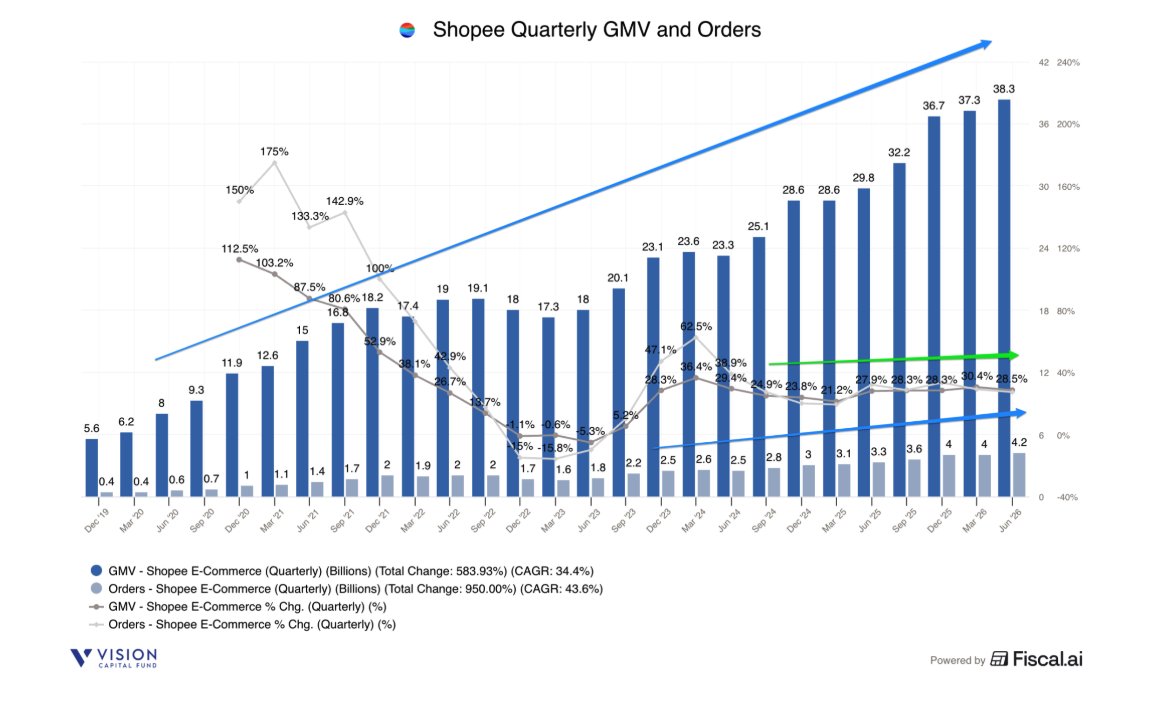

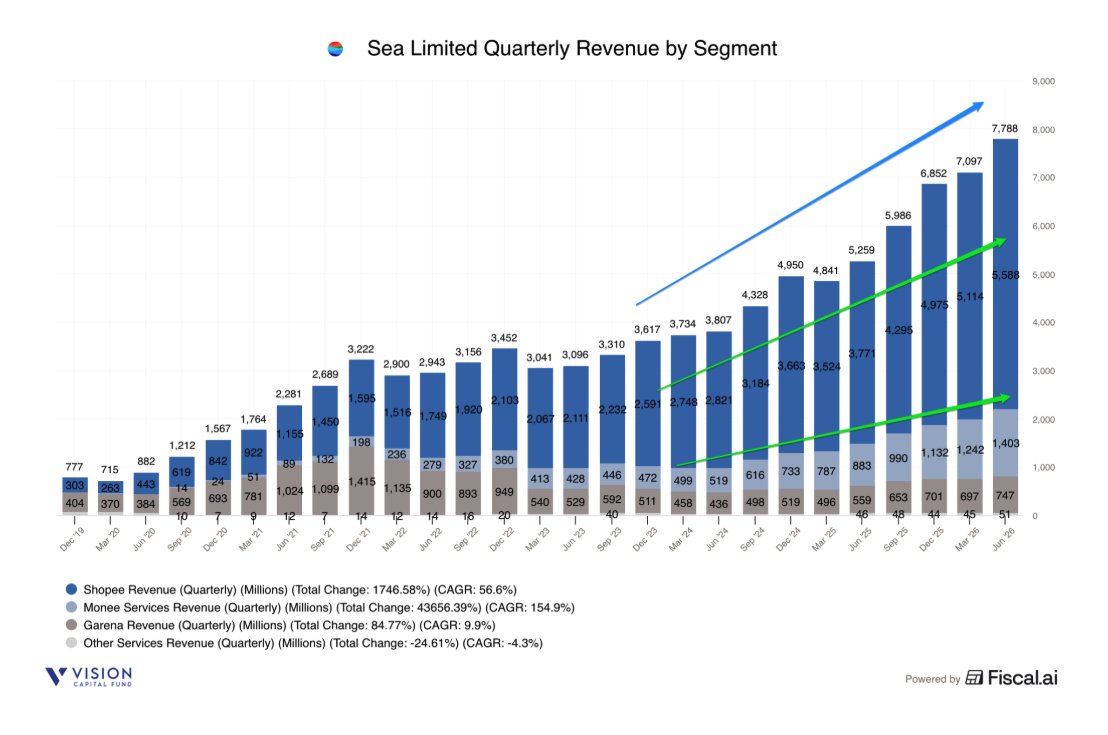


![EugeneNg's tweet photo. The Trade Desk $TTD 1Q25 Earnings
- Rev $616m +25% ↗️🟢
- Adj EBITDA $208m +29% ↗️🟢 margin 34% +82 bps ✅
- EBIT $54m +90% ⤴️🟢 margin 9% +301 bps ✅
- NG Net Inc $165m +26% ↗️🟢 margin 27% +14 bps ✅
- Net Inc $51m +60% ↗️🟢 margin 8% +178 bps ✅
- OCF $291m +57% ↗️🟢 margin 47% +955 bps ✅
- FCF $230m +30% ↗️🟢 margin 37% +140 bps ✅
2Q25 Mgmt Guide
- Rev $682m +17% ↗️🟢
- Adj EBITDA $259m
Biz Metrics (% share)
- Customer retention >95% (past 11Y) ✅
- CTV (47.5%)
- Mobile (35%)
- Display (12.5%)
- Audio (5%)
- NA 88% spend
- International 12% (growing faster)
1 | Strong quarter, uptake in Kokai adoption and upgrades
I would say we're really proud of what we delivered in Q1. It was such a strong quarter for us -- and I would attribute the strength to the uptake in Kokai adoption and the early momentum from the upgrades that we talked about earlier in the year related to our business that we made in I wouldn't say that the Q4 to Q1 sequential strength was driven by political simply because we exited presidential cycle in the U.S., entered 2025 when we're not in an off-cycle and don't have much contribution.
2 | Recovered from 4Q24 miss with strong growth, seeing encouraging signs that changes made were the right ones
As many of you know, in Q4, we experienced a setback as we undertook the most significant company upgrade in our 16-year history. I won't revisit the details today, but as company scale and complexity increases, changes and upgrades become necessary to unlock the next wave of growth. That's exactly what we did.
And now we are beginning to see encouraging signs that the changes we made were the right ones. As you've seen from the press release, despite increasing economic uncertainty, we showed incredible resilience, growing revenue 25% YoY, far surpassing our own expectations. We continue to grow at a rate significantly higher than the broad digital marketing industry and gain market share.
3 | Strong progress on Kokai, adoption ahead of schedule, ⅔ clients using it, bulk of ad spend now on Kokai
Let's talk now about our progress on Kokai. The core of Kokai has been delivered and adoption is now ahead of schedule. Around 2/3 of our clients are now using it and the bulk of the spend in our platform is now running through Kokai. We expect all clients to be using it by the end of the year. One thing about Kokai that I would like to underline whenever we go through a platform overhaul like this, and this is the biggest in our history, we are always trying to balance giving clients exactly what they want versus pushing the industry forward.
4 | Despite all features of Kokai fully launched, will will continue to iterate and ship product weekly, still got a few major pieces to ship
Kokai is perhaps our biggest engineering achievement yet, and it is helping clients get the full value of the open Internet and manage the complexity of the open Internet at the same time. Even as all of the features of Kokai are fully launched. We will continue to iterate and ship product every week. As I said, Kokai adoption now represents the majority of our spend, almost 2/3, a signi cant acceleration from where we ended 2024, and clients are seeing major campaign improvements as a result
Of course, we also have to talk about our focus on upgrading our product across the Board. There's still a lot of exciting things coming out of Kokai. It seems that we continue to upgrade -- so there are a few major pieces left that we expect to ship in the very near future.
5 | Will introduce a new approach for understanding and managing performance, and will continue to improve the polish, the navigation and the usability of Kokai
We will introduce the final major components of Kokai, including a revolutionary new approach for understanding and managing the performance of deals. One of the most important things we do to realize the value of programmatic. We will also continue to improve the polish, the navigation and the usability. But to be clear, Kokai has already proven itself and the results are fantastic. The injection of our industry-leading CoA AI tools across every aspect of our platform has been a game changer, and we are just getting started.
6 | Kokai deliver lower cost per conversion and acquisitions
Kokai campaign performance on Kokai continues to be exceptional. Kokai's delivering on lower funnel KPIs, including 24% lower cost per conversion and 20% lower cost per acquisition, and these improvements are helping unlock performance and performance budgets from existing clients, but also from new clients that are a bit more focused on the performance side of things.
7 | Overhauled the product process, business and product now more in sync, simplified GTM, seeing green shoots with strong JVP pipelines
Lastly, I mentioned in our last call that we've made significant upgrades across the company. In engineering, we now have over 100 scrums all shipping product every week. We've overhauled the product process. And as a result, business and product and engineering are more in sync than they've been in years. We simplified our go-to-market teams and their org structures. While it is still early, we are already seeing green shoots. Our JVP pipeline and the number of JVPs in active contract negotiations are at all-time highs.
8 | Continue to focus on growing JVPs, now 40% of spend under JVPs, which is growing faster
There's still more to come on that but the trend line is awesome, and it's good enough to validate that we've made the right choices. Also validating in that same way is our strong JVP pipeline. As we've highlighted before, over 40% of our spend is now under JVPs. And then you can think of JVPs as partnerships with long-term commitments and vision for what we'll do together. And that continues to grow 50% faster than overall spend. So when we put those together, our business grows faster. And so naturally, we're focused on more of those.
9 | Continue to grow faster and gain market share versus the industry
We continue to grow at a rate significantly higher than the broad digital marketing industry and gain market share. As you know, we have a long history of setting goals and hitting them. We're happy to report that we did it again. We also have a long history of growing faster than all of the other scaled players in our industry, and we did that again, too.
10 | Google’s challenges will focus them to focus on their core business, and be less focused on the open internet, allowing TTD who was won in a unfair market, to do better in a fairer market
think the news yesterday about Apple's decision to focus more on the AI search engines rather than Google as a result of the remedy of that rst trial is as signi cant as anything. And it tells you what's to come, which is Google has got to focus on its core business. And as they focus on the core business, which is largely about search, and that includes Gemini and also YouTube, that means they are going to be less focused on the open Internet.
And that means for us that we can go participate in the open Internet with less competition, but even more signi cant than less competition is the fact that Google has been disrupting the competitive market that we would have thrived even more. So I stand by what I said, again, again, including in the prepared remarks that we were winning in an unfair market and the market is getting fair already.
11 | Q1 saw intensifiying pressure with growing concerns amongst clients
First, the macro environment. As I mentioned before, Q4 was relatively stable, though signs of volatility we're building beneath the surface have made a contentious election cycle. That pressure intensified in Q1 with growing concern among clients. As you know, our primary clients are the largest brands in the world and the agencies that serve them. All of whom are navigating increasing volatility so far in 2025.
12 | Acquired Sincera, a metadata company that crawls internet to give clients more data and signal to improve ad performance, plan to offer Open Sincera
Another massive upgrade we have made to improve the supply chain was the acquisition of Sincera. Most outside of ad tech don't know the company. So for the uninitiated, Sincera is a metadata company that crawls the Internet looking for insights about the supply chain of advertising, and seeks to shine a light of transparency on that supply chain. Following the acquisition, we have been working to invest Sincera data across Kokai, so our clients can have as much data and signal as possible about ad performance.
But it doesn't stop there. In the coming months, we plan to relaunch their product for the ad tech community and offer a new version of Sincera called Open Sincera. This product will be free to advertisers, to agencies, to ad tech companies, to sellers and to publishers who want to better understand the supply chain and how to make it more efficient.
13 | Vivek Kundra joins as COO from EVP, Salesforce
We've hired a new COO, Vivid Kandra. He joined the company as our new Chief Operating O cer. So that may be a well-known name to many of you as he was the first ever Chief Information O cer for the United States Federal Government back in 2009. But perhaps most relevant to us, he spent several years at Salesforce and is a key driver of growth at a time when they were pretty much the same size and scale as we are now. These kind of appointments will help us achieve our very own high-growth expectations in the years ahead.
14 | TTD is pointed to the entire open Internet and think nearly all global advertising will be transacted programmatically at end state, best positioned to win lion share
The Trade Desk is pointed at the entire open Internet, and nearly all of global advertising will be transacted programmatically at end state. We are convinced that based on the current landscape and current competitive set, we are the best positioned to win the lion's share of market share at end state. We simply need to execute between here and there.
15 | Significant shifts in Google, Apple, Meta that is making the market more competitive and more fair
But so far this year, there have been some massive shifts that have significantly upgraded the prospects of the open Internet and the Trade Desk. Here are a few of them. First, Google has been declared an illegal monopoly in two separate instances in 2025 by the U.S. courts. Of course, the same has happened in various government cases all over the world.
Fourth, Google announced that it is not going to eradicate cookies from its market-leading Chrome browser. So naturally, you may ask, what do all these changes mean for -- the Trade Desk and the open Internet. First, we've been winning share in the DSP race year after year and quarter after quarter. And we've done that in an unfair market. We think the signal that comes from all of these ships is that one that points to a more fair and more competitive market, which is what we built our business for. Our model is designed to compete. As we've said before, if we can win share in an unfair market against the biggest tech players in the world, as we have over the last 15 years, imagine what we can do in a fair market
16 | Google DV360, Amazon DSP will continue to focus on their own properties
Doing so will significantly improve competition, transparency and fairness in the ad market for all participants. I continue to believe that Google will stop trying to monetize the open Internet and instead focus more on their destinations. I expect that Amazon will continue on the same path. DV360 is primarily technology to buy YouTube. Amazon's DSP is primarily a product built to buy Amazon's Prime video
17 | TTD can be agile, adjust quickly because its more data driven
Programmatic advertising is extremely agile. Because our technology buys one impression at a time and evaluates every single impression, we can adjust quickly. We also can be more data-driven than the other forms of advertising.
18 | CTV currently having more supply than demand, and is a buyers market, consumers will see fewer but more relevant ads, and will perform better
Because of the pressure on consumers over the last 2 quarters, CTV and streamers have invested more into advertising. We're seeing more supply than demand in all forms of advertising, but that is especially important in CTV. In general, this dynamic makes for more of a buyer's market, but additionally, this is having a great impact on market dynamics. As a result, in general, CTV companies are once again leading the supply dynamics of the open Internet. They are plugging directly into our demand. They are also describing their supply in greater detail than ever. Nearly every scaled player has adopted UID2 and those that have not are under monetizing their inventory. We expect that the market dynamics are going to create the best ad-funded television experience for consumers in the history of television. They will see fewer ads. They will be personally relevant and these fewer ads will make more money for content owners than linear and broadcast ever did, and they will perform better for advertisers per dollar than spray and pray ever did.
19 | NY Post and VIZIO seeing strong gains from using OpenPath
With OpenPath, they were able to increase their fill rates by 4x and improved programmatic revenue by 79%, all because they are able to provide advertisers, our clients with clear visibility into what they're buying. [indiscernible] dozens more examples -- the New York Post saw its digital advertising fill rate increase more than 8x and programmatic revenue increased 97% with Openpath. In the world of CTV, VIZIO sats programmatic revenue increased 39% and another major network saw their ll rate increase 7x, leading to a revenue increase of over 25%.
20 | Continue to see strength of underlying business
That said, we are encouraged by the strength of our underlying business, driven by continued progress on Kokai is our enhancements to our engineering and go-to-market teams and a growing pipeline of joint business plans. We remain confident in the fundamental drivers of our revenue growth, especially given our track record of gaining market share during periods of economic volatility. Assuming the macro environment remains stable, and we do not see deterioration in economic conditions
➡️ Final Thoughts on The Trade Desk $TTD
Jeff Green and his team proved their mantle and worked hard to deliver the strong growth in 1Q25 after the poor execution in 4Q24. TTD continues to execute and be open to take in feedback and continue to reiterate on Kokai and keep improving on it and drive growing customer adoption. The continued shipping of product updates is testament. The acquisition of Sincera is highly strategic to improve ad performance that is a space to watch. The alignment of business and product is much needed and is showing back green shoots in the rebound. Continue to have confidence in Jeff and his management to bring it to greater heights.](https://pbs.twimg.com/media/GqfjUhHbcAIyEZI.jpg)
![EugeneNg's tweet photo. The Trade Desk $TTD 1Q25 Earnings
- Rev $616m +25% ↗️🟢
- Adj EBITDA $208m +29% ↗️🟢 margin 34% +82 bps ✅
- EBIT $54m +90% ⤴️🟢 margin 9% +301 bps ✅
- NG Net Inc $165m +26% ↗️🟢 margin 27% +14 bps ✅
- Net Inc $51m +60% ↗️🟢 margin 8% +178 bps ✅
- OCF $291m +57% ↗️🟢 margin 47% +955 bps ✅
- FCF $230m +30% ↗️🟢 margin 37% +140 bps ✅
2Q25 Mgmt Guide
- Rev $682m +17% ↗️🟢
- Adj EBITDA $259m
Biz Metrics (% share)
- Customer retention >95% (past 11Y) ✅
- CTV (47.5%)
- Mobile (35%)
- Display (12.5%)
- Audio (5%)
- NA 88% spend
- International 12% (growing faster)
1 | Strong quarter, uptake in Kokai adoption and upgrades
I would say we're really proud of what we delivered in Q1. It was such a strong quarter for us -- and I would attribute the strength to the uptake in Kokai adoption and the early momentum from the upgrades that we talked about earlier in the year related to our business that we made in I wouldn't say that the Q4 to Q1 sequential strength was driven by political simply because we exited presidential cycle in the U.S., entered 2025 when we're not in an off-cycle and don't have much contribution.
2 | Recovered from 4Q24 miss with strong growth, seeing encouraging signs that changes made were the right ones
As many of you know, in Q4, we experienced a setback as we undertook the most significant company upgrade in our 16-year history. I won't revisit the details today, but as company scale and complexity increases, changes and upgrades become necessary to unlock the next wave of growth. That's exactly what we did.
And now we are beginning to see encouraging signs that the changes we made were the right ones. As you've seen from the press release, despite increasing economic uncertainty, we showed incredible resilience, growing revenue 25% YoY, far surpassing our own expectations. We continue to grow at a rate significantly higher than the broad digital marketing industry and gain market share.
3 | Strong progress on Kokai, adoption ahead of schedule, ⅔ clients using it, bulk of ad spend now on Kokai
Let's talk now about our progress on Kokai. The core of Kokai has been delivered and adoption is now ahead of schedule. Around 2/3 of our clients are now using it and the bulk of the spend in our platform is now running through Kokai. We expect all clients to be using it by the end of the year. One thing about Kokai that I would like to underline whenever we go through a platform overhaul like this, and this is the biggest in our history, we are always trying to balance giving clients exactly what they want versus pushing the industry forward.
4 | Despite all features of Kokai fully launched, will will continue to iterate and ship product weekly, still got a few major pieces to ship
Kokai is perhaps our biggest engineering achievement yet, and it is helping clients get the full value of the open Internet and manage the complexity of the open Internet at the same time. Even as all of the features of Kokai are fully launched. We will continue to iterate and ship product every week. As I said, Kokai adoption now represents the majority of our spend, almost 2/3, a signi cant acceleration from where we ended 2024, and clients are seeing major campaign improvements as a result
Of course, we also have to talk about our focus on upgrading our product across the Board. There's still a lot of exciting things coming out of Kokai. It seems that we continue to upgrade -- so there are a few major pieces left that we expect to ship in the very near future.
5 | Will introduce a new approach for understanding and managing performance, and will continue to improve the polish, the navigation and the usability of Kokai
We will introduce the final major components of Kokai, including a revolutionary new approach for understanding and managing the performance of deals. One of the most important things we do to realize the value of programmatic. We will also continue to improve the polish, the navigation and the usability. But to be clear, Kokai has already proven itself and the results are fantastic. The injection of our industry-leading CoA AI tools across every aspect of our platform has been a game changer, and we are just getting started.
6 | Kokai deliver lower cost per conversion and acquisitions
Kokai campaign performance on Kokai continues to be exceptional. Kokai's delivering on lower funnel KPIs, including 24% lower cost per conversion and 20% lower cost per acquisition, and these improvements are helping unlock performance and performance budgets from existing clients, but also from new clients that are a bit more focused on the performance side of things.
7 | Overhauled the product process, business and product now more in sync, simplified GTM, seeing green shoots with strong JVP pipelines
Lastly, I mentioned in our last call that we've made significant upgrades across the company. In engineering, we now have over 100 scrums all shipping product every week. We've overhauled the product process. And as a result, business and product and engineering are more in sync than they've been in years. We simplified our go-to-market teams and their org structures. While it is still early, we are already seeing green shoots. Our JVP pipeline and the number of JVPs in active contract negotiations are at all-time highs.
8 | Continue to focus on growing JVPs, now 40% of spend under JVPs, which is growing faster
There's still more to come on that but the trend line is awesome, and it's good enough to validate that we've made the right choices. Also validating in that same way is our strong JVP pipeline. As we've highlighted before, over 40% of our spend is now under JVPs. And then you can think of JVPs as partnerships with long-term commitments and vision for what we'll do together. And that continues to grow 50% faster than overall spend. So when we put those together, our business grows faster. And so naturally, we're focused on more of those.
9 | Continue to grow faster and gain market share versus the industry
We continue to grow at a rate significantly higher than the broad digital marketing industry and gain market share. As you know, we have a long history of setting goals and hitting them. We're happy to report that we did it again. We also have a long history of growing faster than all of the other scaled players in our industry, and we did that again, too.
10 | Google’s challenges will focus them to focus on their core business, and be less focused on the open internet, allowing TTD who was won in a unfair market, to do better in a fairer market
think the news yesterday about Apple's decision to focus more on the AI search engines rather than Google as a result of the remedy of that rst trial is as signi cant as anything. And it tells you what's to come, which is Google has got to focus on its core business. And as they focus on the core business, which is largely about search, and that includes Gemini and also YouTube, that means they are going to be less focused on the open Internet.
And that means for us that we can go participate in the open Internet with less competition, but even more signi cant than less competition is the fact that Google has been disrupting the competitive market that we would have thrived even more. So I stand by what I said, again, again, including in the prepared remarks that we were winning in an unfair market and the market is getting fair already.
11 | Q1 saw intensifiying pressure with growing concerns amongst clients
First, the macro environment. As I mentioned before, Q4 was relatively stable, though signs of volatility we're building beneath the surface have made a contentious election cycle. That pressure intensified in Q1 with growing concern among clients. As you know, our primary clients are the largest brands in the world and the agencies that serve them. All of whom are navigating increasing volatility so far in 2025.
12 | Acquired Sincera, a metadata company that crawls internet to give clients more data and signal to improve ad performance, plan to offer Open Sincera
Another massive upgrade we have made to improve the supply chain was the acquisition of Sincera. Most outside of ad tech don't know the company. So for the uninitiated, Sincera is a metadata company that crawls the Internet looking for insights about the supply chain of advertising, and seeks to shine a light of transparency on that supply chain. Following the acquisition, we have been working to invest Sincera data across Kokai, so our clients can have as much data and signal as possible about ad performance.
But it doesn't stop there. In the coming months, we plan to relaunch their product for the ad tech community and offer a new version of Sincera called Open Sincera. This product will be free to advertisers, to agencies, to ad tech companies, to sellers and to publishers who want to better understand the supply chain and how to make it more efficient.
13 | Vivek Kundra joins as COO from EVP, Salesforce
We've hired a new COO, Vivid Kandra. He joined the company as our new Chief Operating O cer. So that may be a well-known name to many of you as he was the first ever Chief Information O cer for the United States Federal Government back in 2009. But perhaps most relevant to us, he spent several years at Salesforce and is a key driver of growth at a time when they were pretty much the same size and scale as we are now. These kind of appointments will help us achieve our very own high-growth expectations in the years ahead.
14 | TTD is pointed to the entire open Internet and think nearly all global advertising will be transacted programmatically at end state, best positioned to win lion share
The Trade Desk is pointed at the entire open Internet, and nearly all of global advertising will be transacted programmatically at end state. We are convinced that based on the current landscape and current competitive set, we are the best positioned to win the lion's share of market share at end state. We simply need to execute between here and there.
15 | Significant shifts in Google, Apple, Meta that is making the market more competitive and more fair
But so far this year, there have been some massive shifts that have significantly upgraded the prospects of the open Internet and the Trade Desk. Here are a few of them. First, Google has been declared an illegal monopoly in two separate instances in 2025 by the U.S. courts. Of course, the same has happened in various government cases all over the world.
Fourth, Google announced that it is not going to eradicate cookies from its market-leading Chrome browser. So naturally, you may ask, what do all these changes mean for -- the Trade Desk and the open Internet. First, we've been winning share in the DSP race year after year and quarter after quarter. And we've done that in an unfair market. We think the signal that comes from all of these ships is that one that points to a more fair and more competitive market, which is what we built our business for. Our model is designed to compete. As we've said before, if we can win share in an unfair market against the biggest tech players in the world, as we have over the last 15 years, imagine what we can do in a fair market
16 | Google DV360, Amazon DSP will continue to focus on their own properties
Doing so will significantly improve competition, transparency and fairness in the ad market for all participants. I continue to believe that Google will stop trying to monetize the open Internet and instead focus more on their destinations. I expect that Amazon will continue on the same path. DV360 is primarily technology to buy YouTube. Amazon's DSP is primarily a product built to buy Amazon's Prime video
17 | TTD can be agile, adjust quickly because its more data driven
Programmatic advertising is extremely agile. Because our technology buys one impression at a time and evaluates every single impression, we can adjust quickly. We also can be more data-driven than the other forms of advertising.
18 | CTV currently having more supply than demand, and is a buyers market, consumers will see fewer but more relevant ads, and will perform better
Because of the pressure on consumers over the last 2 quarters, CTV and streamers have invested more into advertising. We're seeing more supply than demand in all forms of advertising, but that is especially important in CTV. In general, this dynamic makes for more of a buyer's market, but additionally, this is having a great impact on market dynamics. As a result, in general, CTV companies are once again leading the supply dynamics of the open Internet. They are plugging directly into our demand. They are also describing their supply in greater detail than ever. Nearly every scaled player has adopted UID2 and those that have not are under monetizing their inventory. We expect that the market dynamics are going to create the best ad-funded television experience for consumers in the history of television. They will see fewer ads. They will be personally relevant and these fewer ads will make more money for content owners than linear and broadcast ever did, and they will perform better for advertisers per dollar than spray and pray ever did.
19 | NY Post and VIZIO seeing strong gains from using OpenPath
With OpenPath, they were able to increase their fill rates by 4x and improved programmatic revenue by 79%, all because they are able to provide advertisers, our clients with clear visibility into what they're buying. [indiscernible] dozens more examples -- the New York Post saw its digital advertising fill rate increase more than 8x and programmatic revenue increased 97% with Openpath. In the world of CTV, VIZIO sats programmatic revenue increased 39% and another major network saw their ll rate increase 7x, leading to a revenue increase of over 25%.
20 | Continue to see strength of underlying business
That said, we are encouraged by the strength of our underlying business, driven by continued progress on Kokai is our enhancements to our engineering and go-to-market teams and a growing pipeline of joint business plans. We remain confident in the fundamental drivers of our revenue growth, especially given our track record of gaining market share during periods of economic volatility. Assuming the macro environment remains stable, and we do not see deterioration in economic conditions
➡️ Final Thoughts on The Trade Desk $TTD
Jeff Green and his team proved their mantle and worked hard to deliver the strong growth in 1Q25 after the poor execution in 4Q24. TTD continues to execute and be open to take in feedback and continue to reiterate on Kokai and keep improving on it and drive growing customer adoption. The continued shipping of product updates is testament. The acquisition of Sincera is highly strategic to improve ad performance that is a space to watch. The alignment of business and product is much needed and is showing back green shoots in the rebound. Continue to have confidence in Jeff and his management to bring it to greater heights.](https://pbs.twimg.com/media/GqfjT4lbcAE1P3T.jpg)


![EugeneNg's tweet photo. The Trade Desk $TTD 4Q24 Earnings
- Rev $741m +22% ↗️🟢
- Adj EBITDA $350m +23% ↗️🟢 margin 47% +40 bps ✅
- EBIT $195m +35% ↗️🟢 margin 26% +251 bps ✅
- NG Net Inc $297m +43% ↗️🟢 margin 40% +590 bps ✅
- Net Inc $182m +87% ⤴️🟢 margin 25% +853 bps ✅
- OCF $199m +119% ⤴️🟢 margin 27% +1187 bps ✅
- FCF $179m +172% ⤴️🟢 margin 24% +1330 bps ✅
The Trade Desk $TTD FY24 Earnings
- Rev $2.4b +26% ↗️🟢
- Adj EBITDA $1.0b +31% ↗️🟢 margin 41% +169 bps ✅
- EBIT $427m +113% ⤴️🟢 margin 17% +717 bps ✅
- NG Net Inc $832m +33% ↗️🟢 margin 34% +177 bps ✅
- Net Inc $393m +120% ⤴️🟢 margin 16% +688 bps ✅
- OCF $739m +24% ↗️🟢 margin 30% -50 bps ↘️🔴
- FCF $641m +16% ↗️🟢 margin 26% -211 bps ↘️🔴
- Gross spend $12b +25% ↗️🟢
- Take-rate 20.3%+6bps ↗️🟢
TTD Annual Gross Spend
Biz Metrics (% share)
- Customer retention >95% (past 11Y) ✅
- CTV (High 40%)
- Mobile (Mid 30%)
- Display (Low double digit)
- Audio (5%)
- NA 88% spend
- International 12% (growing faster)
1Q25 Mgmt Guide
- Rev $575m +17% ↗️🟡 (weak)
- Adj EBITDA $145m ↘️🟡 (lower)
1 | CTV was strong and performance in majority of verticals
CTV growth across international regions was particularly strong during the fourth quarter and throughout 2024. In terms of verticals that represent at least 1% of our spend, growth was broadbased again this quarter. We saw strong performance in the majority of our verticals, particularly in automotive, shopping and technology and computing. Political spending was also strong in Q4 as expected. Home & Garden and pets were both below average. We continue to believe there is significant opportunity for us to gain share in all of the verticals we serve.
2 | But for the first time (excl. COVID) results came in below expectations
- 4Q24 Rev $741m +22% lower vs guide $756m +25%
- 4Q24 Adj EBITDA $350m +23% lower vs guide $363m
However, for the first time in our 8.5 years as a public company, excluding the rst quarter of 2020, our results came in below our expectations. As a company, we take great pride in our ability to forecast accurately, and we take full ownership of the shortfall. Importantly, this miss was not due to a lack of opportunity or increased competition. It was on us.
3 | Weak EBITDA is to be expected in 1Q25, expect it to improve through 2025
with regard to your question about Q1 EBITDA, I did mention in the script that we do anticipate a modest increase in the [indiscernible] of our operating expenses in 2025 and that we'd see some deleverage for the year. I wouldn't recommend thinking about it linearly. Typically, in our business, EBITDA improves as the year progresses, which is just driven by our investment choices and seasonality in business.
4 | Jeff Green owned up to it and took full responsibility
I want to acknowledge upfront that for the first time in 33 quarters as a public company, we fell short of our own expectations. During COVID, we revised our expectations once along with the rest of the markets, but for the rst time in 8 years, we missed the expectations we set, and it was our fault.
5 | Caused by a series of small execution missteps and turned over the ball too many times
Starting off, let me explain it as I see it. What falling short of our own expectations does not represent. This didn't happen because the opportunity isn't as big as we thought. In this case, it isn't because of our competition either. For Q4, the reality is that we stumbled due to a series of small execution missteps, while simultaneously preparing for the future.
If this were a sporting event, we'd still have a championship caliber team. But in this particular game, we turned over the ball too many times.
6 | Brightest days remain ahead of them
I want you to know that we take this moment seriously, and we want to assure our investors, partners and customers that their trust is well placed and deserved. Our brightest days are still ahead of us. But before I talk about that, I want to spend a few minutes sharing what we got wrong and the changes we are making to meet this moment and maximize our unique and growing opportunity.
7 | Market remains larger and faster growing, but TTD needs to recalibrate to unlock new growth and a stronger future
That said, we see a larger and faster-growing market than we originally expected which is why we have been making changes and will continue to do so. Simply put, as you've seen before, as companies grow and become increasingly complex, they need recalibration to unlock new opportunities. We are recalibrating our larger company for an even stronger future.
8 | Did 4 major changes - (1) reorganization with clear roles, responsibilities and reporting structure, (2) stronger emphasis on internal effectiveness and scalability, (3) focus more on brands, (4) revamped product development to smaller agile teams
In that effort, I want to highlight 4 major changes we've made at The Trade Desk in the last few months and some related initiatives that accompany them. First, we did the largest reorganization in company history in December. While we often make structural changes at the end of the year to improve our business, this was bigger than usual. For most people in the company, we provided a much clearer view of their roles and responsibilities and for most, that also meant a change in reporting structure. Additionally, we streamlined client-facing teams, reducing complexity and clarifying responsibilities, some team focus on brands, while others focus on agencies.
The second, beyond structural improvements, we placed a stronger emphasis on internal effectiveness and scalability. Over the past 2 months, leadership has spent more time discussing operational improvements than at any other point in our history. While we've historically been focused on external opportunities, we understand that this moment requires us to scale our internal operations and continue hiring senior talent to support long-term growth. These changes position us to execute at a higher level and capitalize on the expanding market opportunities ahead.
Third, we have increased our resource allocation on brands. A broader shift is occurring in the industry. Advertisers are becoming more strategic and data-driven in their media buying decisions, and that's great for us. While this shift has caused short-term fluctuations, it's ultimately aligned with our long-term strength. We recognize that advertising will ebb and flow.
Fourth, we revamped our product development process, shifting back to smaller agile teams that release updates weekly instead of drifting towards waterfall methods, which are less conducive to our fast-paced and changing industry. Our engineering team is now divided into nearly 100 scrum teams with a system to more easily ship and collaborate with the business team on what has shipped and what will ship and when.I expect this to continue to accelerate Kokai enhancements and complete the transition of 100% of our clients from Solimar to Kokai during this calendar year.
9| Sincera acquisition will improve the supply chain of the Open Internet
Secondly, we announced in January the acquisition of Sincera. Sincera is a metadata company that is dedicated to improving the supply chain of the open Internet. Joining Sincera's work with ours will accelerate a cleaner supply chain for the open Internet and accelerate the work of OpenPath, which is one of our biggest efficiency efforts, both internally and externally. A better supply chain will free up resources internally and improve the ecosystem.
10 | Doing 15 big things to benefit from secular activities
(1) Focusing on scale
First, we're focused on scale. More accurately, we're obsessing about scale. We control $12 billion of ad spend in an approximately $1 trillion advertising industry. With every success we have and with every efficiency we find, operationally and technologically, we follow it with a question, how can we make that scale quickly? While our share is growing faster than perhaps any scaled competitor, our opportunity is growing too. We can accelerate growth when we sufficiently orient around scale.
(2) Preparing as Google exits the Open Internet and focus more on Google owned and operated properties (e.g. YouTube)
Second thing, we are preparing for a world where Google exits the open Internet. I'm confident that one way or another, Google will exit the open Internet. I think they should. Most of their antitrust and regulatory problems come from the draconian ways they have engaged with the open Internet in the past. In April of 2024, Facebook shut down their news program thereby distancing itself further from one of the most important pillars of the open Internet. Some evidence suggests the substantial majority of spend going through DV360, Google's DSP, and is routed to the Google owned and operated platform of YouTube. Regardless of what happens with the pending trial decision, Google will likely distance itself from the open Internet. If and when Google exits the open Internet, they will leave a big hole and a big opportunity for the rest of us. Relatedly, let's move to number 3.
(3) Focus and protect independent objectivity, independent DSPs should get lion share
Third, we will promote and protect our objectivity more than ever. More and more, the only competitors we encounter today have the worst objectivity problems. Amazon is asking advertisers big and small, for their advertising budgets. Meanwhile, Amazon competes with most of the Fortune 500 companies in some way, whether we're talking about Microsoft in cloud or PNG and CPG products or UPS or Nike or all the rest, in our very first business plan 15 years ago, we argued that the objective independent DSP should get the lion's share of the marketplace. They'd be the only company that can be trusted. We have a mantra that we've repeated again and again internally for years, and it's this. Every day that goes by, objectivity matters more and more.
(4) Leverage supply and demand imbalance - supply will always exceed demand, buyer’s market, focusing exclusively on buy side DSP helps
The fourth thing we'll do, leverage the supply and demand imbalance to make the ecosystem better. In advertising, there is more supply than demand. There always has been and there always will be. This, by definition, makes it a buyer's market. By focusing exclusively on the buy side, we are in the strongest position in the market. Unlike so many players attack, we are not using our position of strength to become draconian we are trying to use our ever-growing influence and impact on the industry to make it better and to improve the supply chain. This is why we expect 2025 to be the year OpenPath enters the steep acceleration phase of its S-curve growth.
(5) Make CTV the most effective channel, and programmatic advertising
The fth action we'll take make CTV the most effective channel and programmatic advertising by layering more data, better auction mechanics and capitalizing on the fact that CTV is the only channel that has nearly 100% of traffic logged in. CTV is the kingpin of the open Internet. CTV should be the first place all brand advertiser spend, not walled gardens. If we expand Sincera's charter and capabilities to CTV and audio, CTV and premium video can reach its potential as a channel. It can be half the pie of the advertising TAM. So many companies like Disney, Netflix, Paramount, MAX, Fox and Peacock need to get the best out of programmatic advertising in order to maximize their opportunity.
(6) Bring programmatic advertising to streaming audio
The sixth thing we'll do, make 2025 the best year audio has seen yet. I maintain that audio is still the most on-sale corner of the open Internet. Companies like Spotify have been making changes to embrace the potential of programmatic advertising. They're making changes and we're using AI partnerships to bridge the creative creation gap. I think this is one of the biggest opportunities in programmatic and one of the biggest opportunities for a company like Spotify to take their company to the next level.
(7) Move all clients from Solimar to Kokai, which is so much better
The seventh action item will move 100% of our clients to Kokai this year. Now the majority already have. But today, we're maintaining 2 systems, Solimar and Kokai. This slows us down. Kokai is more effective in almost every way. We are producing case study after case study as clients continue to lean into the features of our Kokai platform. Every one of them showing the enhancements and effectiveness that goes up with the use of Kokai. As you know, Kokai represents our largest and most important platform overhaul ever. Some clients are still transitioning from our previous platform, Solimar, but well before the end of this year, I expect that all of our clients will be using Kokai exclusively. In all of the case studies coming out of Kokai, the consistent theme is accessing and acting on better data and signal.
(8) Help advertisers and agencies avoid bad deals with AI-powered forecasting
Eight, we will change the way the industry manages deals. We'll help advertisers and agencies avoid bad deals, which generally consider too few ad impressions and force advertisers to buy impressions that they wouldn't otherwise want, and we can avoid these bad deals by using AI-powered forecasting. To do this, we are enhancing Kokai with some of the most game-changing parts, like Deal Manager, which lays groundwork for the forward market, which we think in the future will change the ecosystem and eventually upgrade the upfronts.
(9) Continue to invest in AI and drive results
Ninth, we will continue to invest in AI with provable upgrades and auditable results. We started our ML and AI e orts in 2017 with the launch of Koa, but today, the opportunities are much bigger. We're asking every scrum inside of our company to look for opportunities to inject AI into our platform. Hundreds of enhancements recently shipped and coming in 2025 would not be possible without AI. We must keep the pedal to the metal, not to chest them on stages, which everyone else seems to be doing, but instead to produce results and win share.
(10) Simplify their retail offering
Tenth, we will simplify our retail offering in 2025. So far, it's been powerful and a significant driver of our growth, but it has often been too complicated. We've studied what works and understand the changes needed to help retail media continue to meaningfully outpace our business. Achieving this will require a closer collaboration with our retail partners.
In Kokai, we have the industry's richest retail data environment, including data for many of the world's leading retailers to help advertisers understand the connection between campaign spend and consumer action. We will make this easier to adopt for our clients, both endemic and non-endemic to our retail partners.
(11) Maintain simplicity (not complexity) while adding more new features
Number 11, we will simplify our platform. As platforms mature, they add features, but that can make it more complex. We will continue to add features and powerful controls for the most sophisticated buyers in the world. However, we're finding ways to improve the experience and make decisions easier and also more intuitive for our users.
(12) Will use more data to drive data-driven ad buying
Twelfth, we'll use more data. We have another mantra. Data-driven buying is better than guessing. Across all parts of our platform, we're using AI to help clients make better decisions, whether it is in making sense of complex data in real time when it may have previously taken weeks or bringing retail conversion data to bear more often and enriching bid requests.
(13) Focus more on JBPs
Thirteenth, as I said at the beginning, we will focus on joint business partnerships or JBPs. JBPs are joint innovation partnerships where agencies and brands collaborate with us to grow our relationship and drive programmatic innovation. They grow about 50% faster than the rest of our business.
(14) Ensuring agile product development
Number 14, on our action item list. We have already revised and will continue to revise our product process. As we grow, it is essential that our product development process remains agile. Even as it has to ingest more inputs for more stakeholders. We'll do this with a clear focus on what we're delivering week by week, which continues to be at the bleeding edge of adtech innovation.
(15) Hire senior leadership to take TTD to the next level
And then lastly, number 15, we'll hire senior leadership to take us to the next level. I believe that over the next few years, we will double the number of senior leaders in the company at the VP level and above, especially, including some very key senior level appointments in [ my org ]. This is a natural part of a high-growth company's journey. We want to scale The Trade Desk significantly in the years ahead. and that means ensuring we have the right kind of leadership rigor across the company while preserving the best elements of what we've done so well so far.
11 | Focus on making the Open Internet better than the Walled Gardens, on the Premium Open Internet, CTV, movies, journalism, music
In my view, we have to obsess about making the open Internet better than walled gardens. Walled gardens have cheap inventory. And I think there's a lot of people that are chasing cheap even if it doesn't help them in the long term. But we have the best of the entire open Internet on our side and via our platform. Our supply chains are very different from others, especially the walled gardens.
They control their small ecosystems. But I think we have something way better going for us. If you just look at any trade media today, you'll see that brands are increasingly wary of the dangers of cheap reach. Meanwhile, we have access to all the media that people love most. CTV, movies, journalism, all of music, that's all the premium open Internet.
And while we don't control the supply chain end to end the way walled gardens do by the nature of walled gardens, I think that's a way better long term for us and for the market. because competitive markets become more efficient over time. The competition of our markets are working for us, and we're in a very strong position being on the buy side. but there's so much to do to make the supply chain more efficient and to make our company more efficient
12 | Google’s network business has been shrinking for years, TTD now competing with Google’s 27th highest priority
The network business at Google has been shrinking on shrinking for years. And to me, this is evidence of the deprioritization. Google continues to focus on Gemini and cloud and AI and search and YouTube, I think that makes sense for them to do if you look at where the money comes from. I think the network and open Internet business is way less important to them than it has ever been. So as a result, I'm confident that one way or another, Google is going to exit the open Internet.
And I've often said, we don't compete with big Google. We compete with the 27th highest priority at Google, which was once DV360. And now I believe that has been downgraded when you compete with something like the 47th highest priority at Google. But that is less and less becoming a competitor because the majority of spend that is going through DV360 seems to be routed to YouTube or at least that's what the evidence suggests.
12 | Not happy, but remain confident with steps, can resume acceleration and continue the path of strength
I am not happy with our results in the fourth quarter, but there is so much opportunity in 2025 and the years ahead to help our clients take full advantage of data-driven advertising on the premium Internet to drive growth and brand loyalty for their businesses. And that's why I'm condent that Trade Desk will eventually resume acceleration and continue the path we've been on for over 33 quarters as a publicly-traded company. We are also the clear leader in the DSP race and perhaps the leader of the open Internet.
13 | Still in early stages across the growth drivers, will continue to invest if growth continues
And when I look across our growth drivers, frankly, I believe nearly all of them are still in their early stages compared to where they will be in 5 to 10 years. So if we generate significant revenue gains, we'll continue investing.
14 | $1T TAM, and only have 1.2% of it, still have large opportunity
We have $1 trillion TAM. We currently control a little over 1% of it. We think we have 98% of the TAM left and the CTV should be fast-growing outside the United States should be growing faster than the United States for obvious reasons.
15 | Long-term trajectory remains strong
In closing, while the back half of 2024 did not end exactly as we had hoped, our long-term trajectory remains strong. I'm optimistic about 2025. We continue to lead in a rapidly growing industry, delivering pro table growth and gaining significant market share. Our momentum is fueled by a strong set of growth drivers, including ongoing secular shift to CTV, enhanced measurement through retail data, international expansion, a robust identity framework, supply chain improvements and the ability to drive long-term leverage in our model. As we look ahead, we remain confident in our ability to sustain this growth and capitalize on the opportunities before us.
➡️ Final Thoughts on The Trade Desk $TTD
In one of the rare times, TTD looks to have taken their eye off the ball and become complacent, and 4Q24 ended up not doing as well as they would have liked. Execution turned out to be poorer than expected. We appreciate that Jeff Green took full responsibility and has a detailed game plan to re-accelerate its growth path. Expect some near-term weakness (1Q-2Q25) as it rebuilds, and remain confident that he will work with his team to deliver and bring TTD back across the finishing lines many more times from here.](https://pbs.twimg.com/media/GjpC_rZaAAA2ndZ.jpg)
![EugeneNg's tweet photo. The Trade Desk $TTD 4Q24 Earnings
- Rev $741m +22% ↗️🟢
- Adj EBITDA $350m +23% ↗️🟢 margin 47% +40 bps ✅
- EBIT $195m +35% ↗️🟢 margin 26% +251 bps ✅
- NG Net Inc $297m +43% ↗️🟢 margin 40% +590 bps ✅
- Net Inc $182m +87% ⤴️🟢 margin 25% +853 bps ✅
- OCF $199m +119% ⤴️🟢 margin 27% +1187 bps ✅
- FCF $179m +172% ⤴️🟢 margin 24% +1330 bps ✅
The Trade Desk $TTD FY24 Earnings
- Rev $2.4b +26% ↗️🟢
- Adj EBITDA $1.0b +31% ↗️🟢 margin 41% +169 bps ✅
- EBIT $427m +113% ⤴️🟢 margin 17% +717 bps ✅
- NG Net Inc $832m +33% ↗️🟢 margin 34% +177 bps ✅
- Net Inc $393m +120% ⤴️🟢 margin 16% +688 bps ✅
- OCF $739m +24% ↗️🟢 margin 30% -50 bps ↘️🔴
- FCF $641m +16% ↗️🟢 margin 26% -211 bps ↘️🔴
- Gross spend $12b +25% ↗️🟢
- Take-rate 20.3%+6bps ↗️🟢
TTD Annual Gross Spend
Biz Metrics (% share)
- Customer retention >95% (past 11Y) ✅
- CTV (High 40%)
- Mobile (Mid 30%)
- Display (Low double digit)
- Audio (5%)
- NA 88% spend
- International 12% (growing faster)
1Q25 Mgmt Guide
- Rev $575m +17% ↗️🟡 (weak)
- Adj EBITDA $145m ↘️🟡 (lower)
1 | CTV was strong and performance in majority of verticals
CTV growth across international regions was particularly strong during the fourth quarter and throughout 2024. In terms of verticals that represent at least 1% of our spend, growth was broadbased again this quarter. We saw strong performance in the majority of our verticals, particularly in automotive, shopping and technology and computing. Political spending was also strong in Q4 as expected. Home & Garden and pets were both below average. We continue to believe there is significant opportunity for us to gain share in all of the verticals we serve.
2 | But for the first time (excl. COVID) results came in below expectations
- 4Q24 Rev $741m +22% lower vs guide $756m +25%
- 4Q24 Adj EBITDA $350m +23% lower vs guide $363m
However, for the first time in our 8.5 years as a public company, excluding the rst quarter of 2020, our results came in below our expectations. As a company, we take great pride in our ability to forecast accurately, and we take full ownership of the shortfall. Importantly, this miss was not due to a lack of opportunity or increased competition. It was on us.
3 | Weak EBITDA is to be expected in 1Q25, expect it to improve through 2025
with regard to your question about Q1 EBITDA, I did mention in the script that we do anticipate a modest increase in the [indiscernible] of our operating expenses in 2025 and that we'd see some deleverage for the year. I wouldn't recommend thinking about it linearly. Typically, in our business, EBITDA improves as the year progresses, which is just driven by our investment choices and seasonality in business.
4 | Jeff Green owned up to it and took full responsibility
I want to acknowledge upfront that for the first time in 33 quarters as a public company, we fell short of our own expectations. During COVID, we revised our expectations once along with the rest of the markets, but for the rst time in 8 years, we missed the expectations we set, and it was our fault.
5 | Caused by a series of small execution missteps and turned over the ball too many times
Starting off, let me explain it as I see it. What falling short of our own expectations does not represent. This didn't happen because the opportunity isn't as big as we thought. In this case, it isn't because of our competition either. For Q4, the reality is that we stumbled due to a series of small execution missteps, while simultaneously preparing for the future.
If this were a sporting event, we'd still have a championship caliber team. But in this particular game, we turned over the ball too many times.
6 | Brightest days remain ahead of them
I want you to know that we take this moment seriously, and we want to assure our investors, partners and customers that their trust is well placed and deserved. Our brightest days are still ahead of us. But before I talk about that, I want to spend a few minutes sharing what we got wrong and the changes we are making to meet this moment and maximize our unique and growing opportunity.
7 | Market remains larger and faster growing, but TTD needs to recalibrate to unlock new growth and a stronger future
That said, we see a larger and faster-growing market than we originally expected which is why we have been making changes and will continue to do so. Simply put, as you've seen before, as companies grow and become increasingly complex, they need recalibration to unlock new opportunities. We are recalibrating our larger company for an even stronger future.
8 | Did 4 major changes - (1) reorganization with clear roles, responsibilities and reporting structure, (2) stronger emphasis on internal effectiveness and scalability, (3) focus more on brands, (4) revamped product development to smaller agile teams
In that effort, I want to highlight 4 major changes we've made at The Trade Desk in the last few months and some related initiatives that accompany them. First, we did the largest reorganization in company history in December. While we often make structural changes at the end of the year to improve our business, this was bigger than usual. For most people in the company, we provided a much clearer view of their roles and responsibilities and for most, that also meant a change in reporting structure. Additionally, we streamlined client-facing teams, reducing complexity and clarifying responsibilities, some team focus on brands, while others focus on agencies.
The second, beyond structural improvements, we placed a stronger emphasis on internal effectiveness and scalability. Over the past 2 months, leadership has spent more time discussing operational improvements than at any other point in our history. While we've historically been focused on external opportunities, we understand that this moment requires us to scale our internal operations and continue hiring senior talent to support long-term growth. These changes position us to execute at a higher level and capitalize on the expanding market opportunities ahead.
Third, we have increased our resource allocation on brands. A broader shift is occurring in the industry. Advertisers are becoming more strategic and data-driven in their media buying decisions, and that's great for us. While this shift has caused short-term fluctuations, it's ultimately aligned with our long-term strength. We recognize that advertising will ebb and flow.
Fourth, we revamped our product development process, shifting back to smaller agile teams that release updates weekly instead of drifting towards waterfall methods, which are less conducive to our fast-paced and changing industry. Our engineering team is now divided into nearly 100 scrum teams with a system to more easily ship and collaborate with the business team on what has shipped and what will ship and when.I expect this to continue to accelerate Kokai enhancements and complete the transition of 100% of our clients from Solimar to Kokai during this calendar year.
9| Sincera acquisition will improve the supply chain of the Open Internet
Secondly, we announced in January the acquisition of Sincera. Sincera is a metadata company that is dedicated to improving the supply chain of the open Internet. Joining Sincera's work with ours will accelerate a cleaner supply chain for the open Internet and accelerate the work of OpenPath, which is one of our biggest efficiency efforts, both internally and externally. A better supply chain will free up resources internally and improve the ecosystem.
10 | Doing 15 big things to benefit from secular activities
(1) Focusing on scale
First, we're focused on scale. More accurately, we're obsessing about scale. We control $12 billion of ad spend in an approximately $1 trillion advertising industry. With every success we have and with every efficiency we find, operationally and technologically, we follow it with a question, how can we make that scale quickly? While our share is growing faster than perhaps any scaled competitor, our opportunity is growing too. We can accelerate growth when we sufficiently orient around scale.
(2) Preparing as Google exits the Open Internet and focus more on Google owned and operated properties (e.g. YouTube)
Second thing, we are preparing for a world where Google exits the open Internet. I'm confident that one way or another, Google will exit the open Internet. I think they should. Most of their antitrust and regulatory problems come from the draconian ways they have engaged with the open Internet in the past. In April of 2024, Facebook shut down their news program thereby distancing itself further from one of the most important pillars of the open Internet. Some evidence suggests the substantial majority of spend going through DV360, Google's DSP, and is routed to the Google owned and operated platform of YouTube. Regardless of what happens with the pending trial decision, Google will likely distance itself from the open Internet. If and when Google exits the open Internet, they will leave a big hole and a big opportunity for the rest of us. Relatedly, let's move to number 3.
(3) Focus and protect independent objectivity, independent DSPs should get lion share
Third, we will promote and protect our objectivity more than ever. More and more, the only competitors we encounter today have the worst objectivity problems. Amazon is asking advertisers big and small, for their advertising budgets. Meanwhile, Amazon competes with most of the Fortune 500 companies in some way, whether we're talking about Microsoft in cloud or PNG and CPG products or UPS or Nike or all the rest, in our very first business plan 15 years ago, we argued that the objective independent DSP should get the lion's share of the marketplace. They'd be the only company that can be trusted. We have a mantra that we've repeated again and again internally for years, and it's this. Every day that goes by, objectivity matters more and more.
(4) Leverage supply and demand imbalance - supply will always exceed demand, buyer’s market, focusing exclusively on buy side DSP helps
The fourth thing we'll do, leverage the supply and demand imbalance to make the ecosystem better. In advertising, there is more supply than demand. There always has been and there always will be. This, by definition, makes it a buyer's market. By focusing exclusively on the buy side, we are in the strongest position in the market. Unlike so many players attack, we are not using our position of strength to become draconian we are trying to use our ever-growing influence and impact on the industry to make it better and to improve the supply chain. This is why we expect 2025 to be the year OpenPath enters the steep acceleration phase of its S-curve growth.
(5) Make CTV the most effective channel, and programmatic advertising
The fth action we'll take make CTV the most effective channel and programmatic advertising by layering more data, better auction mechanics and capitalizing on the fact that CTV is the only channel that has nearly 100% of traffic logged in. CTV is the kingpin of the open Internet. CTV should be the first place all brand advertiser spend, not walled gardens. If we expand Sincera's charter and capabilities to CTV and audio, CTV and premium video can reach its potential as a channel. It can be half the pie of the advertising TAM. So many companies like Disney, Netflix, Paramount, MAX, Fox and Peacock need to get the best out of programmatic advertising in order to maximize their opportunity.
(6) Bring programmatic advertising to streaming audio
The sixth thing we'll do, make 2025 the best year audio has seen yet. I maintain that audio is still the most on-sale corner of the open Internet. Companies like Spotify have been making changes to embrace the potential of programmatic advertising. They're making changes and we're using AI partnerships to bridge the creative creation gap. I think this is one of the biggest opportunities in programmatic and one of the biggest opportunities for a company like Spotify to take their company to the next level.
(7) Move all clients from Solimar to Kokai, which is so much better
The seventh action item will move 100% of our clients to Kokai this year. Now the majority already have. But today, we're maintaining 2 systems, Solimar and Kokai. This slows us down. Kokai is more effective in almost every way. We are producing case study after case study as clients continue to lean into the features of our Kokai platform. Every one of them showing the enhancements and effectiveness that goes up with the use of Kokai. As you know, Kokai represents our largest and most important platform overhaul ever. Some clients are still transitioning from our previous platform, Solimar, but well before the end of this year, I expect that all of our clients will be using Kokai exclusively. In all of the case studies coming out of Kokai, the consistent theme is accessing and acting on better data and signal.
(8) Help advertisers and agencies avoid bad deals with AI-powered forecasting
Eight, we will change the way the industry manages deals. We'll help advertisers and agencies avoid bad deals, which generally consider too few ad impressions and force advertisers to buy impressions that they wouldn't otherwise want, and we can avoid these bad deals by using AI-powered forecasting. To do this, we are enhancing Kokai with some of the most game-changing parts, like Deal Manager, which lays groundwork for the forward market, which we think in the future will change the ecosystem and eventually upgrade the upfronts.
(9) Continue to invest in AI and drive results
Ninth, we will continue to invest in AI with provable upgrades and auditable results. We started our ML and AI e orts in 2017 with the launch of Koa, but today, the opportunities are much bigger. We're asking every scrum inside of our company to look for opportunities to inject AI into our platform. Hundreds of enhancements recently shipped and coming in 2025 would not be possible without AI. We must keep the pedal to the metal, not to chest them on stages, which everyone else seems to be doing, but instead to produce results and win share.
(10) Simplify their retail offering
Tenth, we will simplify our retail offering in 2025. So far, it's been powerful and a significant driver of our growth, but it has often been too complicated. We've studied what works and understand the changes needed to help retail media continue to meaningfully outpace our business. Achieving this will require a closer collaboration with our retail partners.
In Kokai, we have the industry's richest retail data environment, including data for many of the world's leading retailers to help advertisers understand the connection between campaign spend and consumer action. We will make this easier to adopt for our clients, both endemic and non-endemic to our retail partners.
(11) Maintain simplicity (not complexity) while adding more new features
Number 11, we will simplify our platform. As platforms mature, they add features, but that can make it more complex. We will continue to add features and powerful controls for the most sophisticated buyers in the world. However, we're finding ways to improve the experience and make decisions easier and also more intuitive for our users.
(12) Will use more data to drive data-driven ad buying
Twelfth, we'll use more data. We have another mantra. Data-driven buying is better than guessing. Across all parts of our platform, we're using AI to help clients make better decisions, whether it is in making sense of complex data in real time when it may have previously taken weeks or bringing retail conversion data to bear more often and enriching bid requests.
(13) Focus more on JBPs
Thirteenth, as I said at the beginning, we will focus on joint business partnerships or JBPs. JBPs are joint innovation partnerships where agencies and brands collaborate with us to grow our relationship and drive programmatic innovation. They grow about 50% faster than the rest of our business.
(14) Ensuring agile product development
Number 14, on our action item list. We have already revised and will continue to revise our product process. As we grow, it is essential that our product development process remains agile. Even as it has to ingest more inputs for more stakeholders. We'll do this with a clear focus on what we're delivering week by week, which continues to be at the bleeding edge of adtech innovation.
(15) Hire senior leadership to take TTD to the next level
And then lastly, number 15, we'll hire senior leadership to take us to the next level. I believe that over the next few years, we will double the number of senior leaders in the company at the VP level and above, especially, including some very key senior level appointments in [ my org ]. This is a natural part of a high-growth company's journey. We want to scale The Trade Desk significantly in the years ahead. and that means ensuring we have the right kind of leadership rigor across the company while preserving the best elements of what we've done so well so far.
11 | Focus on making the Open Internet better than the Walled Gardens, on the Premium Open Internet, CTV, movies, journalism, music
In my view, we have to obsess about making the open Internet better than walled gardens. Walled gardens have cheap inventory. And I think there's a lot of people that are chasing cheap even if it doesn't help them in the long term. But we have the best of the entire open Internet on our side and via our platform. Our supply chains are very different from others, especially the walled gardens.
They control their small ecosystems. But I think we have something way better going for us. If you just look at any trade media today, you'll see that brands are increasingly wary of the dangers of cheap reach. Meanwhile, we have access to all the media that people love most. CTV, movies, journalism, all of music, that's all the premium open Internet.
And while we don't control the supply chain end to end the way walled gardens do by the nature of walled gardens, I think that's a way better long term for us and for the market. because competitive markets become more efficient over time. The competition of our markets are working for us, and we're in a very strong position being on the buy side. but there's so much to do to make the supply chain more efficient and to make our company more efficient
12 | Google’s network business has been shrinking for years, TTD now competing with Google’s 27th highest priority
The network business at Google has been shrinking on shrinking for years. And to me, this is evidence of the deprioritization. Google continues to focus on Gemini and cloud and AI and search and YouTube, I think that makes sense for them to do if you look at where the money comes from. I think the network and open Internet business is way less important to them than it has ever been. So as a result, I'm confident that one way or another, Google is going to exit the open Internet.
And I've often said, we don't compete with big Google. We compete with the 27th highest priority at Google, which was once DV360. And now I believe that has been downgraded when you compete with something like the 47th highest priority at Google. But that is less and less becoming a competitor because the majority of spend that is going through DV360 seems to be routed to YouTube or at least that's what the evidence suggests.
12 | Not happy, but remain confident with steps, can resume acceleration and continue the path of strength
I am not happy with our results in the fourth quarter, but there is so much opportunity in 2025 and the years ahead to help our clients take full advantage of data-driven advertising on the premium Internet to drive growth and brand loyalty for their businesses. And that's why I'm condent that Trade Desk will eventually resume acceleration and continue the path we've been on for over 33 quarters as a publicly-traded company. We are also the clear leader in the DSP race and perhaps the leader of the open Internet.
13 | Still in early stages across the growth drivers, will continue to invest if growth continues
And when I look across our growth drivers, frankly, I believe nearly all of them are still in their early stages compared to where they will be in 5 to 10 years. So if we generate significant revenue gains, we'll continue investing.
14 | $1T TAM, and only have 1.2% of it, still have large opportunity
We have $1 trillion TAM. We currently control a little over 1% of it. We think we have 98% of the TAM left and the CTV should be fast-growing outside the United States should be growing faster than the United States for obvious reasons.
15 | Long-term trajectory remains strong
In closing, while the back half of 2024 did not end exactly as we had hoped, our long-term trajectory remains strong. I'm optimistic about 2025. We continue to lead in a rapidly growing industry, delivering pro table growth and gaining significant market share. Our momentum is fueled by a strong set of growth drivers, including ongoing secular shift to CTV, enhanced measurement through retail data, international expansion, a robust identity framework, supply chain improvements and the ability to drive long-term leverage in our model. As we look ahead, we remain confident in our ability to sustain this growth and capitalize on the opportunities before us.
➡️ Final Thoughts on The Trade Desk $TTD
In one of the rare times, TTD looks to have taken their eye off the ball and become complacent, and 4Q24 ended up not doing as well as they would have liked. Execution turned out to be poorer than expected. We appreciate that Jeff Green took full responsibility and has a detailed game plan to re-accelerate its growth path. Expect some near-term weakness (1Q-2Q25) as it rebuilds, and remain confident that he will work with his team to deliver and bring TTD back across the finishing lines many more times from here.](https://pbs.twimg.com/media/GjpC5QMawAAV1Ix.jpg)


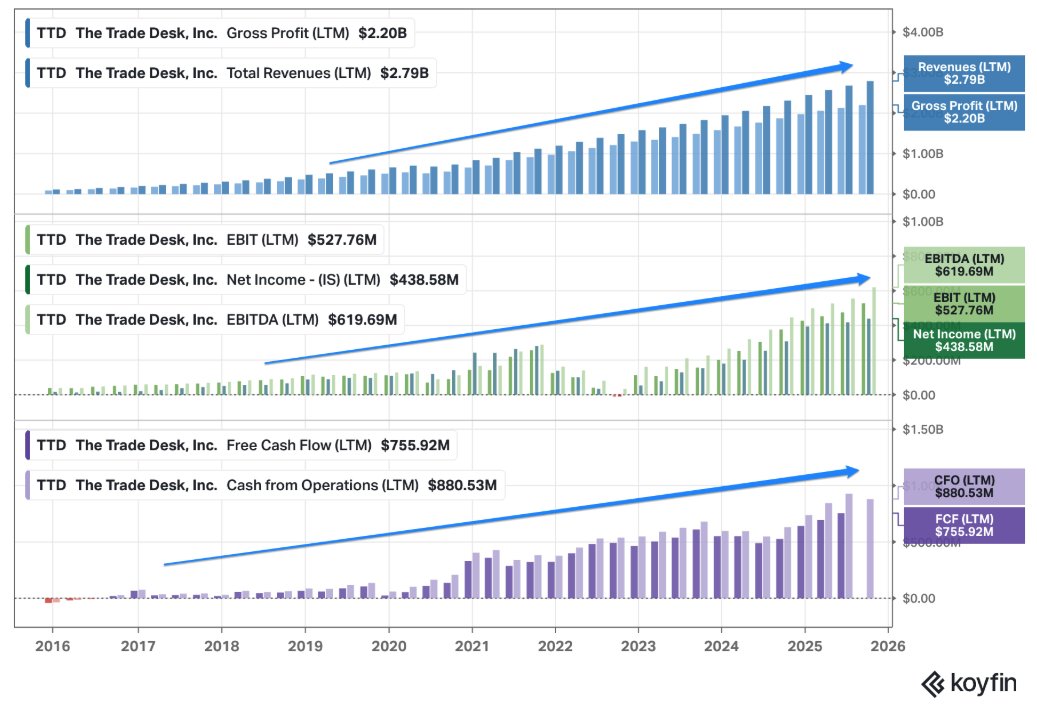


![EugeneNg's tweet photo. The Trade Desk $TTD 2Q25 Earnings
- Rev $694m +19% ↗️🟢(+20% ex US political spend)
- Adj EBITDA $271m +12% ↗️🟡 margin 39% -237 bps ↘️🔴
- EBIT $117m +23% ↗️🟢 margin 17% +62 bps ✅
- NG Net Inc $203m +3% ↗️🟡 margin 29% -452 bps ↘️🔴
- Net Inc $90m +6% ↗️🟡 margin 13% -156 bps ↘️🔴
- OCF $165m +103% ⤴️🟢 margin 24% +987 bps ✅
- FCF $117m +106% ⤴️🟢 margin 17% +712 bps ✅
Biz Metrics
- Customer retention >95% (11 consecutive years)
- CTV (47.5%)
- Mobile (35%)
- Display (12.5%)
- Audio (5%)
- NA 86% spend
- International 14% (growing faster)
Alex Kayyal joins as CFO, previously Partner at Lightspeed Venture and Salesforce Venture, replacing previous CFO, Laura Schengen.
Omar Tawakol joins Board of Directors, founded BlueKai (acquired by Oracle) and most recently founded Rembrand, a pioneer in creative AI.
3Q25 Mgmt Guide
- Rev $717m +14% (“soft”) +18% (ex-US political spend)
- Adj EBITDA $277m
1 | Growth continued to be strong especially driven by CTV
During the quarter, we continued to build momentum across our key growth areas as advertisers increasingly value the e ciency and measurable results of their media investments. Growth was particularly strong within CTV and retail media fueled by the continued shift into decision channels for buying TV and the rapid adoption of retail media across verticals and regions.
From a scale channel perspective, CTV led our growth again during the quarter. In Q2, video, which includes CTV, represented a high 40s percentage share of our business and continues to grow as a percentage of our mix.
2 | Q2 not as strong as auto and CPG, large global advertisers were weaker, but have stabilized
That pressure intensi ed in Q1 with growing concerns among the largest brands and agencies, which of course, make up the vast majority of our business. In Q2, starting right at the beginning of April, some of the biggest brands, particularly in sectors like auto and CPG, which are, of course, meaningful categories for us and for the Fortune 500, they began to experience even greater volatility. But since then, things have stabilized. I think it's important to know things are more business as usual. However, the impact of tariffs and related policies on these businesses are very real.
Most others rely heavily on SMBs, and our platform is largely concentrated on the large global advertisers. So we see the e ects that are directly impacting them. So I would argue that this is a short-term negative, which by the way, this fact that we concentrate on the large ones is not generally a negative. It is almost always a positive.
3 | Technology and computing and medical health were strong, but home and garden and style and fashion were weak
In terms of verticals that represent at least 1% of our spend, we saw double-digit growth in the majority of our verticals with particularly strong growth in technology and computing and medical health. Home and garden and style and fashion were below average. We continue to see signi cant opportunities for us to gain share in all of the verticals we serve.
4 | Still bullish because programmatic is almost anti-cyclical where customers demand agility and measurable performance
But the reason I'm so bullish is that in volatile environments, these things have historically accelerated the move to programmatic precisely because it comes with control, agility and performance. When advertisers become more deliberate and performance-driven, programmatic is at its very best. That's the very best that we can o er to them, and that's when we're doing our best work for them. So because programmatic, which really is just a fancy word for fast-paced and data-driven, is measurable, because it's measurable, it allows us to win share.
5 | See upside in coming quarters and years ahead with the strong pipeline, and faster growing spend, best positioned to accelerate in 2026
We are signing more multiyear JBPs, or joint business plans, than ever before with leading agencies and brands. In fact, the number of live JBPs is at an all-time high, and we continue to see spend under JBPs signi cantly outpace the rest of our business. What's even more encouraging is the strength of our JBP pipeline with nearly 100 JBPs in progress, many of them in the late stages of development.
And while many of our JBPs are signed directly with brands, we are working hand in hand with their agencies almost in every case to bring these partnerships to life. It is not an either/or. I want to start by giving you an update on our business, but I also want to take the time to describe our vision and where we're heading. We see clearly what is on the horizon for our space, and we're convinced we're the best-positioned company in adtech to accelerate our growth in 2026.
6 | Kokai progress is going well, clients are seeing significant performance improvements, Kokai campaigns are outperforming legacy by 20%, with 20% higher spend, currently ¾ of ad spend flowing through Kokai, expect 100% adoption before year end
So first of all, the progress in the last few months has been amazing. The iteration on client feedback has been really rapid, and the releases, especially over the last month, have made Kokai truly the best adtech platform ever pointed at the open Internet. Kokai, of course, is the most signi cant platform upgrade in our company's history, and it really marks what I think is a new frontier in programmatic advertising, in part just because of the advent of AI and what's possible. We've injected AI into so many areas in our platform like in forecasting, in campaign optimization, in supply path optimization, in predictive clearing. And in all of those places, it is already paying off. So to just give you a sense of some of the impact, clients who've adopted Kokai are already seeing dramatic performance improvements.
Samsung saw a 43% increase in its ability to reach target audiences for an omnichannel campaign in Europe. Cashrewards in Asia reported a 73% improvement in cost per acquisition. And across the board, Kokai campaigns are outperforming legacy ones by more than 20 points on KPIs. But even more telling are the clients who have shifted the majority of their spend to Kokai because they're increasing their total spend on the platform more than 20% faster than those who haven't. So those that lean in and try it see results and then they accelerate their businesses. Today, about 3/4 of spend is already flowing through Kokai. So the vast majority of our clients are already on it. And we expect full adoption of all of our clients. In other words, all of our clients will use it before the end of the year.
7 | Excited about Deal Desk, currently in beta which helps with forecasting, rescuing underperforming deals, Disney is an early adopter
One additional innovation that will help accelerate our supply chain work is Deal Desk. It is one of the major nal pieces of Kokai, and it is in beta now. Deal Desk leverages AI, especially AI forecasting, to reshape how we think about deals between advertisers and publishers and intermediaries such as SSPs. It helps advertisers and publishers understand how deals are performing, how they are pacing, whether the right impressions are being delivered and so on. But perhaps just as important, when deals are underperforming, Deal Desk will help those deals get back on track, and it will showcase open market and premium Internet alternatives. We are seeing very strong appetite for Deal Desk across both advertisers and publishers. Everyone recognize the limitation of deals and wants innovation that can help improve them.
8 | Disney is one of the first publishers to lean into Deal Desk, and Disney intends to shift 75% of their ad revenue to biddable programmatic by 2027
Disney is one of the first publishers to lean into Deal Desk. Jamie Power at The Walt Disney Company has said several times over the past couple of years that they intend to shift 75% of their ad revenue to biddable programmatic by 2027. I'm thrilled that our innovation will help them achieve this goal.
9 | Seeing good progress with OpenPath, enabling publishers to directly integrate with TTD, while don’t expect 100% of flow, it will make the supply chain better and more efficient
Second, we are trying to create the most e cient supply chain possible for digital advertising, and we are seeing great progress with OpenPath. OpenPath allows publishers to directly integrate with The Trade Desk if they choose to, and it enables publishers to see more clearly how much our clients are willing to pay for their ad impressions. And it gives our clients a direct line of sight into what they are buying. And today, a material amount of spend on our platform is now owing through OpenPath, and it is doing exactly what we expected. OpenPath is both a canary in [ the ] coal mine and a stalking horse. We don't expect 100% of spend to flow through OpenPath, but we do expect it to, one way or another, make the supply chain better and more e cient. And the benefits have been exceptional, not just for our clients, but for the publishers, too.
10 | See customers as spending increasingly more time in the premium open internet, like premium CTV, premium audio, etc
So rst of all, it is true that consumers spend more of their time on the premium open Internet. And if you think about this from your own perspective -- and I'll just speak for myself rather than everybody else. But I spend a lot of time inside of the premium connected television. I spend a lot of time inside of Spotify and premium audio and same with movies.
And then I think about my interactions with YouTube, for instance, where I'd go there just like nearly everybody else does. But when I'm consuming content and there's ads there, I'm hovering over it to skip it. It's a very different engagement that I have with the rest. The premium open Internet performs way better. It's way better for the biggest brands to be associated with it.
11 | TTD focuses on the most premium parts of the open internet, and that is taking more time, but will have more upside as that is where consumers are increasingly spending their time, still see majority of ad spend shifting to the open internet from walled gardens
And because we are doing that among the most premium parts of the open Internet, it naturally takes a little bit longer, but it also comes with way more upside. So -- and if you look at this long term, where do consumers spend most of their time? Where -- what is the content that they love the most? Where do those with purchasing power spend most of their time?
And so as a result of that just very real phenomenon, I believe it's only a matter of time before the majority of spend is on the open Internet and not inside of walled gardens
12 | TTD’s strategy remains unchanged to have full transparency, objectivity and access to the entire internet, different from the walled gardens
So first and foremost, our strategy has not changed. We give marketers the power and the tools to own and control their own future. And we want them to do that with, of course, the things that have gotten us here, which is full transparency, objectivity and access to the entire Internet. In my opinion, that is the only way to get large clients to come on your platform and stay there for the long term. And that's why it's always been our focus. And it's why we've constantly and consistently won the trust of the world's largest brands. We have long said that walled gardens, whether it's Amazon or Google, are best suited to buy their own inventory with their own data. But their bias makes it hard for them to buy across the open Internet in a truly objective way. So when you look at it from that perspective or from a certain perspective, point of view, Amazon is not a competitor, and Google really isn't much of a competitor anymore either.
13 | With Google abandoning the open internet, FB focusing on their own walled garden, it leaves TTD to be the largest source of third party demand for publishers
On the supply chain, we're driving e ciency across the ecosystem with innovations like OpenPath and our integration of Sincera. As Google continues to pull away from the open Internet, that creates a vacuum which we're stepping into. Stepping back, it's more of a buyer's market than it's ever been before. Large publishers need partners like The Trade Desk to win. And as Google and Facebook have largely abandoned the open Internet, The Trade Desk is the largest source of third-party demand for many publishers around the world.
14 | TTD currently focuses on the fat tail with the biggest advertisers, which is 50% of the TAM, don’t see the need to chase the long tail of SMEs yet to expand
which is we uniquely started with the fat head and not the long tail. We started with the biggest advertisers in the world. And we have the belief that if we could win the trust and do well for the biggest brands in the world that it would make it easier for us to do that with midsized and smaller.
It is where we're heading, but it is not our focus right now because if you look at how much of the TAM is made up of the Ls, it's almost half of it. So because there's so much TAM there, we just want to continue to support them and help them grow and think that's a critical part of the future. And especially if you look at how much of CTV has been made up by those in the past and will likely represent the lion's share for as far as we can see into the future, that becomes a great place for us to continue to grow for as far as we can see in the future. So while this is a part of our ambition, I don't believe that we have to go chase Ms or Ss in order for us to grow for the foreseeable future. We just simply need to execute among the clients that we already have and continue to expand.
15 | Does have ambition to service the long tail, the SMEs, know that if they can service the toughest largest advertisers, they can cover the smaller ones
Incidentally, I think acronym SMB, small and midsized business, is only useful in the sense that it makes it digestible, but midsize are as di erent, if not more different than small than the large are to the mid or to the small. So there are at least 3 categories. But if you just look at it as there is essentially this like ski slope where you start with the very largest, which are very big and they spend a lot of money and then just go down to those very small, we are working our way down that slope.
And we have ambition to service all of it. We recognize that servicing and Ms and Ss are very different than servicing the Ls that we focus on today. But we also know that if you figure out how to serve them well, and they're very tough critics, they have very high demand. If you figure out how to service them well, then you can use those same tools. Of course, you get rid of all the questions and the dials that you give to the large ones and even the visibility and simply just perform for them. But taking out reports and taking out dials is a lot easier than starting with nothing as it relates to control that you can give to large buyers and then trying to add it on afterwards. So -- but it is absolutely in our ambitions.
It is my understanding that Amazon nearly doubled the supply of Prime Video inventory in the recent months. That creates a number of conflicts. And in my opinion, it further weakens their already shaky arguments about objectivity. But if that weren't enough, Amazon already competes with many of the world's biggest advertisers in categories like retail, CPG and cloud, which makes it difficult for those brands to fully trust them as a partner.
They are still primarily focused on prenegotiated deals that lack an open identity solution like UID2, none of their strategic decisions or investments suggest that they're trying to buy the open Internet objectively or even that, that is a priority.
17 | See TTD as competing with Amazon DSP on ad spend that is not spent on Amazon owned and operated, think of Amazon as a potential partner should they decide to open Prime Video to external demand
So to be clear, if you insist on calling Amazon a competitor, we compete with a tiny division of Amazon. We don't compete with Amazon or retail. We certainly don't compete with AWS. We compete with whatever small amount of spend goes to the Amazon DSP that isn't spent on Amazon owned and operated. I think Amazon is more of a potential partner, honestly, than it is a long-term competitor. If Amazon opens Prime Video to external demand, which I believe they should, we believe we'd be an amazing partner to drive demand to them, and it wouldn't surprise us if that were to eventually be the course that they choose to take. But to sum up, while we watch them closely and we know exactly what they're doing, we are playing in a very different sandbox. Ours is focused on decision media, precision, identity and outcomes.
18 | Continue to remain independently objective, to drive the use of retail data across as many advertisers, not compete with them
Again, objectivity is a major factor here. Unlike others in the market, our goal is to drive the use of retail data across as many advertiser campaigns as possible. We do not compete with retailers and only an independent objective partner like us can truly help advertisers unlock this opportunity. In Q2, a record amount of spend was influenced by retail data both on our platform and on the Walmart DSP as more shopper marketing budgets flow into programmatic. And fourth, I'd just like to reiterate that underpinning all of our success this year is a strong focus on operational rigor.
19 | Added Instacart and Ocado to provide even more granularity on consumer purchases allowing advertisers to measure with greater precision
But we've recently launched expanded partnerships with leaders such as Instacart and Ocado to provide even more granular data on actual consumer purchases, so advertisers can measure with even greater precision.
20 | TTD is to redefine DSP, beyond, display, CTV, but the entire open internet, from the biggest customers first, and eventually to the smallest
Our vision is to define clearly the category of a DSP. Access is not at the core of our value proposition, simply getting access to inventory. Database decisioning and measurement is at the core of our offering. Some have mistakenly thought our ambitions are about display. Some have mistakenly thought our ambitions were only about CTV or branding budgets. Our goal is to buy the entire open Internet objectively for buyers, big and small. We've started with the biggest, and we serve them well.
➡️ Final Thoughts on The Trade Desk $TTD
Good to see Kokai increasingly being adopted by clients and for complete adoption before year end. Slightly “softer” quarter due to weaker large advertiser spend in specific pillars, see it as more temporary than structural. Strong JBP pipeline should position for growth reacceleration in 2026 and beyond. TTD remains the best position DSP is the dominant ad-tech player outside the walled gardens focusing on the premium open internet, while their near and mid-term focus remains on the larger advertisers, they could start looking at the long tail, smaller advertisers down the road (similar to Meta), which would be exciting.](https://pbs.twimg.com/media/Gxzm24ibsAQahVs.jpg)
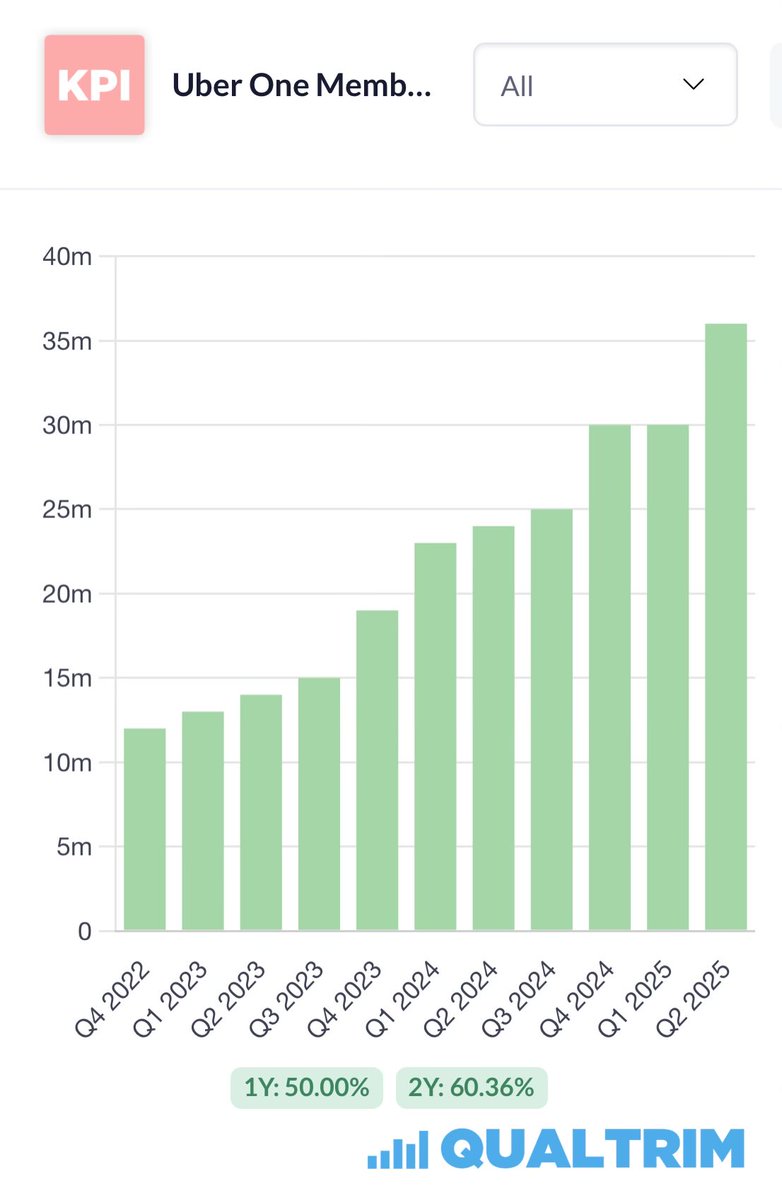


![EugeneNg's tweet photo. The Trade Desk $TTD 1Q25 Earnings
- Rev $616m +25% ↗️🟢
- Adj EBITDA $208m +29% ↗️🟢 margin 34% +82 bps ✅
- EBIT $54m +90% ⤴️🟢 margin 9% +301 bps ✅
- NG Net Inc $165m +26% ↗️🟢 margin 27% +14 bps ✅
- Net Inc $51m +60% ↗️🟢 margin 8% +178 bps ✅
- OCF $291m +57% ↗️🟢 margin 47% +955 bps ✅
- FCF $230m +30% ↗️🟢 margin 37% +140 bps ✅
2Q25 Mgmt Guide
- Rev $682m +17% ↗️🟢
- Adj EBITDA $259m
Biz Metrics (% share)
- Customer retention >95% (past 11Y) ✅
- CTV (47.5%)
- Mobile (35%)
- Display (12.5%)
- Audio (5%)
- NA 88% spend
- International 12% (growing faster)
1 | Strong quarter, uptake in Kokai adoption and upgrades
I would say we're really proud of what we delivered in Q1. It was such a strong quarter for us -- and I would attribute the strength to the uptake in Kokai adoption and the early momentum from the upgrades that we talked about earlier in the year related to our business that we made in I wouldn't say that the Q4 to Q1 sequential strength was driven by political simply because we exited presidential cycle in the U.S., entered 2025 when we're not in an off-cycle and don't have much contribution.
2 | Recovered from 4Q24 miss with strong growth, seeing encouraging signs that changes made were the right ones
As many of you know, in Q4, we experienced a setback as we undertook the most significant company upgrade in our 16-year history. I won't revisit the details today, but as company scale and complexity increases, changes and upgrades become necessary to unlock the next wave of growth. That's exactly what we did.
And now we are beginning to see encouraging signs that the changes we made were the right ones. As you've seen from the press release, despite increasing economic uncertainty, we showed incredible resilience, growing revenue 25% YoY, far surpassing our own expectations. We continue to grow at a rate significantly higher than the broad digital marketing industry and gain market share.
3 | Strong progress on Kokai, adoption ahead of schedule, ⅔ clients using it, bulk of ad spend now on Kokai
Let's talk now about our progress on Kokai. The core of Kokai has been delivered and adoption is now ahead of schedule. Around 2/3 of our clients are now using it and the bulk of the spend in our platform is now running through Kokai. We expect all clients to be using it by the end of the year. One thing about Kokai that I would like to underline whenever we go through a platform overhaul like this, and this is the biggest in our history, we are always trying to balance giving clients exactly what they want versus pushing the industry forward.
4 | Despite all features of Kokai fully launched, will will continue to iterate and ship product weekly, still got a few major pieces to ship
Kokai is perhaps our biggest engineering achievement yet, and it is helping clients get the full value of the open Internet and manage the complexity of the open Internet at the same time. Even as all of the features of Kokai are fully launched. We will continue to iterate and ship product every week. As I said, Kokai adoption now represents the majority of our spend, almost 2/3, a signi cant acceleration from where we ended 2024, and clients are seeing major campaign improvements as a result
Of course, we also have to talk about our focus on upgrading our product across the Board. There's still a lot of exciting things coming out of Kokai. It seems that we continue to upgrade -- so there are a few major pieces left that we expect to ship in the very near future.
5 | Will introduce a new approach for understanding and managing performance, and will continue to improve the polish, the navigation and the usability of Kokai
We will introduce the final major components of Kokai, including a revolutionary new approach for understanding and managing the performance of deals. One of the most important things we do to realize the value of programmatic. We will also continue to improve the polish, the navigation and the usability. But to be clear, Kokai has already proven itself and the results are fantastic. The injection of our industry-leading CoA AI tools across every aspect of our platform has been a game changer, and we are just getting started.
6 | Kokai deliver lower cost per conversion and acquisitions
Kokai campaign performance on Kokai continues to be exceptional. Kokai's delivering on lower funnel KPIs, including 24% lower cost per conversion and 20% lower cost per acquisition, and these improvements are helping unlock performance and performance budgets from existing clients, but also from new clients that are a bit more focused on the performance side of things.
7 | Overhauled the product process, business and product now more in sync, simplified GTM, seeing green shoots with strong JVP pipelines
Lastly, I mentioned in our last call that we've made significant upgrades across the company. In engineering, we now have over 100 scrums all shipping product every week. We've overhauled the product process. And as a result, business and product and engineering are more in sync than they've been in years. We simplified our go-to-market teams and their org structures. While it is still early, we are already seeing green shoots. Our JVP pipeline and the number of JVPs in active contract negotiations are at all-time highs.
8 | Continue to focus on growing JVPs, now 40% of spend under JVPs, which is growing faster
There's still more to come on that but the trend line is awesome, and it's good enough to validate that we've made the right choices. Also validating in that same way is our strong JVP pipeline. As we've highlighted before, over 40% of our spend is now under JVPs. And then you can think of JVPs as partnerships with long-term commitments and vision for what we'll do together. And that continues to grow 50% faster than overall spend. So when we put those together, our business grows faster. And so naturally, we're focused on more of those.
9 | Continue to grow faster and gain market share versus the industry
We continue to grow at a rate significantly higher than the broad digital marketing industry and gain market share. As you know, we have a long history of setting goals and hitting them. We're happy to report that we did it again. We also have a long history of growing faster than all of the other scaled players in our industry, and we did that again, too.
10 | Google’s challenges will focus them to focus on their core business, and be less focused on the open internet, allowing TTD who was won in a unfair market, to do better in a fairer market
think the news yesterday about Apple's decision to focus more on the AI search engines rather than Google as a result of the remedy of that rst trial is as signi cant as anything. And it tells you what's to come, which is Google has got to focus on its core business. And as they focus on the core business, which is largely about search, and that includes Gemini and also YouTube, that means they are going to be less focused on the open Internet.
And that means for us that we can go participate in the open Internet with less competition, but even more signi cant than less competition is the fact that Google has been disrupting the competitive market that we would have thrived even more. So I stand by what I said, again, again, including in the prepared remarks that we were winning in an unfair market and the market is getting fair already.
11 | Q1 saw intensifiying pressure with growing concerns amongst clients
First, the macro environment. As I mentioned before, Q4 was relatively stable, though signs of volatility we're building beneath the surface have made a contentious election cycle. That pressure intensified in Q1 with growing concern among clients. As you know, our primary clients are the largest brands in the world and the agencies that serve them. All of whom are navigating increasing volatility so far in 2025.
12 | Acquired Sincera, a metadata company that crawls internet to give clients more data and signal to improve ad performance, plan to offer Open Sincera
Another massive upgrade we have made to improve the supply chain was the acquisition of Sincera. Most outside of ad tech don't know the company. So for the uninitiated, Sincera is a metadata company that crawls the Internet looking for insights about the supply chain of advertising, and seeks to shine a light of transparency on that supply chain. Following the acquisition, we have been working to invest Sincera data across Kokai, so our clients can have as much data and signal as possible about ad performance.
But it doesn't stop there. In the coming months, we plan to relaunch their product for the ad tech community and offer a new version of Sincera called Open Sincera. This product will be free to advertisers, to agencies, to ad tech companies, to sellers and to publishers who want to better understand the supply chain and how to make it more efficient.
13 | Vivek Kundra joins as COO from EVP, Salesforce
We've hired a new COO, Vivid Kandra. He joined the company as our new Chief Operating O cer. So that may be a well-known name to many of you as he was the first ever Chief Information O cer for the United States Federal Government back in 2009. But perhaps most relevant to us, he spent several years at Salesforce and is a key driver of growth at a time when they were pretty much the same size and scale as we are now. These kind of appointments will help us achieve our very own high-growth expectations in the years ahead.
14 | TTD is pointed to the entire open Internet and think nearly all global advertising will be transacted programmatically at end state, best positioned to win lion share
The Trade Desk is pointed at the entire open Internet, and nearly all of global advertising will be transacted programmatically at end state. We are convinced that based on the current landscape and current competitive set, we are the best positioned to win the lion's share of market share at end state. We simply need to execute between here and there.
15 | Significant shifts in Google, Apple, Meta that is making the market more competitive and more fair
But so far this year, there have been some massive shifts that have significantly upgraded the prospects of the open Internet and the Trade Desk. Here are a few of them. First, Google has been declared an illegal monopoly in two separate instances in 2025 by the U.S. courts. Of course, the same has happened in various government cases all over the world.
Fourth, Google announced that it is not going to eradicate cookies from its market-leading Chrome browser. So naturally, you may ask, what do all these changes mean for -- the Trade Desk and the open Internet. First, we've been winning share in the DSP race year after year and quarter after quarter. And we've done that in an unfair market. We think the signal that comes from all of these ships is that one that points to a more fair and more competitive market, which is what we built our business for. Our model is designed to compete. As we've said before, if we can win share in an unfair market against the biggest tech players in the world, as we have over the last 15 years, imagine what we can do in a fair market
16 | Google DV360, Amazon DSP will continue to focus on their own properties
Doing so will significantly improve competition, transparency and fairness in the ad market for all participants. I continue to believe that Google will stop trying to monetize the open Internet and instead focus more on their destinations. I expect that Amazon will continue on the same path. DV360 is primarily technology to buy YouTube. Amazon's DSP is primarily a product built to buy Amazon's Prime video
17 | TTD can be agile, adjust quickly because its more data driven
Programmatic advertising is extremely agile. Because our technology buys one impression at a time and evaluates every single impression, we can adjust quickly. We also can be more data-driven than the other forms of advertising.
18 | CTV currently having more supply than demand, and is a buyers market, consumers will see fewer but more relevant ads, and will perform better
Because of the pressure on consumers over the last 2 quarters, CTV and streamers have invested more into advertising. We're seeing more supply than demand in all forms of advertising, but that is especially important in CTV. In general, this dynamic makes for more of a buyer's market, but additionally, this is having a great impact on market dynamics. As a result, in general, CTV companies are once again leading the supply dynamics of the open Internet. They are plugging directly into our demand. They are also describing their supply in greater detail than ever. Nearly every scaled player has adopted UID2 and those that have not are under monetizing their inventory. We expect that the market dynamics are going to create the best ad-funded television experience for consumers in the history of television. They will see fewer ads. They will be personally relevant and these fewer ads will make more money for content owners than linear and broadcast ever did, and they will perform better for advertisers per dollar than spray and pray ever did.
19 | NY Post and VIZIO seeing strong gains from using OpenPath
With OpenPath, they were able to increase their fill rates by 4x and improved programmatic revenue by 79%, all because they are able to provide advertisers, our clients with clear visibility into what they're buying. [indiscernible] dozens more examples -- the New York Post saw its digital advertising fill rate increase more than 8x and programmatic revenue increased 97% with Openpath. In the world of CTV, VIZIO sats programmatic revenue increased 39% and another major network saw their ll rate increase 7x, leading to a revenue increase of over 25%.
20 | Continue to see strength of underlying business
That said, we are encouraged by the strength of our underlying business, driven by continued progress on Kokai is our enhancements to our engineering and go-to-market teams and a growing pipeline of joint business plans. We remain confident in the fundamental drivers of our revenue growth, especially given our track record of gaining market share during periods of economic volatility. Assuming the macro environment remains stable, and we do not see deterioration in economic conditions
➡️ Final Thoughts on The Trade Desk $TTD
Jeff Green and his team proved their mantle and worked hard to deliver the strong growth in 1Q25 after the poor execution in 4Q24. TTD continues to execute and be open to take in feedback and continue to reiterate on Kokai and keep improving on it and drive growing customer adoption. The continued shipping of product updates is testament. The acquisition of Sincera is highly strategic to improve ad performance that is a space to watch. The alignment of business and product is much needed and is showing back green shoots in the rebound. Continue to have confidence in Jeff and his management to bring it to greater heights.](https://pbs.twimg.com/media/GqfjV4hbcAEVqEl.jpg)
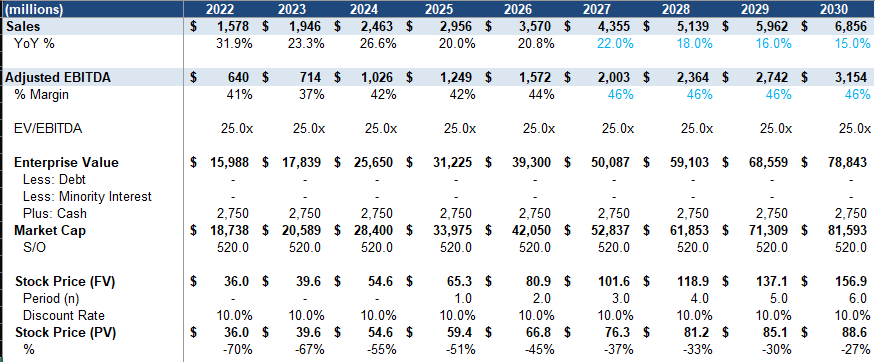
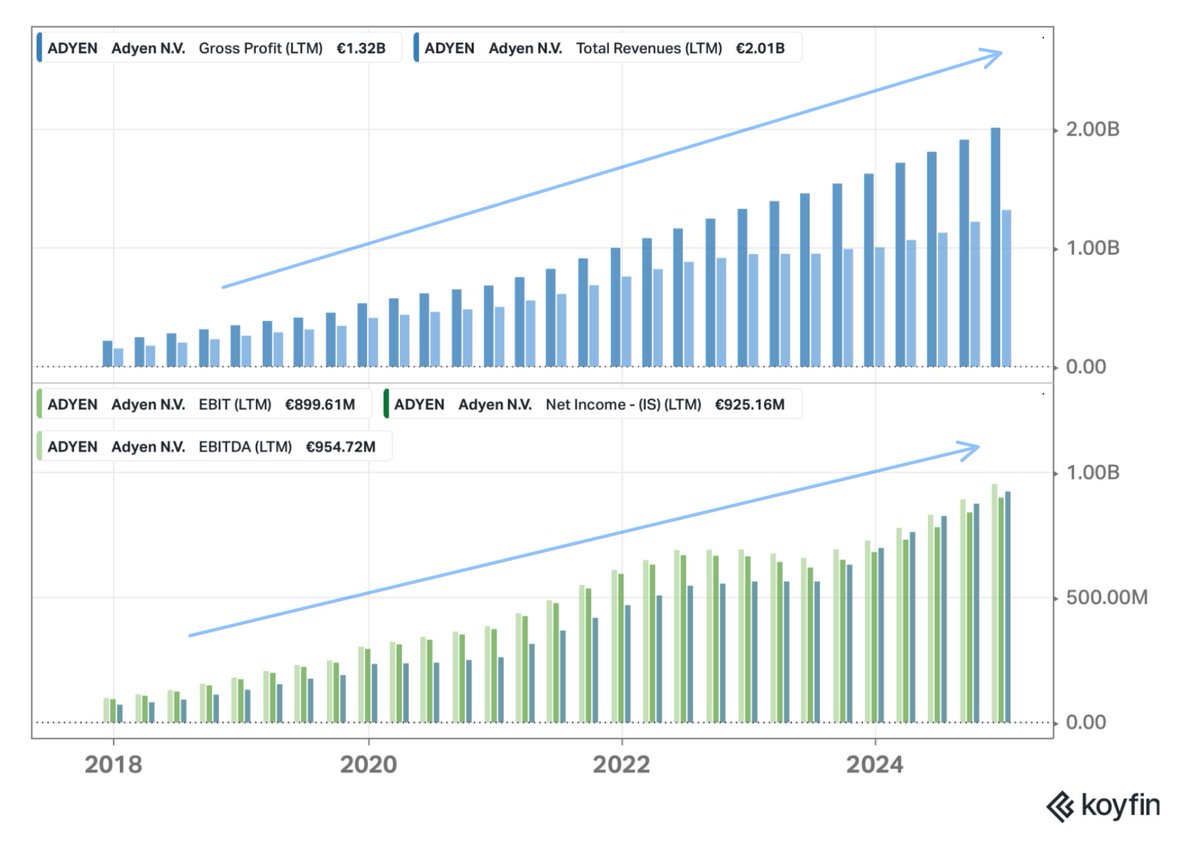
![EugeneNg's tweet photo. The Trade Desk $TTD 4Q24 Earnings
- Rev $741m +22% ↗️🟢
- Adj EBITDA $350m +23% ↗️🟢 margin 47% +40 bps ✅
- EBIT $195m +35% ↗️🟢 margin 26% +251 bps ✅
- NG Net Inc $297m +43% ↗️🟢 margin 40% +590 bps ✅
- Net Inc $182m +87% ⤴️🟢 margin 25% +853 bps ✅
- OCF $199m +119% ⤴️🟢 margin 27% +1187 bps ✅
- FCF $179m +172% ⤴️🟢 margin 24% +1330 bps ✅
The Trade Desk $TTD FY24 Earnings
- Rev $2.4b +26% ↗️🟢
- Adj EBITDA $1.0b +31% ↗️🟢 margin 41% +169 bps ✅
- EBIT $427m +113% ⤴️🟢 margin 17% +717 bps ✅
- NG Net Inc $832m +33% ↗️🟢 margin 34% +177 bps ✅
- Net Inc $393m +120% ⤴️🟢 margin 16% +688 bps ✅
- OCF $739m +24% ↗️🟢 margin 30% -50 bps ↘️🔴
- FCF $641m +16% ↗️🟢 margin 26% -211 bps ↘️🔴
- Gross spend $12b +25% ↗️🟢
- Take-rate 20.3%+6bps ↗️🟢
TTD Annual Gross Spend
Biz Metrics (% share)
- Customer retention >95% (past 11Y) ✅
- CTV (High 40%)
- Mobile (Mid 30%)
- Display (Low double digit)
- Audio (5%)
- NA 88% spend
- International 12% (growing faster)
1Q25 Mgmt Guide
- Rev $575m +17% ↗️🟡 (weak)
- Adj EBITDA $145m ↘️🟡 (lower)
1 | CTV was strong and performance in majority of verticals
CTV growth across international regions was particularly strong during the fourth quarter and throughout 2024. In terms of verticals that represent at least 1% of our spend, growth was broadbased again this quarter. We saw strong performance in the majority of our verticals, particularly in automotive, shopping and technology and computing. Political spending was also strong in Q4 as expected. Home & Garden and pets were both below average. We continue to believe there is significant opportunity for us to gain share in all of the verticals we serve.
2 | But for the first time (excl. COVID) results came in below expectations
- 4Q24 Rev $741m +22% lower vs guide $756m +25%
- 4Q24 Adj EBITDA $350m +23% lower vs guide $363m
However, for the first time in our 8.5 years as a public company, excluding the rst quarter of 2020, our results came in below our expectations. As a company, we take great pride in our ability to forecast accurately, and we take full ownership of the shortfall. Importantly, this miss was not due to a lack of opportunity or increased competition. It was on us.
3 | Weak EBITDA is to be expected in 1Q25, expect it to improve through 2025
with regard to your question about Q1 EBITDA, I did mention in the script that we do anticipate a modest increase in the [indiscernible] of our operating expenses in 2025 and that we'd see some deleverage for the year. I wouldn't recommend thinking about it linearly. Typically, in our business, EBITDA improves as the year progresses, which is just driven by our investment choices and seasonality in business.
4 | Jeff Green owned up to it and took full responsibility
I want to acknowledge upfront that for the first time in 33 quarters as a public company, we fell short of our own expectations. During COVID, we revised our expectations once along with the rest of the markets, but for the rst time in 8 years, we missed the expectations we set, and it was our fault.
5 | Caused by a series of small execution missteps and turned over the ball too many times
Starting off, let me explain it as I see it. What falling short of our own expectations does not represent. This didn't happen because the opportunity isn't as big as we thought. In this case, it isn't because of our competition either. For Q4, the reality is that we stumbled due to a series of small execution missteps, while simultaneously preparing for the future.
If this were a sporting event, we'd still have a championship caliber team. But in this particular game, we turned over the ball too many times.
6 | Brightest days remain ahead of them
I want you to know that we take this moment seriously, and we want to assure our investors, partners and customers that their trust is well placed and deserved. Our brightest days are still ahead of us. But before I talk about that, I want to spend a few minutes sharing what we got wrong and the changes we are making to meet this moment and maximize our unique and growing opportunity.
7 | Market remains larger and faster growing, but TTD needs to recalibrate to unlock new growth and a stronger future
That said, we see a larger and faster-growing market than we originally expected which is why we have been making changes and will continue to do so. Simply put, as you've seen before, as companies grow and become increasingly complex, they need recalibration to unlock new opportunities. We are recalibrating our larger company for an even stronger future.
8 | Did 4 major changes - (1) reorganization with clear roles, responsibilities and reporting structure, (2) stronger emphasis on internal effectiveness and scalability, (3) focus more on brands, (4) revamped product development to smaller agile teams
In that effort, I want to highlight 4 major changes we've made at The Trade Desk in the last few months and some related initiatives that accompany them. First, we did the largest reorganization in company history in December. While we often make structural changes at the end of the year to improve our business, this was bigger than usual. For most people in the company, we provided a much clearer view of their roles and responsibilities and for most, that also meant a change in reporting structure. Additionally, we streamlined client-facing teams, reducing complexity and clarifying responsibilities, some team focus on brands, while others focus on agencies.
The second, beyond structural improvements, we placed a stronger emphasis on internal effectiveness and scalability. Over the past 2 months, leadership has spent more time discussing operational improvements than at any other point in our history. While we've historically been focused on external opportunities, we understand that this moment requires us to scale our internal operations and continue hiring senior talent to support long-term growth. These changes position us to execute at a higher level and capitalize on the expanding market opportunities ahead.
Third, we have increased our resource allocation on brands. A broader shift is occurring in the industry. Advertisers are becoming more strategic and data-driven in their media buying decisions, and that's great for us. While this shift has caused short-term fluctuations, it's ultimately aligned with our long-term strength. We recognize that advertising will ebb and flow.
Fourth, we revamped our product development process, shifting back to smaller agile teams that release updates weekly instead of drifting towards waterfall methods, which are less conducive to our fast-paced and changing industry. Our engineering team is now divided into nearly 100 scrum teams with a system to more easily ship and collaborate with the business team on what has shipped and what will ship and when.I expect this to continue to accelerate Kokai enhancements and complete the transition of 100% of our clients from Solimar to Kokai during this calendar year.
9| Sincera acquisition will improve the supply chain of the Open Internet
Secondly, we announced in January the acquisition of Sincera. Sincera is a metadata company that is dedicated to improving the supply chain of the open Internet. Joining Sincera's work with ours will accelerate a cleaner supply chain for the open Internet and accelerate the work of OpenPath, which is one of our biggest efficiency efforts, both internally and externally. A better supply chain will free up resources internally and improve the ecosystem.
10 | Doing 15 big things to benefit from secular activities
(1) Focusing on scale
First, we're focused on scale. More accurately, we're obsessing about scale. We control $12 billion of ad spend in an approximately $1 trillion advertising industry. With every success we have and with every efficiency we find, operationally and technologically, we follow it with a question, how can we make that scale quickly? While our share is growing faster than perhaps any scaled competitor, our opportunity is growing too. We can accelerate growth when we sufficiently orient around scale.
(2) Preparing as Google exits the Open Internet and focus more on Google owned and operated properties (e.g. YouTube)
Second thing, we are preparing for a world where Google exits the open Internet. I'm confident that one way or another, Google will exit the open Internet. I think they should. Most of their antitrust and regulatory problems come from the draconian ways they have engaged with the open Internet in the past. In April of 2024, Facebook shut down their news program thereby distancing itself further from one of the most important pillars of the open Internet. Some evidence suggests the substantial majority of spend going through DV360, Google's DSP, and is routed to the Google owned and operated platform of YouTube. Regardless of what happens with the pending trial decision, Google will likely distance itself from the open Internet. If and when Google exits the open Internet, they will leave a big hole and a big opportunity for the rest of us. Relatedly, let's move to number 3.
(3) Focus and protect independent objectivity, independent DSPs should get lion share
Third, we will promote and protect our objectivity more than ever. More and more, the only competitors we encounter today have the worst objectivity problems. Amazon is asking advertisers big and small, for their advertising budgets. Meanwhile, Amazon competes with most of the Fortune 500 companies in some way, whether we're talking about Microsoft in cloud or PNG and CPG products or UPS or Nike or all the rest, in our very first business plan 15 years ago, we argued that the objective independent DSP should get the lion's share of the marketplace. They'd be the only company that can be trusted. We have a mantra that we've repeated again and again internally for years, and it's this. Every day that goes by, objectivity matters more and more.
(4) Leverage supply and demand imbalance - supply will always exceed demand, buyer’s market, focusing exclusively on buy side DSP helps
The fourth thing we'll do, leverage the supply and demand imbalance to make the ecosystem better. In advertising, there is more supply than demand. There always has been and there always will be. This, by definition, makes it a buyer's market. By focusing exclusively on the buy side, we are in the strongest position in the market. Unlike so many players attack, we are not using our position of strength to become draconian we are trying to use our ever-growing influence and impact on the industry to make it better and to improve the supply chain. This is why we expect 2025 to be the year OpenPath enters the steep acceleration phase of its S-curve growth.
(5) Make CTV the most effective channel, and programmatic advertising
The fth action we'll take make CTV the most effective channel and programmatic advertising by layering more data, better auction mechanics and capitalizing on the fact that CTV is the only channel that has nearly 100% of traffic logged in. CTV is the kingpin of the open Internet. CTV should be the first place all brand advertiser spend, not walled gardens. If we expand Sincera's charter and capabilities to CTV and audio, CTV and premium video can reach its potential as a channel. It can be half the pie of the advertising TAM. So many companies like Disney, Netflix, Paramount, MAX, Fox and Peacock need to get the best out of programmatic advertising in order to maximize their opportunity.
(6) Bring programmatic advertising to streaming audio
The sixth thing we'll do, make 2025 the best year audio has seen yet. I maintain that audio is still the most on-sale corner of the open Internet. Companies like Spotify have been making changes to embrace the potential of programmatic advertising. They're making changes and we're using AI partnerships to bridge the creative creation gap. I think this is one of the biggest opportunities in programmatic and one of the biggest opportunities for a company like Spotify to take their company to the next level.
(7) Move all clients from Solimar to Kokai, which is so much better
The seventh action item will move 100% of our clients to Kokai this year. Now the majority already have. But today, we're maintaining 2 systems, Solimar and Kokai. This slows us down. Kokai is more effective in almost every way. We are producing case study after case study as clients continue to lean into the features of our Kokai platform. Every one of them showing the enhancements and effectiveness that goes up with the use of Kokai. As you know, Kokai represents our largest and most important platform overhaul ever. Some clients are still transitioning from our previous platform, Solimar, but well before the end of this year, I expect that all of our clients will be using Kokai exclusively. In all of the case studies coming out of Kokai, the consistent theme is accessing and acting on better data and signal.
(8) Help advertisers and agencies avoid bad deals with AI-powered forecasting
Eight, we will change the way the industry manages deals. We'll help advertisers and agencies avoid bad deals, which generally consider too few ad impressions and force advertisers to buy impressions that they wouldn't otherwise want, and we can avoid these bad deals by using AI-powered forecasting. To do this, we are enhancing Kokai with some of the most game-changing parts, like Deal Manager, which lays groundwork for the forward market, which we think in the future will change the ecosystem and eventually upgrade the upfronts.
(9) Continue to invest in AI and drive results
Ninth, we will continue to invest in AI with provable upgrades and auditable results. We started our ML and AI e orts in 2017 with the launch of Koa, but today, the opportunities are much bigger. We're asking every scrum inside of our company to look for opportunities to inject AI into our platform. Hundreds of enhancements recently shipped and coming in 2025 would not be possible without AI. We must keep the pedal to the metal, not to chest them on stages, which everyone else seems to be doing, but instead to produce results and win share.
(10) Simplify their retail offering
Tenth, we will simplify our retail offering in 2025. So far, it's been powerful and a significant driver of our growth, but it has often been too complicated. We've studied what works and understand the changes needed to help retail media continue to meaningfully outpace our business. Achieving this will require a closer collaboration with our retail partners.
In Kokai, we have the industry's richest retail data environment, including data for many of the world's leading retailers to help advertisers understand the connection between campaign spend and consumer action. We will make this easier to adopt for our clients, both endemic and non-endemic to our retail partners.
(11) Maintain simplicity (not complexity) while adding more new features
Number 11, we will simplify our platform. As platforms mature, they add features, but that can make it more complex. We will continue to add features and powerful controls for the most sophisticated buyers in the world. However, we're finding ways to improve the experience and make decisions easier and also more intuitive for our users.
(12) Will use more data to drive data-driven ad buying
Twelfth, we'll use more data. We have another mantra. Data-driven buying is better than guessing. Across all parts of our platform, we're using AI to help clients make better decisions, whether it is in making sense of complex data in real time when it may have previously taken weeks or bringing retail conversion data to bear more often and enriching bid requests.
(13) Focus more on JBPs
Thirteenth, as I said at the beginning, we will focus on joint business partnerships or JBPs. JBPs are joint innovation partnerships where agencies and brands collaborate with us to grow our relationship and drive programmatic innovation. They grow about 50% faster than the rest of our business.
(14) Ensuring agile product development
Number 14, on our action item list. We have already revised and will continue to revise our product process. As we grow, it is essential that our product development process remains agile. Even as it has to ingest more inputs for more stakeholders. We'll do this with a clear focus on what we're delivering week by week, which continues to be at the bleeding edge of adtech innovation.
(15) Hire senior leadership to take TTD to the next level
And then lastly, number 15, we'll hire senior leadership to take us to the next level. I believe that over the next few years, we will double the number of senior leaders in the company at the VP level and above, especially, including some very key senior level appointments in [ my org ]. This is a natural part of a high-growth company's journey. We want to scale The Trade Desk significantly in the years ahead. and that means ensuring we have the right kind of leadership rigor across the company while preserving the best elements of what we've done so well so far.
11 | Focus on making the Open Internet better than the Walled Gardens, on the Premium Open Internet, CTV, movies, journalism, music
In my view, we have to obsess about making the open Internet better than walled gardens. Walled gardens have cheap inventory. And I think there's a lot of people that are chasing cheap even if it doesn't help them in the long term. But we have the best of the entire open Internet on our side and via our platform. Our supply chains are very different from others, especially the walled gardens.
They control their small ecosystems. But I think we have something way better going for us. If you just look at any trade media today, you'll see that brands are increasingly wary of the dangers of cheap reach. Meanwhile, we have access to all the media that people love most. CTV, movies, journalism, all of music, that's all the premium open Internet.
And while we don't control the supply chain end to end the way walled gardens do by the nature of walled gardens, I think that's a way better long term for us and for the market. because competitive markets become more efficient over time. The competition of our markets are working for us, and we're in a very strong position being on the buy side. but there's so much to do to make the supply chain more efficient and to make our company more efficient
12 | Google’s network business has been shrinking for years, TTD now competing with Google’s 27th highest priority
The network business at Google has been shrinking on shrinking for years. And to me, this is evidence of the deprioritization. Google continues to focus on Gemini and cloud and AI and search and YouTube, I think that makes sense for them to do if you look at where the money comes from. I think the network and open Internet business is way less important to them than it has ever been. So as a result, I'm confident that one way or another, Google is going to exit the open Internet.
And I've often said, we don't compete with big Google. We compete with the 27th highest priority at Google, which was once DV360. And now I believe that has been downgraded when you compete with something like the 47th highest priority at Google. But that is less and less becoming a competitor because the majority of spend that is going through DV360 seems to be routed to YouTube or at least that's what the evidence suggests.
12 | Not happy, but remain confident with steps, can resume acceleration and continue the path of strength
I am not happy with our results in the fourth quarter, but there is so much opportunity in 2025 and the years ahead to help our clients take full advantage of data-driven advertising on the premium Internet to drive growth and brand loyalty for their businesses. And that's why I'm condent that Trade Desk will eventually resume acceleration and continue the path we've been on for over 33 quarters as a publicly-traded company. We are also the clear leader in the DSP race and perhaps the leader of the open Internet.
13 | Still in early stages across the growth drivers, will continue to invest if growth continues
And when I look across our growth drivers, frankly, I believe nearly all of them are still in their early stages compared to where they will be in 5 to 10 years. So if we generate significant revenue gains, we'll continue investing.
14 | $1T TAM, and only have 1.2% of it, still have large opportunity
We have $1 trillion TAM. We currently control a little over 1% of it. We think we have 98% of the TAM left and the CTV should be fast-growing outside the United States should be growing faster than the United States for obvious reasons.
15 | Long-term trajectory remains strong
In closing, while the back half of 2024 did not end exactly as we had hoped, our long-term trajectory remains strong. I'm optimistic about 2025. We continue to lead in a rapidly growing industry, delivering pro table growth and gaining significant market share. Our momentum is fueled by a strong set of growth drivers, including ongoing secular shift to CTV, enhanced measurement through retail data, international expansion, a robust identity framework, supply chain improvements and the ability to drive long-term leverage in our model. As we look ahead, we remain confident in our ability to sustain this growth and capitalize on the opportunities before us.
➡️ Final Thoughts on The Trade Desk $TTD
In one of the rare times, TTD looks to have taken their eye off the ball and become complacent, and 4Q24 ended up not doing as well as they would have liked. Execution turned out to be poorer than expected. We appreciate that Jeff Green took full responsibility and has a detailed game plan to re-accelerate its growth path. Expect some near-term weakness (1Q-2Q25) as it rebuilds, and remain confident that he will work with his team to deliver and bring TTD back across the finishing lines many more times from here.](https://pbs.twimg.com/media/GjpDD6SbYAAUXpr.jpg)