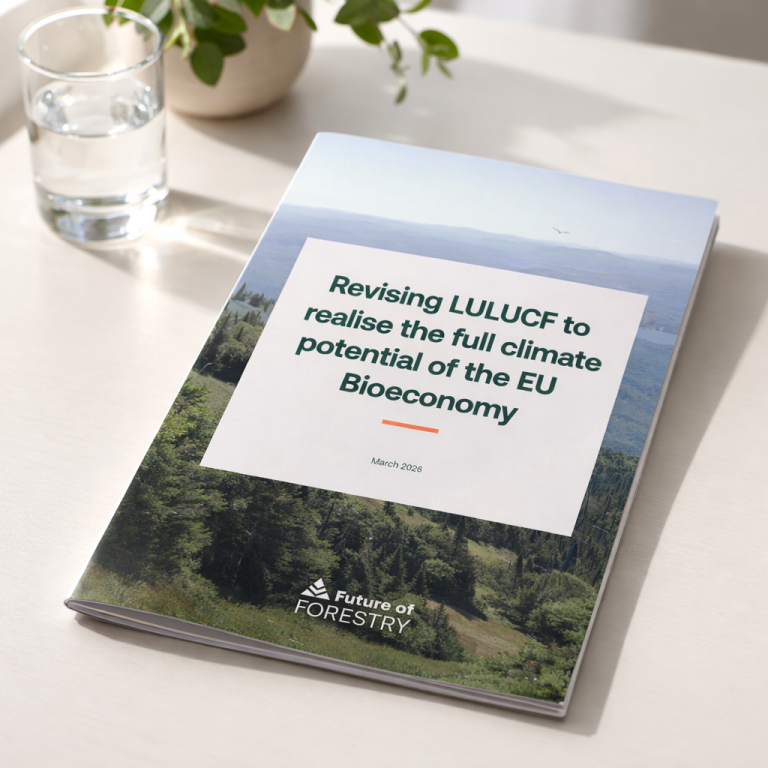
📢 NEW REPORT: Revising LULUCF to realise the full climate potential of the EU Bioeconomy.
Get the full report to learn more about the proposed policy changes and the role of the EU bioeconomy in the climate transition:
https://t.co/HznaGos3Rp
Det finns många åsikter om skogsbruk och känslor runt skog. Men vad är sant och vad är falskt i debatten? Framtidens Skogsnäring reder ut myterna om skogen.
Påståendet att låta skogen stå är det bästa för klimatet är förenklat.
Skogar som förvaltas hållbart och där virket används till långlivade produkter och för att ersätta fossilintensiva material och bränslen kan ge stor klimatnytta. Klimatnyttan uppstår genom både kolinlagring i skogen och i produkter, samt genom minskade fossila utsläpp via #substitutionseffekten.
Forskning har visat att det viktigaste för klimatet över tid är att hålla så hög tillväxt som möjligt. Det ger både en inlagring i skogen, i produkter och hjälper till att ersätta fossilbaserade material.
Källa: https://t.co/D6FL1W0NA5
Can production forests also support biodiversity? 🌿
A new study shows that fast-growing broadleaved trees may have more biodiversity value than previously thought-especially for lichens. This could be important for sustainable forestry in #EUForests.
https://t.co/qAp5QYSAXv
It starts small, with a bowl or a cup, but it has a big impact.
Favouring a substitution-friendly EU policies will give fibre-based products and innovations the extra push they need to deliver new solutions to the climate challenge with #EUForests.
More: https://t.co/7Yoyev0rjo
Small-scale family forestry is the backbone of European forests.
Fredrik Johansson is just one of 16 million forest owners in the EU, the majority being rural family forest owners who provide an abundance of valuable assets to society.
#EUForests#NordicForestSummit2026
Let's celebrate some of the positive developments made in #EUForests forests since 1990:
🌳 +11% Forest area (+16 million ha)
🌰 +6,7% Naturally regenerating forests (6,9 million ha)
🪵 +40% Carbon stock in biomass (+3,1 Gt)
🌱 +39% Forest growing stock (+7,8 billion m3)
💧 +33% Forests protected for water and soil (2,6 million ha)
🐛 +376% Forests protected for biodiversity conservation (15,1 million ha)
Source: FAO https://t.co/mOIlOx2ov0
🇪🇺 All this happens while the carbon stocks in #EUForests are increasing. Between 1990 and 2020 stocks rose by 48% and forest area grew by almost 10%. Forests now cover 39% of Europe. More: https://t.co/64vMOj0GXZ
Forests and #forestbased products help lower European emissions. This is how👇
🌳 Wood is turned into products that replace fossil-based products and fossil intense processes.
♻️ This saves 390m tons of CO2eq annually – equal to the emissions of 50m people #substitioneffect
🟢 By 2050, the forestry sector has the potential to contribute to further reducing carbon dioxide emissions by at least 171 million tons. In total, forest-based raw materials can take us about a quarter of the way to #netzero in 2050.
"Climate action is not about saving the bees and the trees" says @WBHoekstra, Commissioner for Climate, Net-Zero and Clean Growth.
"It’s a strategic move to mitigate the damage climate change is doing to our economies, make us more competitive and independent."
Source: https://t.co/5SvbVCduru
European forests are expanding in both area and wood volume. Active sustainable forest management boosts the bioeconomy, supports the transition away from fossil raw materials, and reduces import reliance. Increased biomass supply, achieved through sustainable forest management, will be essential in the transition away from the fossil economy of the past and into an economy powered by nature.
In 2025, we saw a number of EU initiatives and legislative revisions impacting the bioeconomy, including the forest sector, making the goals clearer and the rules simpler. Most notably the Clean Industrial Deal, EU Climate Law, Bioeconomy Strategy, and a much-needed revision and postponement of the EUDR package.
The European Forest Coalition welcomes the @EU_Commission's ambition and strong commitment to the #bioeconomy, recognizing and elevating the forestry sector as a driver in the union’s shift towards a #biobased economy, not only when it comes to the supply of biomass but also in terms of #competitiveness, strategic self-sufficiency and job creation.
Can we grow more trees in Europe? And if so, where?
Afforestation potential varies by region, climate zone, land availability, but Spain, Romania, France and Italy offer notable opportunities. In total, 10 to 20 million hectares of EU land could be used for afforestation.
Turning former agricultural lands into forest land is another approach. The European Commission has approved state aid to convert approximately 10% of Denmark's total land area into forest and nature by 2045. 🇪🇺🇩🇰👏