Tschechien: Kurzzeitige Inhaftierung von Metropolit Ilarion und neuer Wirkungsort in Brasilien
Republik Moldau: Metropolit Petru tritt zurück
Bulgarien: ESC-Sieg sorgt für Kontroversen unter Fundamentalisten und Nationalisten
... und weitere News auf https://t.co/uJP6oSMjB6
🕊️ Join the Global Prayer for Peace in Ukraine on 11 June, 13:00–14:00 CET!
#WCC invites people around the world to pray for peace and justice for #Ukraine and show solidarity with its people.
Read more: https://t.co/RHz8kiONCL
Register: https://t.co/sjLlt9etW7
WCC denounces deadly cycle of violence in Russia’s ongoing invasion of Ukraine
World Council of Churches (WCC) general secretary Rev. Prof. Dr Jerry Pillay denounced the deadly cycle of violence in the context of Russia’s ongoing invasion of Ukraine.
In the early hours of 2 June, Russian forces launched hundreds of drones and dozens of missiles at Kyiv and other cities in Ukraine, reportedly killing some 18 people and injuring more than 100.
This follows two other deadly attacks on Kyiv last month in which 24 people were killed, and Russian reports of a Ukrainian drone strike on a college dormitory in the Russian-controlled Luhansk region of eastern Ukraine, reportedly killing 21 students.
“We call for an immediate end to this war, to stop the death and destruction,” said Pillay. “We urge all WCC member churches and all people of good will to pray and act for peace – a lasting peace in the region and throughout the world, based on respect for international law and for fundamental moral precepts.”
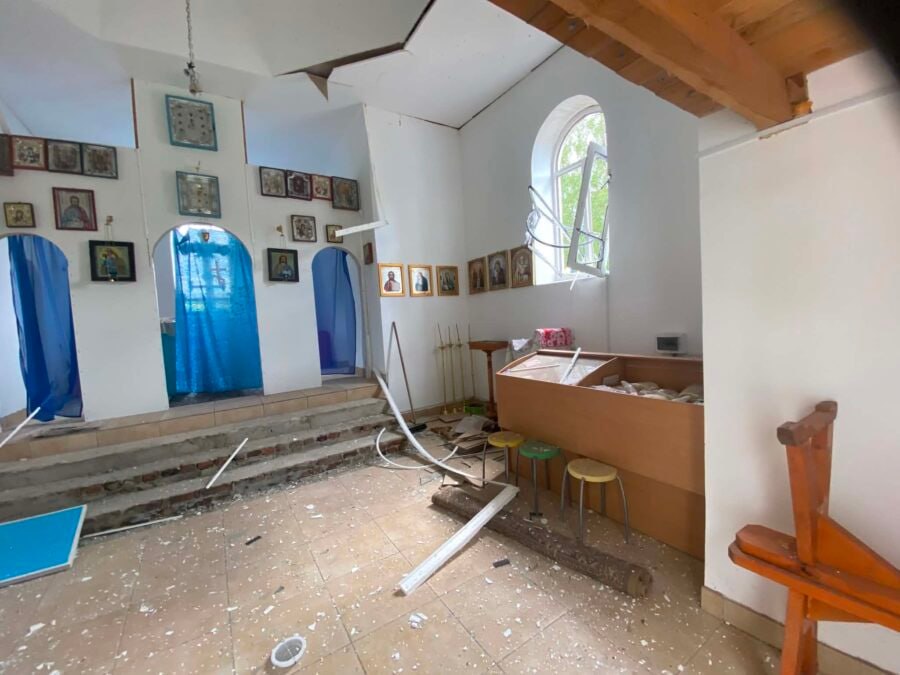
On May 30, Russian troops attacked the village of Zakotne in the Donetsk region, Ukraine. The strike hit the Church of the Nativity of the Blessed Virgin Mary of the Ukrainian Orthodox Church.
The Ukrainian military claims a drone was used in the attack: an incendiary bomb was dropped on the roof of the church. As a result, the church was destroyed.
The church had already been destroyed in the 1930s during the Soviet anti-religious campaign. The current building was built in 2009–2010 and consecrated on July 31, 2010.
Unholy order: Russia is building a system of religious control in occupied Ukraine
Moscow’s forces are destroying churches, persecuting clergy, and forcing religious communities underground while tightening control over faith and daily life.
https://t.co/7NGC1PHyzg
Russian troops destroyed two more Orthodox churches and one Lutheran church in Ukraine.
In the frontline village of Tersyanka in Ukraine's Zaporizhia Oblast, Russian troops destroyed a Lutheran church built in 1911 by immigrants from Germany and the Netherlands.
Russian troops also destroyed an Orthodox church in the village of Ulanove in Sumy Oblast. The church's ruins were discovered on May 25. According to preliminary reports, Russian troops destroyed it with artillery. The village itself is no longer inhabited. Everyone had long since been evacuated, but Russian troops continue to shell and destroy the village.
Also on May 26, Russian troops used drones to attack the town of Snovsk in the Chernihiv Oblast. The strikes hit the local cemetery, damaging dozens of graves and significantly damaging the cemetery's Sts.
In the Ukrainian city of Mariupol, which was captured and destroyed by Russiaʼs siege of the city between February 24, 2022, and May 20, 2022, many religious communities lost their places of worship. Of the 55 houses of worship identified in the city before the invasion, the study confirms 39 as damaged, or 71%. By November 2024, entire faiths and denominations present in Mariupol before the siege no longer have houses of worship, including Jews, Jehovah’s Witnesses, Mormons, Reformed Protestants, and Roman Catholics. Other faiths, including Orthodox Christians and Protestants, have only a small number of houses of worship left, and it is not clear in every case that these spaces are still available to their original congregants.
Today, May 27, Belarusian human rights defender, former political prisoner and 2022 Nobel Peace Prize laureate Ales Bialiatski was received in audience by Pope Leo XIV (@Pontifex) at the Vatican.
Bialiatski was accompanied by his wife, Natallia Pinchuk. During the meeting he both spoke personally with the Pontiff and handed him a written message describing the situation in Belarus.
The audience had been in preparation for several months. As @OSVNews reported back in April 2026, Pope Leo XIV had expressed his wish to meet the Belarusian Nobel laureate, but no date had been set — Bialiatski was still recovering after four and a half years behind bars, and the possibility to travel to Rome came only now.
Bialiatski was released from a Belarusian penal colony and forcibly expelled from the country in December 2025, after serving four and a half years of a ten-year sentence handed down for his human rights work.
@viasna96@HolySeePress@yambrazevich@BelarusMFA
Georgien: Neuer Patriarch Schio III. inthronisiert
Belarus: Amerikanischer Pastor Graham betet für Lukaschenka und Putin
Petition gegen neuen russischen Exarchen für Westeuropa
…und weitere News auf https://t.co/Rifj9nhJSh
Seit 2019 steht das Thema sexueller Missbrauch in Polen im Scheinwerferlicht. Seither fand im Umgang damit ein langsamer Wandel statt, so wurden Geistliche sanktioniert und die Opferhilfe ausgebaut, wie @Guzik_Paulina in RGOW 5/2026 schreibt: https://t.co/6qKspvwQdp @Forum_RGOW
Sexueller Missbrauch durch Geistliche ist ein viel diskutiertes Thema geworden. Das Problem betrifft alle Kirchen, denn die Machtstrukturen und Missbrauchsstrategien sind überall gleich - nachzulesen in RGOW 5/2026: https://t.co/vUqjoy61fO @Forum_RGOW
Franklin Graham in Minsk called for prayer for Lukashenko and Putin.
American preacher Franklin Graham, speaking at the "Festival of Hope" in Minsk, Belarus on May 16, kept his promise to pray for Alexander Lukashenko, who has ruled the country with dictatorial methods since 1994 and holds nearly a thousand political prisoners, including Christians. He also called for prayer for Vladimir Putin, who unleashed the war in Ukraine, which has killed hundreds of thousands of people.
“The Bible tells us to do something. The Bible tells us that we should pray for those in authority. 1 Timothy 2:1-2 tells us to do that. We now know we've had a prayer for your leadership. I told your president yesterday, I told President Lukashenko that we would all stand. And what I'm gonna ask you to do is we'll stand... And I want you to pray out loud for your president, for those that are in authority. If you're here from Russia, you pray for President Putin. Those that are in authority in your country.”
"Our Heavenly Father, we thank You for this privilege to be here tonight, we pray for President Lukashenko, we pray for all those that are in authority in this country. We pray that You guide and direct their steps. Father, we thank You for tonight, for each one that is here. We pray this in Jesus’s name. Amen", he prayed.
Five priests and one monk are being expelled from Belarus.
Five Polish priests and one monk from the Minsk-Mahilioŭ Archdiocese are being expelled from Belarus after authorities refused to renew their permits to serve in the country. According to Khrystsiya Viziya, the following were denied permission to continue their ministry:
- Lech Bochanek, rector of St. Alexei Parish in Ivianiec.
- Marian Szerszeń, Dean of the Stoŭbсy Deanery and rector of the Dormition of the Blessed Virgin Mary Parish in Naliboki.
- Bogusław Modrzejewski, Dean of the Miadzieł Deanery and rector of St. Nicholas Parish in Svir.
- Paweł Lelito, rector of St. Andrew the Apostle Parish in Narač.
- Sobiesław Tomala, rector of St. Francis Parish in Salihorsk.
- Wojciech Wróblewski, a Capuchin monk from the parish of St. Casimir in Maładziečna.
All the priests have been serving in Belarus for many years, including Lech Bochanek, who has served for over 25 years.
Also, in the spring, the priesthood permits of five Polish priests from the Viciebsk and Pinsk dioceses were not renewed.
Bibles have begun to be confiscated from universities and stores in Russia.
The Russian Prosecutor General's Office has designated Mission Eurasia Inc., an American evangelical organization that works in the post-Soviet space, as undesirable in Russia. It trains evangelical leaders, supports Protestant communities, provides humanitarian aid, youth programs, and monitors religious freedom. On May 13, it was added to the official list of the Ministry of Justice, and the decision itself was made on April 30.
The probable reason for its inclusion on the Russian list is that Mission Eurasia, since the start of the full-scale war in 2022, has been actively assisting Ukraine, documenting pressure on believers in the occupied territories, criticizing the persecution of religious communities in Belarus and Russia, and writing about the influence of the "Russian world" and the Russian Orthodox Church.
Books published by Mission Eurasia are now being confiscated in Russia. On May 15, security forces confiscated all books published with the support of the evangelical organization at the St. Petersburg Christian University. And on May 14, prosecutors raided the "Slovo" Christian bookstore in St. Petersburg. They confiscated copies of the Bible published by the evangelical mission.
Metropolitan Shio (Mujiri) has been elected Catholicos-Patriarch of the Georgian Orthodox Church, succeeding the late Ilia II, who passed away in March at the age of 93 after nearly five decades leading one of Georgia’s most trusted institutions, and who had named Mujiri as his Locum Tenens in 2017.
The decision was announced by Metropolitan Anania (Japaridze), who headed the vote-counting commission, on May 11, at around 4 pm, following hours of extended church assembly at Tbilisi’s Holy Trinity Cathedral. The assembly drew some 1,200 delegates, with both clerical and lay groups, with the 39 members of the Holy Synod casting their votes by secret ballot.
Mujiri, 57, received 22 votes, more than half of Synod’s support required to make him a patriarch in the first round. Next came Metropolitan Iobi (Akiashvili) of Ruisi and Urbnisi diocese with 9 votes, while Metropolitan Grigol (Berbichashvili) of Photi and Khobi diocese secured 7 votes.
Shio – from now Shio III – thus becomes the 142nd primate of the Georgian Orthodox Church, and the tenth Patriarch since the restoration of the Church’s autocephaly in 1917. The May 11 election marks a generational turning point, the first succession in nearly half a century, closing the era of Ilia II, who is credited with reviving the Church and establishing it as the most trusted institution in a country where over 80 percent of the population professes Orthodox Christianity.
Read more: https://t.co/oUb0xngC1Y
Georgien: Kandidaten für Patriarchenwahl stehen fest
Belarus: Drei katholische Geistliche müssen das Land verlassen
Ukraine: Ukrainische Orthodoxe Kirche bekommt vor Gericht Recht
...und weitere neue Nachrichten auf
https://t.co/PLlklkaSva
Metropolitan Evlogy (Gutchenko) of Sumy and Akhtyrka of the Ukrainian Orthodox Church sharply criticized the statements of Patriarch Kirill of Moscow.
In particular, he analyzed Kirill's words about a "holy war," the "washing away of sins" through death at the front, and attempts to exempt the war against Ukraine from the commandment "thou shalt not kill."
According to the Metropolitan, the very concept of "holy war" is alien to Orthodoxy: war in church tradition is a tragedy and a consequence of sin, not a path to salvation. Evlogy also calls the assertion that death in war supposedly "washes away all sins" a violation of the Christian teaching on repentance.
Evlogy previously wrote that the head of the Russian Orthodox Church selectively expresses condolences, but "stubbornly refuses to acknowledge the suffering of Christians in Ukraine."