What does it take for an AI agent to improve not just its behavior, but the process by which it improves?
We’re excited to share our new survey:
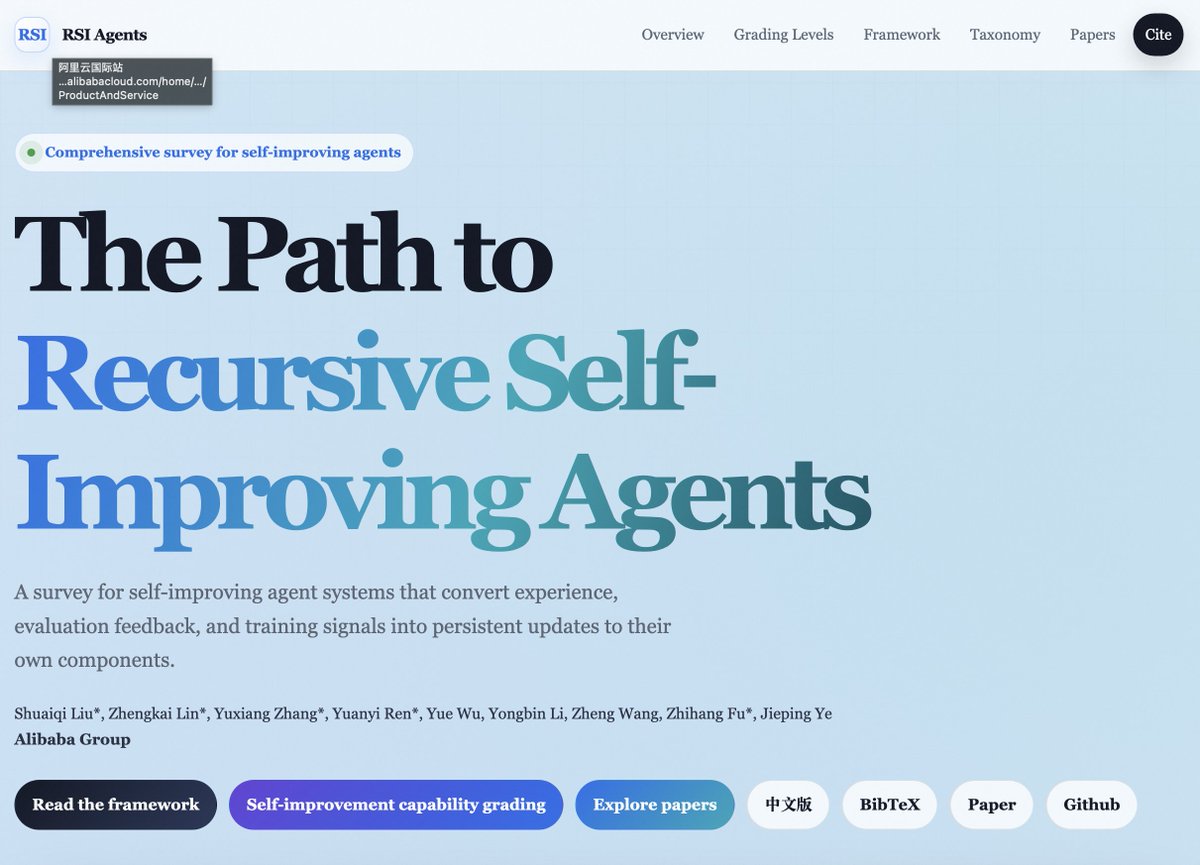
The Path to Recursive Self-Improving Agents
Foundation. Framework. Future directions.
Paper: https://t.co/xmXmVQsMcz
Five open fronts shape the road to reliable RSI:
• evaluation
• infrastructure
• generality
• safety & controllability
• human–agent co-improvement
Explore the project and paper collection:
https://t.co/7qOS4yYA72
Which systems are closest to L4—and what are we missing?
What does it take for an AI agent to improve not just its behavior, but the process by which it improves?
We’re excited to share our new survey:
The Path to Recursive Self-Improving Agents
Foundation. Framework. Future directions.
Paper: https://t.co/xmXmVQsMcz
What does it take for an AI agent to improve not just its behavior, but the process by which it improves?
We’re excited to share our new survey:
The Path to Recursive Self-Improving Agents
Foundation. Framework. Future directions.
Paper: https://t.co/xmXmVQsMcz
We define self-improvement as persistent updates to an agent system’s own components—not merely adaptation within one run.
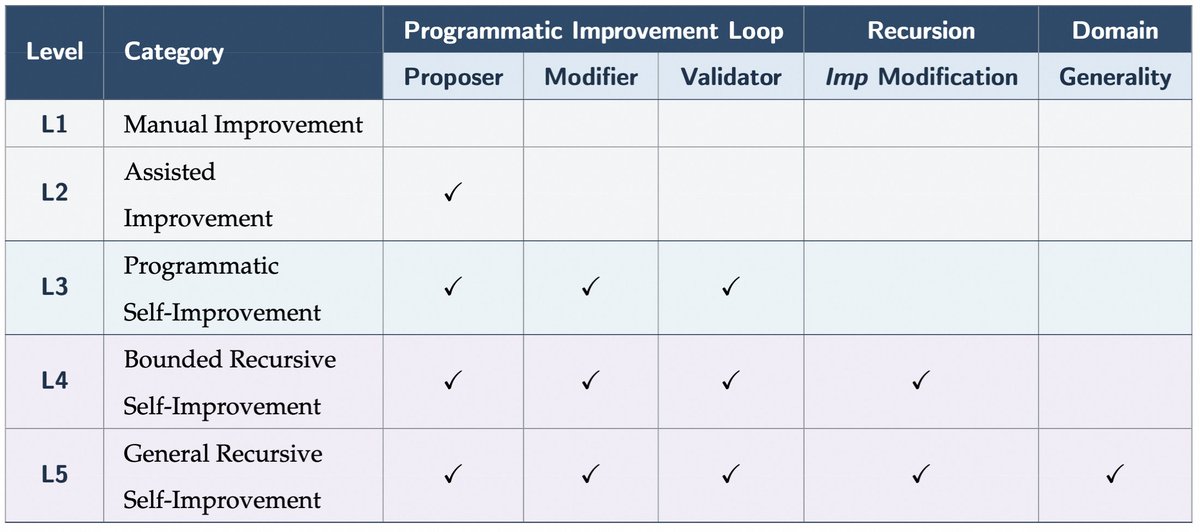
We then introduce an L1–L5 capability scale, from manual improvement to general recursive self-improvement.
What does it take for an AI agent to improve not just its behavior, but the process by which it improves?
We’re excited to share our new survey:
The Path to Recursive Self-Improving Agents
Foundation. Framework. Future directions.
Paper: https://t.co/xmXmVQsMcz
Our unified framework models five coupled components:
• foundation model
• agent harness
• data system
• trainer
• improvement mechanism
The key RSI step: the system improves not only its capabilities, but also how it improves.
📊 +1.3% Accuracy with -8.6% Token Usage
🧩 Training-free representation editing
🔌 Plug-and-Play with vLLM
By monitoring step-level difficulty in real-time. It acts as a "brake"—slowing down only on complex sub-problems to allocate sufficient space for deep thinking.
Human cognition toggles between Fast & Slow thinking. Why not LRMs?
Presenting our #NeurIPS25 Spotlight: Thinking Speed Control. We enable dynamic reasoning speed adjustment WITHOUT any training!
📄 Paper: https://t.co/hYNgAqL5YY
💻 Code: https://t.co/3h20XQKEt0