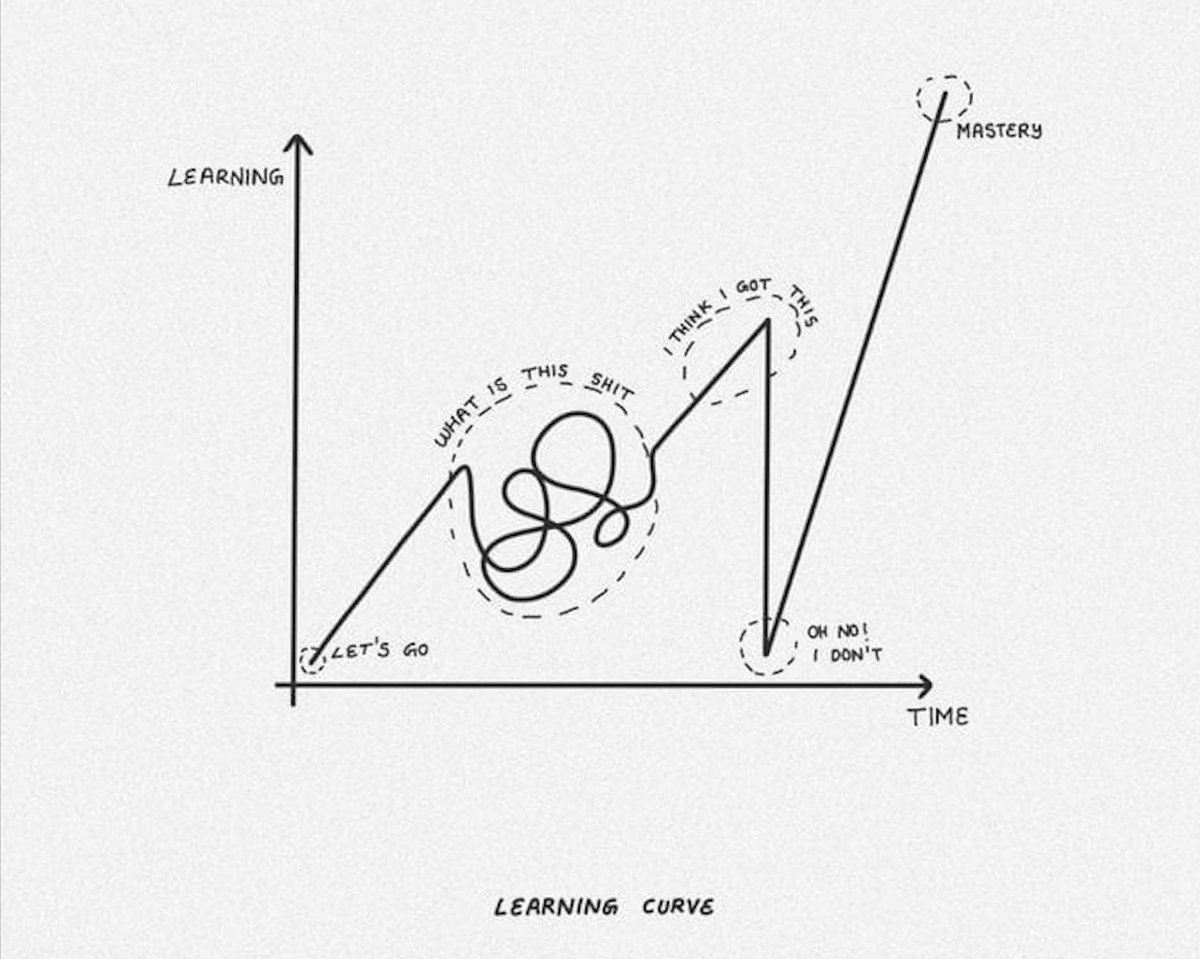
Walt Disney got fired for "lacking imagination."
James Dyson created 5,127 failed prototypes.
Sara Blakely was told no by every manufacturer.
Elon Musk nearly went broke funding Tesla and SpaceX.
Jack Ma failed his college entrance exam twice.
Here's the truth nobody admits:
Every founder you admire failed their way to success.
The only difference? They understood failure is tuition, not a verdict.
In early 2003, LinkedIn's team worried that users wouldn't understand the site without one feature: Contact Finder, a request forwarded contact to contact until it reached the right person.
They launched without it.
14 years later, Reid Hoffman wrote that it still hadn't been built. His rule:
"If you're not embarrassed by the first version of your product, you've launched too late."
Texas averaged 197 days of large hail a year between 2012 and 2024.
Hailstones an inch across or bigger, somewhere in the state, more than half the days of the year.
Nearly 8 million Texas properties carry moderate or greater hail exposure, with $3.1 trillion in reconstruction value, according to a September analysis in Claims Journal by a senior building consultant.
The losses have moved well beyond houses. DNV, the engineering firm, estimates hail losses on Texas solar farms alone have passed $600 million since 2018. One March 2024 storm at the Fighting Jays solar farm in Fort Bend County is expected to cost hundreds of millions to remediate on that single project.
Then there are the rooftops. Schools, hospitals and commercial buildings carry their HVAC equipment on the roof, directly under the hail. Older units running R-22 refrigerant are a particular trap. The refrigerant has been banned from production since 2020, so a damaged condenser can mean replacing far more than the part that was hit.
Most claim fights start right there: repair or replace. What the policy owes versus what the adjuster offers.
For an institutional owner, the time to understand that fight is before the storm.
About 54,000 older Australians are still waiting for full home care.
They're not on the official waitlist.
Get 60% of your approved care and you're off the list. The Minister says 100,000 are waiting. The ABC counts about 154,000.
https://t.co/EBYAji3Loc
Steven Bartlett hosted Harvard professor Daniel Lieberman.
He broke down 8 of the biggest health myths about sleep, exercise and ageing:
1. You need 8 hours of sleep a night.
In November 1995, Bill Gates tried to explain the internet to David Letterman.
People publish information, Gates said. Everybody can have a home page. You can send electronic mail.
Letterman had heard you could now listen to a baseball game on a computer. "Does radio ring a bell?"
From Letterman.
24 people applied when KFC came to Jack Ma's city. 23 were hired.
He was the one turned down.
The police took 4 of 5 applicants. Not him either. He was rejected for 30 jobs, and by Harvard 10 times.
At Davos in 2015, he said: "We have to get used to it."
From the World Economic Forum.
In 2008, SpaceX's first three rockets had all failed to reach orbit.
60 Minutes asked Elon Musk if he ever thought about packing it in.
"Never. I don't ever give up."
The fourth launch reached orbit. He said there was no money left for a fifth.
From 60 Minutes, 2012.
When people say AI, they're talking about the head of the missile.
The missile underneath it is electrification.
Everything needs power. Energy is the crux of the problem, and copper is how the energy gets delivered.
So copper is the bottleneck.
That's why nations are moving to secure strategic minerals. If they don't line up their supply channels, everything grinds to a halt.
And the AI race is almost an existential race. If your AI isn't up to snuff, you're not going to be competitive in anything.
So governments are throwing massive support at this sector. They're cutting red tape and doing things governments don't normally do. If they don't, they'll never catch up.
Meanwhile, supply isn't growing nearly as fast as it should. There are real supply issues in places like Chile and the Congo. And this space has been massively underinvested for the last 25 years.
Even if you know exactly where the copper is, you can't get it out tomorrow.
The math is super compelling.
$PNPN.V | $PNPNF | $IVV1
168 hours in a week. Mohnish Pabrai's employer expected 40 of them.
He used to get top reviews. The day he committed to his startup, he set a new target at work: "just above firing level." Everything else went into the company.
From @StevenBartlett's The Diary of a CEO with @MohnishPabrai
Six months of arguing product direction, after the deal had closed. That was one of Nikesh Arora's first acquisitions.
So he changed the model. Founders now get 30 days with his product team, and the definitive term sheet waits until they sign a joint product roadmap.
From @davidsenra with @nikesharora
80% of the time, the customer came out to meet him.
Robert Herjavec hand-delivered every quote the same day, while his competitors mailed theirs. Even when customers said not to bother.
"Urgency gets you out of poverty. Patience gets you to wealth."
From Robert Herjavec, via @Codie_Sanchez
Last week, a couple on average wages lost $117,000 without losing their jobs.
No pay cut. No layoff. Just one board meeting.
The rate rise cut their borrowing power by close to $117,000.
There has to be another way in.
https://t.co/JV4vYk39FQ
In 2018, Sam Altman asked founders to judge a market the way investors judge a startup: by how fast it can grow.
The size today can hide the opportunity ahead.
From Sam Altman at Y Combinator's Startup School.
In this 50-second clip, Ray Dalio describes the risk that ends the game.
He explains how caution and practice let people try again after a fall.
From Ray Dalio on The Jay Shetty Podcast, June 2019.
In July 2024, Amjad Masad showed Paul Graham Replit's AI agent, two months before launch.
Graham's reaction: "It freaked me out."
The idea behind it was his own: make something 10% easier and you don't get 10% more people. You get twice as many.
From @amasad with Paul Graham
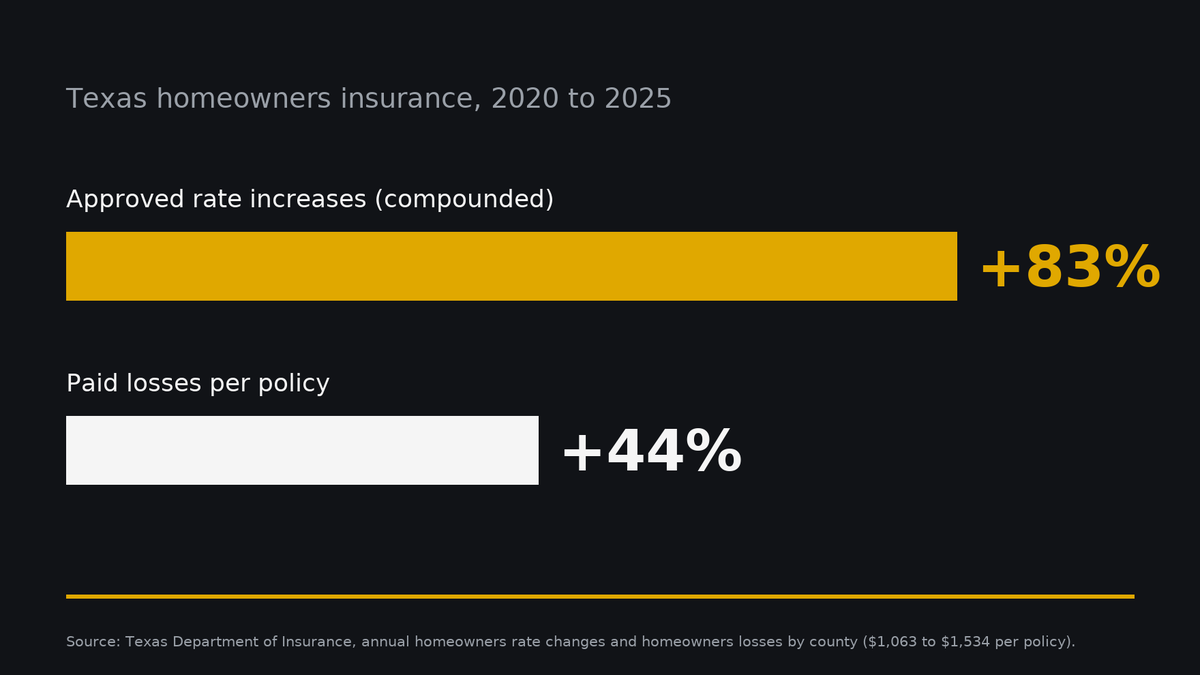
Texas approved home insurance rate increases of 83% over six years.
What insurers actually paid out, per policy, rose 44%.
Both numbers come from the Department of Insurance.
TDI publishes the average statewide homeowners rate change every year. Compound them from 2020 through 2025 and you get 83%.
TDI also publishes what companies paid on home claims, county by county, every year. In 2020 that was $1,063 per policy. In 2025 it was $1,534. That is 44%.
Rates roughly doubled. Payouts per policy went up about half as much.
There are real reasons for part of that gap. Reinsurance costs moved. Rebuild costs moved. Carriers price for the catastrophe they have not had yet, not the one they just finished paying.
But a gap that size is not a rounding error, and it is worth saying plainly, because the people carrying it are usually the ones least able to argue with it.
One more number from the same dataset, because it complicates the story rather than simplifying it.
Insurers paid less per policy in 2025 than in 2024. $1,534 against $1,801.
Rates were approved upward again that year anyway.
Before your next renewal, ask which of these two lines your increase is tracking.
$2,000 of judgment at the front desk.
Greg Isenberg uses Ritz-Carlton's employee-spending rule to explain what a startup can change about customer service. His opening scene is a hypothetical date at the hotel.
From Greg Isenberg.
I used to tell investors to stop calling us a nickel company.
Back then nickel was a four-letter word.
Now I think it's on the rise.
Lion is copper, palladium, platinum, gold and silver, and it sits over top of a nickel ore body. Nisk Main, the deposit that first brought us to this property, is nickel too.
So I watch that market closely.
The single biggest change is in Indonesia. It's curtailing some of the environmental issues it's had with its Chinese developers. That's slowing the rapid expansion over there and changing the cost structures.
Demand is coming back as well.
And when the Indonesian market ran into trouble, a number of mines were shut in. Once a mine is shut down, it's very tough to get it back up again.
Put those together and the supply dynamics change.
Then there's the question that will matter more and more in the economics of mining. Where does the metal come from?
Is the jurisdiction safe?
Can you get the mine permitted and built?
Does the country have the rule of law, and does it protect investors' interests?
The market desperately needs nickel, especially from a safe domestic jurisdiction.
Nisk is in Quebec. Right off the road, with power next to the site. It just doesn't get any better.
And the cost side works for us. Norilsk and the other ortho-magmatic deposits are all proven to produce cheaper than Indonesia. That's a fact, and it's well documented.
For a long time investors didn't want to hear the word.
I think nickel could be a good spot to be.
$PNPN.V | $PNPNF | $IVV1
In 1998, Sara Blakely was 27 and still selling fax machines door to door.
She had $5,000 in savings and one idea: pantyhose with no feet.
She drove to North Carolina, home to most of America's hosiery mills. Every one turned her away.
Two weeks later, a mill operator in Asheboro called. His three daughters had talked him into it.
To win Neiman Marcus, she took the buyer into the ladies' room and changed into the product.
Spanx did $4 million in sales its first year. In 2012, Forbes put her on its cover as the youngest self-made female billionaire in the world.
In 1994, nine years after he was pushed out of Apple, Steve Jobs sat for an interview with the Silicon Valley Historical Association.
This is the part people still pass around.
Video: Silicon Valley Historical Association