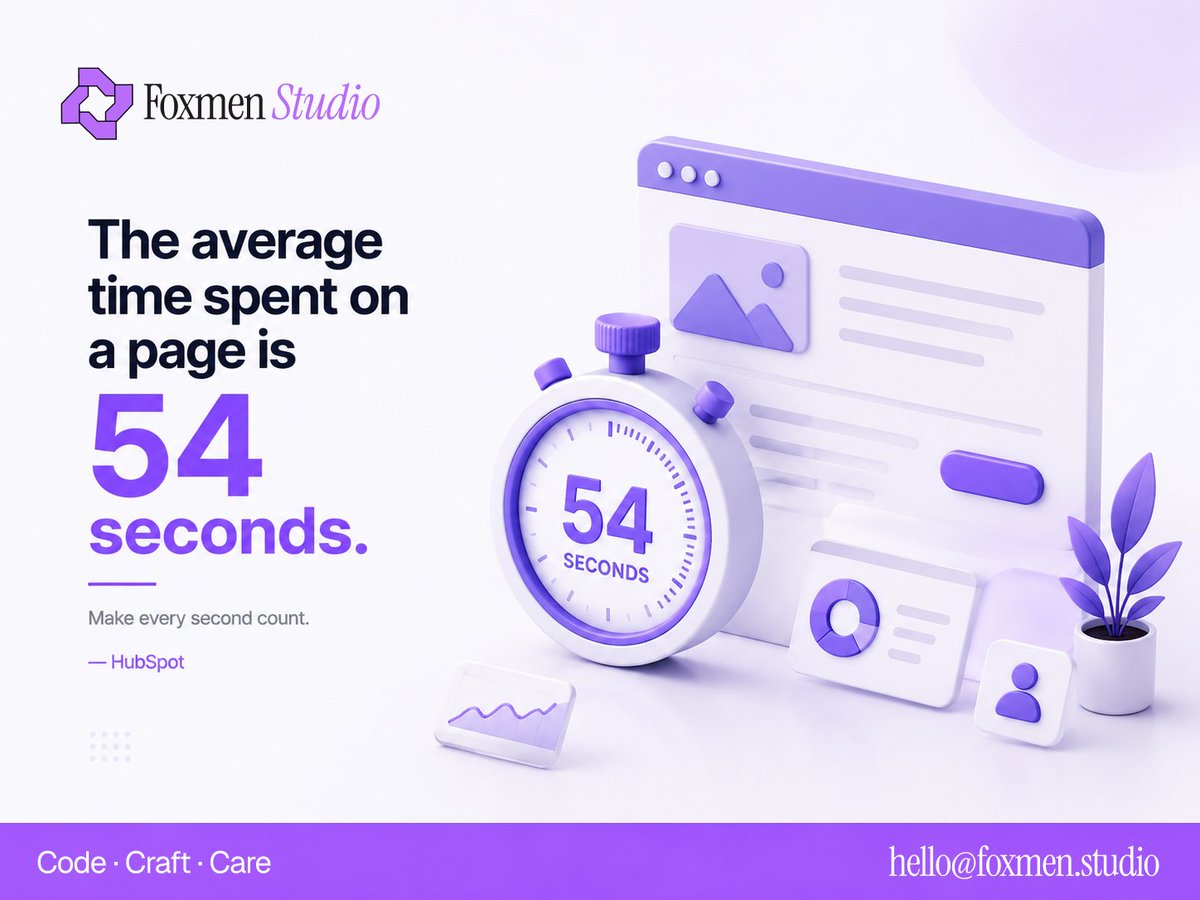
You have about 54 seconds to convince someone your website is worth their time.
The average time a visitor spends on a single webpage is commonly reported to be just 54 seconds.
That’s not a lot of time to capture attention, communicate what you do, build trust, and guide someone toward taking action.
And that’s exactly why your website can’t just look good.
Your visitors should be able to understand:
→ Who you are
→ What you offer
→ Why they should trust you
→ What they should do next
A confusing layout, slow experience, weak messaging, or difficult navigation can give visitors a reason to leave before they ever discover what your business has to offer.
Your website has a job is turn limited attention into meaningful engagement.
Because every second your visitor spends on your site is an opportunity to build trust, communicate value, and move them closer to becoming a customer.
Make every second count. Just like we do at Foxmen
According to Forbes Advisor, 27% of all business activity is now conducted online, reflecting the increasing importance of the internet in today's business world and the growing trend of e-commerce. That means more than 1 out of every 4 dollars of business activity in the US now happens online.
If a quarter of all commerce has already moved online, a business with no site or a neglected one isn't just "missing an opportunity." It's structurally cut off from a growing share of its own market.
Every year that percentage climbs, and every year that business stays offline, the gap between them and their competitors gets wider and wider..
It compounds in a second way too. Forbes Advisor also notes 43% of small businesses are planning to invest in the performance of their website this year alone. That's not a business building a site for the first time. That's businesses who already have one, actively working to make it faster and better, because they know standing still online means losing ground.
So the businesses without a website aren't just behind the 27%. They're behind competitors who are actively investing to grow that number further, every single year.
Your online presence shapes whether customers trust and choose you. Most small businesses don't fail from bad products, they fail from weak marketing and websites that lose trust before a word is read. See why your website matters more than you think. https://t.co/fqcDh42yJ2
Everyone's got "AI" slapped across their homepage right now. Behind a lot of those sites though, it's low-code wrappers, unreviewed AI output, and zero visibility in AI search results.
So how do you tell who can actually build?
> Ask to see their schema
Real technical depth means clean semantic HTML and custom JSON-LD, the kind that gets ChatGPT, Perplexity, and Google actually citing your brand.
> Ask how they review code
AI-generated code that nobody checks is how you end up with security holes and tech debt six in months. Professional teams still run senior developers through every commit.
> Look past the plugin list
If the "custom solution" breaks every time an API changes, that's not architecture. That's a shortcut, not a system.
AI is genuinely useful for speed. It's not a replacement for knowing how to build something that holds up.
We learned most of this the hard way at Foxmen Studio, building for our own clients. A lot of what looks fine in a demo breaks the moment it hits real traffic. So now we build with that in mind from the start.
Before you sign with anyone, look under the hood first.
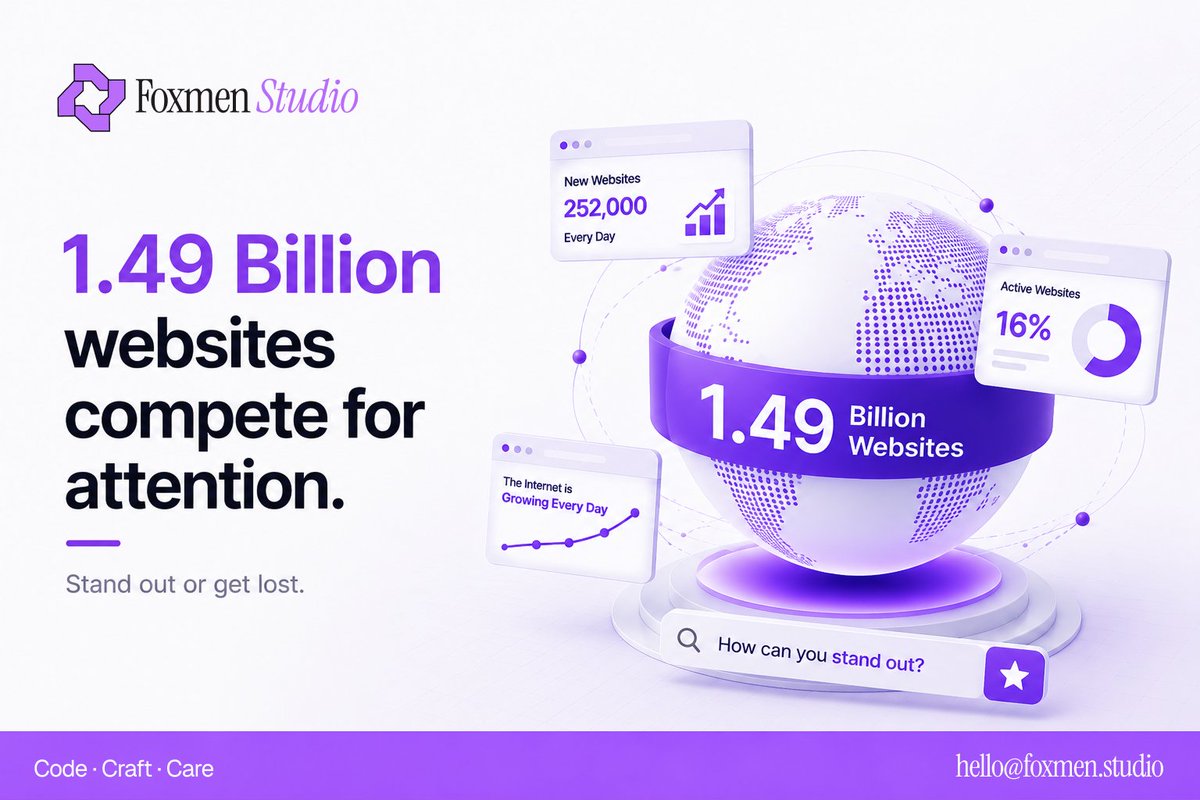
The internet just crossed 1.49 billion websites.
Only 217.7 million of them are actually active. That's about 14.6%.
The other 85%? Parked domains, dead blogs, and business sites that got launched once and never touched again.
Here's the problem nobody talks about when they launch a site:
A website isn't a one-time project. It's a system that breaks quietly. Plugins go stale, security patches get skipped, content stops getting updated, page speed rots as the web moves on, and Google notices before your customers do. None of this happens in one dramatic crash. It happens in slow neglect, one skipped update at a time, until the site is technically "live" but functionally dead.
That's how most of that 85% got there. Not because the business failed. Because nobody kept maintaining the site after launch.
Some numbers that back this up:
→ 1.49B websites exist, but Netcraft's June 2026 survey shows only 217.7M are actually active
→ Even with roughly 703,000 new sites detected per day, most never survive past launch mode
→ The gap between "live" and "active" is almost entirely a maintenance problem, not a build problem
If you're a business owner, here's the uncomfortable question: when was the last time someone actually looked at your site? Not redesigned it. Looked at it. Checked the speed, updated the content, fixed what's broken.
If the answer is "I don't know," you're closer to that 85% than you think.
What separates a digital product studio from an agency?
Ownership.
We don't just execute requirements—we help shape products, improve UX, and focus on outcomes that matter.
- 50+ Projects done
- 5 Countries served
- 98% Client retention
Let's build something people love using.
What separates a digital product studio from an agency?
Ownership.
We don't just execute requirements—we help shape products, improve UX, and focus on outcomes that matter.
- 50+ Projects done
- 5 Countries served
- 98% Client retention
Let's build something people love using.
We're live on @dailydotdev
Join the Foxmen Studio @dailydotdev squad and stay connected with the latest web design & development updates.
Join now → https://t.co/Frk6rgACg8
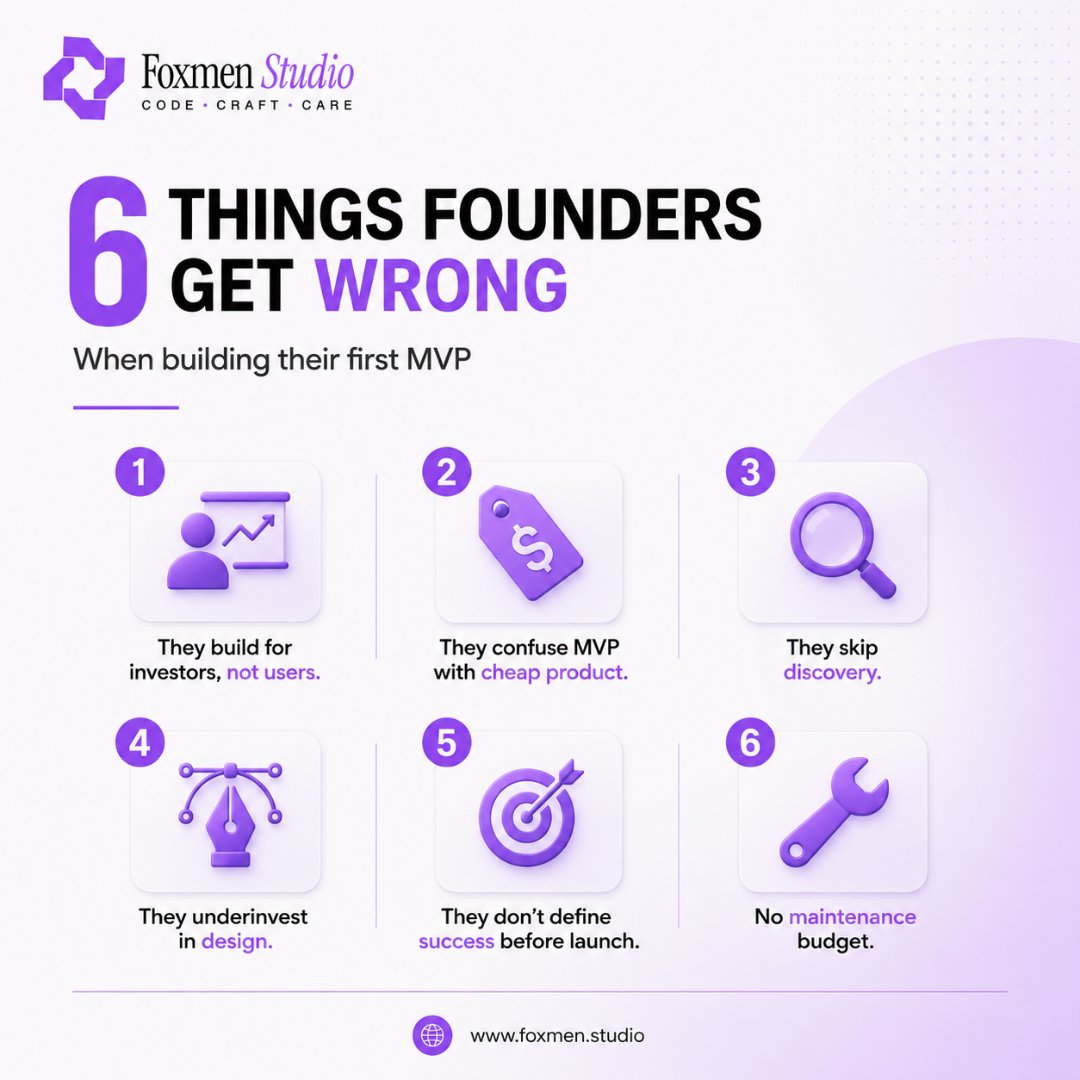
6 things founders get wrong when building their first MVP
1/ They build for investors, not users.
2/ They confuse MVP with cheap product.
3/ They skip discovery.
4/ They underinvest in design.
5/ They don't define success before launch.
6/ No maintenance budget.
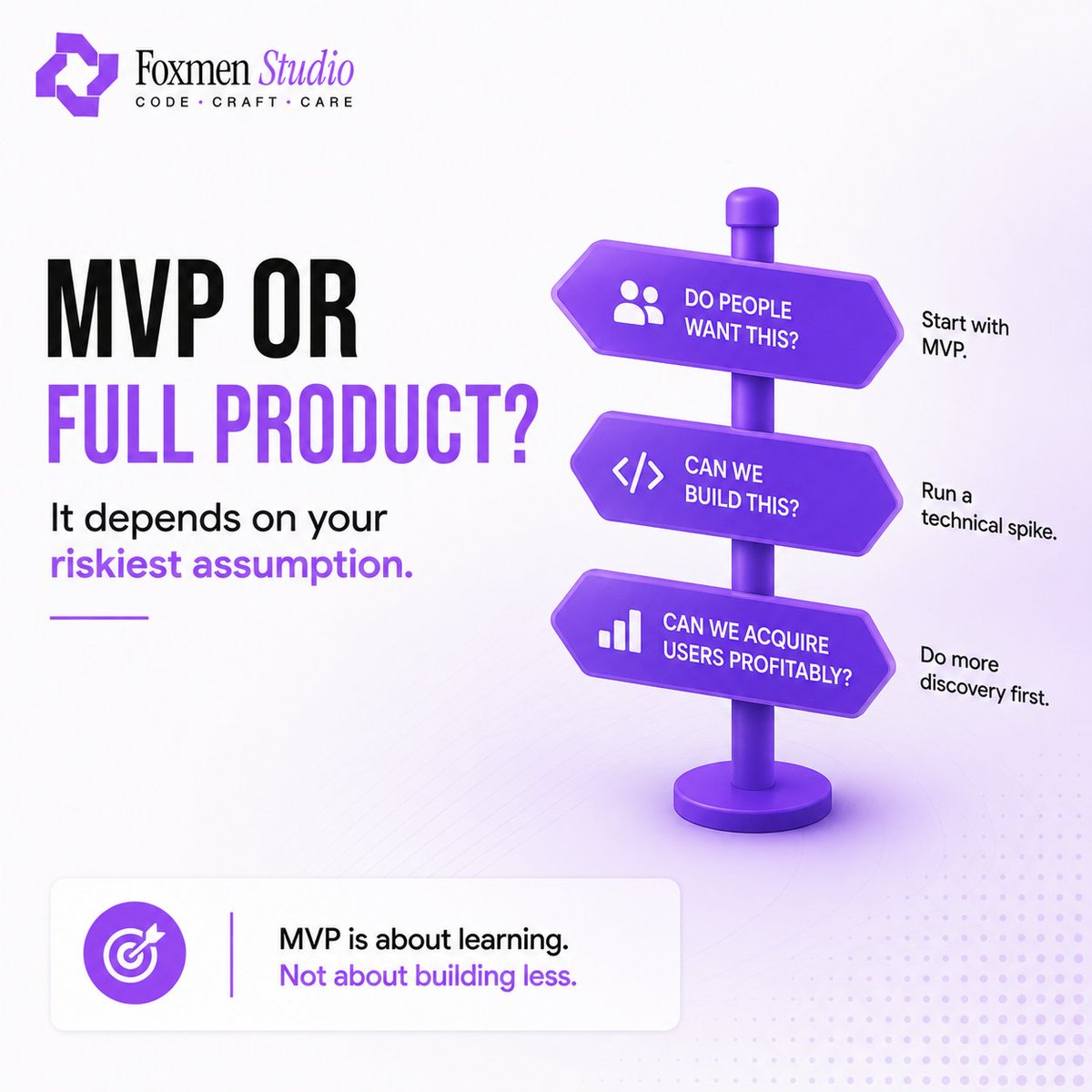
Founders ask us every week: MVP or full product?
Depends on one question: what's your riskiest assumption?
If it's do people want this -> MVP.
If it's can we build this -> technical spike.
If it's can we acquire users profitably -> more discovery first.