When I write about the long-run consequences of population decline, I’ve noticed that most people cannot grasp what a total fertility rate (TFR) of 1.1 means. Many of my readers look at 1.1 and treat it as not that different from 2.1. This is the wrong way to think about it: TFRs are like interest rates; they compound over time.
To make the point, I ran the following simulation. I built the population structure of a country with 1 million inhabitants, a TFR of 2.1 (just at replacement level), and a life expectancy of 85 (with realistic survival rates). Thus, this country has a stationary population over time.
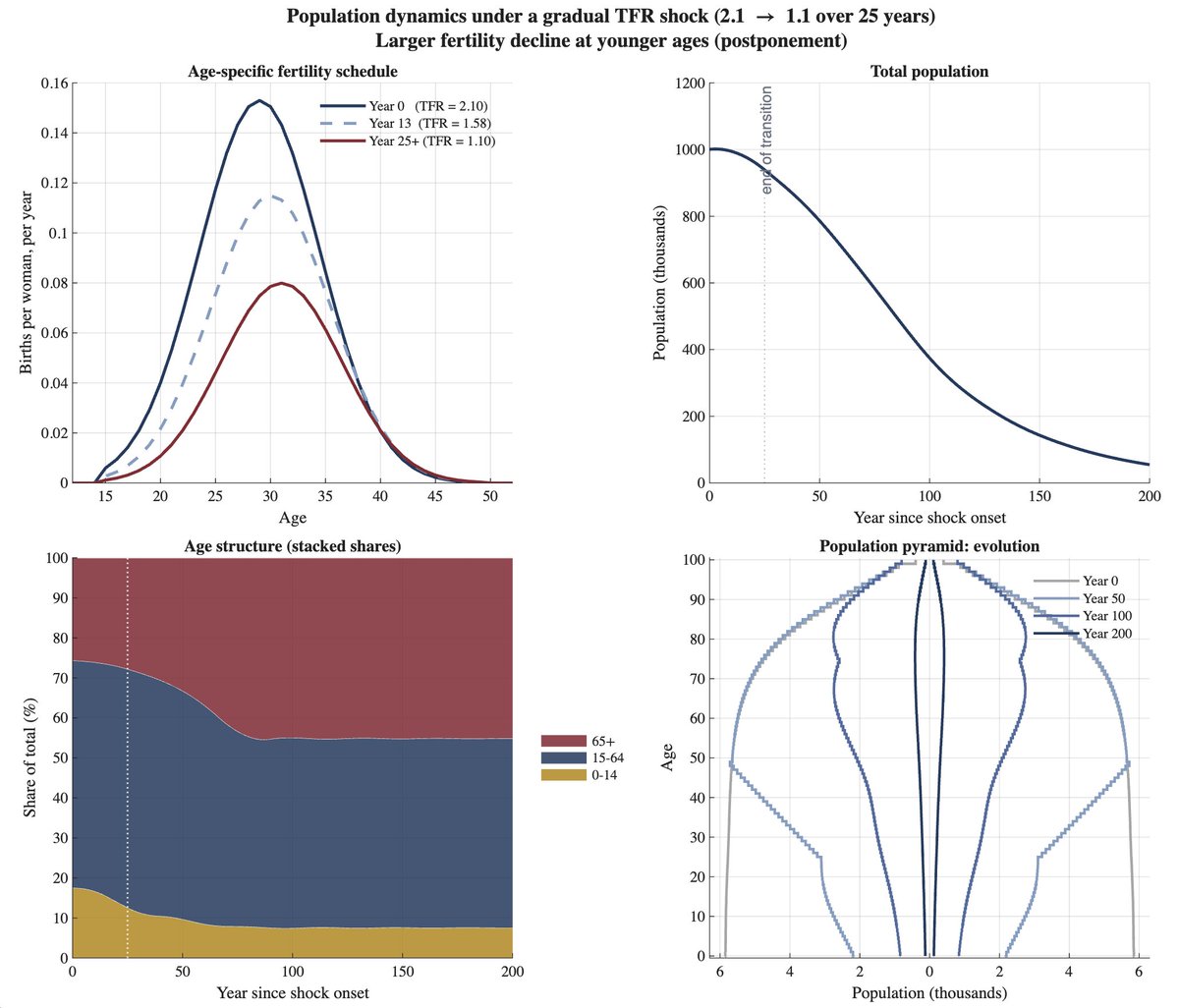
I then hit this country with a reduction in the TFR from 2.1 to 1.1. The reduction, which takes 25 years to complete, is similar in size and duration to what we’ve seen in many advanced and middle-income economies. It is also concentrated among younger women, with fertility postponed to later years. I plot the initial, middle, and final TFR in the top-left panel of the figure.
I then simulate the next 200 years of this population. By the year 200, the original 1 million has fallen to 54,900, a 95.5% reduction. The top-right panel illustrates this evolution. This is not a minor adjustment: it means closing 95 of every 100 universities, hospitals, and shops. Since the population is likely to concentrate in a few remaining cities, nearly the whole country becomes a population desert.
The bottom two panels show the population structure and pyramids. The population stabilizes at a median age of 61 and an old-age dependency ratio of 95.21%.
You might argue that TFR is unlikely to remain at 1.1 for so long because higher-fertility subgroups (e.g., the highly religious) would grow as a share of the population. Fair enough. But I am not offering this simulation as a forecast. I am illustrating how, at current rates, countries of 50 million people (roughly South Korea or Spain) would become countries of 2.75 million, ignoring immigration.
These are the issues for the next century.
James Van Der Beek’s final message to the world is one of the most powerful things I have ever heard. Stop whatever you are doing and listen to this! 🥺
My prayer today is for Catholics who have lost or abandoned their faith or drifted into schism and heresy because of the hypocrisy, incompetence and human frailty of their fellow Catholics.
reminds me of this quote by St. Augustine
“People travel to wonder at the height of mountains, at the huge waves of the sea, at the long courses of rivers, at the vast compass of the ocean, at the circular motions of the stars, and they pass by themselves without wondering.”
Christians Decide To Put Aside Their Petty Differences And Unite For The Gospel (Haha Just Kidding We’re Fighting Each Other Online) https://t.co/V361GSLG4Z
Dear priests, thank you for your lives given in service to the Kingdom, for your daily efforts, for what you endure in silence, which is sometimes accompanied by suffering or misunderstanding. You are all precious in the eyes of God and essential in fulfilling His plan.
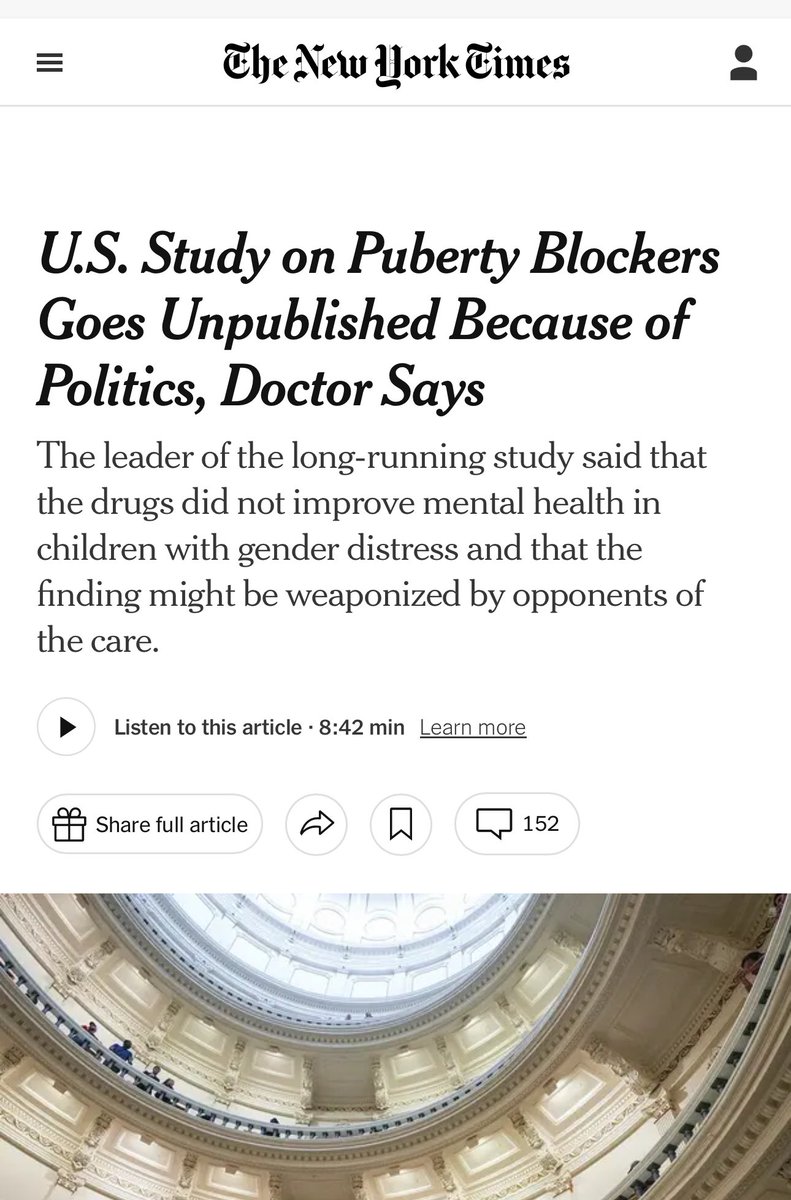
'We must not publish a study that says we're harming children because people who say we're harming children will use the study as evidence that we're harming children, which might make it difficult for us to continue harming children.'
A lot of events brought America to the political precipice it faces tonight, but I think we all know where it all started: with the nominalist metaphysics of thirteenth-century philosopher William of Ockham.
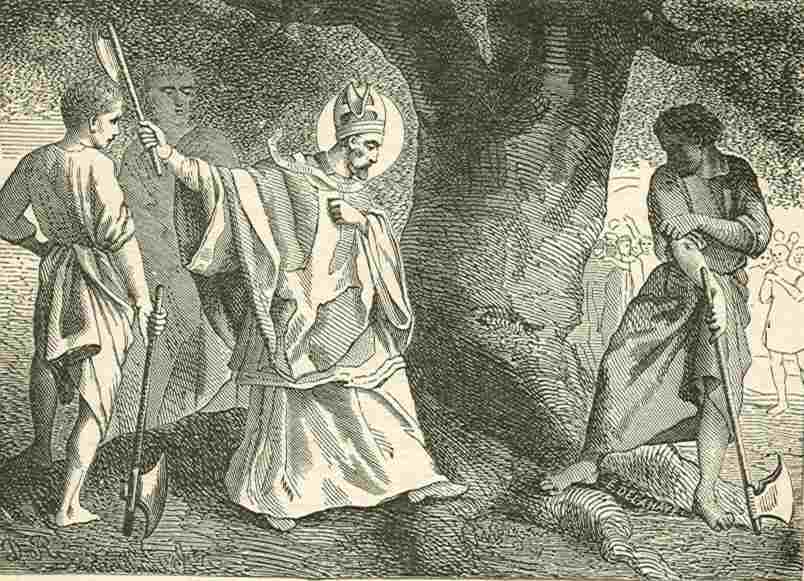
St Boniface was not afraid to chop down things leading his people into sin
What are the false gods in our own lives that we'd be far better off just cutting out?
A phone, computer, alcohol, reputation, even a job or relationship—none of these are worth the loss of eternal life.