🎉 Thrilled to share that our paper received the Best Paper Award at the CV4AEC at CVPR 2026!
Huge thanks to my co-authors, the organizers, and the entire CVPR community! 🙏
#CVPR2026#CV4AEC
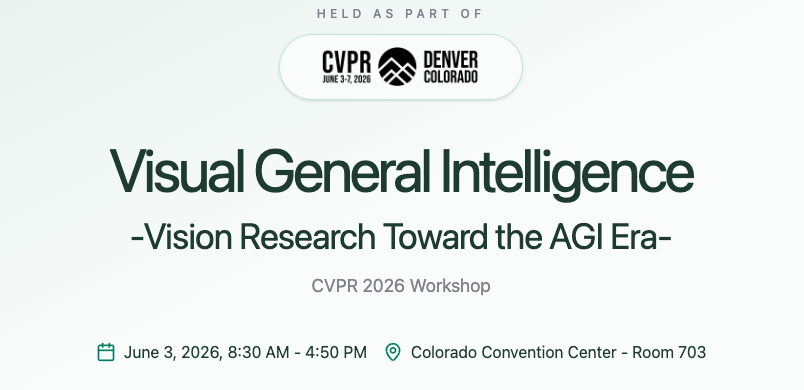
Our Workshop will take place on June 3, 8:30 AM in Room 703😃
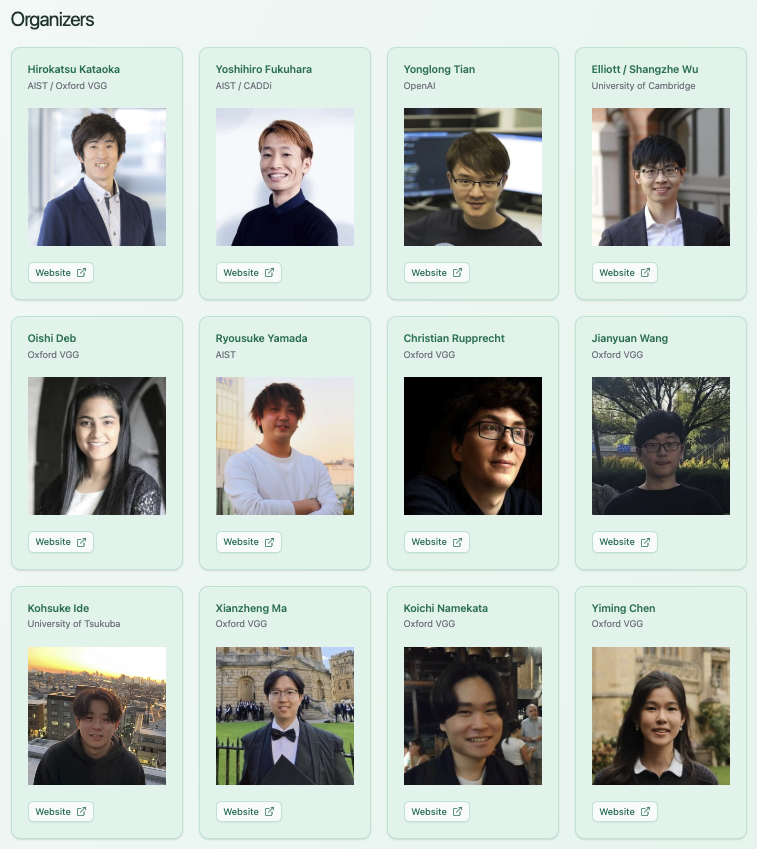
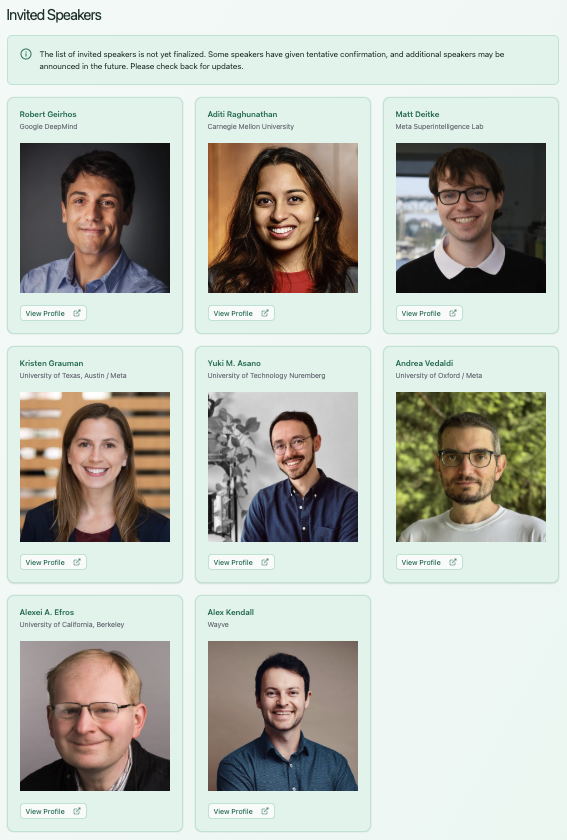
With a great lineup of speakers, we look forward to discussing:
What is Visual General Intelligence?
Let’s think together about the future of the field!!
Please join!!
#CVPR2026@CVPR
Our Workshop will take place on June 3, 8:30 AM in Room 703😃
With a great lineup of speakers, we look forward to discussing:
What is Visual General Intelligence?
Let’s think together about the future of the field!!
Please join!!
#CVPR2026@CVPR
Our Workshop will take place on June 3, 8:30 AM in Room 703😃
With a great lineup of speakers, we look forward to discussing:
What is Visual General Intelligence?
Let’s think together about the future of the field!!
Please join!!
#CVPR2026@CVPR
How can we effectively adapt and leverage foundation models in computer vision?
At the BigMac Workshop, we will explore research directions in the era of foundation models through talks by an amazing lineup of speakers!!
📅 June 4, 1:00 PM
📍 Room 2E-2H
#CVPR2026@CVPR
How can we effectively adapt and leverage foundation models in computer vision?
At the BigMac Workshop, we will explore research directions in the era of foundation models through talks by an amazing lineup of speakers!!
📅 June 4, 1:00 PM
📍 Room 2E-2H
#CVPR2026@CVPR
We will present our work on fine-grained Hand-Object Interaction understanding VideoQA benchmark (HanDyVQA) at the #CVPR2026 main track! Say hello at
- #EgoVis Workshop Poster (3rd 15:30-16:15)
- Poster Session 1 (5th 10:45-12:45)
I’ll be at #CVPR2026 this week!
@AIST_EN will have a sponsor booth, and I’m looking forward to meeting many potential collaborators there😀
If you are interested in research opportunities in Japan, please stop by and say hello!!
📍 AIST Booth #816
#CVPR2026AIST@CVPR
How can we effectively adapt and leverage foundation models in computer vision?
At the BigMac Workshop, we will explore research directions in the era of foundation models through talks by an amazing lineup of speakers!!
📅 June 4, 1:00 PM
📍 Room 2E-2H
#CVPR2026@CVPR
Our Workshop will take place on June 3, 8:30 AM in Room 703😃
With a great lineup of speakers, we look forward to discussing:
What is Visual General Intelligence?
Let’s think together about the future of the field!!
Please join!!
#CVPR2026@CVPR
🎉[openings] I’m hiring postdoctoral researchers to join our @FunAILab at UTN through the Alexander von Humboldt Research Fellowship (@AvHStiftung), via the Henriette Herz Scouting Programme.
As a Henriette Herz Scout, I can nominate outstanding international researchers for this fellowship route. I’m especially keen to hear from candidates working on multimodal learning, video and image pretraining, and post-training.
Fellows would be hosted in our lab at UTN and work closely with us on these topics.
Key requirements:
* finished your doctoral studies less than 4 years ago or will finish in the next 6 months
* did not live/work in Germany in the last 10 years
* applications from female, trans* and/or non-binary candidates are highly encouraged!
Interested? Please send a short note with your CV, PhD year, current affiliation, 2–3 key publications, and a few lines on how your work connects.
Please share! 🔀
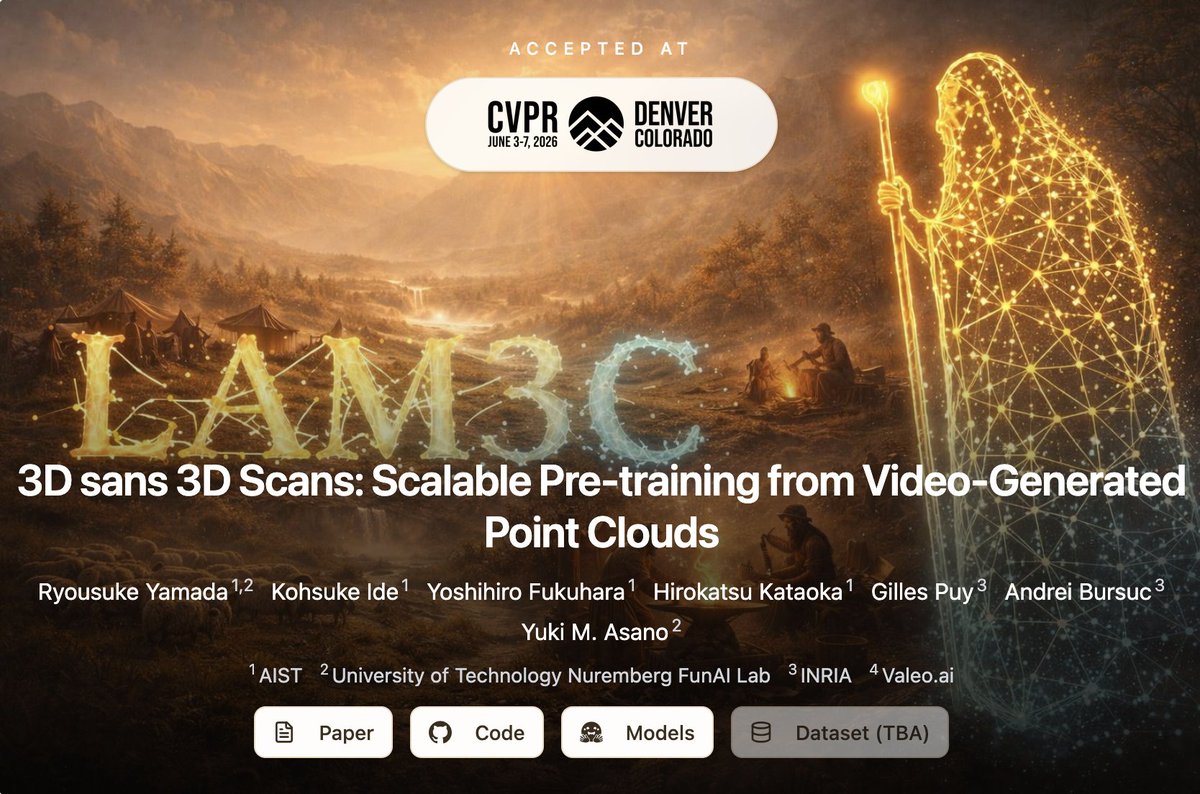
[new CVPR'26 paper]
🔄 SSL works great when you have tons of data.
But in 3D… we don’t.
High-quality 3D scans are expensive, slow, and hard to scale. So what if we could pretrain 3D models without any real 3D scans? 1/
Can we get a SoTA point cloud encoder without actual 3D scans?
Yes, we can, thanks to a clever mix of:
- data generation: video point clouds from web videos
- LAM3C: a new self-supervised learning strategy for such data
Super fun #cvpr2026 project led by @FragileGoodwill
👇
This work lies at the intersection of reconstruction × 3D point clouds (PC) × visual pre-training under limited data.
Video-generated PCs offer a scalable alternative for PC pre-training without (sans in French) relying on 3D scans.
https://t.co/89zvutBpfB
Super excited to share our project (LAM3C x RoomTours)!!
Can we learn 3D point cloud representations without real 3D scans?
Our work explores exactly this 👇
https://t.co/c6oLJ1BFNi
#CVPR2026@CVPR
[new CVPR'26 paper]
🔄 SSL works great when you have tons of data.
But in 3D… we don’t.
High-quality 3D scans are expensive, slow, and hard to scale. So what if we could pretrain 3D models without any real 3D scans? 1/
Can language models learn useful priors without ever seeing language?
We pre-pre-train transformers on neural cellular automata — fully synthetic, zero language. This improves language modeling by up to 6%, speeds up convergence by 40%, and strengthens downstream reasoning.
Surprisingly, it even beats pre-pre-training on natural text!
Blog: https://t.co/Pni0RsIcxL
(1/n)














![y_m_asano's tweet photo. 🎉[openings] I’m hiring postdoctoral researchers to join our @FunAILab at UTN through the Alexander von Humboldt Research Fellowship (@AvHStiftung), via the Henriette Herz Scouting Programme.
As a Henriette Herz Scout, I can nominate outstanding international researchers for this fellowship route. I’m especially keen to hear from candidates working on multimodal learning, video and image pretraining, and post-training.
Fellows would be hosted in our lab at UTN and work closely with us on these topics.
Key requirements:
* finished your doctoral studies less than 4 years ago or will finish in the next 6 months
* did not live/work in Germany in the last 10 years
* applications from female, trans* and/or non-binary candidates are highly encouraged!
Interested? Please send a short note with your CV, PhD year, current affiliation, 2–3 key publications, and a few lines on how your work connects.
Please share! 🔀](https://pbs.twimg.com/media/HHKGfgWXoAA-4Ga.jpg)
![y_m_asano's tweet photo. [new CVPR'26 paper]
🔄 SSL works great when you have tons of data.
But in 3D… we don’t.
High-quality 3D scans are expensive, slow, and hard to scale. So what if we could pretrain 3D models without any real 3D scans? 1/ https://t.co/73EFPE6iFH](https://pbs.twimg.com/media/HEpq_KjXAAEUaXD.jpg)