📢Paper alert: Matrix degradation enhances stress relaxation, regulating cell adhesion and spreading | PNAS. Often our studies focus on how the mechanics of the environment impact cell behavior...but it's a two-way street...cells can also effect changes on their environment.
ETH Postdoctoral Fellowships: A Prestigious Opportunity for Early-Career Researchers from ... - The ETH Zurich Postdoctoral Fellowship programme commonly known as ETH Fellows is one of Europe's most competitive and prestigious funding ... - https://t.co/BwBFcr9H4f
Federal funding for US biomedical research is moribund.
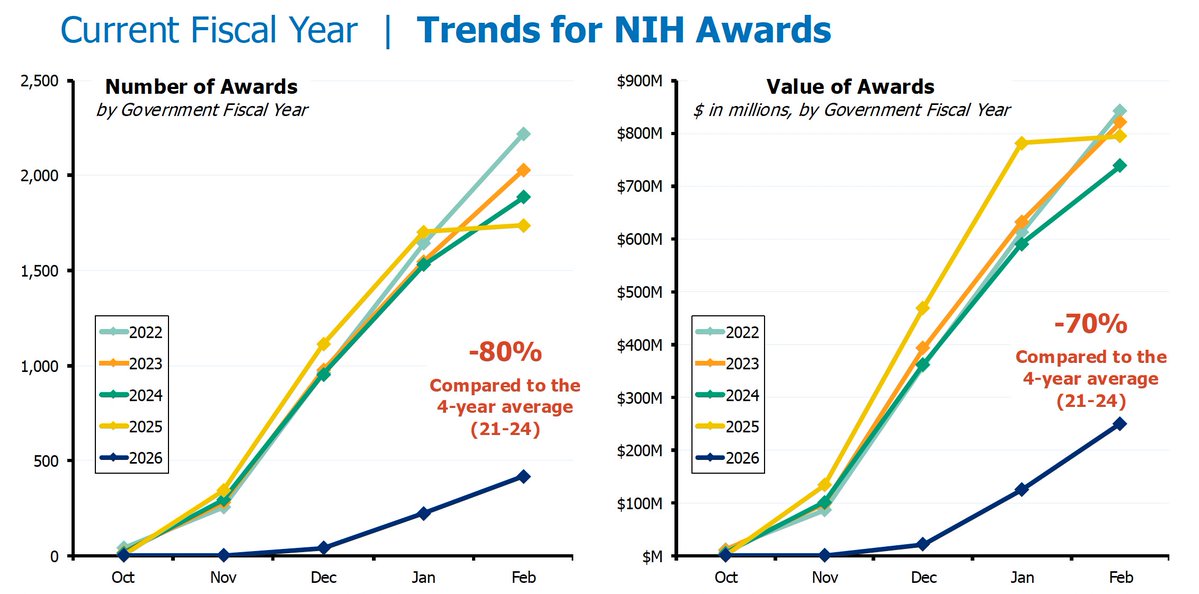
Since October 1 2025, NIH is -80% in new grants and -70% in values (total dollars).
Labs are closing down and researchers are leaving science.
To what end?
While you slept last night, BME kept millions of people alive. Pacemakers. Ventilators. Glucose monitors. Pain management systems. Lawmakers need to see what this field delivers 24/7.
Share your story: https://t.co/mm3g0zVEN4
#biomedicalengineering#bme#innovation #healthcare #bmes #PipelineToProgress
The N.I.H. has terminated hundreds of diversity grants awarded to young researchers, many of whom come from the very places that supported Trump.
https://t.co/4r684hWmPU
Since biomaterial properties are typically assessed post-manufacture without accounting for cellular modification, adjusting for degradation effects will be crucial for engineering biomaterials that sustain desired environmental conditions and regulate cell behavior effectively.
📢Paper alert: Matrix degradation enhances stress relaxation, regulating cell adhesion and spreading | PNAS. Often our studies focus on how the mechanics of the environment impact cell behavior...but it's a two-way street...cells can also effect changes on their environment.
This study shows that hydrogel degradability can be used as a design variable to engineer stress relaxation and cellular adhesion, with far-reaching implications for the development of future biomaterials.
Cells embedded inside these synthetic hydrogels and using their own MMPs showed a similar response, spreading less in the cell-degradable (CD) gels than the non-degradable (ND) gels.
To verify that cells were actually sensing the changes in stress relaxation caused by MMPs, we engineered a synthetic hydrogel with MMP-degradable peptides. When treated with increasing amounts of MMPs, its stiffness doesn't change, but it relaxes faster, like the natural ECM.
In this study, the incredibly talented @badz_nithin asked whether the small cuts in the ECM cells make with their MMPs change the mechanics of the environment in a way that cells can feel...a feedback loop! We found that even small amounts of MMPs change the architecture...
Cells do this in multiple ways, including by using enzymes called matrix metalloproteinases (MMPs) to trim away at their environment, the extracellular matrix (ECM).
Thank you @UCSD for building awareness and facilitating conversations about how federal funding fuels discoveries that cure diseases and solves global challenges. Check out the video about how federal grants work and what’s at risk if they’re cut!
https://t.co/J8awERAYds
The House just passed a Continuing Resolution (CR) to fund the government through September. Here’s what that means for science funding and what happens next.
@AdamSchiff As a biomedical researcher and your constituent, I urge you to finalize the government's Fiscal Year 2025 budget by the March 14 deadline with strong funding for R&D, which is essential to our nation's economic growth, public health, and competitiveness.