His book on the future of venture capital hit #1 on Amazon last year, with a foreword by Tim Draper. Today he’s in Las Vegas.
Rafe Furst (@RafeFurst), Chief Strategy Officer at @TheCryptoCo, closes out the week at Tokenize! AI, Politics, Payments & Entertainment in Las Vegas 2026.
Serial founder, WSOP champion, and advisor to more than 200 founders. One day left.
📅 October 19 to 21, 2026 | Monday to Wednesday
📍 Las Vegas, Nevada
🎟️ Last day to get in: https://t.co/Ng8ye8Okyn
Two weeks ago his company put a post-quantum Layer 1 into testnet. Seven million signed transactions and counting.
Ron Levy, CEO of @TheCryptoCo, is taking the floor at Tokenize! AI, Politics, Payments & Entertainment in Las Vegas 2026.
Frame is built as the interstate highway for crypto: value moving across chains, secured with NIST’s post-quantum standard. Ron co-founded the company in 2017 and has been bridging traditional finance and Web3 since.
📅 October 19 to 21, 2026 | Monday to Wednesday
📍 Las Vegas, Nevada
🎟️ Book your spot: https://t.co/Ng8ye8Okyn
You may have seen it moving. Now it's official: Frame testnet is live in private beta.
Quantum-resistant from genesis, built for cross-chain settlement in under two seconds.
We're already over 7 million test transactions signed with ML-DSA-87, NIST's highest-security post-quantum standard.
Good work by everyone who's been testing alongside us. More invitations going out soon.
Waitlist: https://t.co/LsBa02gTVU
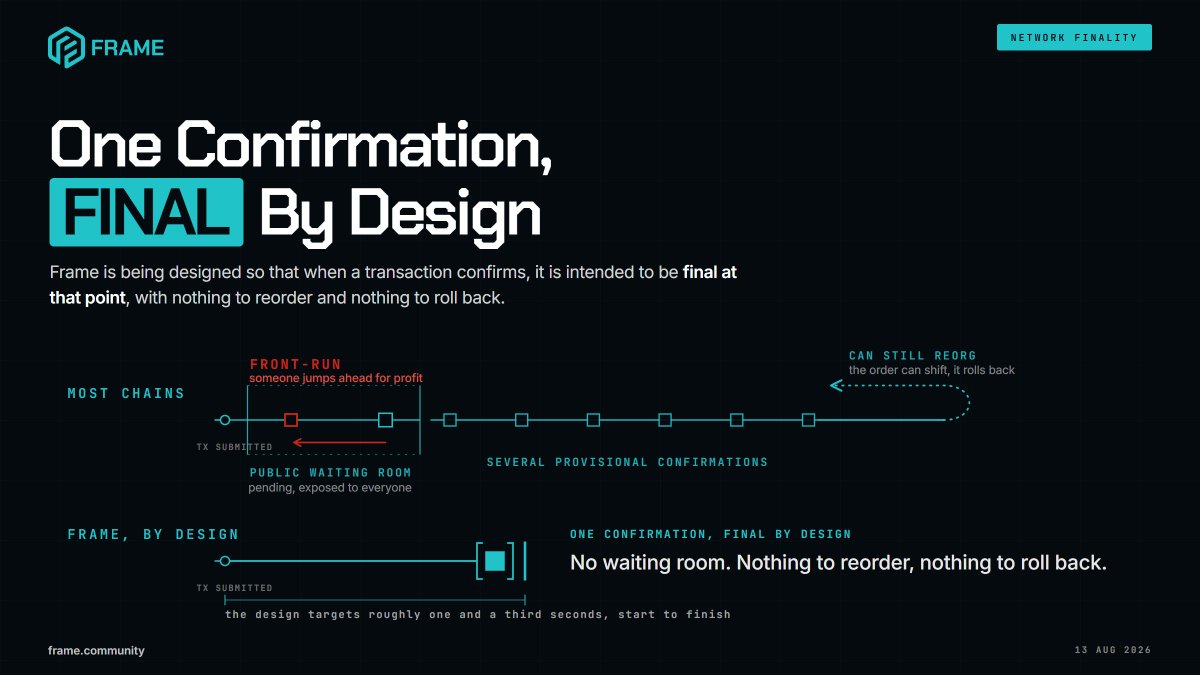
One confirmation, final by design. 1⃣
On most chains you can wait through several confirmations and hope the order didn't shift along the way. Frame is being designed so that when a transaction confirms, it is intended to be final at that point - nothing to reorganize or roll back.
With no public waiting room in the design, nothing sits exposed before it settles, which is intended to remove the chance for someone to jump ahead of your transaction for profit.
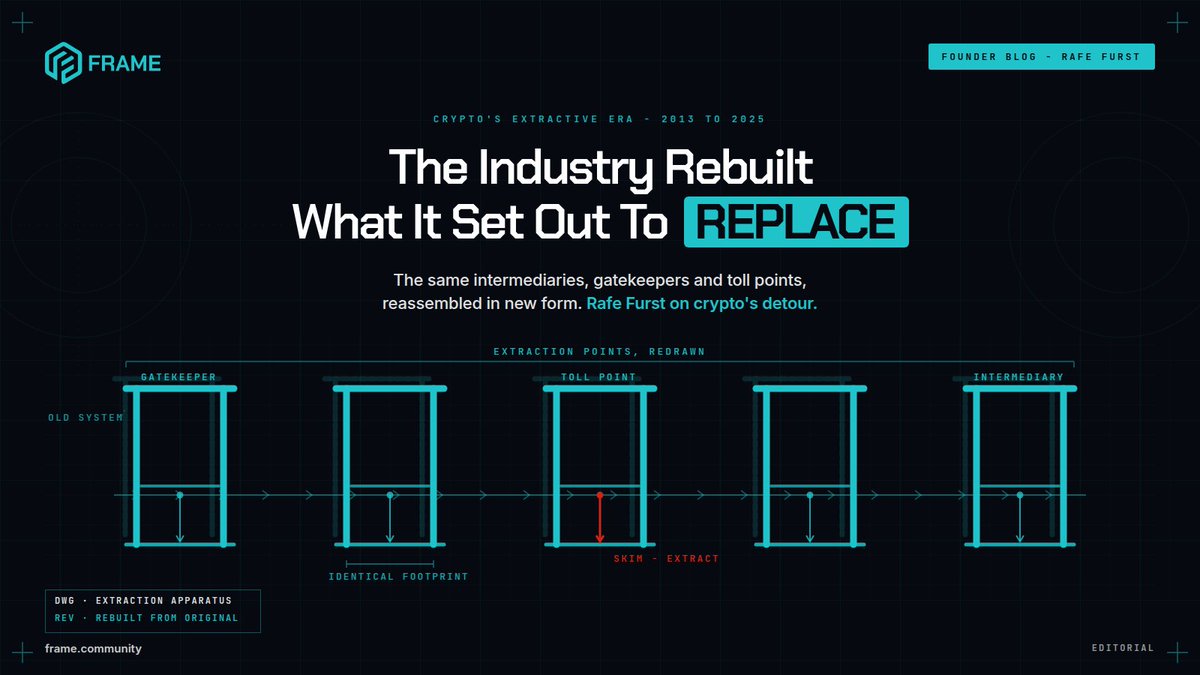
As crypto grew beyond Bitcoin, it rebuilt many of the structures it set out to replace.
- Bots skim from traders before settlement.
- Price feeds get bent.
- Bridges between chains have been drained of billions.
- Every chain became its own island, with an economy built on keeping others walled off.
Same intermediaries. Same toll points. The same blueprint, rebuilt in new forms.
Rafe calls the extractive era of 2013-2025 a detour, not the destination. 🧵
Frame is being designed as a break from that pattern.
The aim isn't another isolated ecosystem. It's infrastructure that removes the need for those barriers in the first place. ⚡
"A fair launch means nobody starts ahead of you."
That's how Sean opens his latest blog. No insiders on cheap tokens, or fund waiting to dump the second there's liquidity. Everybody walks up to the same starting line, and the network earns its way up from there.
Sean explains how we spent a year turning down venture money to protect that. The offers came with governance grabs, locked treasuries, and discounted tokens built to be offloaded onto the community. Frame said no to every one.
The structure that finally made a fair launch fundable was a public company. Its value lives in the growth of the business, not in an insider allocation to unload on retail. 📈
When trading demand spikes, many swaps reach the network in the same moment. 🚥
Frame is being designed to process the ones that arrive together as one batch, rather than one at a time. The aim is fewer failed transactions during heavy activity.
Before mainnet, a public testnet is planned, tested and audited first. Tokenomics and validator requirements come after that.
The full architecture, from region partitioning to the staged validator rollout, is in the blog:
https://t.co/HCsx8MXUDU 💬
Frame is being designed to launch lean and get faster as it grows. 📈⚡️
Adding validators is usually a trade-off, more operators against more coordination overhead. Frame's design aims to turn that into an advantage.
The network is being designed to split by region, with parallel lanes inside each one, so every new validator would add a lane. 🛣️
More validators would mean more throughput, and the cost of running any single one is meant to stay flat.
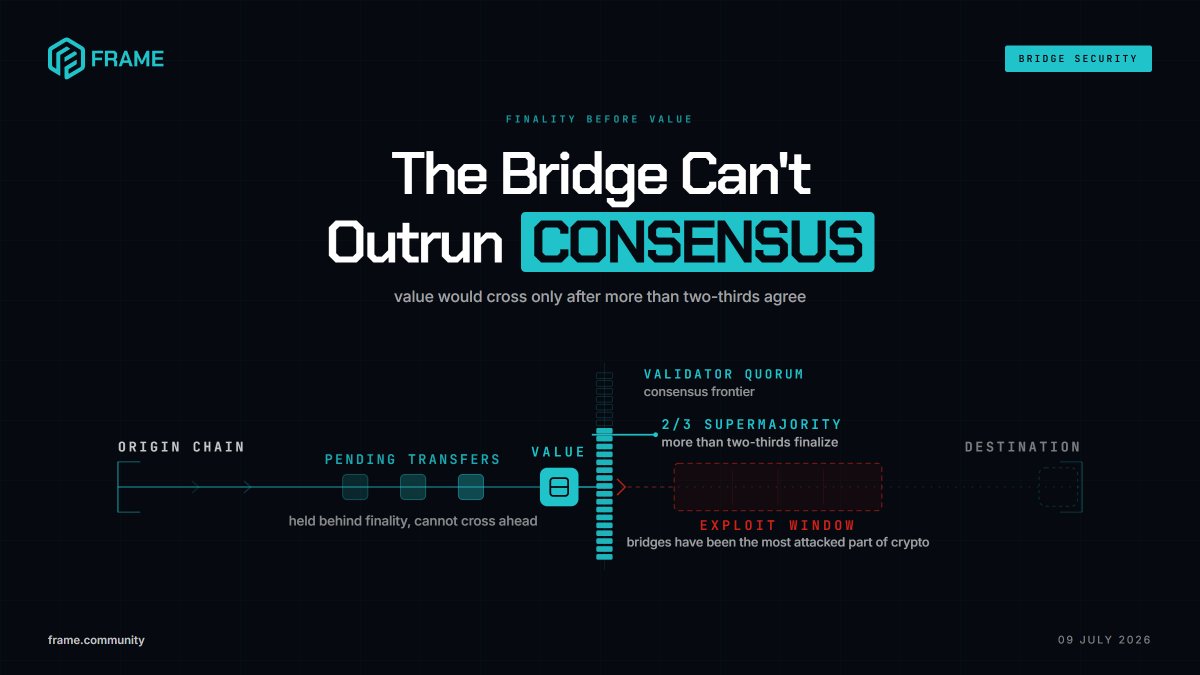
Bridges have been the most attacked part of crypto.
Our latest blog, Decentralization On Purpose, puts it plainly: bridges have historically been the corner that gets hit again and again, and industry losses run into the billions.
The structural reason is that a bridge able to move faster than the network it connects to has a window that can be exploited. 🔓
Frame is being designed around one rule: the bridge can never move faster than consensus. Funds would only leave once Frame's own validators have finalized the transaction and produced cryptographic proof that more than two-thirds of them agreed. 🤝
No single person is meant to hold the keys. The bridge is designed to carry out only what the validators have already approved.
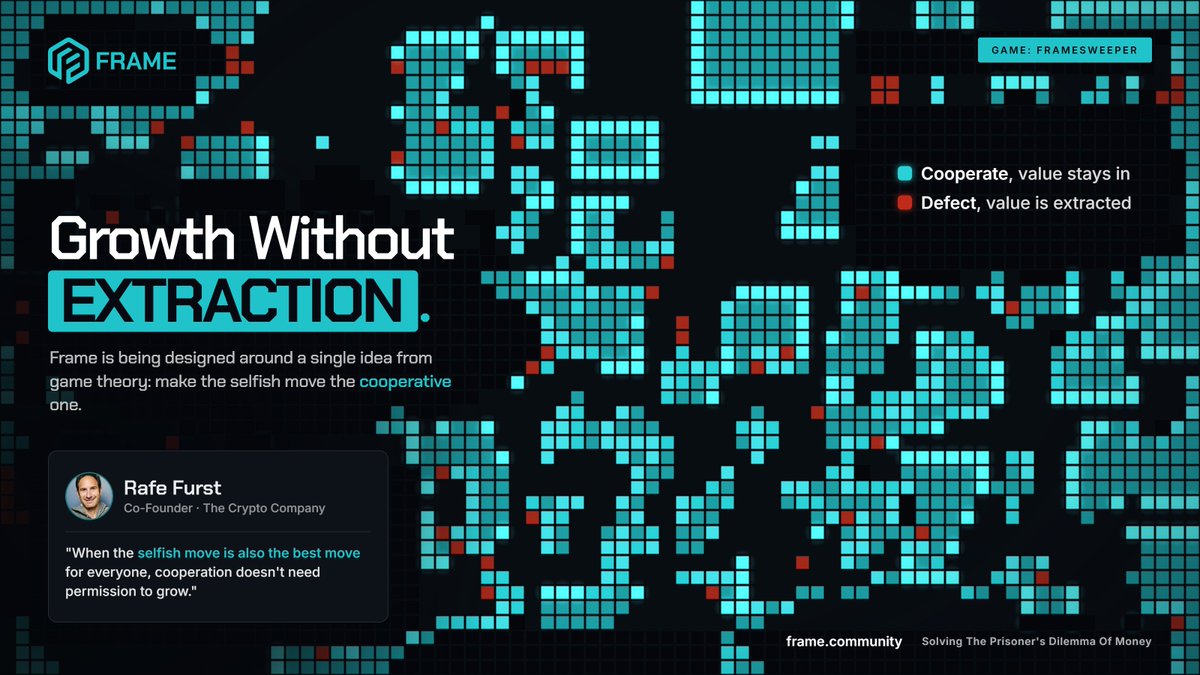
Frame is being designed around a single idea from game theory: make the selfish move the cooperative one. ♦️
Most networks are built to capture value and hold it in. Every chain becomes its own island, and every island profits from staying separate. The bridges between them get exploited, and billions have been lost that way.
Frame is being designed to do the opposite. ⚡️
Connect other chains into one economy, lift what each of them can do, and grow by making them stronger rather than competing with them. 💪
The move that is best for any one participant is also the best move for the whole system.
@Vision33X Yes, Bitcoin showed how powerful aligned incentives can be, and Frame is applying that same kind of thinking to interoperability and cooperation across networks.