Robots shouldn't need a specialist to learn a new task.
Tell the robot what to do → Show it how → Let it learn → Test → Improve.
Listen to our founder @KristofSzabo_ on how we're building FRAME to make that loop real.
A factory robot works because the product never changes.
An orchard breaks that assumption completely. Different size, different angle, different height, half hidden behind leaves.
That's why real-world footage is the bottleneck.
There's a way to get paid for work you're already doing.
It's called FRAME Capture. You open the app, pick a task from the list, film yourself doing it, and submit. If it's filmed correctly, credits go straight to your account.
All you need is your phone.
👉 https://t.co/6HYvD4Hxmi
Before you teach your robot something, check if someone already did it.
Install a skill instead of building one.
FRAME Skill Store is the place for you!
We're taking a closer look at JEV.
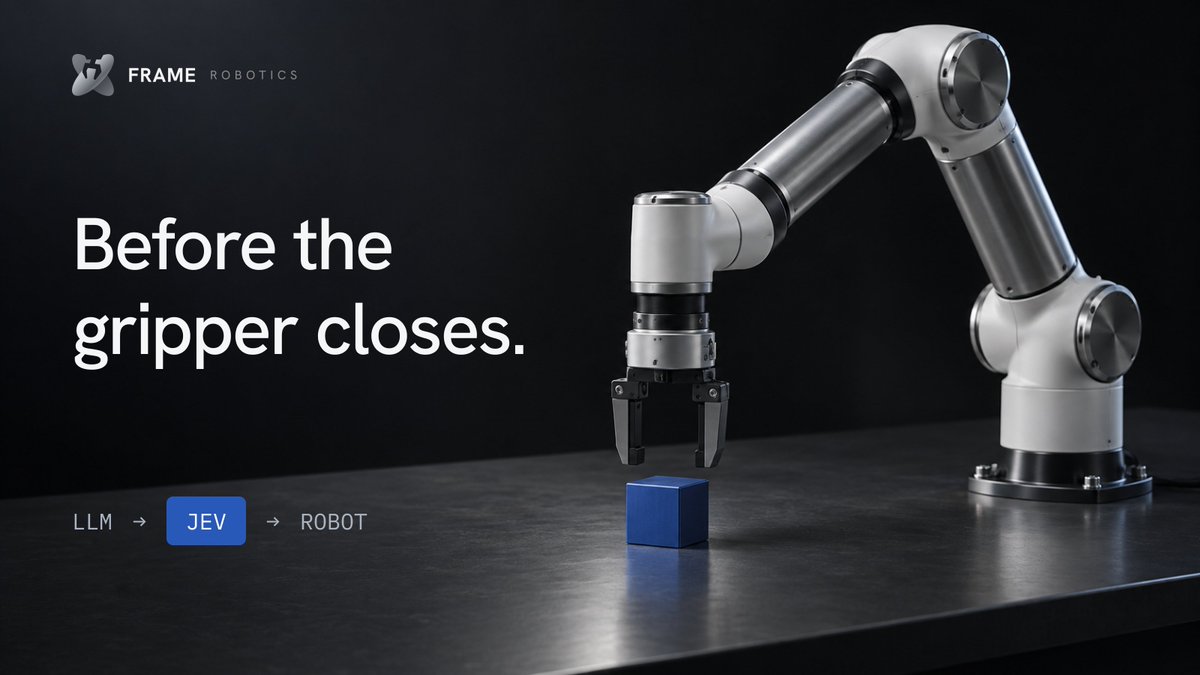
The split we already wanted looks like this. A language model as the brain. A decision model as the gate. The llm reads the task, the demo, the scene. Jev does not write a plan and it does not move joints. It scores the next commit. Grasp or abort. Retry or hold. Is this contact stable enough to keep going.
That stack is technically real. Slow layer proposes. Fast layer votes. Controller runs the arm. Jev is the vote in a form software can consume. A choice, a score, a yes or no, with a probability. Cheap enough for the decision loop. Not the 1khz loop. That still belongs to the hardware.
Jev cannot see a camera. Your code has to turn the scene into state first. It cannot be the safety layer. If confidence is low, you stop in code.
There is still a lot of work. Test it on real ticks. Measure whether 80% confident is actually right 80% of the time on your robot. Perception, rates, fallbacks, what happens when the scene dump is wrong. None of that is done.
JEV-class models in robotics are still promising. Worth the research time. Because the gate between "the model said pick" and "the gripper closed" finally has a shape you can afford to call.
We’re taking the fruit fly to its next challenge: Jenga. 🪰
The goal it to give a fly brain a robot arm and find out whether it can keep the tower standing.
This goes beyond picking up a block. It means choosing where to pull, sensing resistance, adjusting grip, and backing off before a small movement becomes a collapse.
How far can a tiny nervous system go when you give it a completely different body?
GPT-6 Astra is the first model that makes robot control look like a software problem again.
We've been trying for years to make robots usable outside the lab. last couple of months that work actually moved. not a cheaper arm. a model that looks at the camera, misses, and changes grip angle and carry height on the next try.
Nvidia cosmos folks say it cracked RoboLab near-perfect. people who lived in VLAs say they have not seen this kind of image-to-action understanding before. the old line was "LLMs cannot control robots." the new line is "which setup."
It is still slow. ~15 second loops, the arm sitting idle while the model thinks, then flying blind until the next cycle. hardware still matters. a 48-task robotics-engineering bench exists because control is not the whole job.
But training and eval got cheap enough that more teams can actually run them. next months you will see more of that land in boring use cases, not just lab clips. that is the part that was supposed to take a decade.
We are confident our ecosystem will play a huge role in that.
Thinking about your first robot but not sure which one you actually need?
With FRAME Rental, just tell us what happens on your factory floor, and we’ll tell you which robot fits.
We’re building the world’s biggest database of robot providers to make finding the right robot easier.
Try it yourself: https://t.co/njgFU2LOEm
🚨 TODAY: The SEC issued an order granting temporary, conditional exemptive relief to Tokenized Securities Venues from the definition of “exchange” in the Exchange Act to trade tokenized NMS stock using innovative permissioned automated market makers and liquidity pools.
We are already running simulations at scale, testing robots across different environments and under constantly changing conditions. This is a crucial step toward achieving true reliability and ensuring that robots can perform safely and consistently in the real world.
Robot policies can succeed in a demo and still fail as tasks, environments, and conditions change.
With open-source Isaac Lab-Arena 0.3, developers can use an experimental agentic workflow to generate environments, evaluate policies at scale, and identify where and why failures occur.
GPT-6 Astra is the first model that makes robot control look like a software problem again.
We've been trying for years to make robots usable outside the lab. last couple of months that work actually moved. not a cheaper arm. a model that looks at the camera, misses, and changes grip angle and carry height on the next try.
Nvidia cosmos folks say it cracked RoboLab near-perfect. people who lived in VLAs say they have not seen this kind of image-to-action understanding before. the old line was "LLMs cannot control robots." the new line is "which setup."
It is still slow. ~15 second loops, the arm sitting idle while the model thinks, then flying blind until the next cycle. hardware still matters. a 48-task robotics-engineering bench exists because control is not the whole job.
But training and eval got cheap enough that more teams can actually run them. next months you will see more of that land in boring use cases, not just lab clips. that is the part that was supposed to take a decade.
We are confident our ecosystem will play a huge role in that.
You don’t need to buy a robot to put one to work.
Rent one for as long as you need it - anywhere in the world.
And if your robot is sitting idle, we can put it to work.