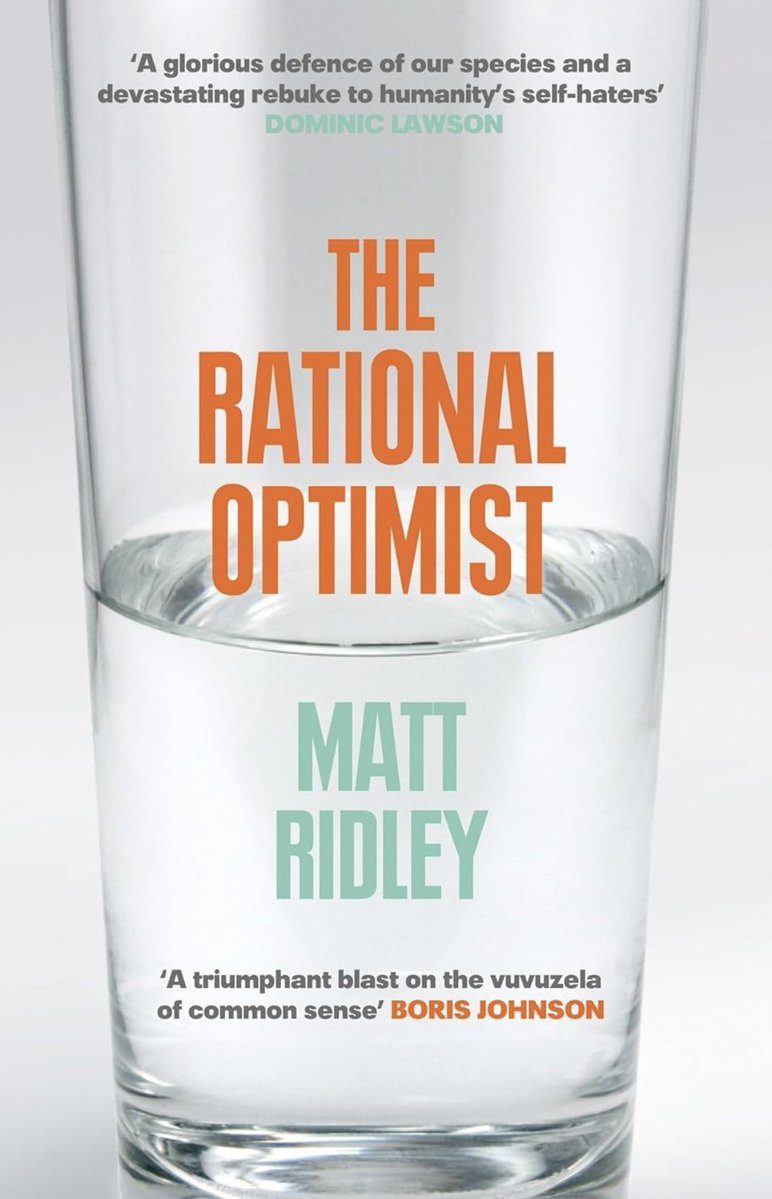
One of the ideas from The Rational Optimist that has stayed with me longest is how Ridley measures progress in hours of human labour. How many hours did you need to work, at the average wage of your time, to afford an hour of artificial light? In 1800, several hours. Today, a fraction of a second.
The corollary, which he traces across every major technological shift in history, is that we have always feared the machine would leave us with nothing to do. Each time, some jobs did disappear. And each time, the productivity gained created more new ones than it eliminated, in directions nobody had anticipated.
I think about this a lot when I read about artificial intelligence. The anxiety is legitimate, and some of the disruption will be real. But if history is any guide, the question is probably less “will there be work” and more “what will that work look like.” We have never been good at imagining the jobs that don’t exist yet.
As an investor and entrepreneur, have you ever lost faith?
I may have a remedy.
In investing as in running a business, what has tripped me up most is losing confidence that the world will keep moving forward. Which is, when you think about it, a strange thing to lose. Because if you genuinely believe progress has stopped, you might as well quit altogether. And if you believe it even a little, despite the wars, despite everything, there is a book I'd hand you.
I'll be honest: I'm a natural pessimist. Not the paralysed kind, but the kind that spends a lot of time mapping out what could go wrong. Every business plan, every investment thesis, I go through the downside scenarios first. It's useful, up to a point. The problem is that if you do it long enough, the negatives start to crowd everything else out. And that's when you stop seeing clearly.
Some people are wired differently. They start from optimism and work backwards. I've always envied that a little.
The Rational Optimist by Matt Ridley doesn't talk about companies. It doesn't talk about stock markets. That's exactly why I think every entrepreneur and every investor should read it once a year. His argument, in short: human prosperity has grown because trade and specialisation allow ideas to combine and recombine. The more we exchange, the more we invent. The more we invent, the better things get. Self-sufficiency, on the other hand, is a trap. Isolated societies don't just stay poor, they become suspicious and fearful.
What struck me most is how well history pairs with investing. Not financial history, but the long arc of human history. There is nothing like stepping back and looking at humanity across its entire story to put a short-term loss, a bad quarter, or a moment of doubt into perspective.
And to be clear: this is not about pretending everything will be fine. The fifteen years since this book was published have reminded us plenty of times that the world is hard, that we are never far from catastrophe. But between two conflicts, two pandemics, two natural disasters, there are real advances worth seeing. Keeping that in view is not naivety. It's discipline.
If you've been spending too much time in the downside scenarios lately, this might be the book that rebalances you.
PS: I'm attaching both covers, because the one with the half-empty glass is particularly good.
@LongGameEquity This is clearly one of the first advice I would give to beginners in investing. Don’t look too far, look around you identify the products or services you love and find if the company providing them is listed.
@silva_shruti At first I thought it was going to be a bit of a too obvious self help book but I read it anyway and I realized after that that it was really useful and I often think about it
@LeifInvests I’m a big big fan of cloudflare as a user especially coming from aws… and they keep expending their offer. But I don’t know well the others
@stockswithtom Yes apple google Amazon and Netflix if you include it. I missed them in 2022 thinking they could go lower. I have a problem with high PE. I know it’s stupid. Still regret it…
@stockswithtom So far not that bad but I have mainly European mid and small caps… I searched for of good point of entry in apple for years unsuccessfully and I regret it!
As an investor and entrepreneur, have you ever lost faith?
I may have a remedy.
In investing as in running a business, what has tripped me up most is losing confidence that the world will keep moving forward. Which is, when you think about it, a strange thing to lose. Because if you genuinely believe progress has stopped, you might as well quit altogether. And if you believe it even a little, despite the wars, despite everything, there is a book I'd hand you.
I'll be honest: I'm a natural pessimist. Not the paralysed kind, but the kind that spends a lot of time mapping out what could go wrong. Every business plan, every investment thesis, I go through the downside scenarios first. It's useful, up to a point. The problem is that if you do it long enough, the negatives start to crowd everything else out. And that's when you stop seeing clearly.
Some people are wired differently. They start from optimism and work backwards. I've always envied that a little.
The Rational Optimist by Matt Ridley doesn't talk about companies. It doesn't talk about stock markets. That's exactly why I think every entrepreneur and every investor should read it once a year. His argument, in short: human prosperity has grown because trade and specialisation allow ideas to combine and recombine. The more we exchange, the more we invent. The more we invent, the better things get. Self-sufficiency, on the other hand, is a trap. Isolated societies don't just stay poor, they become suspicious and fearful.
What struck me most is how well history pairs with investing. Not financial history, but the long arc of human history. There is nothing like stepping back and looking at humanity across its entire story to put a short-term loss, a bad quarter, or a moment of doubt into perspective.
And to be clear: this is not about pretending everything will be fine. The fifteen years since this book was published have reminded us plenty of times that the world is hard, that we are never far from catastrophe. But between two conflicts, two pandemics, two natural disasters, there are real advances worth seeing. Keeping that in view is not naivety. It's discipline.
If you've been spending too much time in the downside scenarios lately, this might be the book that rebalances you.
PS: I'm attaching both covers, because the one with the half-empty glass is particularly good.
@Peregrino1708 Not in API yet but in prompt it’s my first stop for research and after I move to Claude to refine ideas. But I wait also for gemma 4 in cloudflare workers AI which seems promising
Thanks! Yes, and I think below a certain threshold you just can't compete with real estate, your salary, or your main business in terms of impact. And you don't want to take too much risk with stocks at that stage either. It starts to change once the debt is cleared and the foundation is solid.