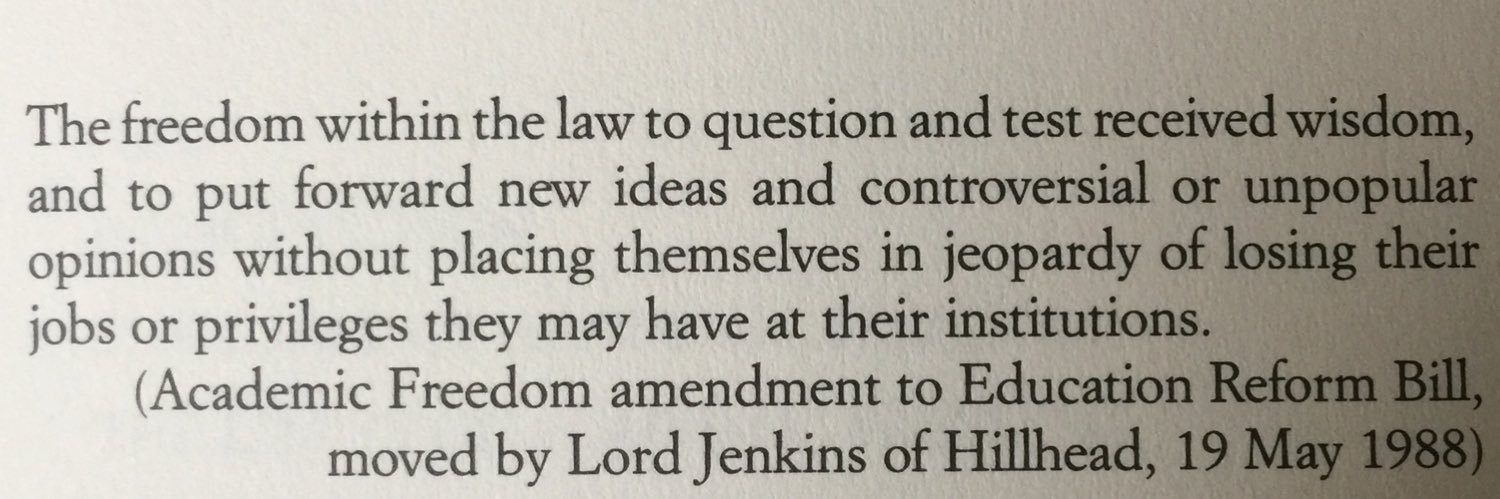
Your daily reminder that good academics don't sign letters to complain about their colleagues or petitions to have their colleagues fired or demoted. Good academics write papers in which they refute the arguments of the colleagues they disagree with.
"The most obvious lesson is that Cambridge is not a free speech university, and anyone with controversial views would be a fool to accept a job there. There are also broader lessons about the state of free speech in academia in general"
https://t.co/HOUGpaoex9
I highly recommend Alan Sokal's excellent paper
Academic freedom, no-platforming, and appeals to "disciplinary competence": A critical analysis of Simpson-Srinivasan's arguments
published today in @JConIdeas.
Earlier this month, @VUBrussel annulled the planned appointment of @HarrygPettit after a short but fierce cancel-campaign, here on @X and elsewhere.
If you value academic freedom and freedom of expression, please read and consider signing this open letter: https://t.co/e9dQJAhSRF
Academic Integrity Is Coming Increasingly Under Attack From Academics Using AI Tools as a Short‐Cut to Publications - Schuklenk - Bioethics - Wiley Online Library https://t.co/9cZtrVBii8
The full quote I gave Times Higher Education for this piece on @nathancofnas:
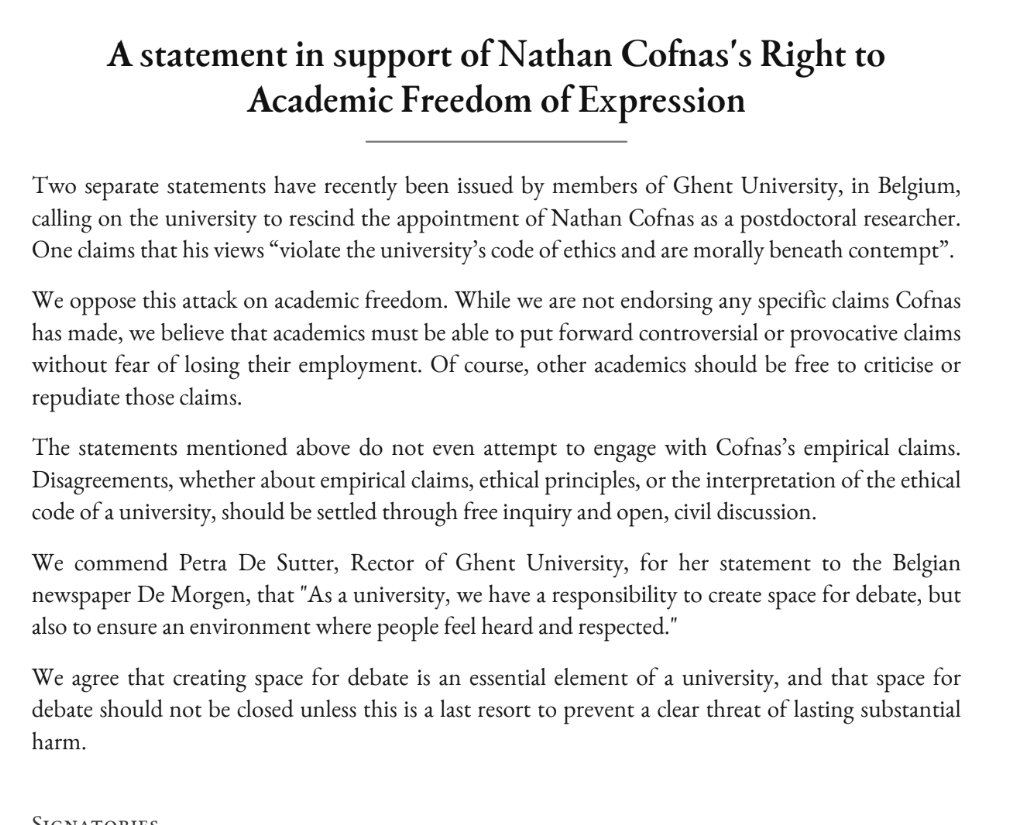
Those seeking to have the philosopher Nathan Cofnas dismissed from his position at Ghent University misunderstand both philosophy and academic freedom. Academic freedom exists precisely to protect contentious, controversial and offensive work. Even where conventional wisdom reflects the truth, it must remain open to criticism and debate; otherwise, living understanding becomes what John Stuart Mill called “dead dogma”. It is heartening that so many of the world’s most distinguished scientists and public intellectuals have signed this statement in support of Cofnas’s academic freedom of expression.
@jdceulaer It's in poor taste, but I don't think it justifies firing him, since it doesn't incite violence in a context where such incitement could have a real impact on anyone. If someone wrote on X that I should be killed (as it happened), I wouldn't want that person to be fired either.
I want to make it clear that I oppose all attempts to cancel or dismiss scholars on the basis of their expressed views or opinions.
I accept that the law may impose limits on speech that incites violence, but those limits must be narrowly drawn. My preferred standard is the one set out in Brandenburg v. Ohio, which makes clear that the relevant threshold is whether speech is likely to produce imminent lawless action. Short of that, free speech includes even speech that glorifies or advocates violence, so long as it is not likely to lead to imminent lawless action.
Pettit's statements on social media, at least as they have been reported, come nowhere near violating that standard. He should have faced no employment reprisals for these statements.
I am saddened that Vrije Universiteit Brussel withdrew its offer of employment to Harry Pettit because of his views. Had there been a petition in his support at the time, and had I been aware of it, I would have signed it.
🚨A statement in support of Nathan Cofnas's right to academic freedom of expression. Signed by over 120 leading academics and public figures. 👇
https://t.co/6wq9w8aVho
@SamaHoole Yeah but factory farming is the norm and it’s horrible and immoral. And that’s what people are rightly concerned about, not traditional farms like the ones you are showing here. They are very, very different things.
We could produce the equivalent of 36.5 billion fewer chickens a year if all obese people were on GLP-1 drugs and ate even just 100kcal less from animal products a day. My paper on GLP-1 drugs has just been published in Bioethics https://t.co/k0QCvAaT06
@sentientist I wonder if, in the case of cats, could help with tweaking their instinct to kill birds and other little animals. Maybe if all cats, fat and non fat alike were ok GLP-1, we could solve this problem.