🤔 ¿Alguien puede pensar en la diplomacia?
Tras meses de guerra, anuncios fallidos y acuerdos que duran menos de un día, el problema ya no es solo militar: también es la ausencia de una diplomacia seria, profesional y sostenida en el tiempo.
ARGENTINA SUBIÓ AL PUESTO 58º EN EL RANKING DE COMPETITIVIDAD
Argentina avanzó cuatro posiciones y quedó en el puesto 58 entre 70 países en el Ranking de Competitividad Mundial elaborado por el International Institute for Management Development (IMD) de Suiza. La mejora se produjo tras haber caído al puesto 66 en 2024 y subir al 62 en 2025.
El informe destacó avances en desempeño económico, eficiencia gubernamental, eficiencia empresarial e infraestructura. En América Latina, Argentina quedó por detrás de Chile (43), pero por delante de Colombia (59), Perú (60) y Brasil (65).
El desempeño de Argentina por área
— Desempeño económico: 58° (+8 puestos)
— Eficiencia gubernamental: 65° (+2 puestos)
— Eficiencia empresarial: 55° (+3 puestos)
(+) en Clarín: https://t.co/PTP7hUXYLL
BREAKING: The US has released the full text of its 14-point "Memorandum of Understanding" with Iran.
Key terms include:
1. The US, Iran, and their allies agree to immediately and permanently end military operations on all fronts, including in Lebanon
2. The US and Iran agree to respect each other's sovereignty and territorial integrity and not interfere in each other's internal affairs
3. The US and Iran commit to negotiating and reaching a final deal within 60 days, unless mutually extended
4. The US will begin removing its naval blockade immediately and fully end the blockade within 30 days
5. Iran will use its best efforts to ensure safe passage for commercial vessels through the Strait of Hormuz for 60 days with no charge
6. The US and regional partners will develop a mutually agreed plan of at least $300 billion for Iran's reconstruction and economic development
7. The US will work toward terminating all types of sanctions against Iran, including UN, IAEA, primary, and secondary sanctions
8. Iran reaffirms that it will not procure or develop nuclear weapons and agrees to address its enriched material stockpile under IAEA supervision
9. Until a final deal is reached, Iran will maintain the current status quo of its nuclear program, while the US will impose no new sanctions and deploy no additional forces
10. The US Treasury will issue waivers for Iranian crude oil, petroleum products, derivatives, and associated banking, insurance, and transportation services
11. The US will make frozen or restricted Iranian funds and assets fully available for use
12. The US and Iran will establish an executive mechanism to monitor implementation of the MOU and future compliance with the final deal
13. After signing the MOU and implementing key ceasefire, blockade, shipping, oil waiver, and asset-release provisions, the US and Iran will begin final deal negotiations
14. The final deal will be endorsed by a binding UN Security Council resolution
The memorandum will trigger a 60-day window to negotiate a final deal.
En casi todos los puertos del mundo, los granos viajan hasta el mar. En el Gran Rosario es al revés: son los buques los que remontan el Paraná para cargar en el corazón productivo. Una lógica única que lo convirtió en el nodo agroexportador #1 del mundo. 🚢🌾.
https://t.co/4qFakWNBK8
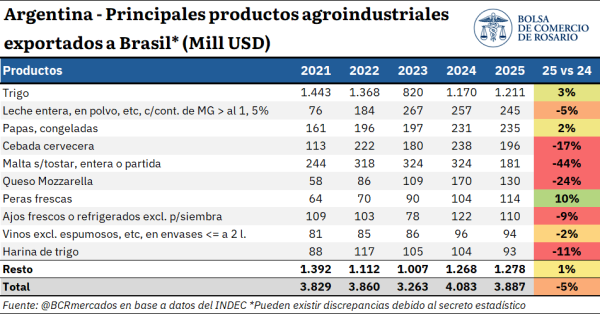
En 2025, Argentina exportó a Brasil bienes agroindustriales por US$ 3.887 millones y se importaron desde ese origen US$ 1.755 millones.
https://t.co/naE8pYvRET
Son muy claros los futbolistas que no tienen que seguir en River.
Bustos
Quarta
Rivero
Pezzela
Galoppo
Maxi Meza
Salas
Castaño
Paulo Díaz
Portillo
Y esta culpa es toda de Marcelo Gallardo, quien trajo a todos estos jugadores.
The world is losing oil, fertilizer, and sulfuric acid simultaneously. The market priced only the oil.
Per The Wall Street Journal, citing Argus pricing data and the US Geological Survey, sulfuric acid prices in China rose roughly 1,150% in May compared with two years earlier. Middle Eastern sulfur prices surged 750%. Chile, the world’s largest sulfuric acid importer, saw prices jump 230%.
Sulfuric acid converts phosphate rock into fertilizer. It processes copper. It manufactures batteries. It fabricates semiconductors. The Persian Gulf supplies roughly half of global sulfur exports. The chemical that touches food, electric vehicles, and chip fabs is breaking simultaneously.
Saudi Aramco CEO Amin Nasser told investors Monday this is “the largest energy supply shock the world has ever experienced.” Per CNBC, the world has lost one billion barrels of oil supply, net 880 million after east-west pipeline reroutes and strategic reserve releases. Two to five ships now pass Hormuz daily, down from seventy before the war. Around 240 ships are waiting outside. The market loses 100 million barrels per week the Strait stays closed. If disruption persists past mid-June, normalization runs “into 2027.”
The Wall Street Journal reports US crude inventories including the Strategic Petroleum Reserve have fallen for four consecutive weeks and risk reaching their lowest level since 1982. Per Bloomberg, the IEA coordinated the release of 400 million barrels of emergency reserves. The United States has released only 79.7 million of the 172 million it pledged.
JPMorgan head of global commodities Natasha Kaneva warned OECD oil inventories could reach “operational stress levels” by June and “fall to minimum operating thresholds by September.”
This is the energy story.
Per the United Nations Food and Agriculture Organization, roughly one-third of global fertilizer trade transits the Strait of Hormuz. Qatar Fertiliser Company, which supplies 14% of global urea single-handedly, has declared force majeure. Major fertilizer plants across the Gulf have reduced or suspended production. Three to four million tonnes per month of fertilizer is stalled.
Per CNBC, urea FOB Egypt has risen from $400 pre-war to $700 per tonne. Per Reuters, Brazil’s urea imports have fallen 33% year over year. Bangladesh has shut four of five fertilizer factories. India has cut output at three urea plants. The United States is running 25% short of fertilizer supply for spring planting.
The World Food Programme projects 45 million people could enter acute hunger within months. The 2022 Ukraine crisis pushed 70 million into hunger over 18 months. This onset is faster.
This is the food story.
Aluminum, helium, and sulfur markets are all in supply shock. Helium is essential to semiconductor manufacturing. Indonesia sulfur prices are up over 80%, prompting nickel producers to cut output for EV batteries.
This is the industrial story.
President Trump rejected Iran’s response Monday as “totally unacceptable” and “a piece of garbage.” He said the ceasefire is “on massive life support.” A US Navy Ohio-class nuclear-armed submarine arrived in Gibraltar Sunday.
Trump arrives in Beijing on May 14 and 15.
A 1,150% sulfuric acid move in China. A 45-million-person acute hunger projection. A US strategic reserve approaching 1982 lows. An OECD inventory cliff in June. A fertilizer famine in three months. A market at all-time high.
The market priced one shock. There are three.
The summit two days away decides which of them gets resolved first.
https://t.co/xmK0gJ0TfI
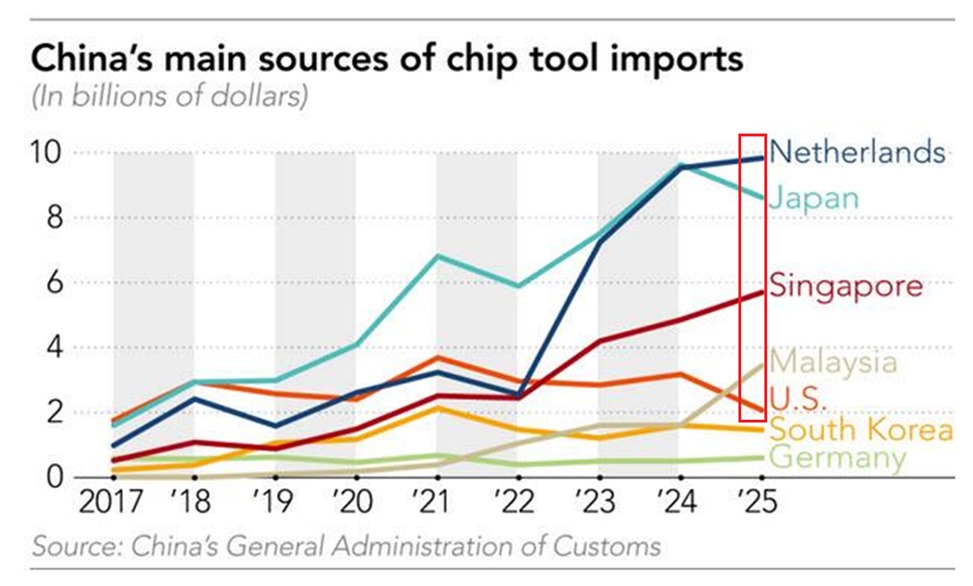
China is rerouting its chip equipment imports amid US export controls:
China's semiconductor equipment imports from Singapore rose +17% YoY in 2025, to a record $5.7 billion.
At the same time, imports from Malaysia surged over +100% YoY, to $3.4 billion, also an all-time high.
Meanwhile, chip tool imports from the US plunged -34% YoY, to ~$2.0 billion, the lowest since 2017.
The Netherlands and Japan remain China's largest sources of chip equipment by origin, at ~$9.9 billion and ~$8.5 billion, respectively.
Over the 2020-2025 period, China's cumulative chip tool imports from Japan totaled over $42.0 billion, followed by the Netherlands at $35.0 billion.
US semiconductor export controls are redefining the market.
There have been several incidents involving U.S. aircraft in the U.S. Central Command (CENTCOM) area of operation (AO) within the last 24 hours:
1. A U.S. Air Force F-15E "Strike Eagle" was hit by Iranian fire and crashed in Iran. Both crew members survived, with 1 being rescued, and a large combat search and rescue operation is ongoing for the 2nd.
2. A U.S. Air Force HH-60W "Jolly Green II" conducting operations to rescue the downed F-15 crew took small-arms fire with at least 1 crew member injured, but it continued back to base.
3. The pilot of a U.S. Air Force A-10C "Thunderbolt II" ejected over the Persian Gulf, with Iran claiming responsibility for shooting it down. The pilot was recovered safely.
4. A U.S. Air Force F-16C "Fighting Falcon" briefly showed on flight tracking sites squawking 7700 (emergency) over Iraq.
5. A U.S. Air Force KC-135 "Stratotanker" was squawking 7700 (emergency) over Israel.
What just happened?
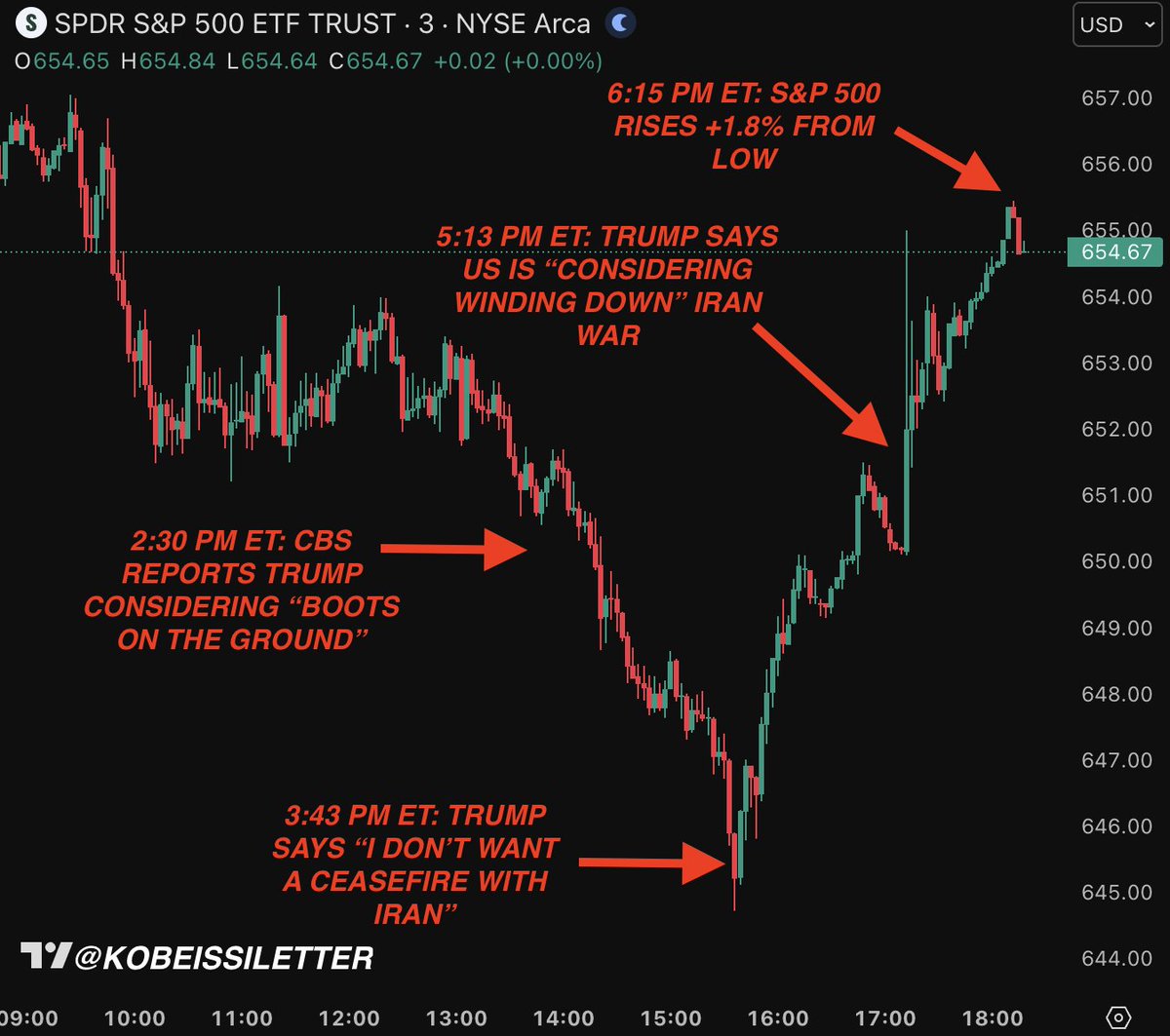
At 2:30 PM ET today, CBS News reported that President Trump was considering "boots on the ground" in Iran.
Then, at 3:43 PM ET, President Trump said "I don't want to do a ceasefire with Iran," with the S&P 500 hitting a new 2026 low.
Exactly 90 minutes later, at 5:13 PM ET, President Trump said the US is "considering winding down" the war with Iran.
Between the 3:43 PM ET and 5:13 PM ET comments, the S&P 500 had already risen nearly +1% on NO news.
By 6:15 PM ET, the S&P 500 rallied +1.8% from its low, adding +$900 BILLION in market cap.
Markets are now closed until Monday.
🇮🇷 La guerra de Irán acaba de dejar fuera de servicio cerca del 33% del helio mundial.
La fabricación de chips, las resonancias magnéticas y cadenas de suministro tech están en peligro.
Los precios ya aumentaron 100% y siguen subiendo.
Para empeorar la situación, se filtró que el gobierno chino está tentado a suspender las exportaciones de fertilizantes.
Y todavía no se cumple un mes de guerra en Irán.
Ojo con esto
“Según informes, la campaña de decapitaciones y ataques contra los servicios de seguridad por parte de la fuerza combinada está generando paranoia entre los funcionarios del régimen iraní y los miembros de los servicios de seguridad iraníes. Los ataques israelíes contra los servicios de seguridad internos están afectando la moral de la tropa y obligando a las fuerzas de seguridad a dormir en vehículos, mezquitas o instalaciones deportivas para evitar ser atacadas.”
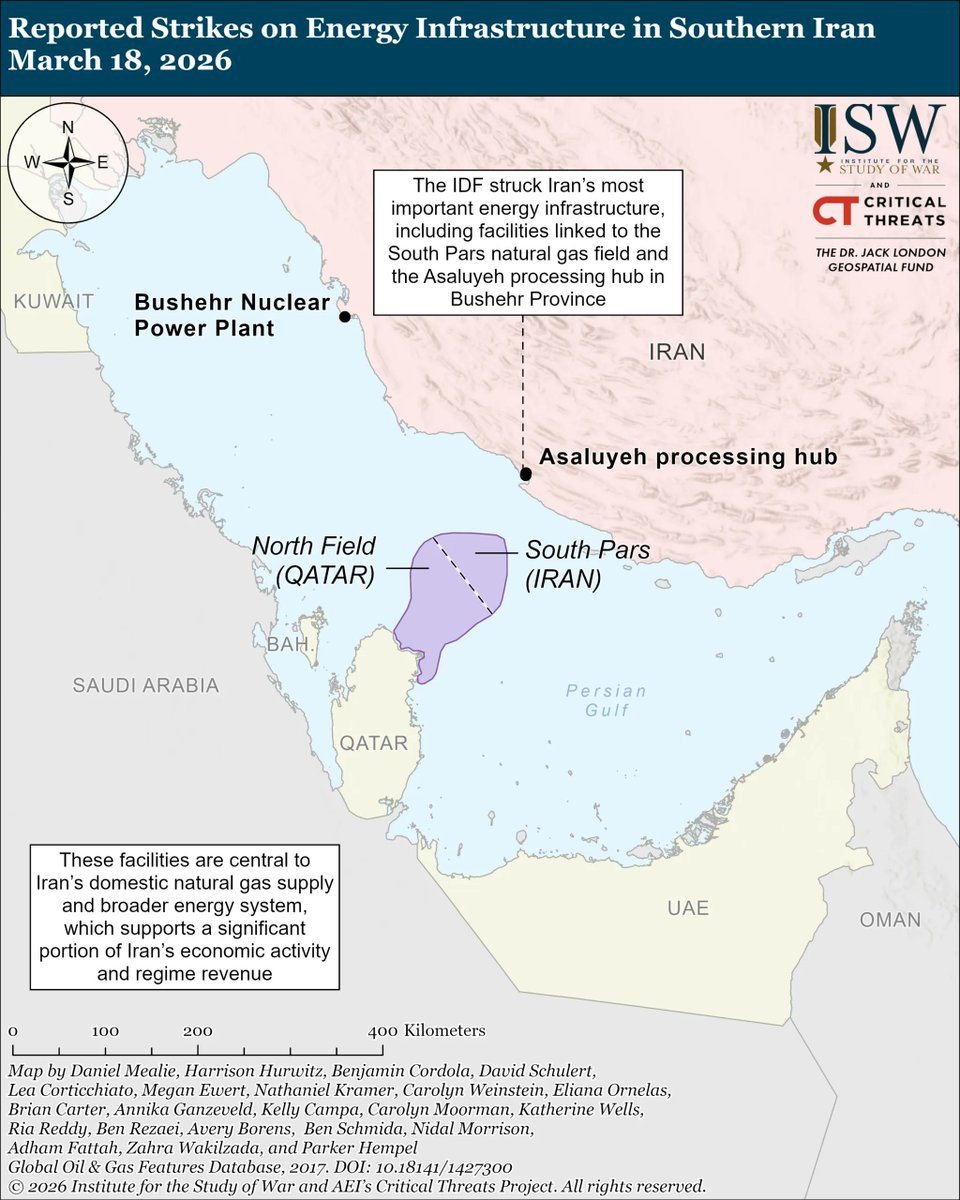
NEW: The Israel Defense Forces (IDF) struck critical Iranian energy infrastructure on March 18, including facilities linked to the South Pars natural gas field and the Asaluyeh processing hub in Bushehr Province. These facilities are central to Iran’s domestic natural gas supply and broader energy system, which supports a significant portion of Iran’s economic activity and regime revenue. Iran exports a small share of its natural gas, primarily to Iraq and Turkey, meaning disruptions will also affect regional energy consumption.
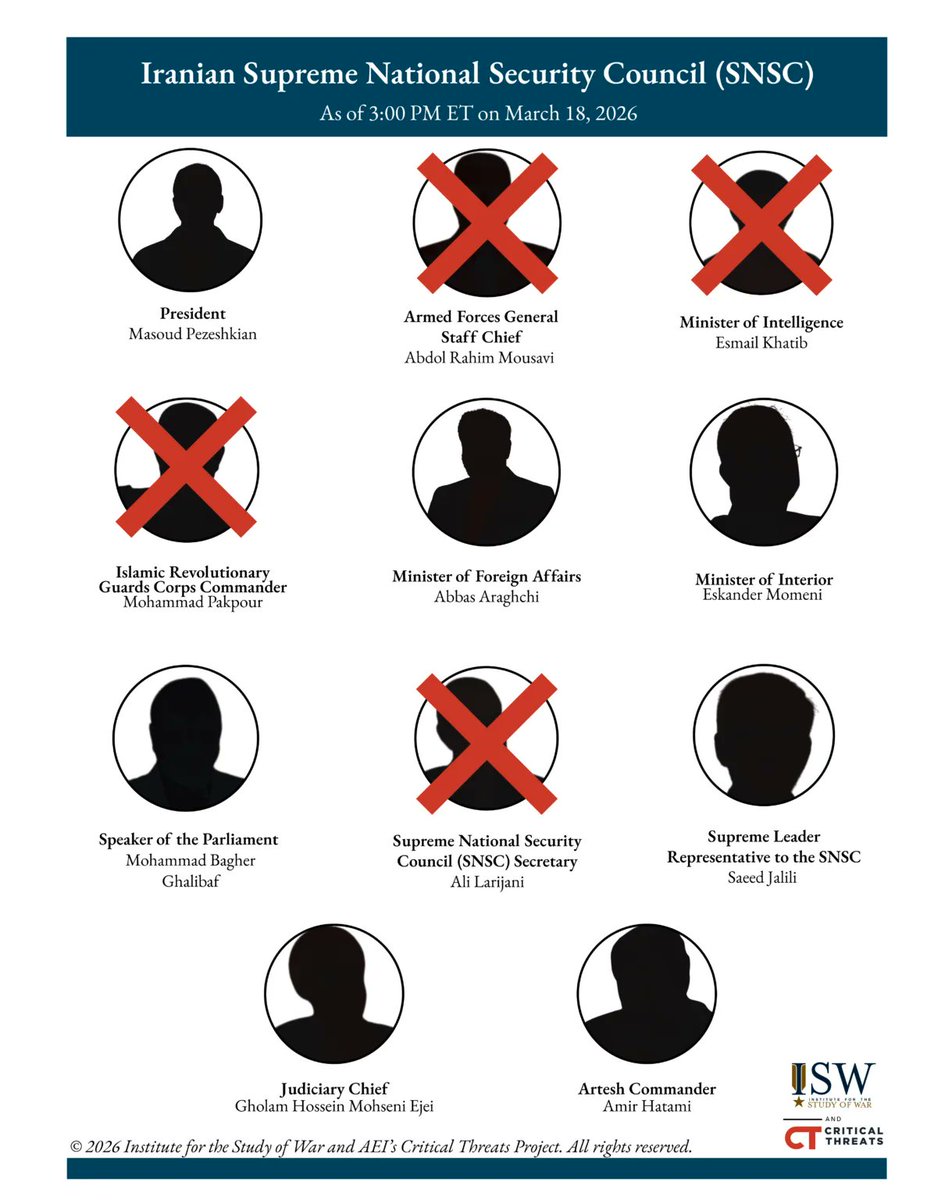
The IDF killed Iranian Intelligence Minister Esmail Khatib in an airstrike on March 18. Khatib was responsible for coordinating the regime’s repression of the Iranian population in his role within the Ministry of Intelligence and Security, including overseeing the regime‘s crackdowns on the Winter 2025-2026 protests and the 2022 Mahsa Amini protests.
The combined force’s decapitation campaign and targeting of security services is reportedly causing paranoia among Iranian regime officials and members of Iranian security services. Israeli strikes targeting internal security services are reportedly hurting “rank-and-file morale” and are driving security forces to sleep in vehicles, mosques, or sports facilities in order to avoid targeting.
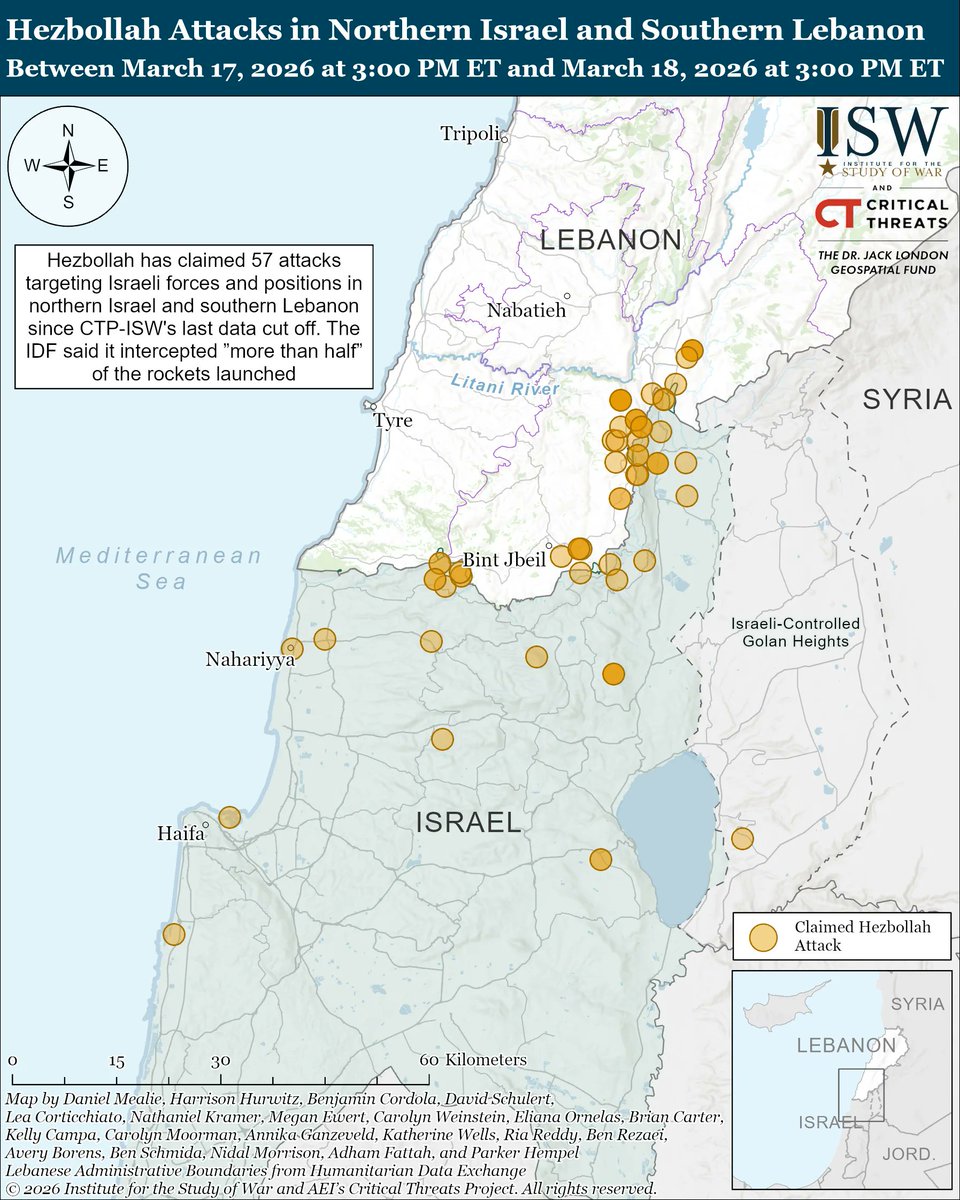
Hezbollah claimed 57 attacks targeting Israeli forces and positions in northern Israel and southern Lebanon since CTP-ISW’s last data cut off. The IDF has continued to conduct airstrikes targeting Hezbollah in southern Lebanon, including strikes targeting Hezbollah’s social and financial service network in Lebanon.