Can your AI tests catch the failures that matter to your business?
That question drove REGATTA, my research with Dr. Abhijit Sanyal, which I presented at IEEE ICoDSE 2026.
Our contribution connects what tests are expected to detect with what they actually detect when an agent runs, while auditing the reference rules behind those judgments.
Across 5,400 generated scenarios, we found that promising test designs do not reliably translate into observed fault detection.
For enterprise leaders, the value is practical: better evidence for deciding where AI needs stronger controls, further testing, or human oversight. A test score alone cannot establish deployment readiness.
I’m pleased to share the paper and welcome conversations with teams working on enterprise AI assurance.
📄 Read REGATTA https://t.co/y7TzU2ABGX
#EnterpriseAI #AIAgents #AIAssurance
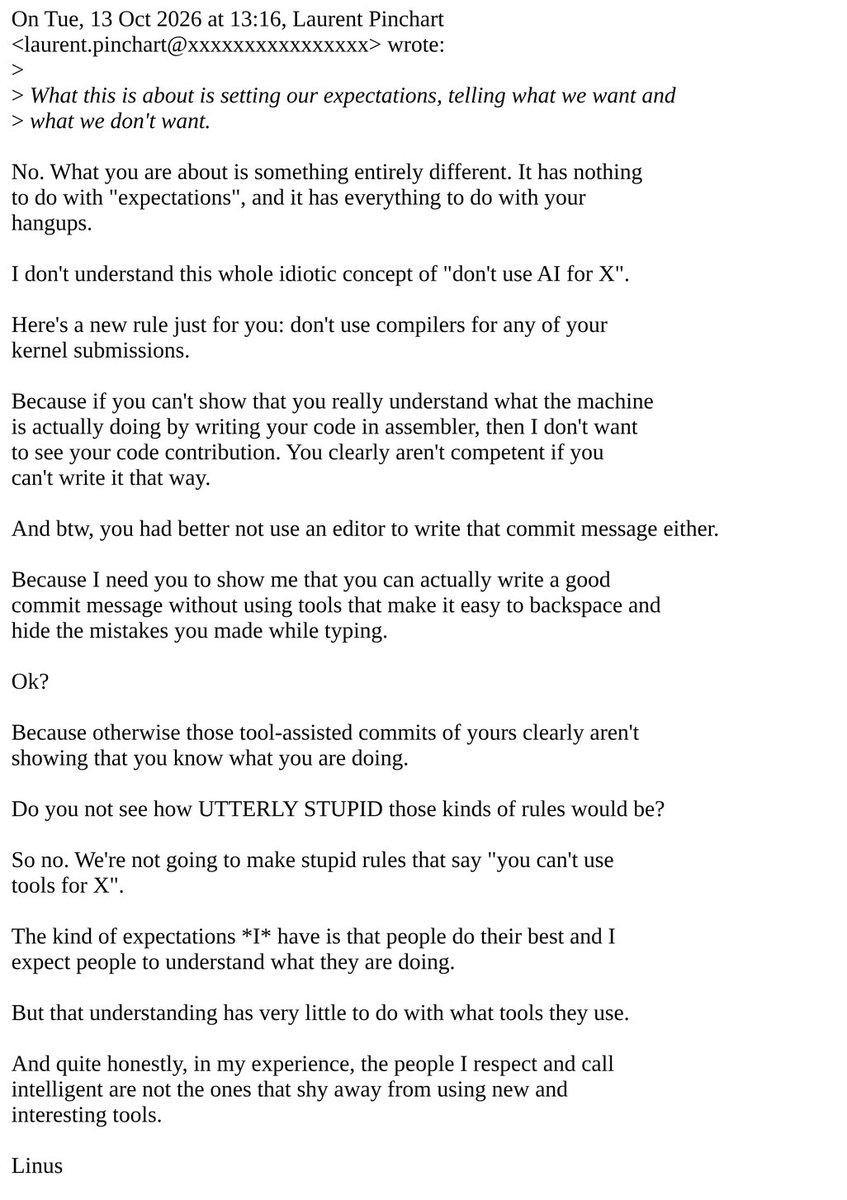
‼️ Linus Torvalds called rules against AI coding tools "UTTERLY STUPID" on the Linux kernel mailing list.
He says people he respects and calls intelligent do not shy away from using new tools.
We Must Pace the Frontier: I’ve written a new essay on why the AI industry should slow down, with a three-part plan for doing so.
Anthropic is unilaterally committing to the first of these steps. We’ll provide third-party evaluators with permanent, employee-level access to our systems, so that they can verify adherence to our safety measures, report on incidents, and assess models’ alignment during training.
You can read the full post here: https://t.co/OGyPb7yaYt
On 1 Oct, I’ll moderate “What Must CIOs Decide Now?” at CIO Summit 2026. We’ll explore how leaders can move AI from pilots to measurable value—with trust, scale and clear accountability. Riverside Palace, HCMC. https://t.co/JTU6SkiBTE #CIOSummit2026
FrankBrain is Customer Zero for FAOS IQ — the compounding-intelligence layer we ship to enterprises, pointed at a market of one, first.
If you're building your own founder-brain, I want to hear how. Reply below.
Everyone's shipping a "second brain" right now. Most of what I've seen is a better search bar.
The real question isn't whether it can find the document. It's whether it knows which one is still true.
Why build this for myself before any customer touches it: if a layer of our platform can't survive my own messy, half-finished, unglamorous founder life, I have no business selling it to you.
The honest result: retrieval is excellent. Knowing which of two conflicting documents still governs is the harder problem — and the real frontier of what "compounding" memory actually means.
That gap is live on the roadmap, not swept under the rug.
Four pieces make it work:
– an Enterprise LLM Wiki, personalized: every decision gets a page with the current truth on top and the evidence trail underneath
– Hermes Agent, our always-on gateway, reading and writing that brain in the background
– Jarvis HUD, the voice layer
– an Even Realities G2 glasses app as the physical surface
The test case: walking out of a meeting, I asked out loud, "what did we decide on the ship date?"
Two seconds later — the real answer. Not the plan everyone in the room still remembered. The later decision that had quietly overridden it.
I put a brain on my face. Literally.
Two weeks ago I finished FrankBrain — a personal instance of FAOS IQ, the compounding-intelligence engine we built for enterprises — running through a pair of smart glasses.
Here's what it actually does.
AI in banking is not just chatbot automation.
This 90-second FAOS demo shows Agentic Banking Vietnam from a Bank CEO view: mission control, banking agent teams, governed workflows, evidence trails, and risk control.
https://t.co/rK0snUBkbB
FAOS Customer Portal - Ep1
The command surface for an agent workforce.
- Active work and agent signals
- Recent spaces and context
- The next action a business operator can take
EN full video: https://t.co/0U0k0Ep6kQ
VN full video: https://t.co/QOCDgfwwHV
FAOS IQ is the intelligence layer behind the FAOS agent workforce.
Memory, trusted knowledge, metrics, graph context, governed answers, cache, and DLP, so agents answer with business context.
Watch: https://t.co/PJ6almpK9U
#FAOS
Today I'm publishing a new essay, Policy on the AI Exponential. AI is progressing extremely fast—much faster than the policy process was built to handle. The essay lays out where I think the technology is now, and the action needed to close the gap: https://t.co/Lh6PWae178
First paper out 🔬
"Ontology-Constrained Neural Reasoning in Enterprise Agentic Systems"
Neurosymbolic architecture that grounds LLM agents in domain ontologies. 600 runs, 5 industries, significant accuracy + compliance gains.
https://t.co/AJcfMqH8F3