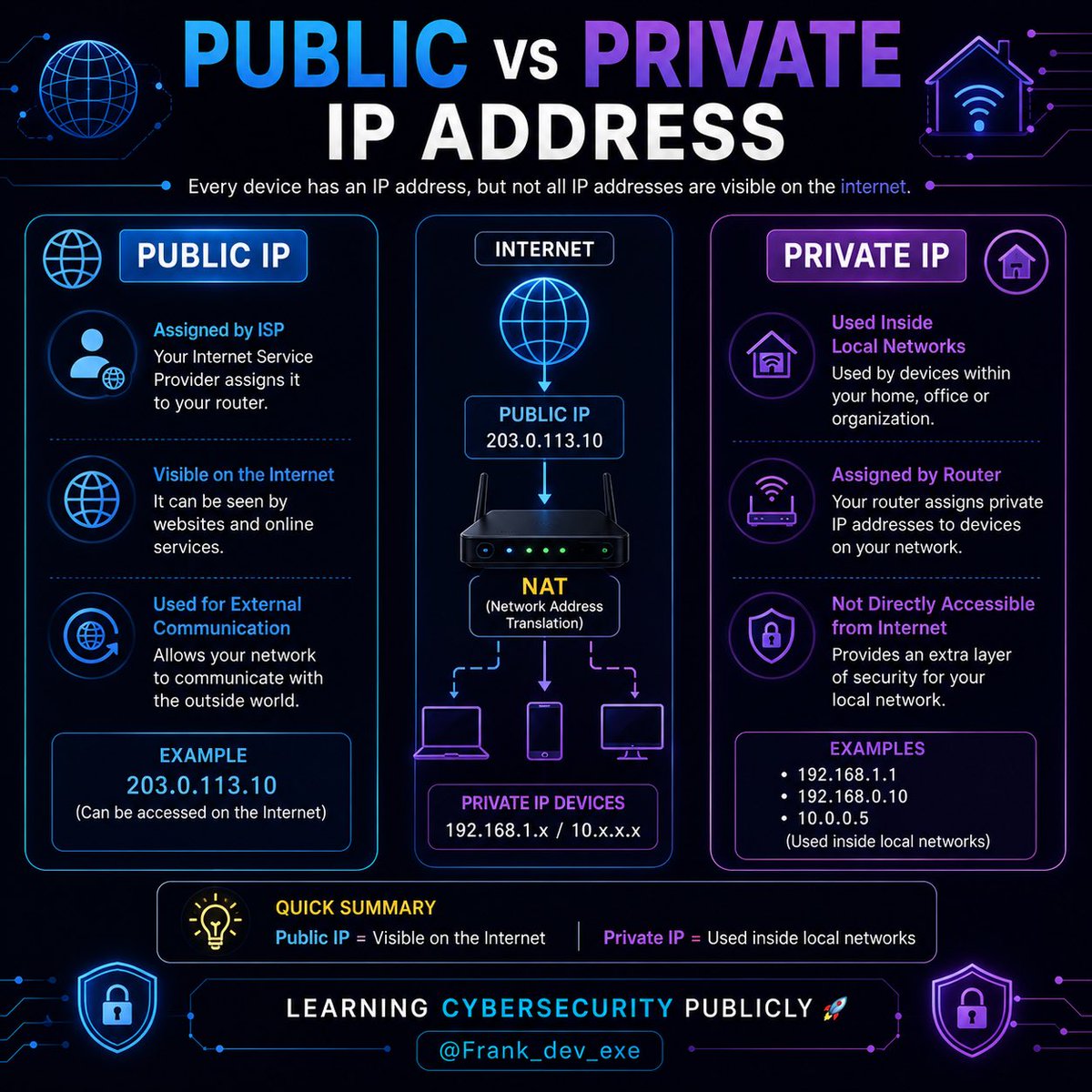
4️⃣ Quick Summary
🌍 Public IP = Visible on the Internet
🏠 Private IP = Used inside local networks
Both work together to keep devices connected and organized.
Still learning daily 🚀
#CyberSecurity#NetworkPlus
Documenting my cybersecurity journey 🔐
Today I learned the difference between Public and Private IP Addresses.
Even though every device has an IP address, not all IP addresses are visible on the internet 🌐
Here are my simplified notes 🧵👇
3️⃣ How Do They Work Together?
Your router receives a Public IP from your ISP.
Then it assigns Private IPs to devices inside your network using NAT (Network Address Translation).
• Next.js 16
• Supabase
• Dashboard
• Planner Engine
• Research Engine
• Script Generator
• Scene Planner
No AI credits yet, so I'm building the entire architecture with mock services first.
When I connect OpenAI later, everything will already be wired up.
#nextjs#ai
Day 2 of building my AI content machine with ChatGPT.
The goal:
Type a prompt like:
"Generate 3 cybersecurity YouTube Shorts"
and the system automatically:
✓ Creates a content plan
✓ Generates research
✓ Creates scripts
✓ Builds scene plans
Check Today's progress below
@Tifecodes Nextjs, is a the best for a fullstack workflow in a single folder , it’s give me joy 🤩 working with it alongside other cool libraries that works with it
4️⃣ IPv4 vs IPv6
IPv4 = Older generation 🌐
IPv6 = Newer generation 🚀
As more devices connect to the internet, IPv6 helps solve the address shortage problem.
Still learning every day 🔐👨💻
#CyberSecurity#NetworkPlus
Documenting my cybersecurity journey 🔐
Today I learned about IPv4 and IPv6 — the systems that help devices communicate across networks and the internet.
Here are my simplified notes 🧵👇
3️⃣ IPv6
IPv6 uses a 128-bit address format.
Example:
2001:0db8:85a3::7334
✔ Supports billions of devices
✔ Better scalability
✔ Built for the future of the internet