Father, Educator, Auburn Alumnus, Never forget that history is a weapon, wield it carefully. Likes and retweets do no represent agreement. My views are my own.
Study histories to question and analyze sources
Learn maths to process procedurally and logically
Read literature to decide how the character’s motives and perspectives reflect our own ethics
Study sciences to examine our own hypotheses, and to find facts in tangible evidence
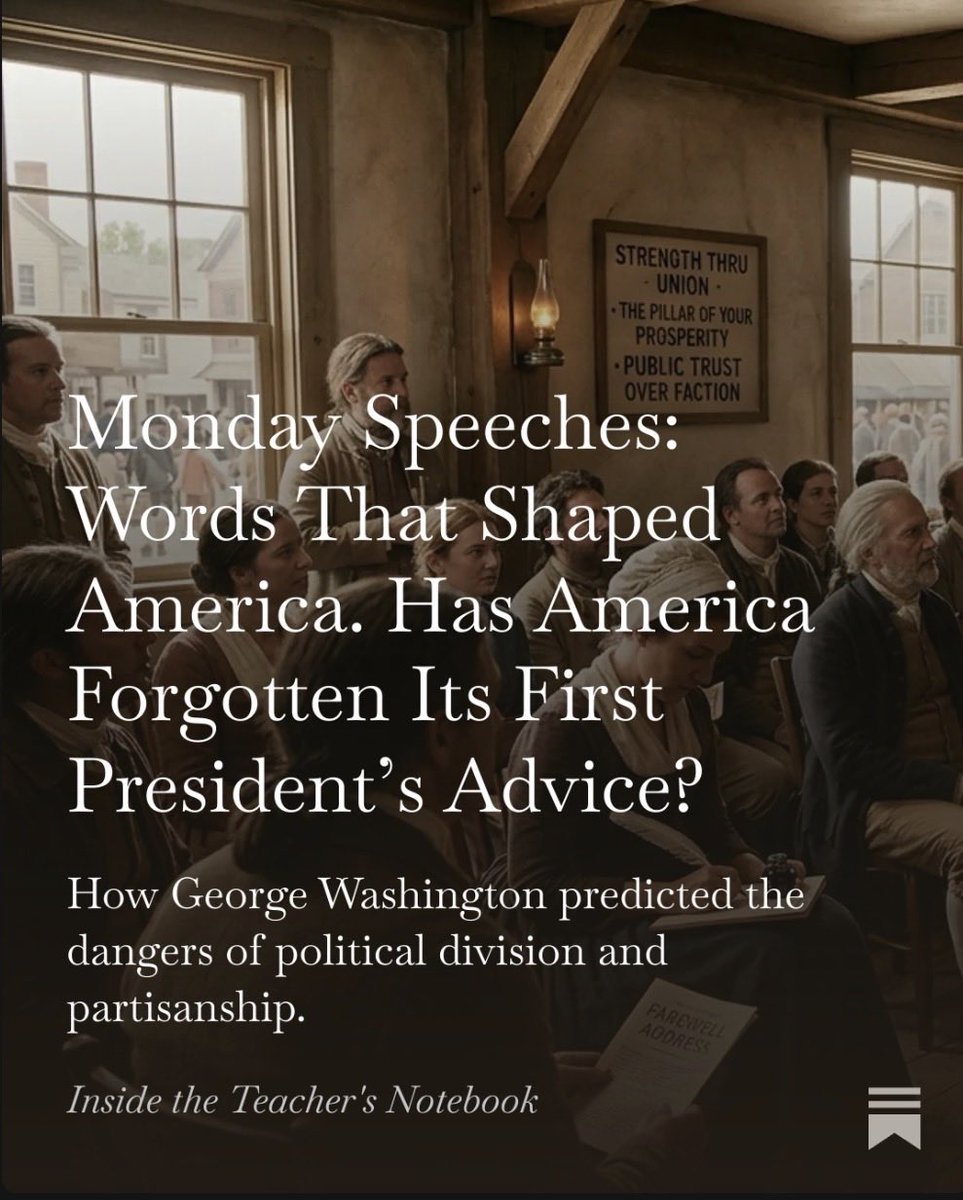
Washington understood that the Constitution could establish the framework for American government, but its success depended on the character and judgment of the people who lived under it. #ushistory#history https://t.co/fTW2oBXDqb
When filling out your Christmas cards this year, take a card and send it to this address:
A Recovering American Soldier, c/o Walter Reed Army Medical Center, 4494 E Palmer Rd, Bethesda, MD 20814, USA. #Christmas
Great literature does not require extraordinary settings or larger-than-life heroes. Human experiences, faithfully observed and thoughtfully presented, possess lasting power. #ushistory#literature https://t.co/WrD9mAvUTG
@Spike_Mordant@educator4ever36 Extracurricular programs deliver the entertainment value that shields institutions from scrutiny and sustains funding. Until the focus of support shifts back to measurable academic achievement, the phrase panem et circenses will remain accurate. https://t.co/cdcHtaC4d7
The persistence of Thanksgiving myths and the idealized imagery of the Pilgrims speak to the broader American tendency to craft unifying national stories, even at the expense of historical accuracy.#ushistory#thanksgiving https://t.co/devojhCMi7
In Humanities, History, and Political Science, learning involves forming judgments about human experience and social systems. Guessing, predicting, recalling, speaking, and thinking aloud are not add-ons; they are the mechanisms through which understanding takes shape. #education
The connection between reading and writing becomes even stronger when readers use deliberate strategies. Passive reading has value, but active reading produces greater results. One effective strategy is annotation. #education#teaching https://t.co/wRAq0KFttC
Teacher-led, explicit instruction of content-rich, cohesive curriculum is the most effective model for educating students. A true education also involves the formation of the whole person. This is why I am such a strong a proponent of classical education.
While the modern education establishment bounces around from one fad to another (often doing everything except what works) classical schools persist in the tried and true method of education.
The old saying “if it ain’t broke, don’t fix it” comes to mind.
Grant’s Second Inaugural Address revealed that Reconstruction transformed the meaning of federal power in the United States. #ushistory#civilrights#reconstruction https://t.co/6BmMQfDhex
@rodjnaquin Knowledge forms the foundation of thinking itself. Students cannot analyze history, evaluate scientific claims, or interpret literature without knowing something about the subject. https://t.co/QNujCLcMyn
Lauren S. Brown, a history teacher, writes that classes with knowledgeable students spark deeper discussions — one sharp question leads to more questions and real engagement. Classes lacking that background knowledge struggle: more time explaining basics, less engagement, more off-task behavior. Her point: teaching solid content knowledge (history, science) in early grades pays off later, since kids need existing knowledge to build new learning on. https://t.co/foMeQdHX8f
Although many Southerners rejected his conclusions, the book raised questions about who truly benefited from slavery Even critics of Helper often found themselves responding to his economic claims, which kept the conversation alive. #ushistory#history https://t.co/IEsRHoNbVy
🚨NEW STUDY🚨
Debunking the widespread use of accommodations
“There was no evidence that any of the academic accommodations significantly improved behavior or academic outcomes”
@VegetablesReidy Learning environments thrive when they encourage patience, resilience, cooperation, and authentic intellectual engagement. By relying on dopamine-driven systems of artificial rewards, education undermines the very qualities it seeks to cultivate. https://t.co/x4IJ0rExIM
Learning environments thrive when they encourage patience, resilience, cooperation, and authentic intellectual engagement. By relying on dopamine-driven systems of artificial rewards, education undermines the very qualities it seeks to cultivate. #learning
Guessing, predicting, recalling, speaking, and thinking aloud are not add-ons; they are mechanisms through which understanding takes shape. Courses that incorporate these produce students who remember more, think clearly, and approach complex questions with confidence. #learning