BTC's 25 delta skew has stabilized across the curve following the sharp repricing observed through June, although downside protection continues to command a premium across all major maturities. Current readings stand at -6.4% (1D), -6.7% (7D), and -7.0% (1M), indicating that front end hedging demand has moderated from recent extremes.
The term structure has become noticeably flatter, with 3M (-6.6%), 6M (-5.6%), and 1Y (-5.3%) skew remaining comparatively close to front end levels. The compression between short and long dated tenors suggests a more balanced distribution of downside premium across the curve than was observed earlier in the quarter.
Puts continue to trade at a premium to calls across all major expirations, although the magnitude of that premium has become more uniform. Relative to previous weeks, downside risk pricing is no longer concentrated exclusively in front end maturities, with medium term expirations accounting for a larger share of overall skew.
The current skew profile reflects a more normalized term structure while maintaining a persistent downside bias in options pricing. Compared with the sharp front end dislocations seen earlier in June, risk pricing is now more evenly distributed across maturities, indicating a less fragmented options market.
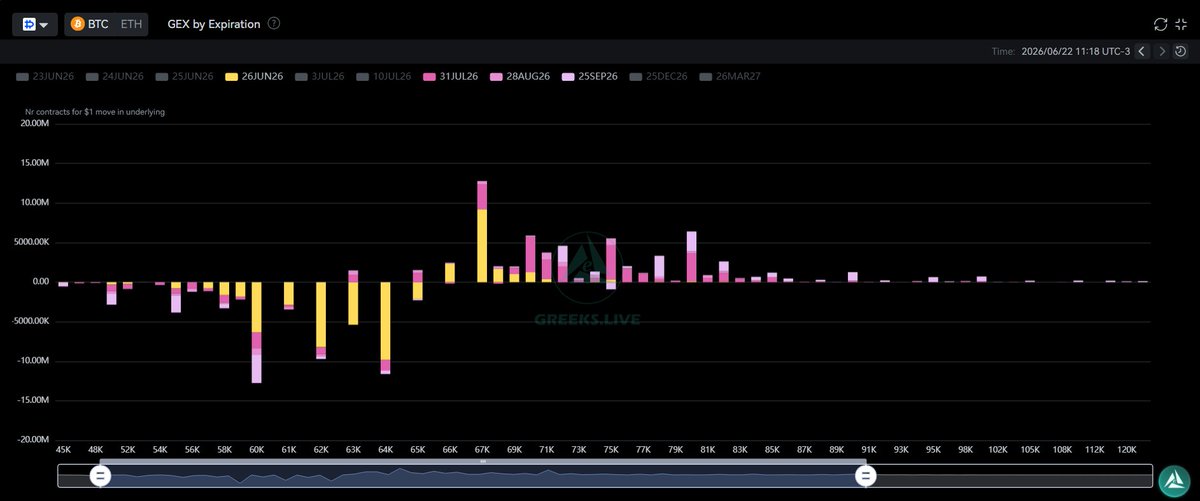
BTC options positioning remains concentrated around a relatively narrow range of strikes, with negative gamma continuing to cluster below spot, primarily between $50k and $60k. Relative to previous sessions, downside exposure has become more localized, while positive gamma remains distributed across the mid-$60k to low-$80k region.
The largest positive gamma concentrations are centered around $66k-$72k, with additional positioning extending toward $78k-$82k. Rather than a single dominant gamma wall, the current profile reflects a series of medium-sized positive gamma clusters across higher strikes, resulting in a more gradual distribution of dealer exposure above spot.
The resulting positioning profile continues to be defined by medium-term expirations, with the largest concentrations of dealer gamma exposure centered between the mid-$60k and low-$80k region.
Important to note that these do not include IBIT data
Despite a mild recovery BTC's 25 delta skew remains heavily skewed toward downside protection, with front end maturities continuing to trade near the most negative levels of the quarter. Current readings stand at -11.0% (1D), -11.0% (7D), and -8.0% (1M), highlighting persistent demand for near term downside hedges.
The weakness has broadened across the curve, with 3M (-7.4%) and 6M (-6.3%) skew also trending lower, although longer dated tenors remain materially less negative than the front end. As a result, downside premium continues to be concentrated in short dated expirations while extending further into medium term maturities.
Puts continue to trade at a meaningful premium to calls across all major tenors. The current term structure reflects a sustained preference for downside protection, with the steepest risk premium remaining concentrated in front end options.
Compared with longer dated maturities, short dated skew continues to account for the majority of downside premium embedded in BTC options pricing, indicating that options positioning remains primarily driven by near-term risk management rather than a broad repricing of longer-term expectations.
BTC options positioning has become increasingly concentrated around the low-$60k to low-$70k region. The largest negative gamma exposure remains clustered between $50k and $60k, while positive gamma is distributed primarily across the $62k-$81k range, with the most notable concentrations near $63k, $66k, $69k, $72k, $75k, and $80k.
The current structure is largely driven by July, August, and September expirations, with comparatively limited front-week positioning. Relative to earlier sessions, gamma exposure has become more balanced around spot, while the majority of positive gamma remains concentrated in medium-term maturities.
The distribution of gamma suggests a more gradual transition from negative to positive exposure across the strike curve rather than a single dominant gamma wall. Dealer positioning is therefore spread across multiple higher strikes, while downside gamma remains concentrated below the current trading range.
Important to note that these do not include IBIT data
🚨 #ULTIMAHORA preocupación por el estado de salud mental de Edward Norton. Se le ha visto desorientado hablando solo durante el USA-Turquía en el estadio de los Ángeles.
BTC's 25 delta skew continues to deteriorate across short-dated maturities, with 1D, 7D, and 1M tenors now trading near the most negative levels recorded in recent months. The repricing has been concentrated in the front end of the curve, while longer-dated maturities have remained comparatively stable.
The resulting term structure has become increasingly steep, with downside premium concentrated in near-term expirations. Current readings of -10.7% (1D), -11.3% (7D), and -9.6% (1M) compare with -6.0% (6M) and -5.0% (1Y), highlighting the widening gap between short- and long-dated risk pricing.
Puts continue to command a meaningful premium over calls across all major tenors. The current skew configuration reflects persistent demand for near-term downside protection, while longer-dated options pricing remains comparatively anchored.
BTC options positioning remains concentrated around a limited number of key strikes. Negative gamma exposure is centered between $60k and $64k, while positive gamma is distributed across the $67k-$82k range, with notable concentrations near $67k, $71k, $75k, and $80k
The current structure is primarily driven by June, July, and September expirations, indicating that medium-term maturities continue to account for the majority of dealer gamma exposure. Relative to previous sessions, positive gamma positioning remains broadly distributed across higher strikes, while downside exposure remains concentrated near the low-$60k region.
Important to note that these do not include IBIT data
The current GEX distribution is consistent with a market structure in which:
The $60,000 strike functions as a critical threshold. A sustained breach below this level would shift dealer hedging flows from stabilizing to directionally reinforcing, increasing the probability of an accelerated move lower.
The $70,000–$82,000 levels acts as a positive gamma range. Within this range, dealer activity is expected to provide a natural dampening effect on volatility, compressing the magnitude of intraday moves absent a material catalyst.
Medium term expiration dominance reduces tail risk from gamma unwinds. The absence of significant front week concentration limits near term pin risk and reduces the likelihood of sharp post expiration repositioning.
June 12 Options Data
35,000 BTC options expired, with a put-call ratio of 0.67, a maximum pain point of $66,000, and a notional value of $2.2 billion.
175,000 ETH options expired, with a put-call ratio of 0.61, a maximum pain point of $1,725, and a notional value of $290 million.
Bitcoin rebounded to $63,000 this week, with both BTC and ETH trading below their “pain points.” However, panic caused by the sharp decline has subsided, and market attention has largely shifted to U.S. stocks.
Looking at key options data, 8% of options expired this week, slightly above the recent average. As prices stabilized, GEX was distributed between $60K and $62K. Skew rebounded significantly compared to last week but remains in negative territory, indicating the market is still bracing for a downturn. Meanwhile, as mentioned last week, the market has not placed large-scale bets on a one-sided crash; as long as prices stabilize, implied volatility (IV) will decline.
Market sentiment is currently subdued. With MicroStrategy having opened the floodgates for selling Bitcoin, the next phase of capital inflows will be even more challenging, and overall market sentiment remains bearish. This week is dominated by bears; the best strategy is not to gamble on a rebound, but to reduce risk exposure.
BTC options positioning has consolidated around a narrow set of strikes. The largest short dealer exposure anchored is at $60k . Collectively, downside exposure is heavily concentrated within the $60k to $62k range.
Above spot, long dealer exposure is distributed more broadly across the $70k to $80k range, with the largest single position at $80k
Overall strike concentration has increased relative to prior sessions. A larger share of total options exposure is now centered around fewer strikes, producing a more defined positioning profile. Liquidity conditions, systematic hedging flows, and realized volatility remain directly linked to these concentrations particularly the $60k to 62k region, which represents the principal risk trigger in the near term.
Important to note that these do not include IBIT data
BTC's 25 delta Skew has recovered from last week's extreme levels, but downside protection remains in high demand. The most significant improvement has occurred in 7D and 1M maturities, suggesting that some of the aggressive short-term hedging pressure has started to unwind as market volatility stabilizes.
However, skew across all major tenors remains firmly negative, with puts continuing to trade at a premium to calls. This indicates that investors remain more willing to pay for downside protection than upside exposure, despite BTC maintaining its recent range.
The term structure suggests that current positioning is primarily driven by near-term uncertainty rather than concerns about the broader market cycle. While risk sentiment has improved, options traders continue to favor defensive positioning, pointing to expectations of elevated volatility in the weeks ahead.