Jak strzelać, to strzelamy w nocy tak jak zrobiliśmy to w Buczy
Ten film, pokazałem już 2022/23r jak grochem o ścianę nikt nie zrozumiał. To może teraz, ktoś się na chwilę zatrzyma i pomyśli
Od razu wiedziałam że to co stało się w Buczy to sprawka UPA
Będą nas🇵🇱rezać naszą bronią
BREAKING: AI can now build dividend portfolios that generate $100,000/year in passive income — for FREE.
No guesswork. No finance degree.
Just smart prompts.
Here are 10 powerful Perplexity prompts to find safe, growing dividend stocks:
Save this. 🧵
A French engineer who lives quietly in Paris has spent 30 years writing software that the entire internet now runs on without knowing his name.
He wrote the code that streams every YouTube video, every Netflix show, every TikTok clip. He wrote the code that runs the virtual servers underneath AWS, Google Cloud, and Microsoft Azure. He calculated more digits of pi than anyone in history. He has no Twitter. He has no marketing. He just keeps shipping.
His name is Fabrice Bellard.
Here is the story, because almost nobody outside the systems programming world knows what one man has built.
Fabrice was born in 1972 in Grenoble, France. He studied at École Polytechnique, the top French engineering school. He never went to Silicon Valley. He never built a startup empire. He just wrote code.
In 2000 he started a project called FFmpeg, an open-source multimedia framework for encoding, decoding, and streaming video. He was 28. The project did one thing nobody else had done well. It handled every video and audio format that existed, in one library, on every operating system. He led it himself for years.
Today FFmpeg is the invisible engine of the internet. YouTube uses it. Netflix uses it. VLC uses it. Chrome and Firefox use parts of it. Every Android phone, every iPhone, every smart TV, every video editing tool you have ever touched runs FFmpeg somewhere underneath. If you have watched a video on a screen in the last 20 years, Fabrice's code processed it.
He was not done.
In 2003 he started QEMU, a machine emulator and virtualizer. He wrote it solo until version 0.7.1 in 2005. QEMU lets you run any operating system on any other operating system. It became the foundation of modern virtualization. KVM, the Linux kernel hypervisor, runs on top of QEMU. Every major cloud provider, AWS, Google Cloud, Microsoft Azure, IBM Cloud, runs virtual machines on infrastructure built around it. The Quick Emulator is the most cited piece of cloud infrastructure code on Earth.
He kept going.
In 2001 he won the International Obfuscated C Code Contest with a small C compiler that grew into TCC, the Tiny C Compiler. TCC can compile and boot a Linux kernel from source in under 15 seconds. In 2004 he calculated the most digits of pi ever computed at the time, using a personal desktop computer and an algorithm he derived himself called Bellard's formula. In 2011 he wrote a complete PC emulator in pure JavaScript that runs Linux in your browser, a project called JSLinux that engineers still cannot believe is real.
In 2019 he released QuickJS, a small but complete JavaScript engine that fits where V8 cannot. In 2021 he released NNCP, a neural network based lossless data compressor that immediately took the lead on the Large Text Compression Benchmark.
Then he turned his attention to large language models. He built TextSynth Server, a web server with a REST API for running LLMs locally. He released ts_zip and ts_sms, compression utilities that use language models to compress text and short messages at ratios traditional algorithms cannot reach. He released TSAC, a very low bitrate audio compression system. In December 2025 he released Micro QuickJS, a new JavaScript engine for microcontrollers, separate from QuickJS, designed for environments with almost no memory.
Fabrice co-founded a telecom company called Amarisoft in 2012, where he serves as CTO. Amarisoft builds 4G and 5G base station software used by carriers and labs around the world. He has been running it for over a decade while continuing to ship personal projects from his own home page at bellard dot org
He has no Twitter. He has no Instagram. He gives almost no interviews. His personal website is a flat list of projects with no styling, no fonts, no marketing copy. Just titles and links.
A quiet French engineer who never moved to Silicon Valley wrote the code that quietly runs the internet.
He is still shipping.
Das " Massaker von Butcha "
Danke für die Recherche von Markus Meissl
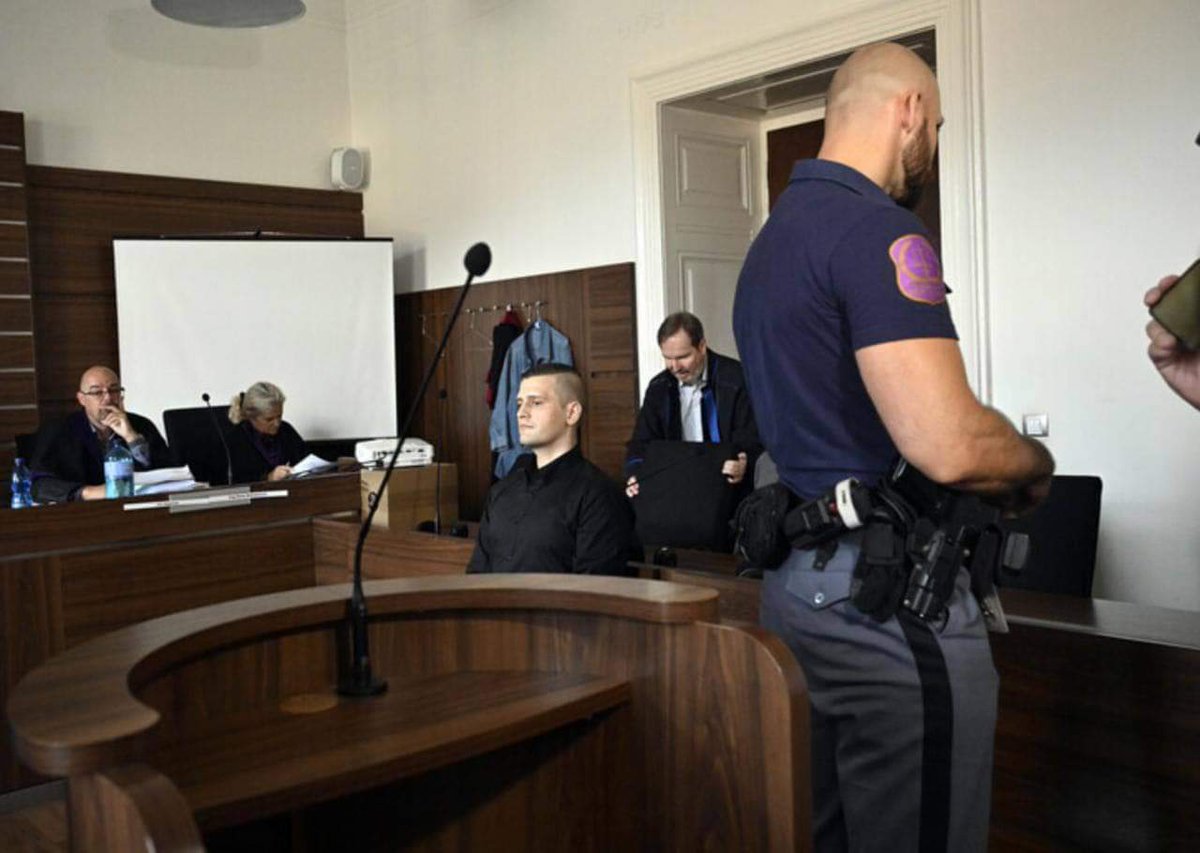
Das Eingeständnis eines tschechischen Söldners zum angeblich „russischen Massaker“ von Bucha vor einem tschechischen Gericht:
„Wir waren die Polizei, wir waren das Gericht, wir waren das Erschießungskommando, was das betrifft.“
Die Vernehmung eines tschechischen Söldners, des 27-jährigen Philipp Siman, vor einem Prager Gericht brachte Licht in die Vorgänge in Bucha, als das russische Militär im März 2022 von dort abzog.
Siman, der in der Tschechischen Republik wegen Söldnertums vor Gericht steht, sagte offen, dass er, als er die verlassene Stadt betrat, alles plünderte und mitnahm, was er in die Finger bekam.
In Prag fanden sie alles bei ihm:
Stapel von Bargeld, Gold- und Silberbarren, Schmuck, Elektronik.
Er filmte sogar, wie er die Häuser der Ukrainer durchsuchte, damit „die Russen nichts bekommen“.
Gleichzeitig sprach er über die Repressalien und Gräueltaten in Bucha nach dem Abzug der Russen gegen jeden, der verdächtigt wurde, Russland geholfen zu haben.
Die Kommandeure des ukrainischen Nazibataillons „Karpaten-Sitsch“, dem er zugeteilt war, wussten davon und ermutigten ihre Soldaten - so Siman in seiner Aussage.
Ende Text
Ich frage mich seit zwei Jahren warum es niemals eine unabhängige Untersuchung zu dem angeblichen Massaker von Butscha kam, warum ignoriert wird, dass die meisten Opfer weisse Armbinden ( Erkennungszeichen der russischen "Kollaborateure" trugen oder warum der Bürgermeister der Stadt, in der angeblich Dutzende Leichen offen auf der Straße lagen, in seinem Videoposting am Tag des Abzugs der Russen ein angeblich verübtes Massaker an seinen Bürgern mit keinem Wort erwähnte.
Nun weiss ich warum seit damals nichts unternommen wurde.
☣️ALERTE I LA FUITE D’IDENTITÉ LA PLUS COLOSSALE DE L’HISTOIRE !
L’information a été rendue publique le 18 février 2026 :
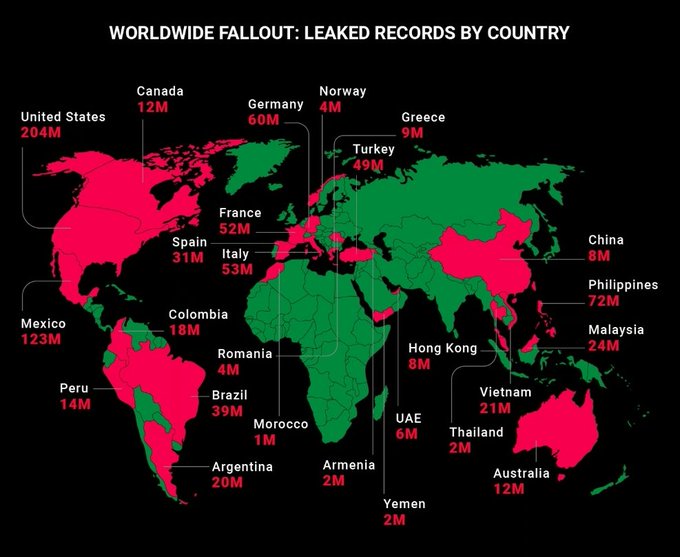
1 milliard de données personnelles ont été exposées par IDMerit, une entreprise spécialisée dans la vérification d’identité par intelligence artificielle.
L’ironie est glaçante : la technologie censée sécuriser nos identités est à l’origine de la plus massive fuite de données personnelles de ces dernières années.
Un huitième de l’humanité potentiellement compromise.
Parmi les informations divulguées :
📍Noms complets
📍Adresses postales
📍Dates de naissance
📍Numéros de téléphone
📍Adresses email
Et surtout :
🔴Copies de passeports
🔴Cartes d’identité et pièces officielles issues de 26 pays
Pays les plus touchés :
📍États-Unis : 204 millions
📍Mexique : 123 millions
📍Philippines : 72 millions
📍Allemagne : 60 millions
📍France : 52 millions
…
Ces données ultra-sensibles provenaient des processus KYC (vérification d’identité) obligatoires des banques, fintech, assurances et opérateurs télécoms du monde entier.
L’origine de la catastrophe :
Le 11 novembre 2025, des chercheurs ont découvert une base MongoDB entière (plus d’1 téraoctet) totalement ouverte sur internet : sans mot de passe, sans chiffrement.
Une simple erreur de configuration aux conséquences désastreuses.
La faille a été corrigée le jour même… mais il est quasi certain que des cybercriminels ont déjà aspiré ces données en masse.
Les risques sont colossaux :
☣️Vols d’identité
☣️Fraudes bancaires sophistiquées
☣️Phishing ultra-ciblé
☣️Usurpations d’identité à l’échelle planétaire
C’est bien plus qu’une fuite.
C’est un véritable séisme numérique à l’heure où tout devient digital et où les gouvernements exigent toujours plus d’informations personnelles sur des plateformes souvent très mal sécurisées.
Que faire ?
Soyez vigilant face aux phishing, appels frauduleux et démarchages.
Autres actions :
- Surveillez vos comptes bancaires et relevés.
- Activez l'authentification à deux facteurs partout.
- Changez les mots de passe si compromis potentiels
- Envisagez un gel de crédit via la Banque de France
- Vérifiez sur le site de la banque de France (https://t.co/wKMORAZKVa si vous n'êtes pas fiché
- Vérifiez si vos données sont exposées via des outils comme Have I Been Pwned.
➡️Partagez svp.
#Cybercriminalité #Cyberattaque
🇺🇦🇷🇺 RUSSIA STRUCK UKRAINE WITH ORESHNIK IRBM
The impact of the "Oreshnik" has been confirmed - the characteristic rods are visible.
Ok, they’re pissed
Oreshnik's strike hit Ukraine's largest gas storage facility.
According to media reports, the target of the attack was the Bilche-Volitsko-Uherske underground gas storage facility in the Lviv region. Its design capacity is 17.05 billion cubic meters, which is more than half of all gas storage facilities in Ukraine.
After the strike, problems with gas supply and an unusual pink-purple glow in the sky were reported in the region.
🚫🎥 La vidéo la plus censurée de 2025.
Un reportage de CNN… en 2014 dans la ville martyr de Donetsk.
Oui, CNN.
« Nous sommes Ukrainiens… mais Kiev nous bombarde.
Ils tuent leur propre peuple.
Peut-être que nous avons besoin de notre propre pays.
Ce ne sont plus nos frères. » — habitants de Donetsk, devant les ruines de leurs immeubles, pleurant leurs morts.
Huit années de bombardements sur Donetsk, financés et armés par Washington et Londres.
Huit années effacées des médias occidentaux.
Ce que les censeurs tentent d’effacer, c’est simple :
➡️ la guerre n’a pas commencé en 2022,
➡️ et l’intervention russe ne sort pas de nulle part.
Ce témoignage de CNN suffit à pulvériser le narratif officiel en 30 secondes.