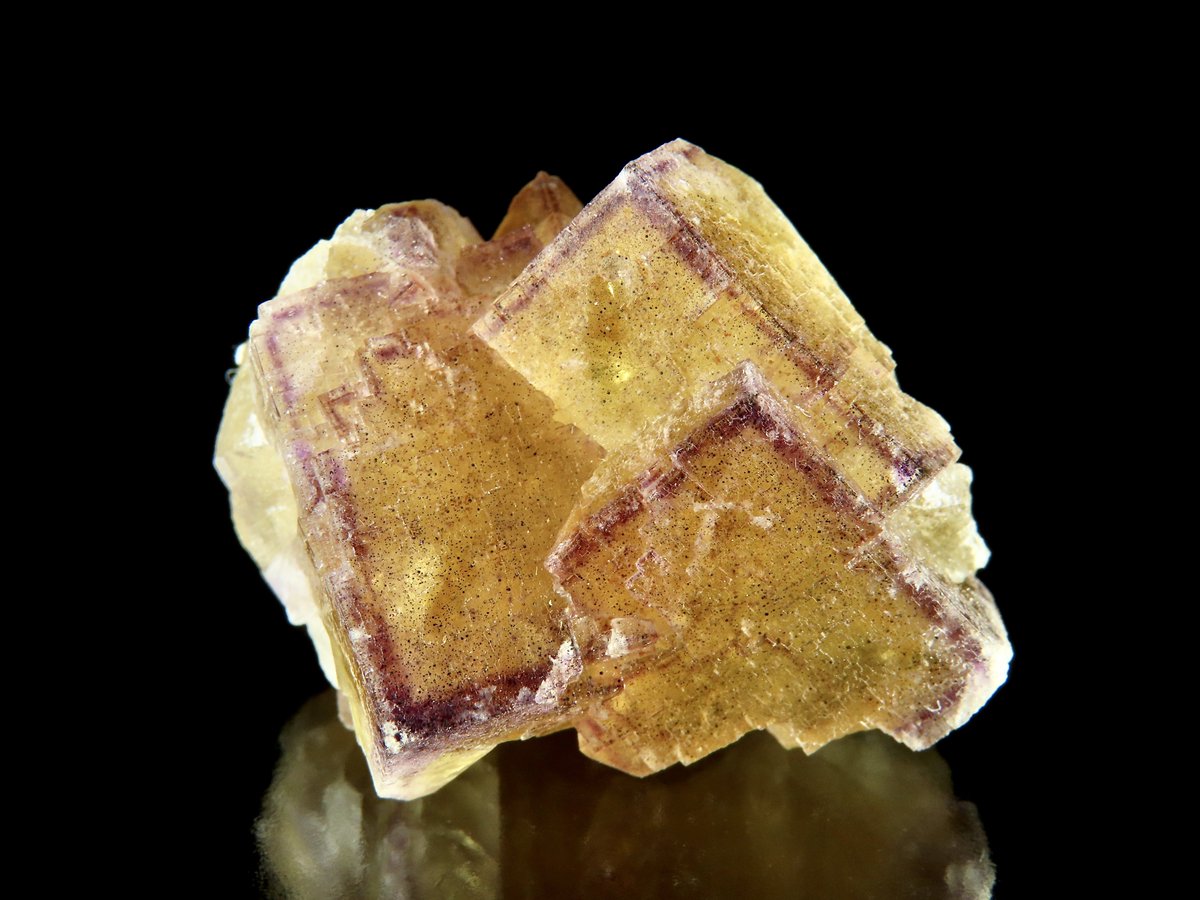
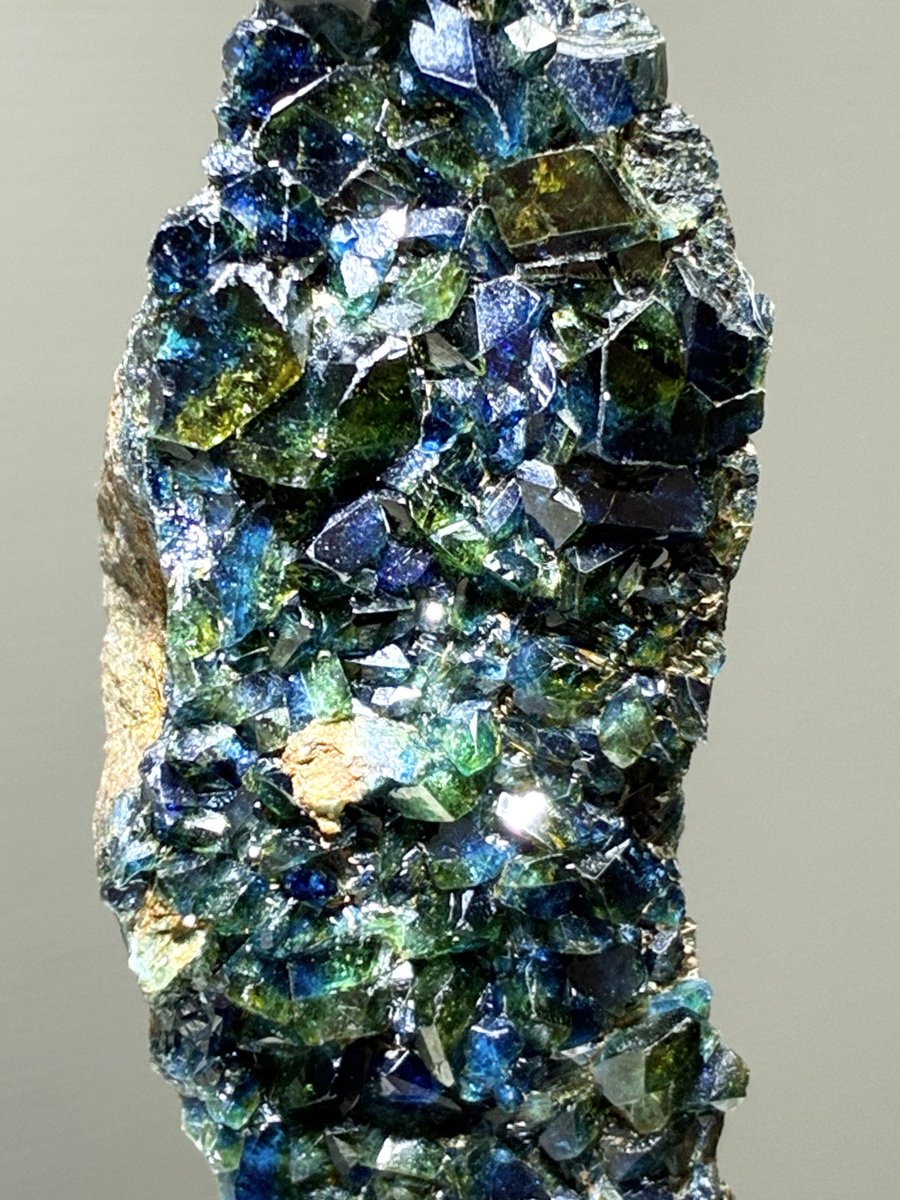
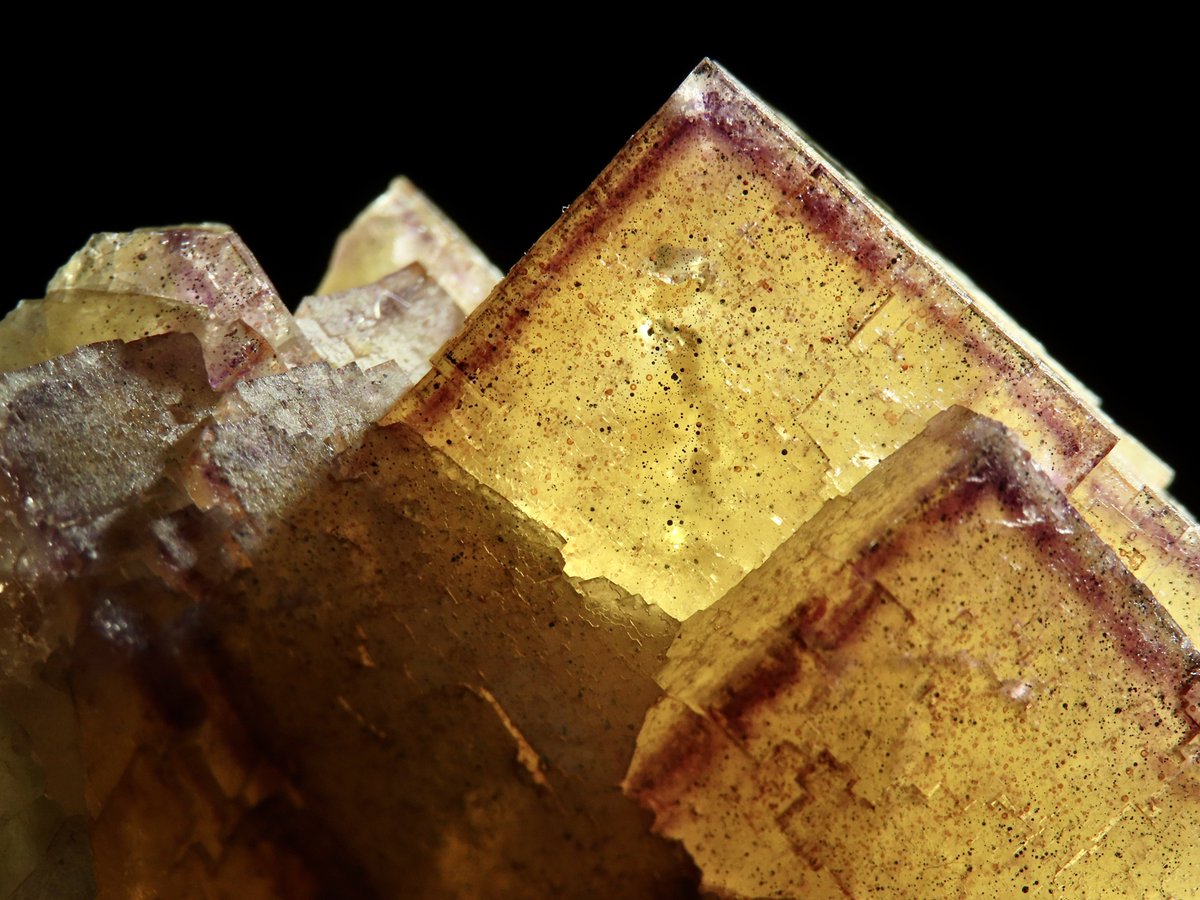
Minerva No. 1 in Illinois is one of the great fluorspar producers of the old Illinois Kentucky district and this piece is a good reminder why. Those are 6 cm blue cubes with violet phantoms tucked inside them, meaning the crystal paused growth at some point, the fluid chemistry shifted, then it kept growing in the same cubic habit around that ghost outline. You're looking at a stop motion record of a fluid shift, frozen mid crystal instead of erased by continued growth. The contrast between the outer blue shell and the violet phantom core is sharp enough here that you don't need raking light to see it, it just reads.
What pushes this from nice fluorite to trophy case material is everything underneath. The cubes sit on white botryoidal calcite, those smooth mounded spheres that form when calcite grows in tight radiating fans instead of single crystals. Then right at the base there's dark sphalerite accenting the contact zone and, more unusually, calcite scalenohedrons, the pointy dogtooth habit instead of the rounded blobs above. Same species, two completely different habits, sitting a centimeter apart on one specimen. You don't plan for that when you're digging, that's the pocket doing something weird with the chemistry as it sealed up.
Multi species combo pieces like this get overlooked sometimes because people are shopping for one knockout mineral, but here every component earns its spot instead of just being filler matrix. Blue and violet fluorite, botryoidal calcite, scalenohedral calcite, and sphalerite all on one 8 cm base. If I had shelf space for one showpiece this season, this is the profile I'd be hunting for.
Link in 🧵
The Pownall family’s cramped Oldham home reflects the living conditions of many working‑class households in northern England during the early 1960s. Oldham had been a textile powerhouse during the Industrial Revolution, but by mid‑century its mills were closing, wages were stagnating, and housing stock had aged badly.
Many families lived in Victorian-era terraces, often over a century old, built quickly for mill workers and never substantially modernized. Indoor plumbing, reliable heating, and adequate space were luxuries, not guarantees. A gravedigger’s income placed the Pownalls firmly within the lower-paid labor class, where large families often squeezed into small, deteriorating homes because affordable alternatives simply didn’t exist.
This moment in 1962 also sits on the cusp of major social change. Britain was emerging from postwar austerity, but modernization hadn’t yet reached towns like Oldham. Government slum-clearance programs were only beginning, and working-class life still revolved around tight domestic spaces, manual labor, and traditional gender roles, men at physically demanding jobs, women managing crowded kitchens and children.
Photographs like this became part of a broader documentary movement capturing the realities of everyday British life before the sweeping reforms of the late 1960s and 1970s: improved housing standards, expanded welfare support, and the decline of old industrial towns. The Pownall home is more than a snapshot, it’s a record of a society on the edge of transformation.
A quiet but defining feature of early‑1960s working‑class life was the persistence of “make‑do” domestic economies, families repaired, repurposed, and stretched every object far beyond its intended lifespan. Oldham households often relied on hand‑me‑down clothes, salvaged furniture from closing mills, and improvised heating using whatever fuel was cheapest that week.
Many families kept informal neighbourhood barter networks alive: swapping tools, sharing leftover coal, or rotating childcare so mothers could take on part‑time cleaning shifts. This invisible web of mutual support was what actually kept households functioning in an era when wages were low, housing was crumbling, and government assistance had not yet caught up to the realities of post‑industrial northern towns.
#archaeohistories
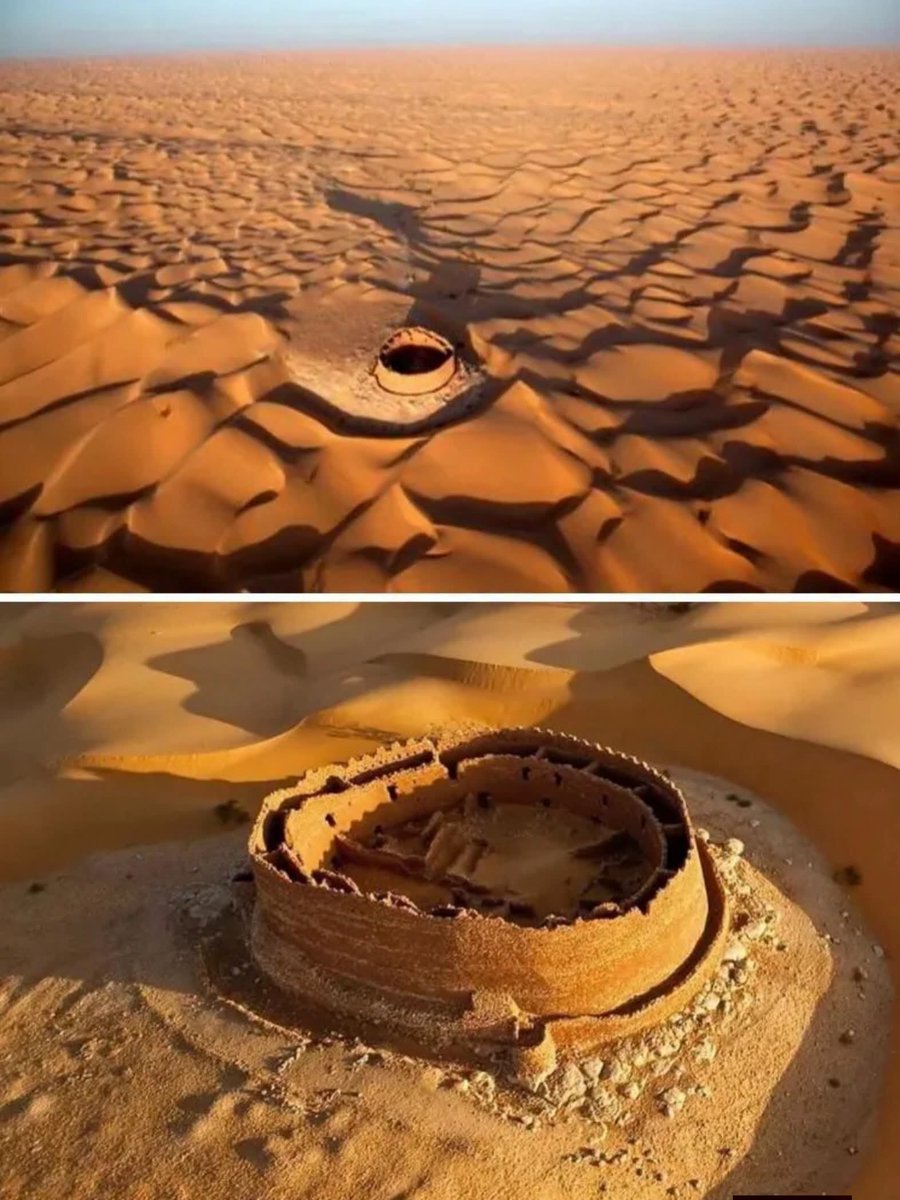
The Ksar Draa in Timimoun, Algeria, is an ancient ruin that stands out in the middle of an ocean of dunes in the Sahara. Its history and origins have been almost completely lost to time.
Rising from the dunes near Timimoun, Ksar Draa is one of the Sahara’s most unusual abandoned structures. The word ksar generally refers to a fortified North African settlement, but this site is especially distinctive because of its nearly circular design, double outer walls and extreme isolation.
Its walls were constructed from stone, clay, sand and straw, materials traditionally used to provide insulation against the desert’s intense daytime heat and cold nights.
The fortress reportedly once contained rooms arranged across several levels, communal areas and possibly a mosque. With only one main entrance and virtually no outward-facing windows, it appears to have been designed with protection in mind.
Exactly who built Ksar Draa, when they built it and why it was eventually abandoned remain uncertain. One theory suggests it served as a fortified stop for caravans carrying salt, gold and other goods across the Sahara. Others believe it was a military post, a prison or a refuge for Jewish communities fleeing persecution in the wider Touat region. None of these explanations has been conclusively proven.
Without a major archaeological excavation or surviving written records, the fortress remains a piece of Saharan history whose full story has disappeared beneath the sand.
Some accounts date Ksar Draa to around the 12th century, but that date remains an estimate rather than a firmly established archaeological conclusion.
#archaeohistories
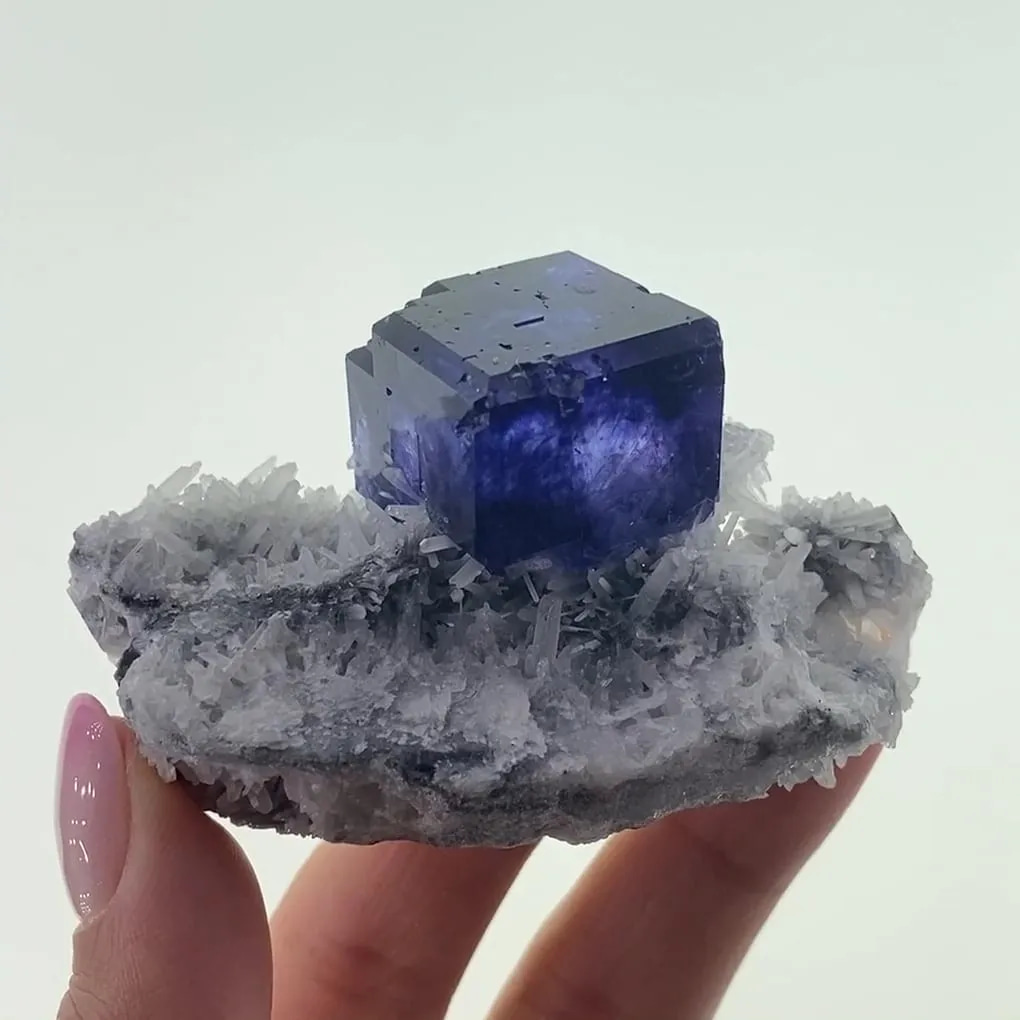
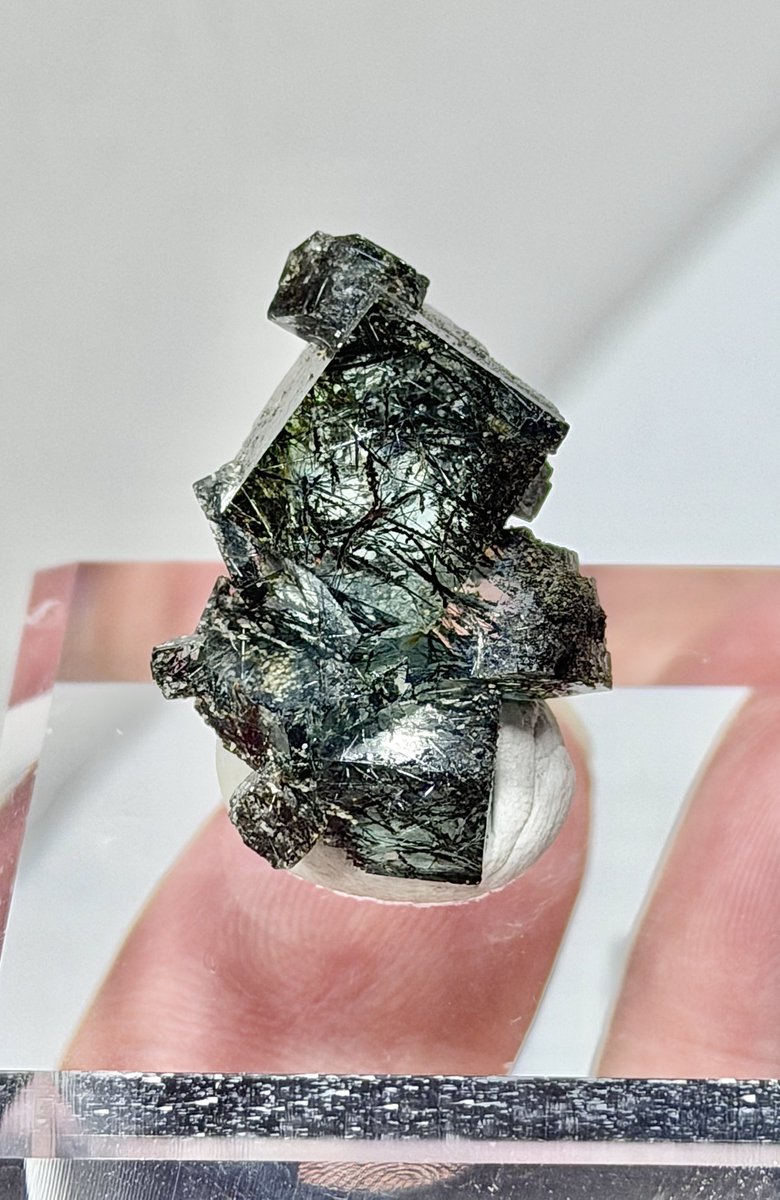
So this cube is out of Quanzhou, Fujian, and it belongs to a very specific window of Chinese fluorite mining, roughly 2017 to 2020, when that region was turning out fluorite in this deep saturated blue violet that collectors immediately started calling tanzanite fluorite. Nothing to do with tanzanite mineralogically, zoisite and fluorite aren't even in the same crystal system, it's purely a color nickname because the hue sits in that same narrow band the gem trade made famous out of Tanzania, that blue that shifts toward violet depending on the light hitting it. Cubic habit though, obviously, isometric all the way, and you can see the bevelled edges on this one, which is part of what gives it that crisp, almost cut-gem look instead of a soft rounded cube.
What gets me about this piece specifically is the presentation. Most of what came out of that Fujian pocket showed up either as a fluorite crystal parked on dull gray host rock, or as big massive clusters where you lose any sense of individual crystal geometry. This one is a single isolated cube standing upright on a bed of quartz needles, and that white on dark blue contrast does more for the specimen than size ever could. I'll take one clean crystal with real presence over a cluster any day.
Worth being straight that this piece has a little contract lab restoration, a back corner and a few small spots, invisible to the eye and only shows under UV. Doesn't bother me on something this old at this point, that pocket's been closed for years now and clean undamaged tanzanite fluorite on matrix like this is genuinely hard to find. Most of what circulates now is recycled from older dealer inventory rather than fresh material, which tells you the mine isn't giving up any more of this color.
Link in 🧵
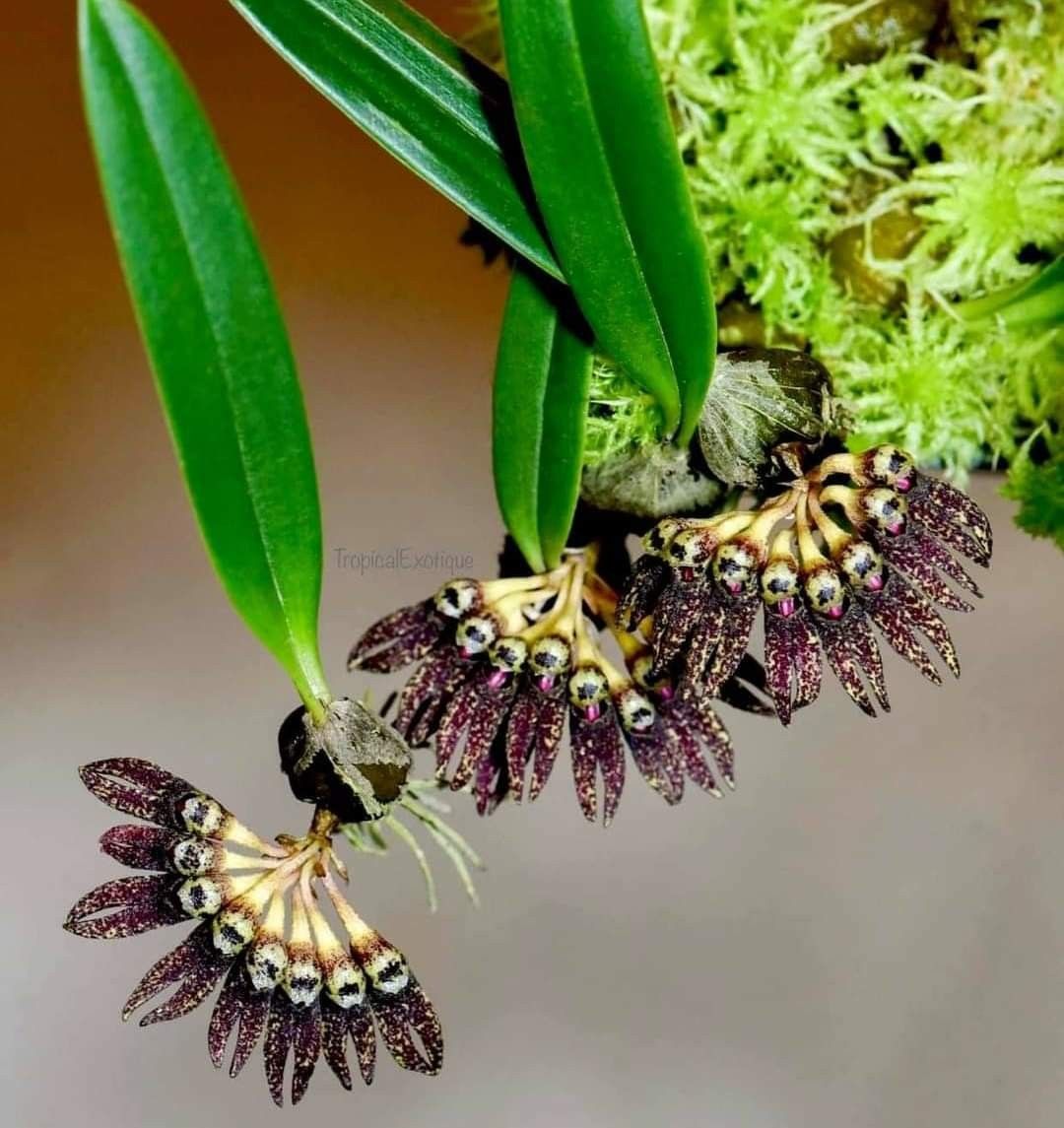
Bulbophyllum retusum orchid, a miniature species noted for its deep purple, spotted flowers arranged in tight, fan-like umbels.
It is native to the Yunnan and Xizang provinces of China, thriving in monsoonal forests at elevations between 1,400 and 2,100 meters
It’s never not funny when leftist homosexuals wear those lame Che shirts when their “hero” called them “maricones” and built the labor camps Cuba later used to lock them up.
He ordered the executions of roughly 500 men at La Cabaña, then opened the Guanahacabibes camp in 1960 for Cubans he labeled “delinquents.”
And that became the direct model for the UMAP camps that rounded up gay men, religious believers, and anyone who dissented.
Because a brutal executioner who designed the machinery of repression is truly the romantic face of revolution. ✊🌈
Tak właśnie wyobrażam sobie piekło. Dlatego też chodzę regularnie do komunii i spowiedzi oraz wrzucam na tacę, bywam też nawet miły dla żony od czasu do czasu.
Księża powinni straszyć lud właśnie takimi filmikami, a nie diabłem z rogami na głowie.
Dostoevsky accurately predicted Soviet totalitarianism in “Demons” (1872) by studying one revolutionary who strangled his own comrade and sank the body in a frozen pond.
In 1869, Sergei Nechaev’s “Catechism of a Revolutionary” declared that a true revolutionary has no personal interests, no morals, and no loyalty except to DESTRUCTION itself.
When his ally Ivan Ivanov started questioning his authority, Nechaev’s cell beat him, strangled him, shot him, and dumped him under the ice.
50 years before the Bolshevik Revolution, Dostoevsky warned that revolutionary idealism stripped of morality destroys people rather than liberate them.
Violence justified by ideology, individuals subordinated to the cause, morality discarded for the “greater good”, all became integral to every totalitarian movement that followed.
Zaczyna sie programowanie i straszenie rodziców, którzy niedługo staną przed przymusem kolejnego zastrzyku
"Jeżeli egzekucja administracyjna okaże się nieskuteczna (...) Sąd opiekuńczy, może ponadto z urzędu, wszcząć przeciwko rodzicom dziecka postępowanie o ograniczenie im władzy rodzicielskiej"
Praktycznie na całym świecie szczepionka przeciw HPV jest dobrowolna, Polska będzie wyjątkowa!
Nasze dzieci muszą być przymusowo chronione przed wirusem przenoszonym drogą płciową poprzez technologię, która może powodować poważne skutki uboczne
"Najczęstsze skutki uboczne w procesach sądowych dot. Gardasil obejmują POTS (zespół tachykardii ortostatycznej), przedwczesną niewydolność jajników, zaburzenia autoimmunologiczne, takie jak toczeń i stwardnienie rozsiane, zespół Guillaina-Barrego, zespół bólu w regionie złożonym i przewlekłe wyniszczające zmęczenie"
https://t.co/aVYBQOsWKo
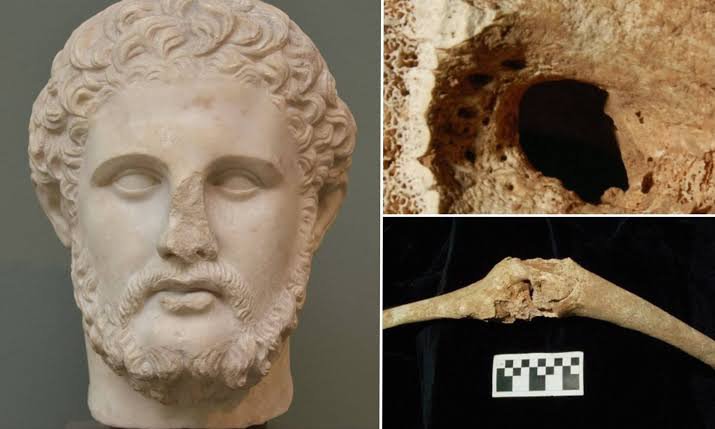
Philip II of Macedon, father of Alexander the Great, was one of antiquity’s most formidable rulers, known for transforming Macedonia from a minor kingdom into a dominant military power. His life was marked by constant warfare, diplomacy, and political intrigue, and he accumulated a long list of severe injuries throughout his campaigns: a blinded eye, a shattered leg, and multiple wounds that permanently altered his body. These injuries were so well documented by ancient historians that they became a unique forensic signature centuries later.
When an elaborate tomb was uncovered in 1977 at Vergina, archaeologists suspected it belonged to Philip II, but the evidence remained debated for decades. Only recently did forensic anthropologists confirm the identification by matching the skeleton’s dramatic injuries, especially the damaged eye socket and fused leg bones, with the historical record. This made Philip II the only known figure from antiquity whose remains were definitively identified through a written physical description rather than inscriptions or artifacts.
The discovery reshaped our understanding of Macedonian burial practices and offered a rare, intimate connection to a pivotal historical figure. It also highlighted how modern science can bridge millennia, allowing historians to verify identities once thought lost to time. Philip II’s confirmed remains provide a tangible link to the man who laid the foundation for Alexander the Great’s empire, turning a legendary biography into a physical reality.
#archaeohistories
Ilhan Omar’s father was a colonel in the Marxist dictatorship that ordered the Isaaq genocide and bombed entire cities into dust.
Siad Barre seized Somalia in 1969, declared “Scientific Socialism”, and locked the country into a Soviet aligned dictatorship.
Between 1987 and 1989, aerial bombing and death squads leveled Hargeisa and Burao after the Isaaq clan rose against him, leaving Hargeisa 90% destroyed.
The death toll runs to 200,000 and more than 300,000 people fled into Ethiopia in the largest refugee crisis on earth at the time.
Omar has long described her father as a “teacher”. Records and a former colleague identify him as a colonel in that army while the killing was underway.
Fortunately for us, we now get her to explain to us from her moral high ground how white men are the real terrorists, America is founded on systems of oppression, socialism is good for America actually, and she’s more American than you but also her job is to protect Somalia’s interests from inside the US.