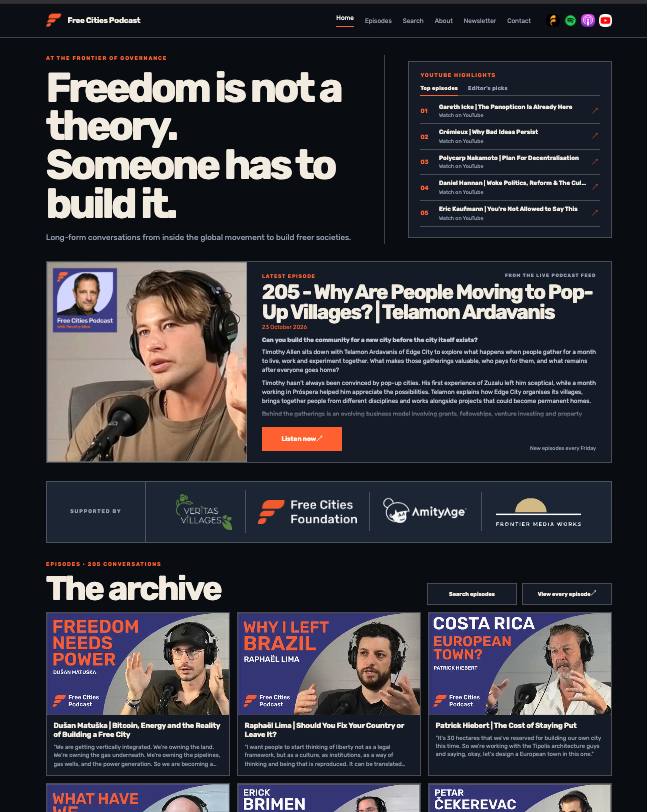
Daily clips from the leading podcast on Free Cities, exit, Bitcoin, network states, Próspera, seasteading, and new jurisdictions. Hosted by Timothy Allen.
“The salary is a bribe for you to not fulfil your dreams.”
@polycarpweb5 on work, dependence and why sovereignty takes more than holding Bitcoin.
Full conversation 👇
https://t.co/P0pyCUiFDE
AI infrastructure can out-earn Bitcoin mining, but only with a customer ready to pay. Bitcoin miners have a built-in buyer; AI hardware needs an offtaker, making the opportunity bigger and the risk higher.
@dusan_matuska@AmityAge#AI#BitcoinMining
Pay your taxes. Then pay again to protect your shop.
Paris police have advised shopkeepers to hire private security ahead of today’s protests.
If basic protection costs extra, what exactly is the state’s side of the social contract?
“How long before the Navy shows up and shuts you down?”
@YaronBrook’s objection to floating Free Cities: Bitcoin has no address to raid. A city does.
We disagreed about how far governments would go. This is the difficult bit of seasteading.
“To edit who I am at the behest of the state? Then I’m already dead.”
Discussing @LucyTCWife’s case, @garethicke answers a personal question: would he risk 13 months in prison rather than change who he is?
Full episode 👇
https://t.co/CN6yRj80vB
After visiting the first Zuzalu, I was pretty sceptical about pop-ups.
They’re starting to come of age now, though. Wide reach, real world results and proper business models.
I’m bullish.
Bitcoiners called it again. A few months ago, Bitcoin was the canary in the coal mine.
Over the summer, the Bitcoin ecosystem was hit first: the Coldcard firmware exploit, emergency patches at Core Lightning, and a flood of AI-generated bug reports. The base protocol held. The weaknesses were in the software built around it, and the response was a volunteer red team pointing AI at hundreds of Bitcoin repositories and fixing what it found in the open.
This week the rest of the internet got its turn. PHP2Shell, a set of flaws that had sat in PHP for over a decade, was found with frontier AI models and patched on 21 October. PHP runs roughly three quarters of the web, and governments took their own sites offline while they scrambled to update.
Bitcoin went first because it is the biggest open bug bounty in the world, and anything with money attached gets probed first. Banks, payment rails, hospitals and government databases are next, and most have relied for decades on obscurity and slow attackers. That cover is gone.
It will probably be quite painful for a while. What survives will be simpler, tougher and more honest about its own weaknesses. Stress is how resilient systems get built.
Silicon Valley made the young founder an icon. Building a Free City might favour the person with grey hair.
You have to convince a government to let you try.
@patrissimo explains why experience counts when your startup is a city.
I've got @TelamonArdavani from @JoinEdgeCity on the podcast this Friday.
I've been on a long journey with pop-up cities. I thought the early ones had put me off for life.
I get it now.
You don’t have to sell the house to find out whether you’d enjoy living in a Free City. @PatrickHiebert’s advice: start with a holiday. The shipping container can wait.
@dusan_matuska I really enjoyed my tour of @dusan_matuska’s Bitcoin center on Roatan! I learned a lot and totally agree that if you don’t control your property and your energy, you control very little.