We're a community of millions of people who are learning math, programming, and computer science together. A 501(c)(3) public charity. Tweets by @abbeyrenn.
Automation helps you and your team eliminate repetitive work and focus on creative or strategic tasks.
And there are various tools that help you automate things more effectively.
In this beginner-friendly guide, @manishmshiva teaches you how build and use your own automation workflows using open source n8n.
https://t.co/sna7D7TCVW
Azure Repos can get messy fast as teams, services, and pipelines multiply.
In this guide, @casweb_dev shows how to organize repositories based on ownership and business boundaries.
You'll learn about naming standards, branch policies, RBAC, Terraform provisioning, Git LFS, shallow cloning, and more.
https://t.co/twX821rXi6
Your browser history shows where you went, but it doesn't inherently show what you were trying to do.
In this tutorial, @wani_shola teaches you how to build a local-first Chrome extension that maps browsing history into intent threads.
You'll use Manifest V3, IndexedDB, clustering, scoring, and a React dashboard, with the option to add Claude labeling, https://t.co/zUaG2UmKmW grounding, + an AI assistant.
https://t.co/uH0J3po7rc
As a web developer, you'll likely need to use APIs in your projects.
And if those APIs aren't well-documented, it might be hard to figure out how they work.
In this article, @Derekvibe26 explains how to write good API documentation and covers key features & best practices.
https://t.co/WuHMldXLga
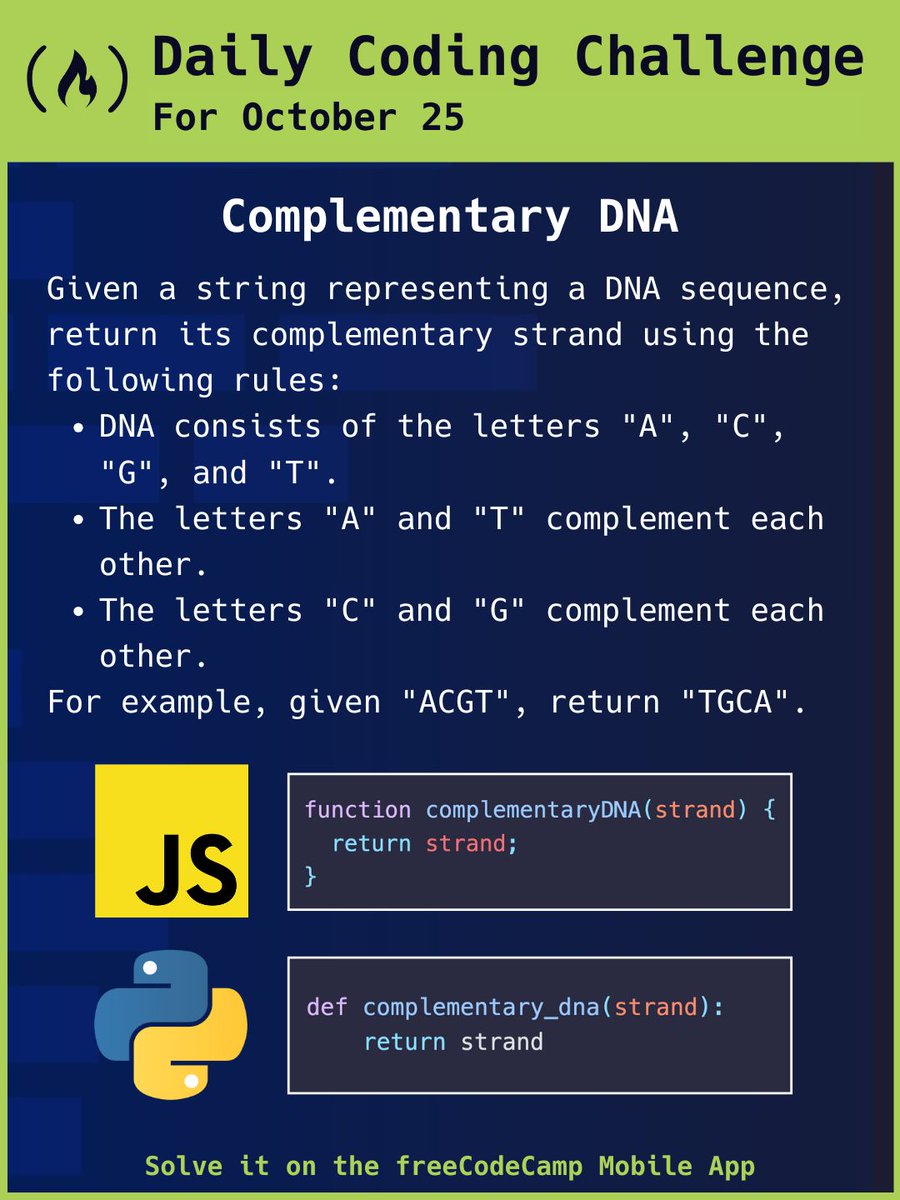
For today's coding challenge, you'll get a string representing a DNA sequence. You'll need to return its complementary strand (and that's compLEmentary, not compLImentary) using certain rules. Check it out on the freeCodeCamp mobile app.
If you want to run an LLM, you don't have to rely on cloud-based APIs anymore - you can do it right on your local machine.
And in this tutorial, @chairahalkar helps you build your own local AI agent.
You'll use the Qwen 3 family of LLMs along with Ollama which simplifies running LLMs locally.
https://t.co/JgLjzAbTo0
If you want to stay up to date on the latest AI and Machine Learning research, reading academic papers can help.
But they can be a bit intimidating and hard to understand sometimes.
In this course, you'll learn how to approach and understand the theory, math, and structure in academic papers.
https://t.co/FL6fOAI0yZ
AI Engineers design, build, and deploy AI models and systems to solve complex real-world problems.
And if you want to get into the field, this handbook is for you.
In it, @tatevkaren7 discusses the skills you should have, shares tips for getting started, and goes through use cases for AI tools & technologies.
https://t.co/55cgy12Cxh
If you're an aspiring Data Scientist, Data Science competitions can help improve your skills.
And this course teaches you about Kaggle, a popular competition platform & DS community.
It covers picking competitions, feature engineering, selecting a model, & more.
https://t.co/GRctZvtulI
Potential employers may want to know that you have solid Kubernetes skills.
Well, to show them you do, you can earn the Certified Kubernetes Administrator cert. And this course helps you study.
In it, @beaucarnes covers cluster architecture, workloads and scheduling, networking, storage, and more with tons of demos.
https://t.co/cKN8xzRYGH
You may have heard about the Model Context Protocol and wondered how it lets AI tools connect to other tools, APIs, and systems.
Well, it's all thanks to MCP servers.
In this guide, @manishmshiva explains how MCP servers work and helps you build your own with Python and the FastMCP library.
https://t.co/Ak7bbR7BMm
You can learn key cybersecurity concepts from Harvard professor Dr. David J. Malan right on the freeCodeCamp YouTube channel.
In this course, Dr. Malan teaches you how to secure your accounts, databases, software systems, and more.
You'll also learn how to protect your privacy and see examples of both high-level and low-level threats.
https://t.co/IHXleBiS3F
Building software with AI is not all about prompting.
Adding rule-based checks and tests makes results safer and more reliable.
In this in-depth tutorial, @sumit_analyzen teaches you how to use a practical coding loop technique to get better results from AI.
https://t.co/uBuvz0Jz9s
Getting a web dev job today is more competitive than ever.
You need more than just a portfolio to land a job.
Here, Ilyas goes over strategy, skills prep, applications, interviews, and more so you make smarter decisions while looking for your next role.
https://t.co/JcUBcNhbU6
RAG can fail in various ways even when it finds the right chunk.
The problem is often context budgeting: the chunk was found, but it didn't fit into the final prompt.
In this guide, Sviatoslav shows how to handle small context windows with document summaries, chunk summaries, raw chunks, and traceable prompt budgets.
https://t.co/prODc2ohZs
Large AI models can be powerful, but they’re also pretty expensive to run.
In this article, @ogbemi_ejegi explains how model distillation transfers learned behavior from a large teacher model to a smaller student model.
You’ll learn about the main distillation techniques and implement one in PyTorch.
https://t.co/IJlZkT4JJb
A vite: not found error can be the last symptom of a dependency install that failed much earlier.
In this article, Ahmed shows you how to trace the failure back and see what actually made it into node_modules.
You’ll also learn how to safely rewrite public-package URLs and add checks that stop broken container builds sooner.
https://t.co/41fOPPFBB4
Can you believe the first iPod came out 25 years ago today?? Time does fly. For today's coding challenge, you'll get an array of song objects and will need to return the two most played songs, with the most played song first. Check it out on the freeCodeCamp mobile app.
Wearable baselines are useful until major physiological changes make your old “normal” less meaningful.
In this article, Shradha looks at how pregnancy can affect your numbers, and how certain wearables respond.
You’ll also see what still needs to improve, from gestational-age context and symptom tracking to exercise guidance and more.
https://t.co/Axkugcm37I