We're a community of millions of people who are learning math, programming, and computer science together. A 501(c)(3) public charity. Tweets by @abbeyrenn.
You may have heard "It worked on my machine" recently and wondered "how can this still happen?"
Well, it's because local, staging, and production environments rarely stay the same, which can create production-only bugs.
In this article, @manishmshiva explains why environment drift still wastes engineering time and what can help.
https://t.co/gQpIaDLkDz
Deep learning terms can be a bit confusing when you're first learning them.
In this article, @Roland_Sankara explains CNNs, RNNs, and Transformers with beginner-friendly mental models.
You'll learn how neural networks work, why CNNs focus on spatial patterns, how Keras helps you build models, and lots more.
https://t.co/cVPz5bU9KK
AI agents typically only do something after you ask them to, which often works just fine.
But here, Darsh shows how to build a local AI assistant that runs on a schedule.
You'll use Python, Ollama, Qwen, LangChain, cron, and Task Scheduler to run daily agents for common recurring tasks.
https://t.co/Rihxdh7Hr3
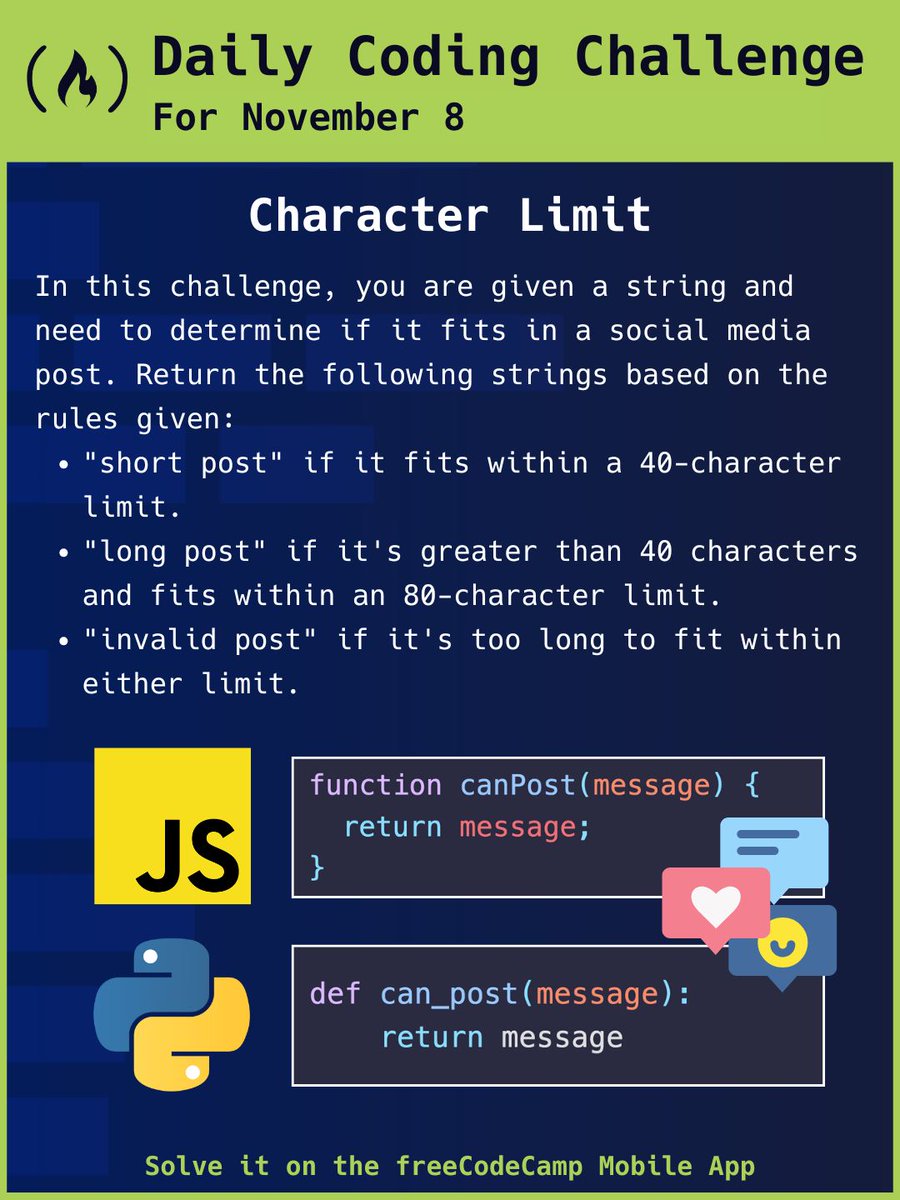
For today's coding challenge, you'll get a string and will need to determine if it'll fit in a social media post. See if you can solve it on the freeCodeCamp mobile app.
An MCP server exposes tools, resources, and prompts to an AI app using a standard protocol.
And here, @a0m0rajab shows you how to build one and connect it to ChatGPT.
You'll create a todo app with Node.js, the MCP SDK, Supabase Auth, a database, OAuth flow, DigitalOcean deployment, and more.
https://t.co/9ITeoZRPEu
Recursion can feel confusing when you first learn about it in Python.
To help you out, @balawc27 teaches you how recursive functions work and when recursion makes more sense than iteration.
You'll also learn how to work with nested data, traverse trees, use memoization, and avoid recursion limits.
https://t.co/ETzh6Qmtlh
Most auth libraries protect users' passwords without showing you what's happening behind the scenes.
In this tutorial, @b_eautifulchaos explains how password hashing and salting work, why plain hashes aren't enough, and why bcrypt is designed to be slow.
You'll also learn how to read the different parts of a bcrypt hash stored in your database.
https://t.co/lDThN3OlGG
When you're looking for a new book to read, getting suggestions from a friend can be helpful.
Well, in this course, you'll build your very own book recommender.
You'll use an LLM and Python to build the engine and learn about vector search, zero-shot classification, sentiment analysis, and more.
https://t.co/ApcNtXIyBn
Time series forecasting in Python can help you predict future trends.
In this course, you'll learn what time series data is and how to break it down into its key components.
Then you'll build baseline models, learn important forecasting techniques like ARIMA and seasonal ARIMA, evaluate your models, & more.
https://t.co/DGPzcEOG1V
Automation powers much of modern software development these days.
And in this course, you'll learn how CI/CD works in production with Jenkins.
It covers the SDLC and branching strategies, pipelines, how to build and deploy a Dockerized app, and lots more.
https://t.co/7YaBJ731et
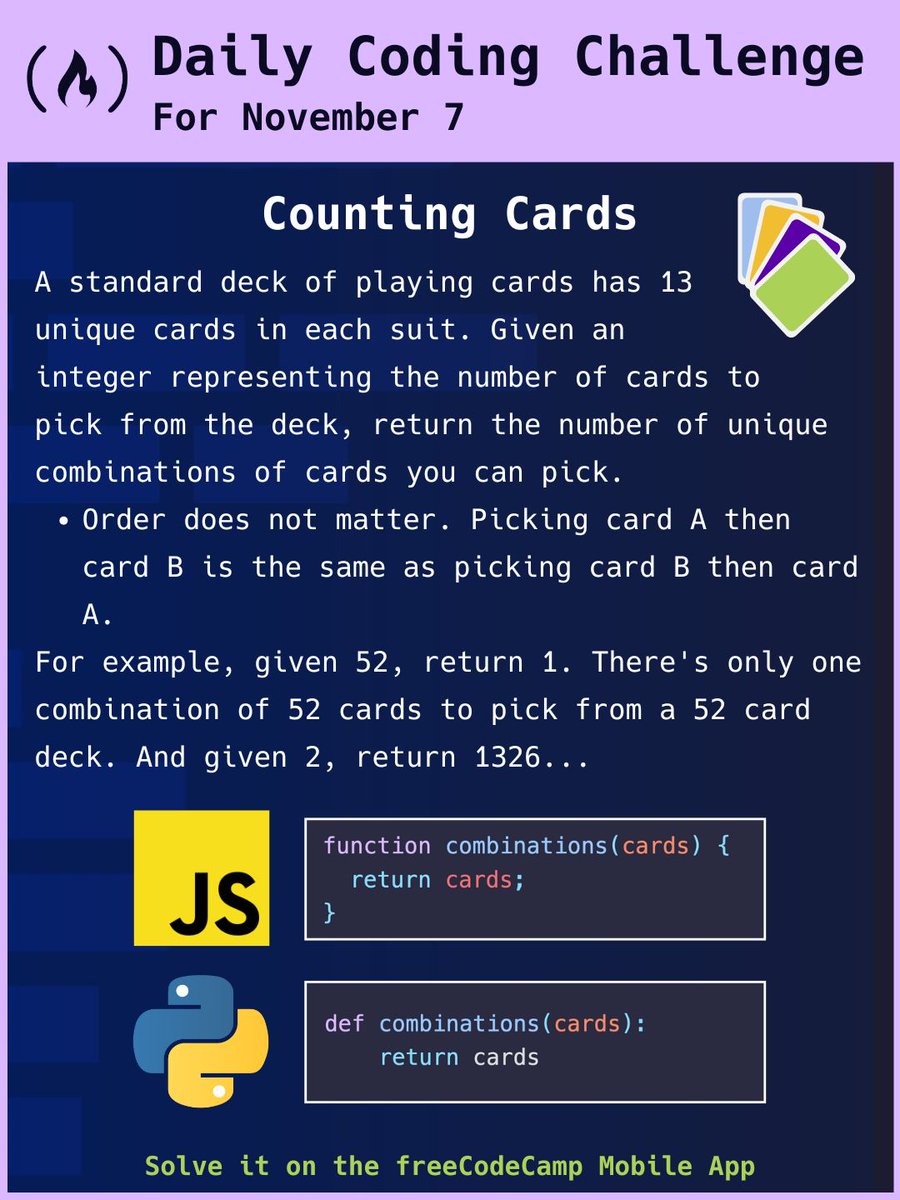
For today's coding challenge, you'll be counting some cards. Given an integer representing the number of cards to pick from a deck, return the number of unique combinations you could draw. Check it out on the freeCodeCamp mobile app.
Reviewing a long PDF page by page can take lots of time that most of us don't want to spend.
But a storyboard gives you a more efficient way to review the contents.
In this in-depth guide, @allinonetools helps you build a browser-based PDF storyboard generator using JavaScript.
https://t.co/vWH5rn724q
When you're building React Native apps, you likely start with a few files and simple components.
But as things get more complex, any change means checking multiple things across the project.
In this handbook, @ajaypatel_aj teaches you how to solve this problem using shadcn/ui + React Native Reusables.
https://t.co/zvc3wiPmR3
You know CAPTCHAS: those little exercises that make you choose the traffic lights or cars?
Well, they may seem like a helpful way to keep bots away from your site, but there's a problem: CAPTCHA farms.
In this guide, @reetain_raina explains how these attacks work and what you can do about it.
https://t.co/HodvMd9stw
Hey everyone, here's two bits of fun fCC news:
1. The freeCodeCamp forum just got a refresh, and
2. Socrates can now help you get through the curriculum. (No, not the ancient Greek philosopher reincarnate. Just a tool inspired by his methods.)
In this article, @ossia gives you the lowdown on what's new. Happy weekend!
https://t.co/UHLiFiXubI
As a developer, you may spend a lot of time in your terminal.
So to help you work more happily and productively there, @pliutau has shared this collection of CLI/TUI tools.
He goes over their features and installation instructions so you can try them out yourself.
https://t.co/ygMd9inlfV
n8n is an open source workflow automation tool that helps you connect various apps, APIs, and services.
And in this course, Gavin teaches you how to use it by building four practical projects.
You'll learn why standards like REST and OAuth2 are key to automation, how to integrate AI Agents into your workflows, and lots more.
https://t.co/4QbvPqIB9v
For today's coding challenge, you'll get a string date in the format YYYY-MM-DD and you'll need to return the day of the week. See if you can solve it on the freeCodeCamp mobile app.
Discrete Mathematics plays a key role in machine learning and algorithms.
And in this Python course, you'll learn some of its VIP concepts like combinatorics, number theory, and the Pigeonhole Principle.
The course also covers permutations, the Rule of Sum, prime and rational numbers, congruences, and lots more.
https://t.co/JeAJME2puM
Many modern apps rely on real-time data, like live sports scores, chat apps, collaborative tools, and more.
A common way to power this is with WebSockets.
In this tutorial, Nneoma explains how WebSockets work, how to build them in Python, and how to use them with FastAPI.
https://t.co/UVZHTDuzEX