PhD in Biochemistry and Molecular Biology. Recovered after 2y of LC with Maraviroc.Fighting for antiviral treatments.LongCovidACTS Research group coordinator
@VogelfreiCAT Voy a hilar por vez primera para hablar de mis antecesores outsiders. Y porque no le paso ni una al fascismo.
Corría el año 1936 en Nueva Carteya, Córdoba, mi bisabuelo Rafael (el primer outsider familiar del que tengo conocimiento y que por el hecho de serlo pagó con su vida).
‼️⚠️I sincerely appreciate that you acknowledged this mistake.
Recognizing errors publicly is not easy, and I respect that.
But I also think this is why I have to ask you to look again at the much bigger issue: the WIRED article itself.
Because the problem is not only one misread study. The broader framing of that article is already causing real harm.
I say this sincerely: I know there is a person behind every account, with their own intentions, limits, mistakes and blind spots. We can all get things wrong. I do not believe the right response is to destroy someone when they are willing to correct mistakes.
But the article needs correction.
Over the last few days, I have received comments and private messages from patients saying that family members, people around them, and even clinicians who do not understand Long COVID are now using this narrative against them.
They are being told that they are not recovering because they do not want to.
Because they are not exercising.
Because they are not doing psychological therapy.
Because they are “stuck” in the wrong mindset.
You may not fully realize the damage that kind of framing can do if you have not lived this disease closely.
For many patients, their environment had finally started to believe them because biomedical research was moving forward. Years of studies showing immune, vascular, autonomic, metabolic and muscular abnormalities were slowly helping people understand that this is a real organic disease.
And then a simple, attractive narrative appears again:
maybe it is mind-body.
maybe patients are afraid of exercise.
maybe recovery is being blocked by beliefs.
That kind of framing can erase years of progress in one family, one workplace, one clinic.
Because when a disease is complex and poorly understood, the easiest story is always the old one: maybe the problem is psychological.
ME/CFS patients have lived with this harm for decades. Many Long COVID patients are now experiencing the same thing.
And this pressure is not harmless.
Patients lose their health.
They lose their jobs.
They lose their social lives.
They lose their independence.
And then, when public narratives suggest that maybe they are not recovering because of their mindset, they can also lose the last thing they had left: being believed and supported.
That pressure can become unbearable.
Some patients end up taking their own lives because they feel abandoned, disbelieved and blamed for an illness they did not choose.
Those lives matter.
They matter as much as yours or mine.
And these patients deserve exactly the same dignity, seriousness and protection that we give to patients with any other recognized disease.
Today, nobody would tell a patient with multiple sclerosis that they remain ill because they do not want to recover, because they do not exercise enough, or because they have not done the right psychological therapy.
Nobody would frame MS as a failure of mindset just because fatigue, stress sensitivity, cognitive symptoms or depression can appear in the disease.
So why is this acceptable with Long COVID or ME/CFS?
This is not about rejecting psychological support.
It is not about denying that the nervous system is involved.
It is not about saying every recovery story is false.
It is about not confusing support with cure.
Not confusing subjective improvement with disease modification.
Not confusing heterogeneous biology with “it might be in your head.”
Not using recovery anecdotes to reframe a post-infectious disease in a way that patients will pay for socially, medically and personally.
I genuinely believe people can reconsider things. None of us has to know everything about every field. Mistakes happen.
But when a mistake has consequences for a vulnerable patient community, correction matters.
The same criticism I have made these days, I would gladly replace with support if you helped correct the framing and the harm caused by the article.
Patients deserve mechanisms.
⚠️ I think this is exactly the problem.
When patients with ME/CFS, fibromyalgia or Long COVID defend themselves, it is often framed as “protecting an illness narrative.”
But if your disease were constantly minimized, psychologized, ignored, and left without biological treatments, while patients are told they are exaggerating or inventing symptoms, this would not feel like protecting a narrative.
It would feel like defending the basic right to be taken seriously and treated with the same dignity as patients with any other disease.
These narratives do not only affect medical care. They affect families, friendships, work, disability support, and social isolation.
Patients are not protecting illness.
They are protecting themselves from being abandoned by a system that too often turns unexplained biology into psychology.
I invite you to read the full thread, because I do not think this is a fair defense of the article:
https://t.co/8s2ayDBGIR
‼️⚠️Please read this until the end.
A widely shared article has presented a deeply misleading view of Long COVID, suggesting once again that cognitive behavioral therapy, exercise, and “mind-body” approaches may be the uncomfortable truth patients refuse to accept.
This needs to be challenged.
Not because the nervous system does not matter.
Not because psychological support cannot help.
But because confusing support with cure, physiology with psychology, and heterogeneity with “it might be in your head” is exactly how medicine has harmed post-infectious patients for decades.
There are articles about Long COVID that look like science journalism, but in reality they repackage, in modern language, a very old idea: if we do not fully understand a disease, maybe the problem is in the patient’s mind.
And that is not science. That is repeating history.
The article begins with a striking sentence:
“There isn’t a single approved pharmaceutical treatment, not even a test to verify the presence of the illness.”
This may sound forceful, but it is a very misleading way of presenting the problem.
The fact that there is still no drug specifically approved for Long COVID, or a single diagnostic test, does not mean that “nothing has been found.” It means that we are dealing with a heterogeneous disease, probably with several biological subgroups, and that medicine has not yet converted those findings into validated clinical tools.
“No single diagnostic biomarker” is not the same as “no biology.”
In just a few years, immunological, vascular, neurological, endocrine, and metabolic abnormalities have been described in subgroups of Long COVID patients: autonomic dysfunction, herpesvirus reactivations such as EBV/HHV-6, alterations in the cortisol axis, autoantibodies against GPCR receptors — including adrenergic and muscarinic receptors — persistent viral antigens, endothelial damage, muscle abnormalities after exertion, mitochondrial dysfunction, persistent inflammation, and differential immune changes.
Is everything settled? No.
Does that mean it is psychological? Also no.
Science does not work like that. Multiple sclerosis did not stop existing before we had MRI. Many autoimmune diseases do not show up in routine blood tests. If a complete blood count, a basic biochemistry panel, or an X-ray comes back “normal, normal, normal,” that does not prove the absence of disease. It only proves that you are looking with inadequate tools.
One of the article’s most serious mistakes is this: it confuses the absence of a simple clinical test with the absence of organic disease.
And that mistake has caused harm for decades.
The article also says:
“Almost $2 billion and half a decade of international effort have yielded little more than hypotheses about micro blood clots and spike proteins and mitochondrial dysfunction.”
No. That is not correct.
A hypothesis is a provisional explanation. But when you compare patients and controls and find significant differences in muscle tissue, metabolism, response to exertion, immune biomarkers, viral antigens, autoantibodies, or vascular dysfunction, you are no longer talking about “little more than hypotheses.” You are talking about lines of biomedical evidence that still need to be organized, replicated, stratified, and translated into treatments.
That is not scientific failure. That is research into a complex and new disease.
🔵Continued in the next post.👇🏻
(1/6)
Breaking: Park-Pagliuca Fund Donates $10 Million to PolyBio Long COVID Cure Initiative
PolyBio Research Foundation today announced a $10M donation to support the Long COVID Cure Initiative (LCCI), a program designed to deliver treatments to millions of Long COVID patients by translating key academic findings into real-world diagnostic tests, faster and more targeted clinical trials, and accessible, patient-ready therapies.
https://t.co/JV2hpYlzO8
It's been about a year now since I mostly recovered from Long COVID (~90%). Some people said it wouldn't last, but fortunately, it has. No major crashes, no chest pain, no shortness of breath, no nerve pain, no racing heart, no vision issues or any of the other random symptoms that made my life hell for 2-3 years.
What symptoms have remained? My left calf has remained numb to the touch since the 4th COVID infection. My sense of taste has improved but has been muted since the first infection in 2021. My sense of smell comes and goes. I get these bouts of POTS-type symptoms (severe dizziness when standing) that last for a few hours. Not consistently, but typically 3-4 days every month.
What caused me to recover? My hypothesis is that my Long COVID symptoms were/are primarily due to damage to my nerves, which eventually mostly healed. Why mine healed and other people's don't is something someone should be trying to figure out.
My recovery coincided with my use of maraviroc, lipitor, modafinil, Tirzepatide, BPC-157, LDN, Lexapro, and a bunch of supplements including vitamin D, alpha lipoic acid, etc. I've discontinued all of them, except the Tirzepatide, and have remained recovered. The maraviroc, lipitor, and modafinil were started closest to my recovery (a couple months before), while the others I had been using for many months/years prior. I have no idea if any of these were relevant. Maybe it was just random, and I would have recovered without any of it. Who knows. I got 2 shots of novavax during this time, and am going to get a third soon.
I have remained a committed masker, and have managed to avoid reinfection for about 1.5 years now. Part of this is just luck, because with 2 young kids and a disabled wife, I can't be as COVID cautious as I'd like to be. When she was hospitalized for a month I thought for sure I'd be exposed and catch it, but luckily it just happened to coincide with a time when transmission was low.
At this point, I've accepted that this will probably be as good as it gets, and I've accepted that I'm OK with that. Whereas I used to think of myself as a sick person who was actively dying in a way, I now see myself as a disabled person who isn't in any pain on a day to day basis, but just has some limitations.
I continue to try to advocate mostly because I'm afraid of what happens if/when I get reinfected (maybe nothing, maybe I'll get really sick again?) and also for the many friends I've picked up along the way who remain just as sick as ever. Plus, the prospect of either of my kids getting this is my worst nightmare.
Viral reactivation seems to be a central part of #LongCovid and #MECFS pathobiology. It´s a pitty that it is rarely discussed in the "premiere league" of ME/CFS researchers, esp. in terms of finding a consensus in how to assess viral reactivation. We should do better here.
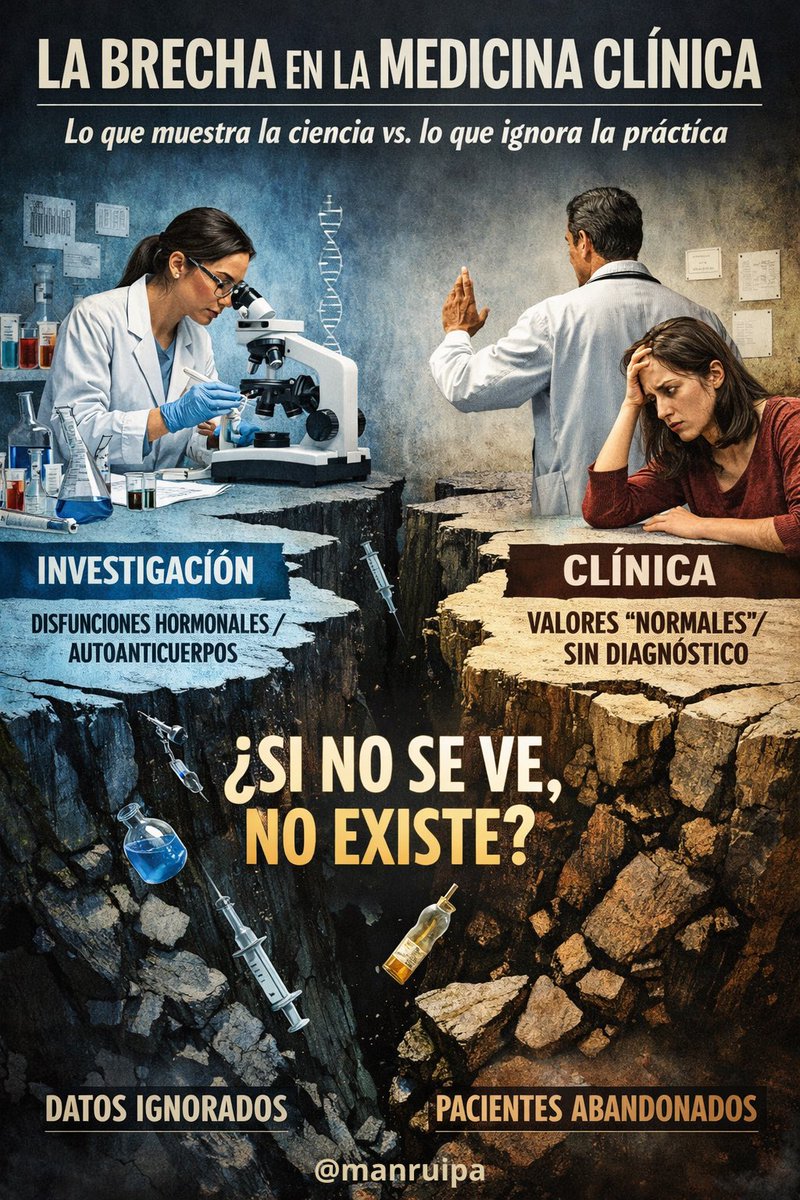
⚠️🪨Hay una brecha enorme entre lo que la investigación biomédica está mostrando y lo que ocurre en la práctica clínica diaria.
En investigación llevamos años viendo que muchos pacientes presentan:
• deficiencias hormonales parciales (cortisol, ACTH u otros ejes)
• autoanticuerpos funcionales que no encajan en las grandes enfermedades autoinmunes clásicas
Sin embargo, en la clínica seguimos funcionando con un esquema extremadamente rígido.
Si la deficiencia hormonal no es clara o severa, no se investiga más.
Si los valores están “dentro de rango”, el caso se da por cerrado.
Las pruebas de estimulación, que son las que realmente permiten evaluar el funcionamiento de un eje endocrino, muchas veces ni siquiera se solicitan.
Esto ocurre, por ejemplo, con pacientes que presentan:
• cortisol bajo en saliva en perfiles de 24 horas
• cortisol matutino en el límite inferior o bajo-normal
y aun así con síntomas claros son dados de alta en consultas de endocrinología simplemente con comentarios como “los valores están dentro de rango”, sin realizar pruebas de estimulación como:
• test de Synacthen (ACTH)
• test de CRH
• test de tolerancia a la insulina (ITT)
que son precisamente las pruebas que permiten confirmar si el eje HPA funciona correctamente.
Con los autoanticuerpos ocurre algo parecido.
Si el anticuerpo no pertenece al pequeño grupo clásico de enfermedades autoinmunes conocidas, entonces para muchos clínicos:
“no existe”,
“es inespecífico”,
o simplemente se atribuye a un error de laboratorio.
Pero la realidad científica es muy distinta.
Sabemos que existen autoanticuerpos funcionales contra receptores, disfunciones inmunológicas y alteraciones endocrinas parciales o dinámicas que pueden producir síntomas severos sin cumplir todavía los criterios de las enfermedades clásicas.
No todo en biomedicina es blanco o negro.
La medicina moderna debería ser capaz de reconocer:
• disfunciones subclínicas
• procesos autoinmunes emergentes
• alteraciones funcionales de ejes hormonales
Ignorar estos procesos no hace que desaparezcan.
Solo deja a miles de pacientes sin diagnóstico y sin tratamiento.
No puede ser que la investigación avance durante años mientras que en la clínica ni siquiera se consideren estas posibilidades.
La medicina necesita cerrar esa brecha.
Porque entre lo que sabemos científicamente y lo que realmente se aplica a los pacientes todavía hay demasiada distancia.
BREAKING: Music legend Bruce Springsteen just released this incredible song that will be sure to piss Trump off beyond belief.
“Streets of Minneapolis”.
He wrote this song about Alex Pretti and Renée Good Saturday and recorded it yesterday.
Share it far and wide and play it as loud as you can
Set 2024, conciertazo de Robe en BCN.Yo sin faltar a una cita suya desde los 90,él más en forma que nunca. Hasta cantó en catalán. No podía ni imaginar que un año después lloraría su muerte. Tantas canciones que nos abracen que no podrán nacer. A much@s nos dejas en la intemperie
El sentido homenaje a Robe será este próximo domingo día 14 de diciembre en Plasencia. Mañana estaremos en disposición de indicaros el lugar y la hora.
Gracias por todo vuestro cariño y apoyo estos días tan difíciles y tan tristes.
Set 2024, conciertazo de Robe en BCN.Yo sin faltar a una cita suya desde los 90,él más en forma que nunca. Hasta cantó en catalán. No podía ni imaginar que un año después lloraría su muerte. Tantas canciones que nos abracen que no podrán nacer. A much@s nos dejas en la intemperie