I introduced the "Fiscal Shackle" law. If politicians fail to do their job, they will pay the price, not the Argentine people.
LONG LIVE FREEDOM, DAMN IT...!!!
BRAVO JAVIER MILEI!
Bei Staatsdefizit „kein Peso Gehalt“ für Präsident, Regierung, Abgeordnete und Beamte!
Unter Milei, dem Merz vorgeworfen hat, er „ruiniere das Land“ und „trete die Menschen mit Füßen“, hat Argentinien
✅ den 1. Haushaltsüberschuss seit 15 Jahren,
✅ einen drastischen Rückgang der Inflation,
✅ massiv Bürokratie und Sozialbetrug abgebaut.
Jetzt nimmt er Regierung, Abgeordnete, Beamte für sparsames Haushalten in die Pflicht.
Am Donnerstag hat er den Gesetzentwurf „Fiskalfessel“ vorgestellt.
INHALT:
Ist das Haushaltsergebnis mehrere Monate hintereinander defizitär, hat der Kongress einige Wochen Zeit, die Konten wieder ins Gleichgewicht zu bringen.
Passiert das nicht, tritt ein „Shutdown“ nicht essenzieller Staatstätigkeiten in Kraft. Dann erhalten Präsident, Regierung, alle Abgeordneten und Beamte - außer Justiz, Polizei und Militär -„keinen einzigen Peso Gehalt“.
.@JMilei legt ein neues Gesetz vor.
Wenn der Staat ein Defizit aufweist und dieses Defizit nicht innerhalb weniger Wochen behoben wird, bekommen folgende Personen kein Gehalt mehr:
- der Präsident
- die Vizepräsidentin
- die Minister
- die Staatssekretäre
- die Unterstaatssekretäre
- die Abgeordneten
Milei: „Politiker haben keinerlei Anreiz, auf die Geldbörsen der Argentinier zu achten, denn sie sind es nie, die die Zeche zahlen. Deshalb wird dieser Gesetzentwurf dafür sorgen, dass derjenige, der den Schaden verursacht, ihn letztendlich auch bezahlt.“
Genau DAS brauchen wir in Deutschland.
Ich bin mir sicher, auch ein Klingbeil und eine Bas finden dann Wege, zu sparen.
BREAKING 🚨; Today is the last day to trade retail paper gold in China. 🇨🇳
Starting tomorrow, major Chinese banks stop offering it entirely.
ICBC. Postal Savings Bank. Ping An Bank. China Guangfa Bank.
All ending leveraged retail gold trading after today's settlement.
Clients have three choices: close, liquidate, or take physical delivery.
Physical gold buying isn't affected. Only the leveraged paper trades.
#Gold #China #ICBC
Tomorrow, July 24, 2026, is the last day to trade paper gold in China.
Starting Monday, paper gold trading will no longer be offered by Chinese banks.
This comes alongside the Hong Kong Gold Clearing Exchange going global. They will have physical gold at any volume ready for sale in Yuan.
Ending the paper trading in China will push their domestic price of physical gold higher. This will cause a Chinese premium in gold to appear versus the Comex and LBMA. That premium can be arbitraged away as metal flows east.
Ultimately, this means China gains pricing power over the metal. They are stockpiling, and in the future if you want to buy some, they will be the ones to have it readily for sale. But at their price.
Could this be the canary in the coal mine that the options traders at the Comex have been positioning for? They are placing bets that gold will be multiples higher by year end.
Possibly. We can only speculate. But these Chinese events are significant, and could cause gold to trend higher into the foreseeable future.
#gold #silver
China's central bank has now bought gold for 19 months straight, the largest official buyer on earth. And this week, as gold broke 4,000 dollars, China's biggest banks moved to push ordinary Chinese out of leveraged gold trading, with at least one warning it will liquidate any position not closed by month-end. Both are true at once, and together they explain what this crash really is.
Start with what is being banned, because the words matter. ICBC and a string of other banks are shutting down retail trading in what the Chinese themselves call paper gold, the margined, leveraged contracts where you bet on the price without ever owning a bar. Some banks lifted the margin requirement to 140 percent to choke the leverage off before closing the products outright. Physical gold, meanwhile, stays wide open. Coins, bars, savings plans, ETFs, all fine. It is only the paper, the leverage, the casino, that is being shut, the last step in a five-year retreat that the crash just finished.
Officially this is about protecting small investors, and that part is real. The same kind of leverage wiped out a wave of Chinese retail in a 2020 commodity blowup. But set the ban beside what the state is doing and something larger comes into view. While its citizens are pushed out of the paper, the People's Bank of China has spent those same 19 months buying the physical metal, more than two thousand three hundred tonnes of it now, accumulating straight through a 28 percent crash that scared everyone else out. Beijing is not trading gold. It is hoarding it.
That is the strategy in one frame. China looked at the two things both called gold, the paper bet and the physical bar, and made a choice no Western government would make. It is taking the metal for the state and closing the casino for everyone else.
The reason sits in a single date. 2022, when Russia's reserves were frozen with a keystroke. That taught every country outside the Western system one lesson: dollars in an account can be switched off, gold in your own vault cannot. So China is building its monetary independence out of the one asset nobody can freeze, and it does not want that foundation in the hands of leveraged traders who panic-sell in a crash, or priced by a paper market it does not control.
Watch this month and the two worlds split in real time. Western investors were forced out of their gold by margin calls and a rate scare. China's central bank bought that exact dip with both hands. One side treats gold as a trade. The other treats it as the floor under a currency.
The West is selling paper gold and calling it a crash. China is buying physical gold and calling it a foundation. In ten years, only one of them will look like it understood what gold was for. The metal is already moving to that side.
They tell you China bought 15 tonnes of gold last month
Customs says 173 tonnes crossed the border
Reports highlight that Goldman hints at the real official bid running up to 5x what's reported... routed through London OTC, into vaults no customs report will ever see
Chess...
The Gold Goes Home
People forget how quickly the world can change.
In February 1965, Charles de Gaulle stood in front of hundreds of journalists at the Élysée Palace and said the one thing no Western leader was allowed to say.
He called for the world to return to gold.
Not to the dollar. Not to promises.
To the one asset, he said, that "has no nationality" and is "eternally and universally accepted."
Washington laughed at the old general.
Then France stopped laughing and started converting.
Through the mid-1960s, the Banque de France redeemed hundreds of millions of American dollars for American gold, ship after ship, drawdown after drawdown.
And de Gaulle's economist, Jacques Rueff, kept telling the world exactly what the game was:
America could spend more than it earned, forever, without consequence… a "deficit without tears," he called it, because it paid its bills in paper only it could print.
Finance minister Valéry Giscard d'Estaing gave the arrangement the name that stuck:
America's "exorbitant privilege."
The pressure worked too well.
On August 15, 1971, President Nixon closed the gold window rather than keep paying out metal.
The last link between the dollar and gold was severed on a Sunday night, on television, precipitating a period of confusion and shock.
France asked for its gold.
The world got the fiat era instead.
Keep that story in mind. Because sixty years later, France just did it again and almost nobody noticed.
The quietest repatriation in history
Starting in July 2025, the Banque de France began unwinding its position at the Federal Reserve Bank of New York.
But there were no armoured convoys.
No transatlantic flights.
No diplomatic incident.
Instead, across 26 separate transactions over seven months, France sold 129 tonnes of old bullion sitting in the New York Fed's vault, bars so old some dated to the late 1920s, cast before modern purity standards existed and bought back the identical tonnage in Europe.
Newer bars. Higher standard. Stored in Paris.
Repatriation without a single bar crossing the Atlantic.
And here's the part that should make every treasury official weep:
They got paid to do it. By selling old New York stock at record prices and repurchasing in Europe, the Banque de France booked a realized gain of roughly €11–13 billion, nearly $15 billion, enough to swing the entire central bank back to profit for the year.
All 2,437 tonnes of French gold, the fourth-largest hoard on Earth, now sit in La Souterraine, the vault carved into the rock beneath Paris.
Governor Villeroy de Galhau insists the move was "not politically motivated."
Of course he does.
Central bankers always say that.
France is not alone.
Watch what they do, not what they say.
Germany repatriated 674 tonnes from Paris and New York, a program announced in 2013 after German politicians grew tired of being told their gold was fine, trust us, no you can't audit it.
Turkey pulled 220 tonnes out of the Federal Reserve.
The Netherlands brought home 122 tonnes.
Poland repatriated 100 tonnes from vaults in England.
And the vaults themselves tell the story in aggregate.
The share of central bank reserve gold stored in London has fallen from 64% to 57%.
The New York Fed's share has dropped from 17% to 14%.
Percentage point by percentage point, decade by decade, the metal is migrating home.
Onto sovereign soil.
The bigger picture
This is not happening in isolation. It's happening inside the largest shift in reserve behaviour in a generation.
Gold now exceeds US Treasuries as a share of global reserves for the first time since 1996.
Read that again.
The world's central banks, the issuers of fiat currency, the operators of the printing presses, collectively hold more of their reserves in a 5,000-year-old metal than in the debt of the United States government.
And a record 45% of them say they plan to buy more gold in the next twelve months.
Ask them why, and you'll get the paragraph about diversification.
But diversification doesn't explain the geography.
You don't move gold out of London and New York to diversify.
You move it because possession has started to matter again.
Because you watched $300 billion of Russian reserves get frozen with a keystroke.
Because you've realized that gold in someone else's vault is not gold. It's a claim on gold.
And a claim is just another word for credit.
The lesson?
Countries are beginning to think differently, not only about how much gold they own, but where they hold it and in what form.
Old bars are being upgraded to modern standards. Foreign custody is being converted to domestic possession. Claims are being converted to metal.
But strip away the financial engineering, and it's the same instinct that sent French ships across the Atlantic in the 1960s.
The same instinct that has moved men and nations for five thousand years.
When nations lose confidence...
They ask for their gold.
The last time France asked, the entire monetary system broke within six years.
This time, nobody's even pretending the window is open.
If you enjoy stories like this, please share it. Last week I wrote a story about JPMorgan. I will continue writing stories like this every weekend.
— GT
🇮🇷🇯🇴🇺🇸 Insane video shows what looks like the Iranian ballistic missile slamming into Muwaffaq Salti Air Base in Jordan overnight, killing 2 American service members.
The base hosts American forces and fighter jets.
This marks the first U.S. fatalities since the latest round of fighting resumed 2 weeks ago.
Writer: Lucas
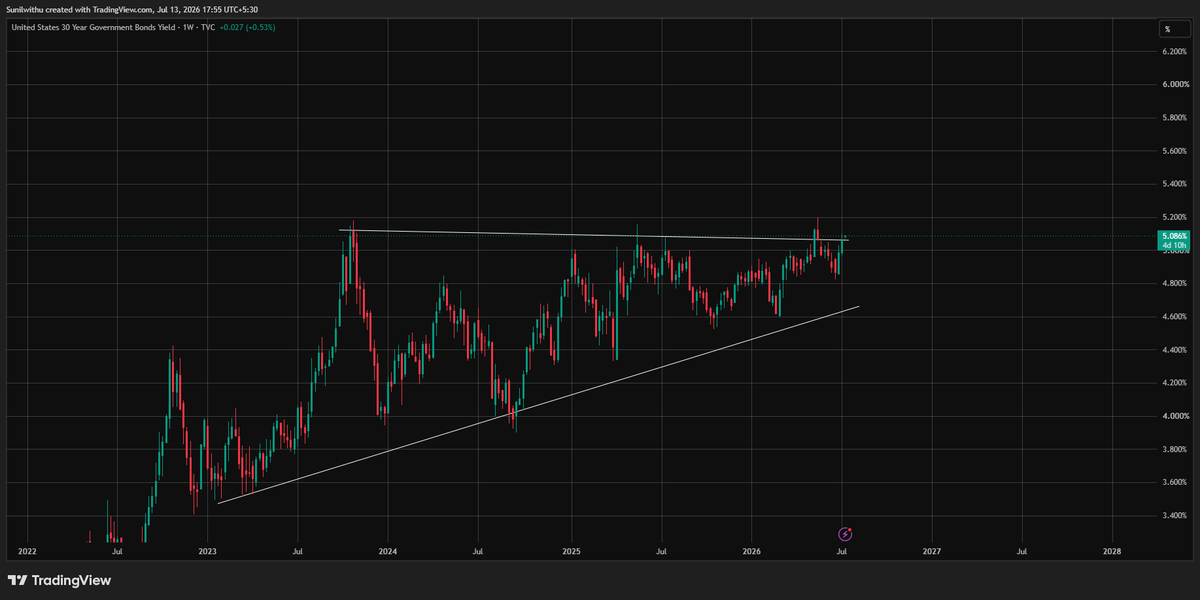
Every time the US 30-year yield moved close to 5%, Trump usually stepped back and de-escalated.
The reason was simple: 5% at the long end is a serious pressure point for the entire financial system. It raises mortgage rates, increases government borrowing costs, tightens liquidity and puts pressure on equities.
But this time, the 30-year yield is already above 5% and Trump is still escalating.
That is a major change.
The bond market has almost no room left to absorb another inflationary or geopolitical shock. Any further escalation from here could push long-term yields sharply higher and trigger a disorderly bond market sell-off.
Watch the 30-year yield closely. This is where the real market risk is building.
Jetzt also doch: Totale Massenüberwachung, jede Mail, jeder Chat, jede Message wird in der EU geprüft, kontrolliert, verfolgt. Der Bürger ist ein Verbrecher und muss täglich seine Unschuld beweisen. https://t.co/zw9smtPpEs
Welcome to the wall.
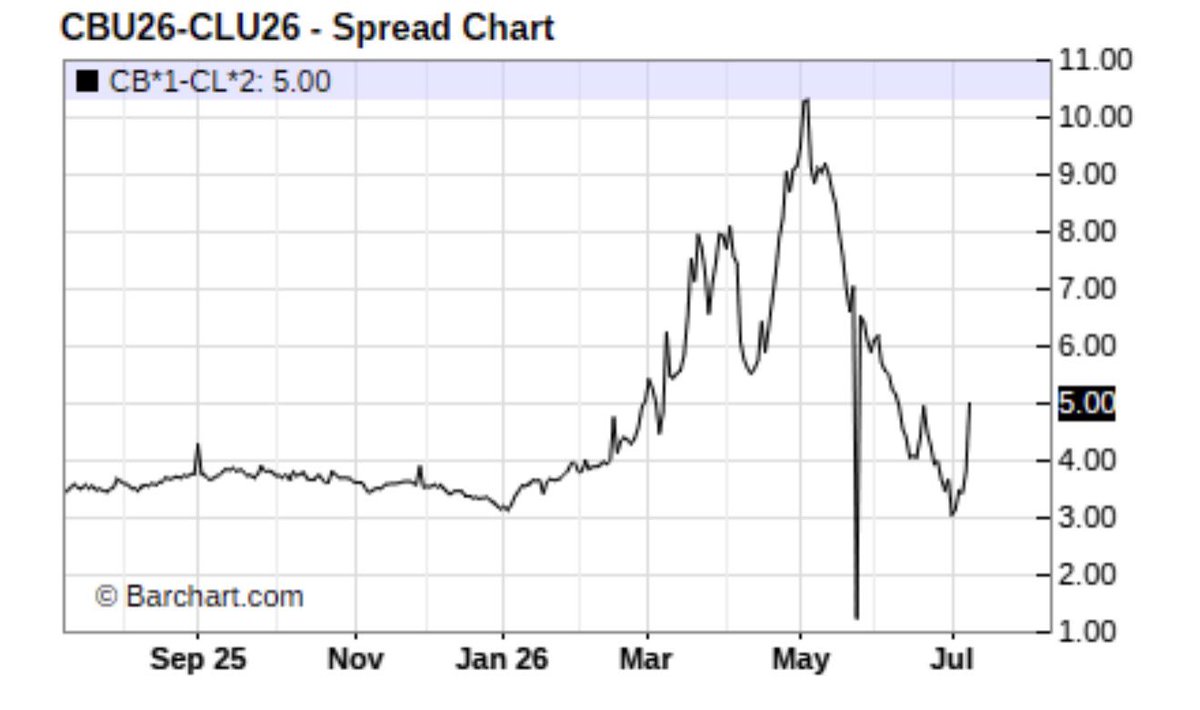
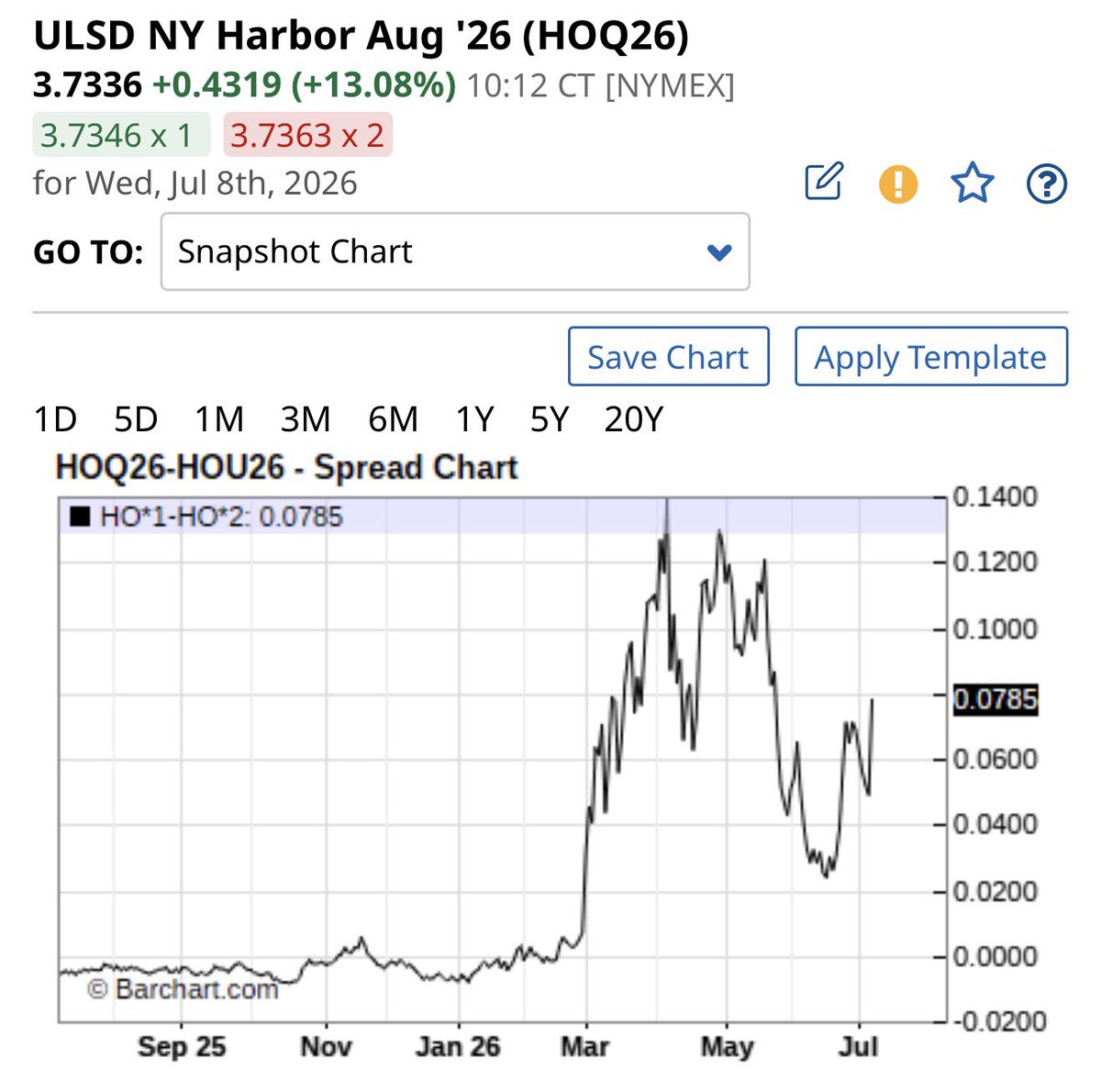
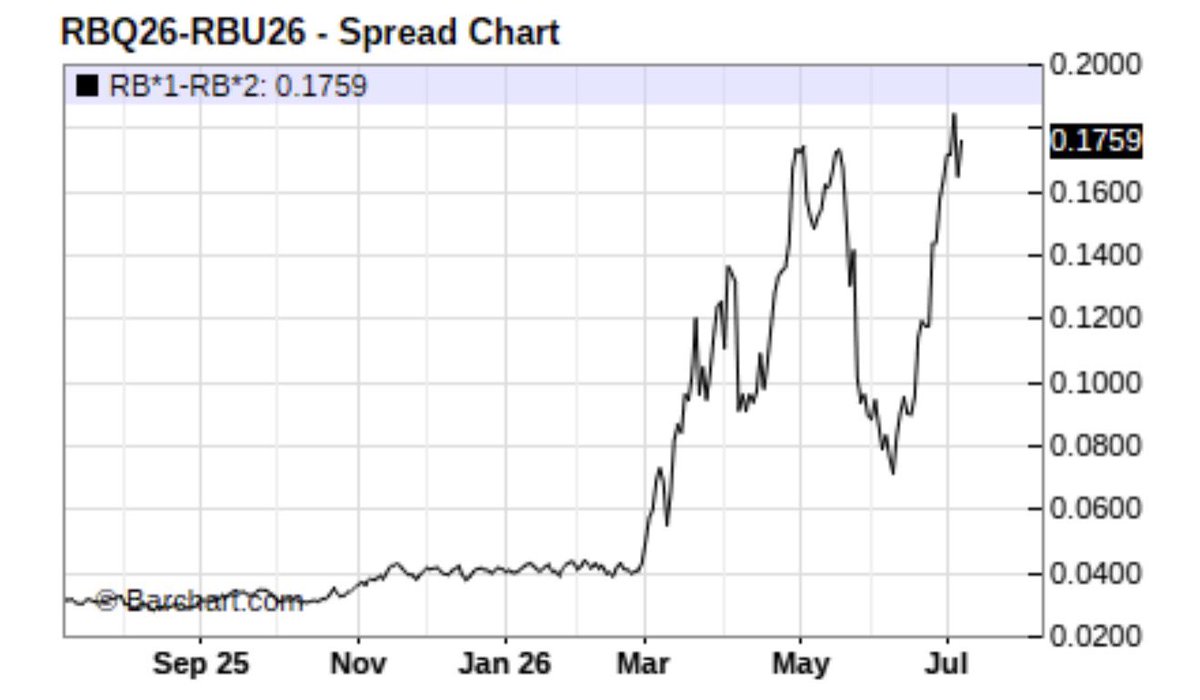
Crack spreads continue to move higher despite the violent move in crude. Product shortage is going to hit imminently with spreads screaming tightness everywhere.
The world is going to suck the US dry of every barrel it has.
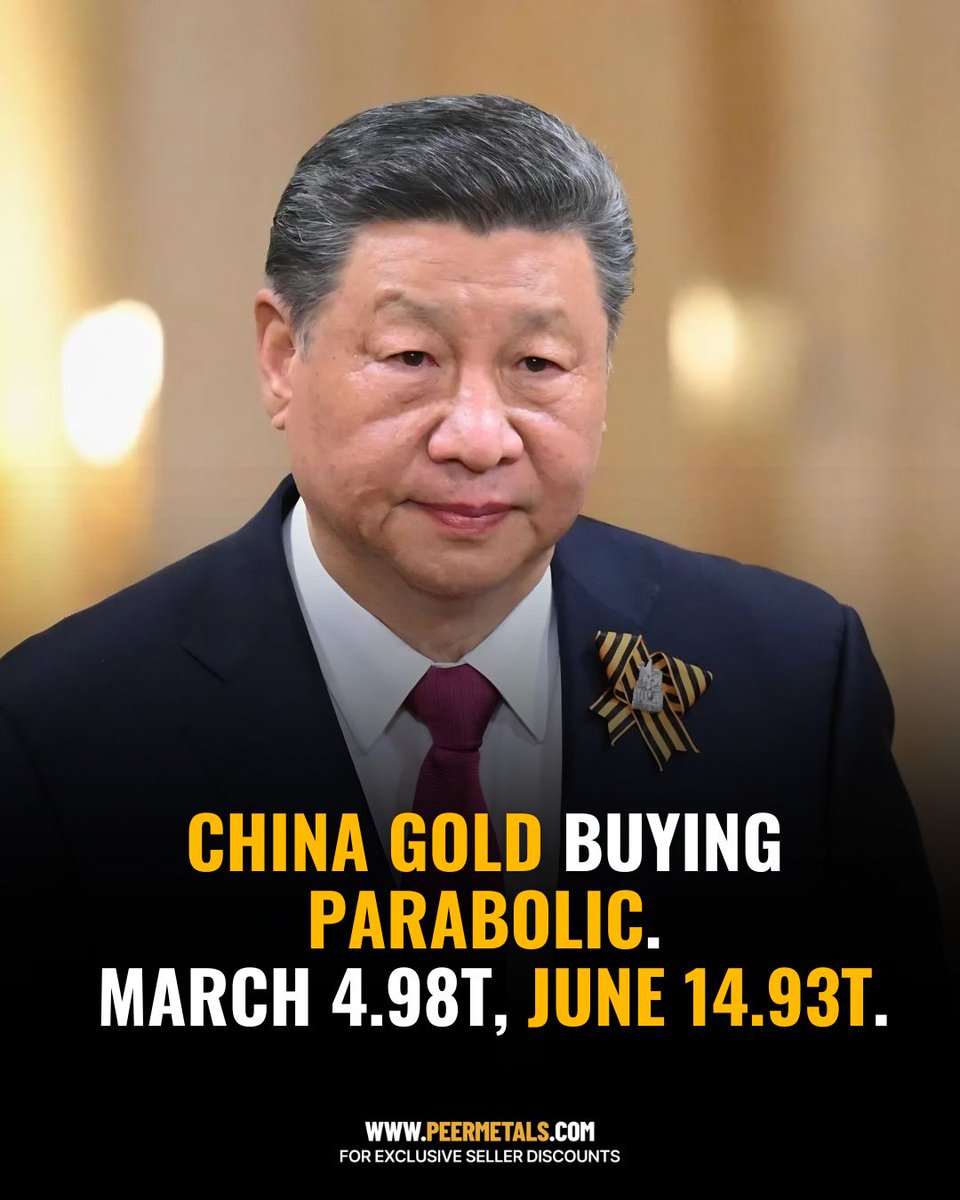
China's gold buying just went parabolic. 🇨🇳
Look at the monthly acceleration:
March 2026: 4.98 tonnes
April 2026: 8.09 tonnes
May 2026: 9.95 tonnes
June 2026: 14.93 tonnes
Three months in a row of accelerating purchases.
Nearly tripling from March to June.
This started in May 2025 at under 2 tonnes per month.
Now buying almost 15 tonnes in a single month.
The PBOC isn't just buying gold.
It's buying faster and faster.
#Gold #CentralBanks #PreciousMetals
The most powerful force in the oil market is now a single country that doesn't produce a drop.
OPEC IS DEAD
And here's why you should change how you think about energy for the next decade:
China controls the oil price not by pumping it, but by REFUSING TO BUY IT.
For two years, while the West wasn't paying attention, China built a war chest of crude.
They bought cheap, sanctioned barrels at $60 while everyone else looked the other way. They stacked a reserve now estimated between 1.2 and 1.5 BILLION barrels.
Then the world got its biggest supply shock in modern history and instead of panic-buying like everyone else, China did the opposite.
They stopped importing and started eating their own stockpile.
Chinese crude imports collapsed from 11.6 million barrels a day to under 8 million - the lowest level since 2017. That single decision accounted for roughly 74% of the entire drop in global oil demand, according to JPMorgan.
Sit with that number for a second.
The world lost 14% of its crude supply. In 1973, OPEC cut off just 7% and the price exploded 134%.
This shock was twice as large.
But oil went the other way. WTI sits at $74 today.
Because the world's largest buyer simply walked out of the store and lived off its pantry.
THAT is the new OPEC.
For 50 years we obsessed over the Saudis. We watched OPEC meetings like Fed meetings, parsing every production quota. Those days are ending and the most powerful swing force in oil is no longer a cartel that controls supply.
It's one country that controls DEMAND.
And demand is the harder lever. You can cheat on a production quota but you can't force a billion-barrel buyer to show up if it doesn't want to.
Here's what this means for your money right now:
China has capped the upside. As long as they're sitting on that hoard, they sell into every rally toward $100. No spike gets to run. The right tail is gone - stop dreaming about $150 oil.
But they've also built the floor. Those reserves are draining fast.
JPMorgan expects China back as a major buyer by August to start refilling. The US has to refill its own SPR, now at its lowest since 1990. Everyone has to restock at once.
You don't get $100 oil - China sells it to you. You don't get $50 oil - China and everyone else has to come back and buy it.
You get a range. And right now we're sitting at the bottom of it.
Crude is parked on its 200-day moving average. Retail traders are positioned near record short in Brent. Sentiment is in the gutter, RSI under 30.
When the entire crowd leans the same way off the same wrong assumption, I want the other side of that trade.
If I had to bet the next $10 or $15 move in crude, I'm betting higher.
Because the most important player in the oil market already told you exactly what it's going to do.
The Saudis didn't break OPEC. China did - by building a reserve nobody could see and refusing to spend it when it mattered most.
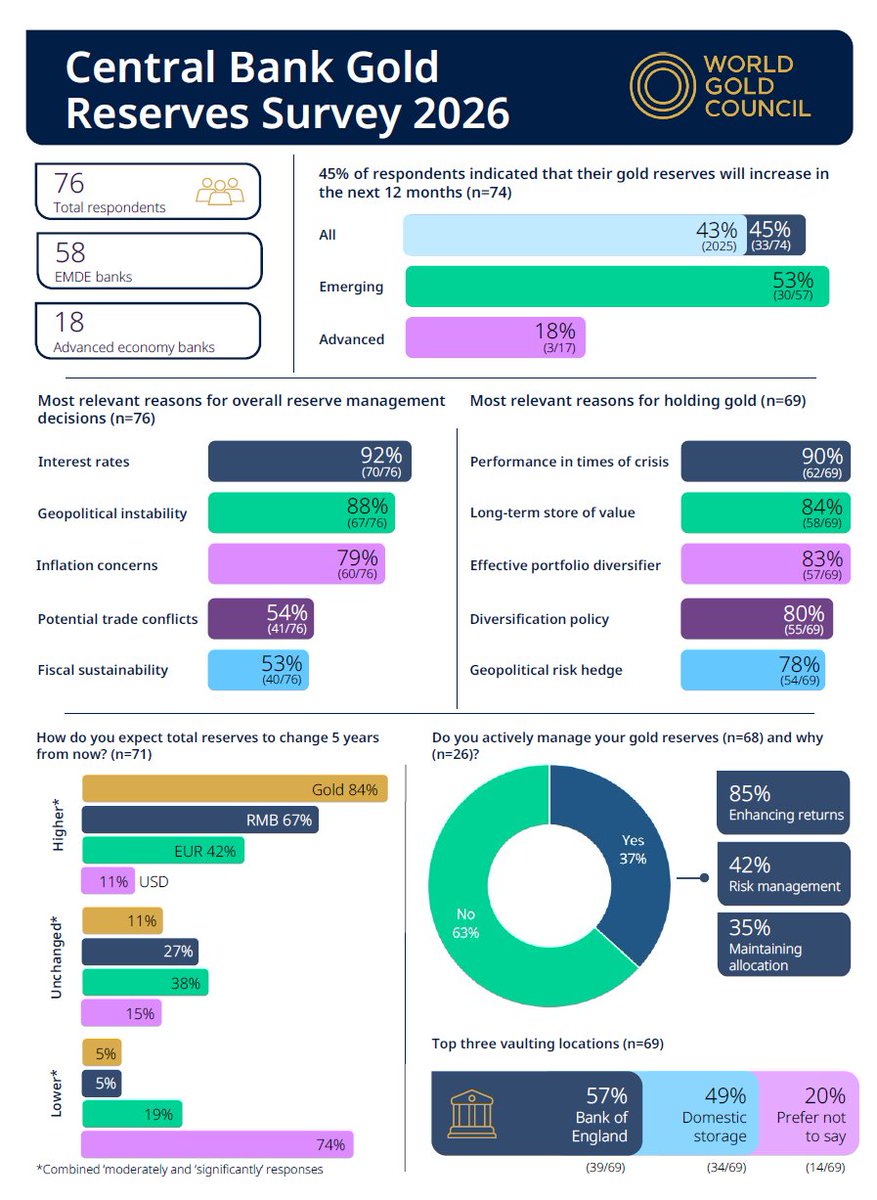
The wonderful people at the @GOLDCOUNCIL have just published the Central Bank Gold Reserves Survey 2026!
Here's an overview, the full publication can be found here: https://t.co/rJdeHEjR6h
Central banks are sending their strongest gold signal on record. A record 45% plan to buy more over the next year. Only 1% expect to hold less. And 74% expect the dollar's share of reserves to keep falling.
Those are the findings of the @GOLDCOUNCIL's survey, published today.
Western funds sold gold into this spring's correction. The official sector used it to keep accumulating, and says it is not done.
الصين وهرمز وأسواق النفط
انخفض الطلب العالمي على النفط بصورة كبيرة خلال الفترات الأخيرة، الأمر الذي يعني أن الفجوة بين العرض والطلب أصبحت صغيرة جداً، وهذا يفسر انخفاض أسعار النفط خلال الفترات الأخيرة، وعدم ارتفاعها بصورة كبيرة بعد أن تبادلت إيران وإسرائيل الهجمات أول من أمس. ولعبت الصين دوراً كبيراً في هذا التخفيض، الأمر الذي يثير أسئلة عديدة، بخاصة أن بكين هي الأقل تأثراً بأزمة مضيق هرمز.
الخطأ الذي يرتكبه بعض المحللين والمعلقين حالياً هو أنهم يركزون على الفرق بين المعروض قبل الأزمة وما بعدها ويتحدثون عن خسارة نحو 15 مليون برميل يومياً، والبعض يقول "خسرنا أكثر من مليار برميل حتى الآن والأسعار لم ترتفع بما يتناسب مع ذلك". هذا المنطق غير صحيح نظرياً وعملياً لأن ما يجب النظر إليه هو الفارق بين الطلب والعرض، وليس المعروض حالياً مقارنة بما كان قبل الأزمة.
فإذا كان ما جرت خسارته من إغلاق مضيق هرمز 15 مليون برميل يومياً، فقد جرى التعويض عن غالبية ذلك بتحويل الصادرات عبر الأنابيب في السعودية والإمارات (نحو 4 ملايين برميل يومياً تقريباً)، والسحب من المخزونات الاستراتيجية والتجارية (نحو 3 ملايين برميل يومياً)، وتخفيض الصين لوارداتها النفطية (5.7 مليون برميل يومياً)، وانخفاض الطلب على النفط بسبب ندرته وارتفاع أسعاره (1 مليون برميل يومياً). هذا يعني أن العجز الحالي بين مليون ومليوني برميل يومياً فقط. كل الأرقام السابقة تقريبية وهدفها توضيح فكرة أن الأسعار تتأثر بالطلب والعرض وليس بفارق الإنتاج ما قبل الأزمة وما بعدها.
وهنا لا بد من التوضيح بأنه بحسب بيانات شركة "كبلر"، فإن واردات الصين من النفط انخفضت بحدود 5.7 مليون برميل يومياً عما كانت عليه قبل الأزمة، وهذا يعني انخفاض الطلب العالمي على النفط بنفس الكمية، وهي كمية ضخمة بكل المقاييس. وهذا لا يعني انخفاض استهلاك الصين بتلك الكمية حيث إن هناك فارقاً بين الطلب والاستهلاك. فالطلب يتضمن المخزون، بينما الاستهلاك هو ما جرى استخدامه. كما لا يعني انخفاض مخزونات الصين بالكمية نفسها أيضاً، فكيف عوضت الصين عن هذه الكميات؟ ولماذا أخطأ المحللون في فهم بيانات الصين؟ أدناه شرح مبسط، والأرقام المستخدمة للتبسيط.
وكما أسلفت في مقالات سابقة، أيقنت الصين منذ حرب يونيو (حزيران) عام 2025 أن مضيق هرمز سيغلق، وأن من سيغلقه ليس الإيرانيون، ولكن الأميركيين، فاتخذوا سياسات عديدة، منها ملء المخزونات. واستمر ملء المخزونات حتى مايو الماضي. فإذا كانت الصين، مثلاً، تملأ المخزون بمعدل 800 ألف برميل يومياً، فهذا يعني استيراد 800 ألف برميل يومياً. فإذا توقفت عملية التخزين، فهذا يعني انخفاض الواردات بالكمية نفسها من دون أن ينخفض المخزون.
المخزونات التي نتحدث عنها باستمرار هي المخزونات التي توجد على اليابسة. خلال آخر شهرين، بدأت الصين بتفريغ حاملات النفط الإيراني والروسي الراسية بالقرب من موانئها والتي تعرف بـ"المخزون العائم". وبلغ هذا التفريغ حدود مليون برميل يومياً. هذا يعني أن الصين استهلكت هذه الكميات من دون التأثير في مخزوناتها.
وقامت الصين بمنع موقت لصادرات المنتجات النفطية. فإذا كانت هناك مصفاة تصدر 200 ألف برميل يومياً من المنتجات النفطية، وجرى منع التصدير، فعلى المصفاة وقف استيراد النفط الذي ينتج هذه الكميات، وهذا يعني انخفاضاً في الواردات من دون التأثير في الاستهلاك المحلي أو المخزونات.
في الوقت ذاته هناك أدلة على انخفاض استهلاك النفط في الصين. ولكن ليس من الواضح إذا ما كان هذا الانخفاض نتيجة التركيز على السيارات والشاحنات الكهربائية أو انخفاض النمو الاقتصادي كنتيجة للحروب التجارية خلال عامي 2024 و2025 أو أنه ناتج عن أزمة هرمز، وقد يكون سبب الانخفاض مجموعة من كل هذه العوامل. هذا الانخفاض في الطلب يعني انخفاضاً في واردات النفط من دون أن ينخفض المخزون.
وأكثر أمر لم يدركه المحللون ووسائل الإعلام هو الزيادة في إنتاج النفط في الصين، بعد أن تبنت بكين سياسة منذ حوالى أربعة أعوام تركز على تنمية الإنتاج المحلي للطاقة في كل المجالات، النفط والغاز والفحم والطاقة الهوائية والشمسية والمائية والوقود الحيوي. الفكرة أمنية بحتة في حال حصول انقطاع في الإمدادات بسبب حرب أو حظر أو غيره. وجهت الحكومة الصينية شركات النفط لزيادة إنتاج النفط والغاز بغض النظر عن التكلفة، ونجحت في ذلك نجاحاً كبيراً، بخاصة في مجال الغاز.
وما تبقى، وهو كمية صغيرة، جرى سحبها من المخزون.
ترمب وهرمز والصين
أدلة كثيرة تشير إلى أن الرئيس الأميركي دونالد ترمب وإيران غير جادين في فتح مضيق هرمز وإعادة الملاحة إلى ما كانت عليه قبل الأزمة. وإذا كان الهدف من ذلك هو تضييق الخناق على الصين، ونقل صناعات آسيوية إلى الولايات المتحدة، فإن بكين كانت واعية لهذه الخطط، واتخذت إجراءات عديدة لتحصين نفسها. المشكلة أن الخطط الأميركية قد تفشل إذا استمرت أزمة هرمز لفترة طويلة.
وقررت وكالة الطاقة الدولية سحب 400 مليون برميل من المخزونات الاستراتيجية، التي تتضمن قرار إدارة ترمب سحب 172 مليون برميل من المخزونات الاستراتيجية الأميركية. المشكلة هنا أنه في الوقت الذي كانت هذه الدول تسحب من مخزوناتها، استمرت الصين في بناء مخزوناتها. وفي النهاية، سنجد أن هذه الدول استنفدت جزءاً كبيراً من مخزوناتها في الوقت الذي تبلغ المخزونات الصينية ضعف المخزونات الأميركية. فإذا حصلت أي أزمة، فإن من سيسيطر على الوضع هو الصين، ومن ثم تسحب البساط من تحت ترمب!
باختصار، ترمب يتحكم في أسواق الطاقة الآن، ولكن استمرار أزمة هرمز سينقل هذه السيطرة للصين!
رابط المقال: https://t.co/Va6a5bx4aJ