Queridos musulmanes de España:
Mi familia y yo hemos decidido mudarnos a un país musulmán. Todavía no hemos elegido cuál — seguimos comparando cuál ofrece el mejor paquete de beneficios.
Naturalmente, todos mis vecinos quieren venir también. Y los vecinos de mis vecinos. Y sus colegas. Y los colegas de sus colegas. En nada, medio país aparecerá con maletas y un vago sentido de derecho adquirido.
Como una gran comunidad cristiana, necesitaremos unos pequeños ajustes:
Por favor, empezad a construir iglesias inmediatamente. Iglesias de verdad, con campanas. Campanas bien fuertes, que se oigan desde la plaza del pueblo.
También necesitaremos cerrar ciertas calles una vez al año para nuestras procesiones. Tranquilos, no es cinco veces al día — no somos animales.
Cada supermercado debe tener cerdo de verdad, jamón serrano, chorizo, panceta y fabada en lata. Ahora somos minoría, así que tendréis que ser comprensivos y acomodaros a nuestro estilo de vida.
Traemos todos los perros. Esperad muchos Labradores felices dejando regalitos en vuestras aceras. Necesitaréis parques caninos, y tendréis que sonreír mientras los paseamos delante de vuestras mezquitas.
Ya que estamos, vuestras fiestas religiosas son un poco… demasiado. Podrían ofender a la comunidad cristiana, así que agradeceríamos que las eliminarais discretamente. Gracias.
En escuelas y lugares de trabajo, nuestros niños y empleados deben poder llevar crucifijos grandes, comer bocadillos de jamón en la cantina y, en general, irradiar vibra cristiana sin que nadie se escandalice.
También exigimos salas de oración en cada edificio, además de traductores porque no tenemos intención de aprender árabe.
Si algo de esto se rechaza, por favor enviad una lista de direcciones de comisarías para poder denunciaros por discriminación, cristianofobia y mala leche en general.
Una cosa más: si mis hijos queman vuestra bandera porque España acaba de ganar un partido de fútbol, por favor sed comprensivos. Les echaré una bronca muy seria. Incluso podría hacer que escriban “perdón” 50 veces.
Por último, queremos beneficios generosos, vivienda gratuita y dinero de bolsillo mientras “nos integramos” durante las próximas tres generaciones. Trabajar es opcional, obviamente. También queremos beber alcohol y apostar de vez en cuando en las carreras de caballos.
Y cuando hace buen tiempo nos gusta ir sin camiseta. Tened paciencia. Ya os acostumbraréis.
Agradecemos vuestra tolerancia por adelantado. Al fin y al cabo, ¡la diversidad es nuestra fuerza!
Atentamente,
Un Cristiano Muy Razonable
Fr. Ripperger: “If you're getting emotionally upset it means there's a disordered attachment somewhere. You have to stop making yourself the principle of judgment...Once your emotions become subordinated to reason, your images clear up, & you'll judge things more prudently.”
I am releasing my full documentary on the islamic takeover of Michigan. We are likely to see our first muslim senator in the United States of America. You want to know what Dearborn is actually like?
Watch this video. It starts with a loud call to prayer, it gets broadcasted 5 times a day in Dearborn. This is by far the most important documentary I've ever made.
A man tells me he wants Hezbollah to be allied with the United States. This is just a Wednesday in Dearborn. I went around for 6 hours and found less than 10 people who said they spoke English. Are you watching closely? Do you see how we will lose our nation like this?
Have conversations about this footage with people you've avoided politics with in the future because you'll lose your freedom to do so sooner than you think.
A Tesla employee once described what happens when Elon Musk walks out of a meeting. Mid sentence. While someone is still talking.
Elon has told his teams explicitly: "Walk out of a meeting or drop off a call as soon as it is obvious you aren't adding value. It is not rude to leave. It is rude to waste people's time."
The employee said the first time he saw it happen the room froze. A senior vice president was presenting a quarterly update and Elon simply stood up, nodded slightly, and left. No explanation. No "excuse me." The presentation continued but nobody was listening anymore. They were all processing what just happened.
Over time the employee said it became normal. People understood the rule. If Elon leaves it means one of two things: the meeting doesn't need him, or the meeting shouldn't exist. Both are useful signals. The meetings got shorter. The presentations got sharper. People stopped scheduling meetings to feel productive and started scheduling them only when a decision needed to be made.
He said the rule sounds brutal in theory but in practice it created the most efficient meeting culture he'd ever experienced. Nobody rambles when the CEO might stand up and leave. Nobody pads a presentation with filler when the audience includes someone who values his time in 5-minute increments.
Most companies worship the appearance of collaboration. Elon worships the elimination of wasted time. And the difference between the two is why Tesla moves faster than companies ten times its size. The discomfort of watching someone leave your meeting is smaller than the cost of keeping someone in a meeting they don't need to be in. Most leaders aren't willing to make others uncomfortable to save time. Elon considers it a moral obligation.
The Atlantic just ran a piece called "The Age of Reading Is Over." We are literally losing the ability to read anything longer than an Instagram post. This is not good. Think about history for a second. During the slave trade, what was the one thing punishable by death? Teaching a slave to read. Why? Because tyrants have always known that literacy is the ultimate key to human freedom.
Less than half of American adults read a single book in 2022. It’s so bad that a staffer at Harvard actually complained that assigning books to students is "arbitrarily withholding information" because it forces them to use a "difficult medium." Let that sink in. IVY LEAGUE STUDENTS have a hard time reading something and then paraphrasing it.
If we stop reading, we go straight back to the dark ages. We'll be sitting around waiting for a government agency or an AI script to tell us what the Constitution means through a paraphrased post on X.
Fr. Ripperger’s plan to protect against demonic influence:
1. Never commit a mortal sin/always stay in the state of grace
2. Daily Mass if you can
3. Frequent Confession (every 2-4 weeks)
4. Morning offering
5. Daily Rosary
6. Daily meditation
7. Sacramentals
8. Binding prayers
Egypt forgot how to build the pyramids.
Rome forgot how to build the aqueducts. Some still carry water today. What they built still stands. Neither civilization remembers how they did it.
Musk: “You look at great civilizations like ancient Egypt, and they were able to make the pyramids, and they forgot how to do that.”
Musk: “And the Romans, they built these incredible aqueducts. They forgot how to do it.”
No army invaded them. The knowledge just stopped getting used, and the moment it did, it was gone.
Same collapse. Compressed into fifty years instead of a thousand.
Musk: “In 1969, we were able to send somebody to the moon… Then the space shuttle retired, and the United States could take no one to orbit.”
Musk: “People are mistaken when they think that technology just automatically improves… it will, by itself, degrade.”
Capability doesn’t sit in a vault. It only exists inside the people doing the work right now.
The second they stop, it doesn’t pause.
It disappears.
That should not scare you. It should focus you.
Nobody loses a civilization to war. They lose it the moment they stop building.
Nobody is owed the future. It belongs to whoever keeps building it.
✝️This song is so powerful. Truly had me sobbing. My Dad isn’t a believer and probably never will be no matter how hard I try. To think I won’t see him on the other side is 💔 Do you ever think about that for your loved ones/friends that don’t believe in Christ?
THE CATHOLIC RULE OF LIFE I WISH SOMEONE HAD TAUGHT ME SOONER
A few years ago, I thought becoming a better Catholic meant learning more.
More theology.
More apologetics.
More books.
More Catholic content.
Those things are good.
But I eventually discovered something surprising.
Most saints did not become saints because they knew more.
They became saints because they consistently did a few simple things every day.
That realization changed how I view the spiritual life.
So after studying Sacred Scripture, the Catechism, and the lives of the saints, I began noticing a pattern.
Different saints.
Different centuries.
Different personalities.
Yet they all built their lives around the same foundations.
If someone asked me today:
“How do I actually live like Jesus Christ every day?”
This is the framework I would share.
And honestly, it is the framework I am still trying to live myself.
1. GIVE GOD THE FIRST MOMENT OF YOUR DAY
Before the notifications.
Before the messages.
Before the news.
Before social media.
Give God the first moment.
Make the Sign of the Cross.
Thank Him for another day.
Offer everything to Him.
The first voice you hear should not be the world.
It should be God.
2. READ THE GOSPEL BEFORE YOU READ OPINIONS
One verse.
One paragraph.
One chapter.
Whatever you can manage.
The point is simple:
Let Christ shape your mind before the world shapes it for you.
Many of us spend hours consuming information and only minutes receiving formation.
That imbalance affects everything.
3. PROTECT THE STATE OF GRACE LIKE YOUR GREATEST TREASURE
Because it is.
The Church teaches that sanctifying grace is God's own life within the soul.
Nothing on earth is worth losing that.
Not success.
Not money.
Not pleasure.
Not popularity.
Go to Confession regularly.
Take sin seriously.
Take God's mercy even more seriously.
4. BUILD YOUR LIFE AROUND THE EUCHARIST
The saints never got tired of speaking about the Eucharist.
Neither should we.
The closer they drew to Jesus in the Blessed Sacrament, the more they began to resemble Him.
Sunday Mass is the minimum.
Not the goal.
If possible, attend daily Mass.
Visit Jesus in Adoration.
Stay after Communion.
Speak to Him.
Listen to Him.
Remain with Him.
5. STOP LOOKING FOR HOLINESS IN EXTRAORDINARY THINGS
Most holiness happens in ordinary moments.
Being patient when you are tired.
Forgiving when you would rather hold a grudge.
Remaining kind when someone is difficult.
Serving when nobody notices.
The saints did not become saints because they did spectacular things every day.
They became saints because they loved God in ordinary circumstances.
6. CARRY YOUR CROSS INSTEAD OF RUNNING FROM IT
Every day brings a cross.
A disappointment.
A struggle.
A wound.
A sacrifice.
A burden nobody else sees.
Modern culture says:
“Avoid suffering.”
Jesus says:
“Follow Me.”
The difference is enormous.
One path seeks comfort.
The other seeks transformation.
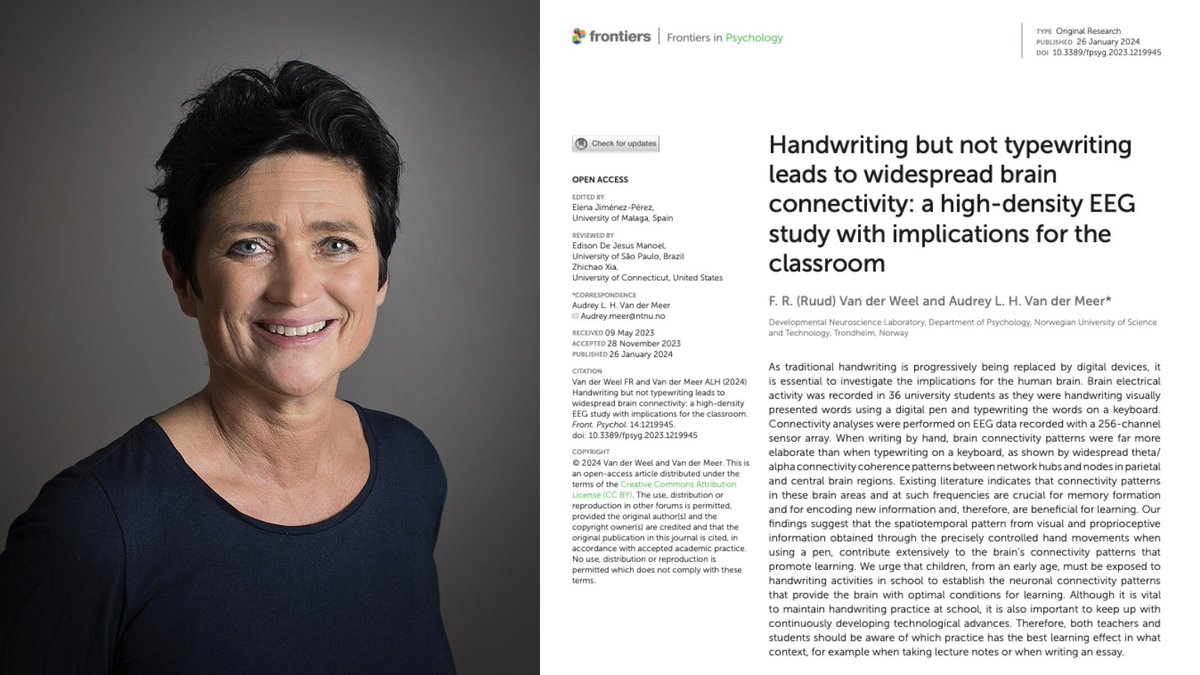
A Norwegian neuroscientist spent 20 years proving that the act of writing by hand changes the human brain in ways typing physically cannot, and almost nobody outside her field has read the paper.
Her name is Audrey van der Meer.
She runs a brain research lab in Trondheim, and the paper that closed the argument was published in 2024 in a journal called Frontiers in Psychology. The finding is brutal enough that it should have changed every classroom on Earth.
The experiment was simple. She recruited 36 university students and put each one in a cap with 256 sensors pressed against their scalp to record brain activity. Words flashed on a screen one at a time.
Sometimes the students wrote the word by hand on a touchscreen using a digital pen, and sometimes they typed the same word on a keyboard. Every neural response was recorded for the full five seconds the word stayed on screen.
Then her team looked at the part of the data most researchers had ignored for years, which is how different parts of the brain were communicating with each other during the task.
When the students wrote by hand, the brain lit up everywhere at once.
The regions responsible for memory, sensory integration, and the encoding of new information were all firing together in a coordinated pattern that spread across the entire cortex. The whole network was awake and connected.
When the same students typed the same word, that pattern collapsed almost completely.
Most of the brain went quiet, and the connections between regions that had been alive seconds earlier were nowhere to be found on the EEG.
Same word, same brain, same person, and two completely different neurological events.
The reason turned out to be something nobody had really paid attention to before her work. Writing by hand is not one motion but a sequence of thousands of tiny micro-movements coordinated with your eyes in real time, where each letter is a different shape that requires the brain to solve a slightly different spatial problem.
Your fingers, wrist, vision, and the parts of your brain that track position in space are all working together to produce one letter, then the next, then the next.
Typing throws all of that away. Every key on a keyboard requires the exact same finger motion regardless of which letter you are pressing, which means the brain has almost nothing to integrate and almost no problem to solve.
Van der Meer said it plainly in her interviews.
Pressing the same key with the same finger over and over does not stimulate the brain in any meaningful way, and she pointed out something that should scare every parent who handed their kid an iPad.
Children who learn to read and write on tablets often cannot tell letters like b and d apart, because they have never physically felt with their bodies what it takes to actually produce those letters on a page.
A decade before her, two researchers at Princeton ran the same fight using a completely different method and ended up at the same answer. Pam Mueller and Daniel Oppenheimer tested 327 students across three experiments, where half took notes on laptops with the internet disabled and half took notes by hand, before testing everyone on what they actually understood from the lectures they had watched.
The handwriting group won by a wide margin on every question that required real understanding rather than surface recall.
The reason was hiding in the transcripts of what the two groups had actually written down.
The laptop students typed almost word for word, capturing more total content but processing almost none of it as they went, while the handwriting students physically could not write fast enough to transcribe a lecture in real time, which forced them to listen carefully, decide what actually mattered, and put it in their own words on the page.
That single act of choosing what to keep was the learning itself, and the keyboard had quietly skipped the choosing and skipped the learning along with it.
Two studies. Two countries. Same answer.
Handwriting makes the brain work. Typing lets it coast.
Every note you have ever typed instead of written went into your brain through a thinner pipe. Every meeting, every book highlight, every idea you captured on your phone instead of on paper was processed at half depth.
You did not forget those things because your memory is bad. You forgot them because typing never woke the part of the brain that would have made them stick.
The fix is the thing your grandmother already knew.
Pick up a pen. Write the thing down. The slower road is the faster one.