The endgame of trading is asset allocation. Why did I choose to convert all my everyday idle stables into Cash Plus?
Over the past few years, I've always been quite cautious about exchange Earn products.
Not because I hate yield, but because the most dangerous products in the crypto market are often the ones flying the banner of 'stable returns'.
If a product only feeds you an APY but can't clearly explain where the yield comes from, that APY probably isn't yield,it's an invisible risk premium.
So when I looked at Bitget Cash Plus, my first reaction wasn't about how high the yield was; instead, I had three questions:
Where is the money going? Can I withdraw it at any time? Is the yield coming from black-box lending?
The routing for Cash Plus is straightforward: deposit USDT/USDC, and receive Cash+ at a 1:1 ratio.
The yield source isn't some complex on-chain farming, nor is it dumping money into an opaque lending pool. It comes from USDGO, with underlying assets consisting of short-term U.S. Treasuries, cash, and repo agreements.
To me, this is way more important than the APY itself.
Because in the current macro environment, short-end Treasuries are already sitting right around 4%. All it does is seamlessly pipe the existing short-end rates from TradFi into your trading account.If you are treating this as some 'degen high-yield play', you've completely misunderstood it.
A lot of traders constantly keep 20%, 30%, or an even higher percentage of stablecoins in their accounts long-term.
This capital serves a pure liquidity function: waiting for pullbacks, waiting for breakouts, waiting for new coin listings, or waiting for arbitrage opportunities.
The problem is, historically, these stablecoins generated zero yield most of the time.
If your average stablecoin balance over a year is $100,000, that 4% is $4,000.
In the crypto world, reasonable yield is sometimes far scarcer than ridiculous yield. Cash Plus is definitely worth your time to look into.
When a lot of people discuss RWAs, they treat 'asset tokenization' as the endgame.
But the assessment from this WallStreetBets article is much closer to market reality: the token is merely the issuance vehicle; the real challenge is whether a complete closed loop of trading and utility can be formed once the asset goes on-chain.
I break this closed loop down into four questions.
First, do the underlying assets actually exist, and is the mapping of rights clear?
Second, can custody, settlement, dividends, and corporate actions be handled reliably?
Third, is there sustained liquidity post-issuance, rather than just a single spike in trading volume on launch day?
Fourth, can users plug it into other financial activities—such as using it as collateral, in portfolio allocation, or as a capital deployment tool?
These four questions explain why the crypto market first attempted 24/7 trading through perps. Perps primarily offer price exposure; they don't require porting the custody, delivery, and legal structures of physical assets entirely on-chain from day one.
But equities, Treasuries, gold, and other real-world assets are different. They don't just need to solve for price discovery; they also need to solve for ownership, settlement, regulatory boundaries, and actual utility post-issuance.
Therefore, 24/7 in itself is not the core product value. Round-the-clock access is merely the gateway; sustained liquidity and composability are the true tests that follow.
On the tokenized equities front, WallStreetBets points to Bitget as a prime case study. Bitget Stocks 2.0 launched rTokens through Reality; according to their public documentation, the product attempts to bridge traditional stock market liquidity while handling underlying mapping, dividends, and corporate actions.
What makes this case worth watching isn't that it's reinventing Nvidia or Tesla, but rather that it is plugging these already-familiar assets into a crypto-native account.
This implies that the role of the trading platform might be shifting.
In the past, exchanges were primarily responsible for order matching and asset listing. Future trading platforms may also need to take on the responsibility of routing assets into the user's capital management workflow, encompassing trading, collateralization, allocation, and cross-product utilization.
This is also why you can't judge RWA projects solely by issuance metrics and PR narratives. The far more critical indicators should be: how thick is the actual order book depth? Can positions be integrated into portfolio management? Are dividends processed as expected? Will users stick around once the novelty wears off? And is there a real pathway for the assets to flow across different markets?
If RWAs are just about repackaging assets into more tokens, then the industry's ultimate battle will just be a race of asset catalogs.
But if RWAs are truly a new layer of financial infrastructure, value will accrue far more to the platforms capable of wiring together issuance, settlement, liquidity, and user activity.
The answer won't be dictated by concepts; it will be decided by long-term user behavior.
$HYPE Now | Market Watch
If you missed my previous reminder on $HYPE, your position is likely already down about 10 points.
HYPE remains in a clear downtrend channel.
RSI is currently at 59.6. Short-term rebound momentum has recovered somewhat, but resistance at 73-75 is still strong.
If it breaks below 62-65 support, the next target could be 55-58.
There’s only one clear winner in the tokenized stocks game right now, but in my eyes, this was inevitable.
There are plenty of tokenized stock products on the market right now, and I generally don't look at the narrative first. RWA, on-chain US equities, 24/7 trading,these buzzwords aren't new in themselves. To truly judge whether a product has value, you have to see if it can pass three questions from the user:
First, what exactly is the exposure I'm getting?
Second, will I get eaten alive by spreads and slippage when I trade?
Third, after I buy it, can this asset continue to work for me beyond just going up or down?
Bitget's rToken is designed exactly around these three questions.
rToken is Bitget's tokenized US stock product, supporting US equity tokens like rAAPL, rTSLA, and rNVDA. Each token is backed 1:1 by real shares, held by regulated, licensed brokers. The significance of this structure is that it attempts to distance itself from purely synthetic products.
Historically, the biggest controversy around tokenized stocks has never been 'can it be traded?', but rather 'what does the user actually own?'. Some products are just price trackers, some offer no shareholder rights, and some rely on internal market making for liquidity. For the average user, just because 'stock' is in the name doesn't mean the experience equals a traditional brokerage account.
So the first layer I look at with rToken isn't whether it's an RWA, but whether it clearly outlines the underlying assets, custody, dividends, regional restrictions, and trading rules.
The second layer is liquidity.
A key selling point for rToken is that it connects directly to the real exchange liquidity of NASDAQ / NYSE, rather than heavily relying on market makers. This difference is crucial. Many RWA products look tradable on the UI, but when users actually place an order, they find the order book is thin, spreads are wide, and execution quality degrades the moment the market gets volatile.
The third layer is capital efficiency.
This is where I think rToken is most worth discussing.
In traditional brokerage accounts, equity positions are usually single-purpose. You buy NVDA, and it's just a holding. It can go up, it can go down, it can collect dividends, but it is entirely siloed from your crypto trading account.
rToken attempts to break down this boundary. According to the product specs, users can hold the stock token while simultaneously using it as margin, and receive dividend-related rights according to the rules. In other words, it's not just giving users US equity price exposure; it's integrating this exposure into the trading system, allowing it to participate in account-level capital deployment.
Of course, increased efficiency inevitably comes with shifting risks.
Using rAAPL, rTSLA, and rNVDA as margin doesn't mean the risk disappears. On the contrary, you have to simultaneously face equity price volatility, margin haircuts, liquidation risks, platform risk control, regional restrictions, and differences in trading hours. Especially the 24/7 trading selling point,it sounds convenient, but users need to know that the real US stock market is not open 24/7. The price discovery mechanisms, order book depth, and spread performance during off-market hours all need to be verified through actual testing.
So my stance on rToken is:
It is not a complete replacement for traditional brokers.
Nor is it a generic RWA concept coin.
It feels more like a US equities exposure module within the crypto exchange environment.
The target audience needs to be users who are very familiar with CEX operations, understand US equity exposure, care about capital efficiency, and are willing to understand margin risks
I will continue to monitor rToken using five metrics:
Actual execution slippage.
Order book depth across different trading hours.
Margin haircuts and liquidation rules.
Dividend distribution and tax handling disclosures.
The disclosure frequency and verifiability of the 1:1 underlying asset backing
If these five points can be consistently clarified, the significance of rToken goes beyond just 'tokenizing US stocks.' What it really wants to achieve is making US equity positions usable, deployable, and composable within a crypto trading account
This is the real direction worth watching for tokenized stocks.
$TRUMP made Donald Trump over $600M.
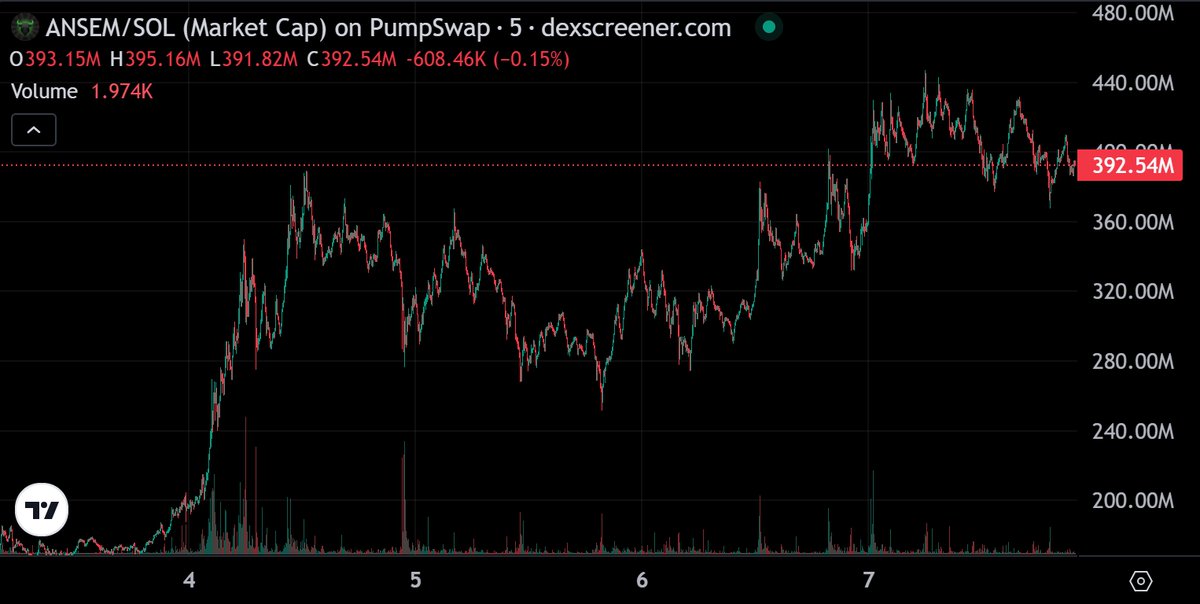
Could $ANSEM create a similar wealth effect for Ansem?
A few thoughts on $ANSEM and $TRUMP.
TRUMP turned political figures into one of crypto’s biggest narratives.
ANSEM is now testing whether crypto native personalities can become the next one.
The real difference isn’t market cap.
It’s the type of influence the market is willing to pay for.
TRUMP is backed by political influence, mainstream media attention, and global recognition.
ANSEM is backed by years of credibility built on Crypto Twitter, a track record of spotting narratives early, and identifying opportunities like SOL, BONK, and WIF before they became mainstream.
Unlike TRUMP, Ansem didn’t launch the token himself.
After receiving a large allocation from the community, he used part of the fees to add liquidity and fund community airdrops as a way of giving back.
The risks are just as obvious.
When a person’s reputation becomes the core asset behind a meme, every opinion and every market call can directly affect sentiment.
If ANSEM continues gaining traction, we may be witnessing more than the success of another meme.
We may be watching the market shift from political memes to crypto native personality memes.
Maybe Character Memes have entered Version 2.0.