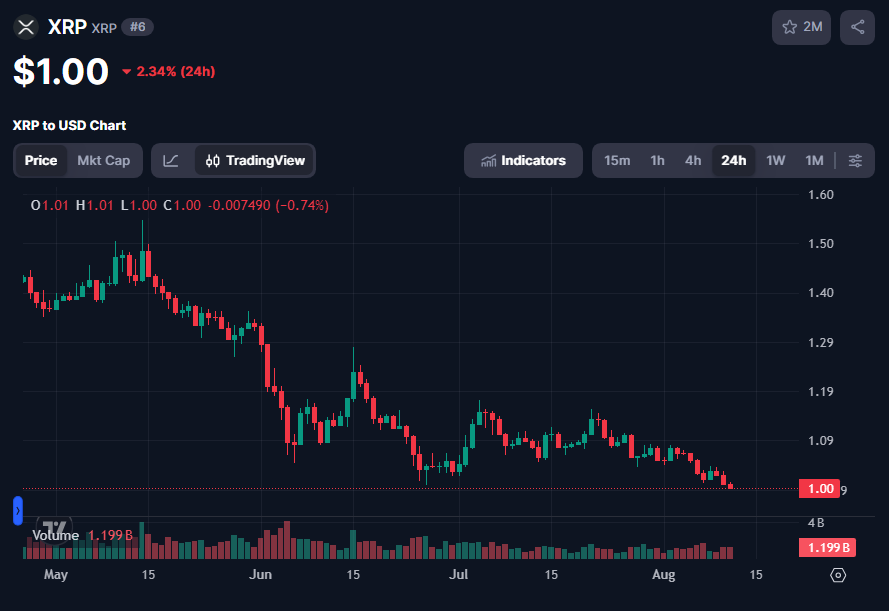
XRP is back at $1.I’ve already seen some familiar comments: “XRP is a scam.” “XRP is finished.” “Why would anyone buy it at this price?”
When the market is going up, people talk about how high XRP can go. The moment the price falls, those same people start asking whether it’s worth anything at all.
Honestly, seeing XRP at $1 makes me a little tempted. Not because I think this is the bottom, and not because I believe it’s about to rally. It’s simply a price level where I’m willing to seriously consider buying again.
So if you ask me whether I’d buy XRP right now? Yes, I would.
I wouldn’t buy everything at once. If it keeps falling, I’ll consider adding gradually. Because I’ve never held XRP simply because of a chart. I have my own long-term reasons for believing in it.
You don’t have to like XRP, and you don’t have to believe it’s worth buying. But for me, seeing the price fall to $1 doesn’t automatically make me forget why I decided to hold it in the first place.
Sometimes, what really tests an investment decision isn’t how confident you feel when the price is going up. It’s whether you still remember why you bought it when the price falls and everyone starts questioning it.
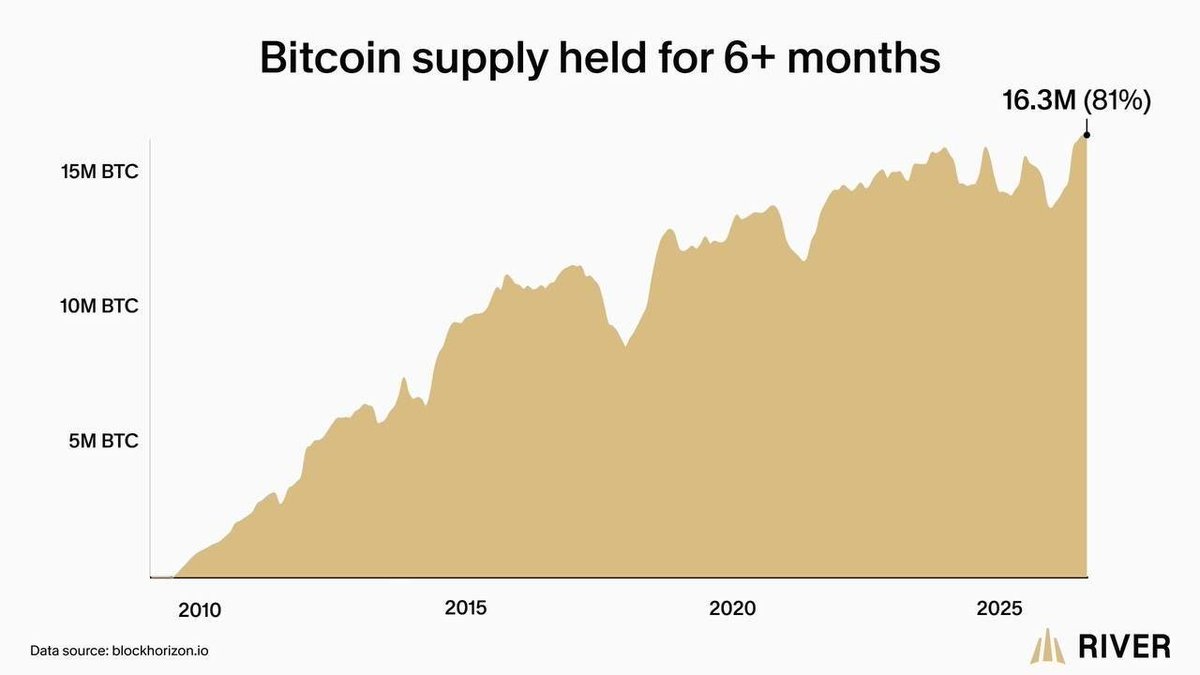
Bitcoin holders are barely moving.
Around 81% of $BTC supply hasn’t moved in at least 6 months, according to recent on-chain data.
That means a huge portion of Bitcoin is sitting untouched even as the market moves higher.
Less supply actively circulating can make liquidity tighter when demand rises.
According to you, is this a sign that BTC holders are preparing for another major move?
Beyond Traditional Brokerages: How BlackRock and Ondo Tokenize $BTC Exposure
BlackRock is partnering with Ondo Finance to tokenize three of its major model portfolios—covering high-income, diversified growth, and high-growth strategies. Ondo is launching seven tokenized model portfolios in total, giving global investors instant 24/7 access to traditional strategies right inside their crypto wallets.
The setup is pretty neat:
The tokenized portfolios will hold a blended mix of stock, bond, and BTC ETFs depending on the strategy. When you buy the token, software automatically purchases the underlying ETF shares in the background.
Why this is a huge deal for the ecosystem:
🔹 Massive TAM: Model portfolios are a $9.8 Trillion industry used heavily by financial advisers worldwide.
🔹 24/7 Utility: Instead of waiting for traditional brokerage hours, token holders can trade anytime and even use their portfolio tokens as collateral for borrowing.
🔹 Wall Street Convergence: Joining players like JPMorgan and Invesco, BlackRock is proving that the future of asset management lives onchain.
While BTC remains the primary digital store of value, seeing trillion-dollar asset managers build automated, multi-asset portfolios on blockchain rails shows just how fast TradFi and crypto are merging.
That's why I pay attention to the rate of return. Speculation can alter short-term price discovery, but it's difficult to permanently change the opportunity cost of capital. Even if market participants don't care about a 5% yield for the time being, other funds will still use it as a benchmark
The 10-year Treasury yield just pushed above 5.1%, its highest level since 2007, and it is forcing a hard question for Bitcoin bulls. Why take risk on a non-yielding asset when you can lock in roughly 5% in government bonds? That opportunity cost is the cleanest read on why BTC slipped from the 85,000s toward 83,000 as yields surged.
The tension is between macro headwinds and crypto-specific catalysts. On one side, higher yields drain liquidity from risk assets, push up discount rates on long-duration bets, and strengthen the dollar. On the other side, Bitcoin is holding above 83,000 with roughly an 11% gain from its recent low near 75,000, and it is still up roughly 43% from the July low near 58,000. The market is weighing a roughly 5% Treasury yield against the potential for a bull market breakout if BTC can clear 88,000 to 90,000.
For traders, the setup is clear. Watch the 10-year yield around 5.12% and then 5.15% for the next leg. A move above 5.15% would signal more pressure on risk assets, while a pullback toward 5.00% would ease the opportunity cost headwind. For BTC, the key levels are 83,000 support and 88,000 to 90,000 resistance. A break below 83,000 could open the path to 80,000 and then 75,000, while a hold above 88,000 would suggest buyers are defending the bull case.
The next catalysts are the Friday roughly 17 billion options expiry across BTC and ETH and any follow-through in yields. If the 10-year backs off from 5.12% and BTC holds 85,000, the path to 90,000 opens. If yields push toward 5.15% and BTC loses 83,000, the risk-free rate narrative will dominate and drag crypto lower.
However, in the long run, we still need to rely on the validation of capital, demand, and fundamentals. Sentiment can push prices very far, but it cannot indefinitely replace real demand. Therefore, I will view the current situation as a phase that requires observation rather than hasty conclusions
🇺🇸 CFTC Chair: Tokenization Could Change How $BTC Markets Work
Tokenization is starting to look less like a crypto experiment and more like a possible upgrade to traditional finance.
CFTC Chair Michael Selig said tokenized real-world assets could eventually support 24/7 trading and much faster settlement, making it easier to move assets and collateral between market participants.
He compared the shift to the move from traditional floor trading to electronic markets.
The interesting part is what happens behind the scenes: if assets, collateral and payments can move onchain almost instantly, a lot of today’s financial infrastructure could start looking very different.
Selig believes the next decade could bring bigger changes to finance than the past several decades combined.
Tokenization may not replace traditional finance. It could become the infrastructure underneath it.
Info only. DYOR and invest responsibly.
For long-term holding, I value the asset's fundamentals, ecosystem development, and sustained demand more than short-term narratives. For me, XRP is not simply a bet on the Clarity Act. I'm more concerned with whether regulation, institutional participation, and the actual use of XRPL can create long-term demand
XRP is back at $1.I’ve already seen some familiar comments: “XRP is a scam.” “XRP is finished.” “Why would anyone buy it at this price?”
When the market is going up, people talk about how high XRP can go. The moment the price falls, those same people start asking whether it’s worth anything at all.
Honestly, seeing XRP at $1 makes me a little tempted. Not because I think this is the bottom, and not because I believe it’s about to rally. It’s simply a price level where I’m willing to seriously consider buying again.
So if you ask me whether I’d buy XRP right now? Yes, I would.
I wouldn’t buy everything at once. If it keeps falling, I’ll consider adding gradually. Because I’ve never held XRP simply because of a chart. I have my own long-term reasons for believing in it.
You don’t have to like XRP, and you don’t have to believe it’s worth buying. But for me, seeing the price fall to $1 doesn’t automatically make me forget why I decided to hold it in the first place.
Sometimes, what really tests an investment decision isn’t how confident you feel when the price is going up. It’s whether you still remember why you bought it when the price falls and everyone starts questioning it.
September is already up nearly 10% — a notable move in what has historically been one of BTC’s weaker months.
BTC monthly seasonality shows:
• September average: around -2%
• October average: around +19%
• November has historically been volatile, with returns varying widely across years
So if BTC closes September strong, Q4 enters a historically stronger seasonal period.
But seasonality is context, not a signal.
What matters next is whether the September strength can hold as October begins. 👀
US Is Buying Bitcoin. Asia Is Selling It.
The 1-minute chart shows the split in CVD, not a verdict on who is right.
$BTC is holding about $85,794 after a session high at $86,473 and a low at $85,591. Coinbase-style btc-usd CVD is +$10.57 million, which is the US bid. Binance btcusdt CVD is −$27.90 million and btc-usdt is −$22.22 million, which is the offshore sell. Price is barely red on the minute while those two flows pull opposite ways.
Key Details:
- Price: $85,794 on Binance 1m
- High / low: $86,473 / $85,591
- US CVD (btc-usd): +$10.57M
- Offshore CVD (btcusdt): −$27.90M
- Other USDT prints: −$22.22M and −$2.82M
US buying into Asia selling is a tug of war under $86,000. If Coinbase CVD keeps rising and price holds $85,600, the US side is winning the tape. If Binance CVD stays deeply negative and $85,600 fails, the sell is still in control.
$BTC $85.8K — Coinbase CVD Green, Binance CVD Red
Do you side with the US bid, or with the offshore sell until $86,000 is back?
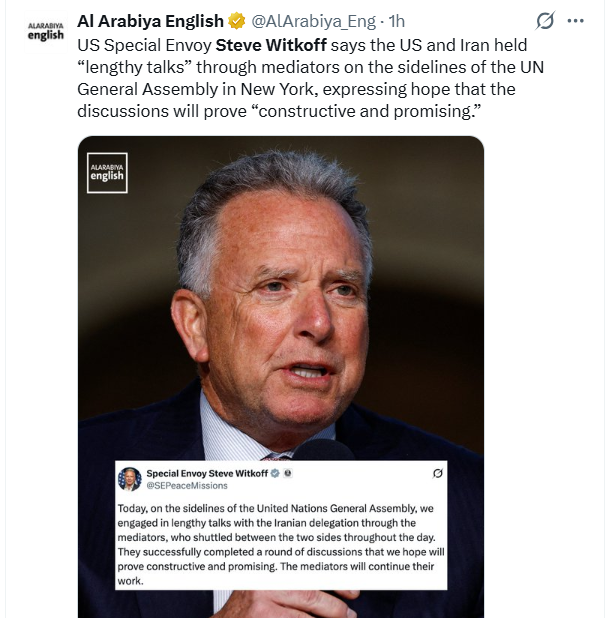
🚀 Bitcoin climbed above $87K before returning to trade on the $86K, extending its weekly gain to nearly 8% as markets reacted to reports of renewed U.S.-Iran negotiations.
The rally got extra fuel from:
🛢 Oil falling to around $89
₿ Rising BTC ETF inflows
📊 Futures open interest reaching $61.4B
🔥 CME OI +5% | Hyperliquid +6%
ETH, XRP, SOL and ZEC also bounced as broader risk sentiment improved.
But the geopolitical picture remains fluid. Iran has presented conditions for de-escalation, while U.S. officials have described the talks positively.
For $BTC , the next test is whether $87K can turn into solid support as traders await further developments and Fed commentary. 👀
📈 Just recently, $BTC was trading at $68,000, but today it managed to reach $86,000
This happened quite quickly and unexpectedly for many
It is very pleasing to see a green market
🇵🇰 One of Crypto’s Biggest Markets Is Leaving the Grey Zone
Pakistan - one of the world’s most active crypto markets (top-3 by global adoption last year), has opened a formal licensing path for crypto firms
Existing companies now have to apply for a PVARA No Objection Certificate until September 5 (or stop operating in the country).
The framework covers exchanges, custody, lending, derivatives, asset management, token issuance and even mining-related services.
📌 The NOC is only the first step though. Firms then need AML registration, a local entity and a full VASP licence. Banks can also open accounts for approved crypto companies - something Pakistan formally enabled in April after replacing its old 2018 restrictions.
Looking at other major crypto markets, a few still stand out for unfinished regulation:
🇮🇳 India - in global crypto adoption, but still has no dedicated comprehensive crypto law; the market largely operates through tax, AML and FIU rules.
🇺🇸 US - still waiting for CLARITY to settle the federal market structure and the SEC/CFTC split.
🇺🇦 Ukraine - where the 2022 Virtual Assets law never entered into force and the new framework is still awaiting final parliamentary adoption.
🇻🇳 Vietnam - currently running crypto under a five-year pilot regime rather than a permanent market framework.
🇰🇷 South Korea - already has user-protection and AML rules, but its broader Phase 2 framework covering issuance, stablecoins and market structure is still being developed.
The more uncertain the market, the more I believe in long-term, stable investment logic, rather than short-term high returns.
The 30-year US Treasury yield hitting a 19-year high is just another reminder. Cycles will always change; what truly endures are strategies that have stood the test of time.
BREAKING: 🇺🇸 US 30Y bond yield hit 5.33%, its highest level in 19 YEARS.
High bond yields make borrowing harder, and it's bad for the markets.
Pray for your crypto bags.
The US CPI fell to 3.4% year-on-year in July, in line with market expectations and a further decline from 3.5% in June. This is a relatively mild inflation signal for the market.
XRP is currently struggling around $1, and this data has at least temporarily alleviated some macroeconomic pressure; meanwhile, BTC continues to attract institutional attention.
However, the CPI is just one variable. Whether it can truly change the trend of cryptocurrencies depends on subsequent capital flows, interest rate expectations, and market sentiment.
XRP recently returned to $1, and the SEC is set to discuss a new cryptocurrency offering framework on Friday.
It's quite interesting to look at these two things together.
I wouldn't say this means XRP is about to rise, nor would I equate a single regulatory meeting directly with a positive for XRP.
However, if US regulators begin to establish clearer rules for cryptocurrency issuance and investment contracts, then assets like XRP, which have undergone years of regulatory controversy, may see their long-term positioning re-evaluated by the market.
Price is one thing. The regulatory environment is another matter. I'd rather see the latter.
@365V2 This is actually the most painful part for long-term holders. It's not that you can't accept volatility, but that you don't know how much longer you have to wait. I don't have the answer either, but that won't make me change my long-term judgment because of anxiety
Bitcoin’s Power Law model remains structurally bullish, with BTC consolidating in the upper-middle of its historical growth band.
The $425K target sits near the model’s upper range, suggesting major upside if the long-term trend stays intact.