PhD Student @TUBerlin @bifoldberlin @mpib_berlin | MSc Neuroscience | Examining life through working memory research and nightly philosophy of mind discussions
Can context-sensitivity improve human–machine alignment in VFMs? We show that incorporating context improves modeling of human similarity decisions.
🎉Accepted to ReAlign @iclr_conf!
Now on @arxiv: https://t.co/GATXzSFFod
Joint first-authored work with amazing Tom Neuhäuser. 1/5
Can context-sensitivity improve human–machine alignment in VFMs? We show that incorporating context improves modeling of human similarity decisions.
🎉Accepted to ReAlign @iclr_conf!
Now on @arxiv: https://t.co/GATXzSFFod
Joint first-authored work with amazing Tom Neuhäuser. 1/5
Huge thanks to all our co-authors for this collaboration and all the support. Tom and I are very grateful to work with such amazing colleagues and advisors @mc_mozer, @lukas_mut, @BDRoads, @AndrewLampinen, Matt Jones, Klaus-Robert Müller, and Bernhard Spitzer (not on X)! 5/5
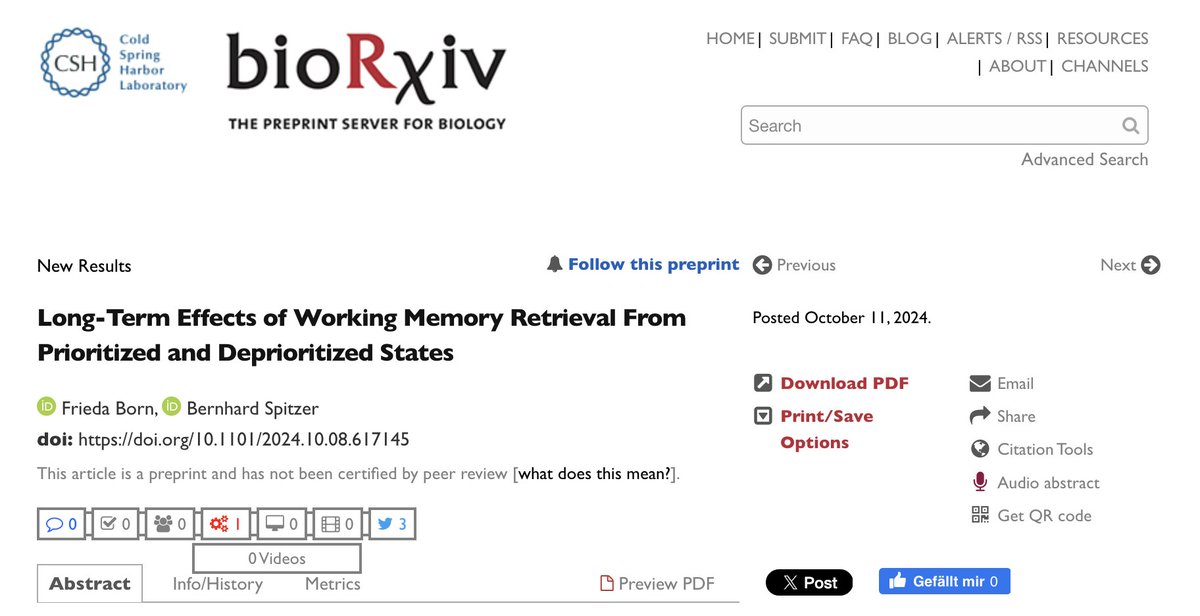
Why do some memories fade in seconds, while others stay with us for life? Working Memory (WM) holds info for just moments, but certain bits manage to stick around and make it into Long-Term Memory (LTM). In our new ⚡️preprint⚡️, we examined what helps these memories stick. 1/
🥳 Our paper on aligning neural networks with human conceptual structure is out in @Nature ! Honored to be part of this amazing team. It was a lot of fun! Thank you @lukas_mut , @AndrewLampinen ,@mc_mozer, Klaus Greff, Bernhard Spitzer & all other collaborators!
What aspects of human knowledge do vision models like CLIP fail to capture, and how can we improve them? We suggest models miss key global organization; aligning them makes them more robust. Check out @lukas_mut's work, finally out (in @Nature!?) + our new blogpost! 1/4
During my PhD, I noticed it can be challenging to decode long-term memory (LTM) contents from EEG activity. We were struck by research showing that transient visual "pings" can boost working memory classification.
So, we evaluated this technique for LTM:
https://t.co/NOhl8J2DZe
🚨The Levels dataset that we collected as part of the AligNet effort is now publicly available: https://t.co/uBUZSzjUkB
Levels is a human similarity judgment dataset across three abstraction/granularity levels meant for evaluating the alignment of vision foundation models w/ 🧠
Which tasks benefit the most from aligning vision models with human perceptual judgments? In our most recent NeurIPS paper we pin down the downstream tasks where perceptual alignment yields the strongest increases in performance. More in the thread below 👇
@nanakatsuchiya Hi, thanks for your question! "Prioritized" and "deprioritized" refer to the WM information’s attentional state: prioritized information stayed in focus during the WM task, while attention was temporarily withdrawn or shifted away from deprioritized information.
Why do some memories fade in seconds, while others stay with us for life? Working Memory (WM) holds info for just moments, but certain bits manage to stick around and make it into Long-Term Memory (LTM). In our new ⚡️preprint⚡️, we examined what helps these memories stick. 1/
The WM-testing effects, particularly for deprioritized info, show intriguing parallels with classic “retrieval practice” effects found in episodic (long-term) memory research. Want to dive deeper into this? 7/