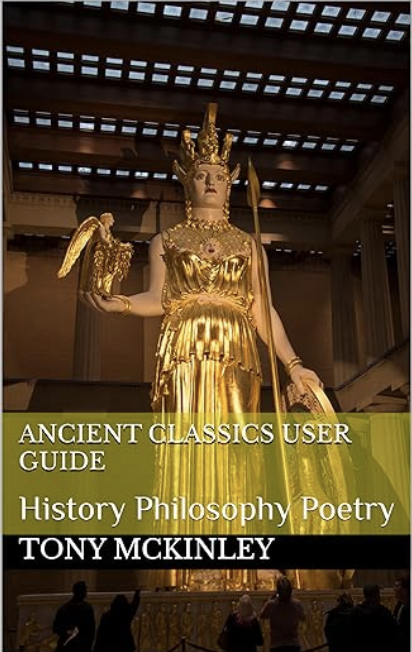
When the surgeon came in that third morning, I said to him “Doc, you have to fix me, I am not going to live another day like this.”
Three days earlier it seemed my procedure had gone well, but it hadn’t. An hour after I talked to the surgeon, as they were wheeling me on the gurney into the operating room, a nurse leaned over and told me “You are having multiple organ failure.”
I thought to myself, “Dang, I haven’t even read the Classics. What would Thomas Jefferson and Ben Franklin think of me?”
Later that summer, after the first week on life support, a couple more weeks in ICU and a week in SNF, two or three months passed as I came back to life, my bone marrow started making red blood cells, my fingernails started growing again. “Whew, that was close, I almost went through Life without reading the Classics!”
I started out with Herodotus, as the first historian he seemed to be the place to start. I was sticking to history, poetry and philosophy seemed beyond my grasp. Self-directed, I logically proceeded to Thucydides. Then I came to understand that Livy was the equivalent of these guys in Roman history. After two or three Penguins of Livy, I decided Greek history was much more interesting and went back to Xenophon, Arrian, even Pausanius, but soon ran out of Greek historians.
So, I went back and read the Romans, more Livy, Tacitus, Sallust, mucked around in Suetonius, finally got to the magnificent Plutarch. As someone who reads all back matter, front matter and footnotes, I was still uncertain of a lot, I couldn’t tell the difference between Cassius Dio and Diodorus Siculus in references. Now I can.
After all the history, I was ready for Homer! Then, I leapt into Virgil and sampled one or two plays from each of the three Tragedians, and Aristophanes. Finally, I felt bold enough to try philosophy, started with Marcus Aurelius, and set off into Plato and Aristotle.
Eventually, during the “Summer of Roman History” I systematically read all the classic historians up to Ammianus Marcellinus.
That’s when I got the idea to write my Ancient Classics User Guide, to provide people like my younger myself, like my grandsons, a clear path, so they wouldn’t have to stumble through the glorious wilderness like I did. I wrote a chapter about each of the ancient authors, who they were and when they lived, what they wrote about, and included rich samples of all the works.
Readers can see the “Scipio’s Dream” view of all of the classics arranged chronologically in the Table of Contents, start from Homer and go straight through to Ammianus, or more likely choose writers who strike their fancy, like Julius Caesar or Marcus. I’m a big fan of Polybius, and my favorite is Longinus and his insuperable commentary on all the greatest authors - “On the Sublime.”
Ammianus, the learned historian, quotes Cicero
“Although the state most to be desired is the permanent continuance of undisturbed good fortune, nevertheless such a smooth course of life does not provide so piquant a sensation as a change to better things from misery and disaster.”
In 355, a powerful general, the “stout rebel Silvanus” had allowed his troops to declare him Augustus, threatening the emperor Constantius. It is resolved to relieve this rebel officer by sending a representative in the person of a recently disgraced but very experienced general who in this role “now became the wisest of generals, the great comrade-in-arms of the emperor Constantine” in Ammianus’ ironic phrasing. In the next sentence, he reveals the other side of this rehabilitation of Ursicinus. “Great efforts were certainly to be made … but if they failed … Ursicinus … would be utterly destroyed, and a very formidable stumbling block removed.” Insights like this, boldly stated about the emperor himself, demonstrate Ammianus’ courageous emulation of the great Tacitus in speaking freely. The author describes his own participation in this delegation, and provides us with a sense of his high rank in the military at 15.5.
"When this was settled Ursicinus received orders to set out. He was accompanied, at his own request, by some tribunes and ten officers of the general staff to help in meeting the needs of the situation. Among the latter were my colleague Verinian and myself; all the rest were chosen by the emperor. … each of us preoccupied solely by fear for his own safety. We were like condemned criminals thrown before fierce wild beasts.”
After this confession of understandable fear, Ammianus takes a philosophical stance, and quotes his most frequently referred authority, Cicero.
“Although the state most to be desired is the permanent continuance of undisturbed good fortune, nevertheless such a smooth course of life does not provide so piquant a sensation as a change to better things from misery and disaster.”
The Loeb version: In Res Gestae 15.5.23, after describing relief from danger and hardship during military and political turmoil under Constantius II, Ammianus writes (in the Loeb translation):"...reflecting that melancholy events after all have this good sequel, that they give way to good fortune, we admired that saying of Tully’s, delivered even from the inmost depths of truth itself, which runs as follows: 'And although it is most desirable that our fortune always remain wholly favourable, yet that evenness of life does not give so great a sense of satisfaction as when, after wretchedness and disaster, fortune is recalled to a better estate.'"
Sallust - "The leader and ruler of mortal life is the rational soul."
The Jugurthine War opens with Sallust reflecting philosophically upon Life.
"It is wrong for humans to complain about human nature, speaking of frailty and saying that their short life is ruled rather by chance than by merit. For, after careful thought … it is more often the case that human nature is lacking more in determined effort than in strength or time. But the leader and ruler of mortal life is the rational soul. And when it proceeds toward glory down a path of manly virtue, it has more than enough power and potential to win fame and it does not need the help of chance, which cannot grant or steal from anyone honesty, diligence, and other excellent qualities."
When the surgeon came in that third morning, I said to him “Doc, you have to fix me, I am not going to live another day like this.”
Three days earlier it seemed my procedure had gone well, but it hadn’t. An hour after I talked to the surgeon, as they were wheeling me on the gurney into the operating room, a nurse leaned over and told me “You are having multiple organ failure.”
I thought to myself, “Dang, I haven’t even read the Classics. What would Thomas Jefferson and Ben Franklin think of me?”
Later that summer, after the first week on life support, a couple more weeks in ICU and a week in SNF, two or three months passed as I came back to life, my bone marrow started making red blood cells, my fingernails started growing again. “Whew, that was close, I almost went through Life without reading the Classics!”
I started out with Herodotus, as the first historian he seemed to be the place to start. I was sticking to history, poetry and philosophy seemed beyond my grasp. Self-directed, I logically proceeded to Thucydides. Then I came to understand that Livy was the equivalent of these guys in Roman history. After two or three Penguins of Livy, I decided Greek history was much more interesting and went back to Xenophon, Arrian, even Pausanius, but soon ran out of Greek historians.
So, I went back and read the Romans, more Livy, Tacitus, Sallust, mucked around in Suetonius, finally got to the magnificent Plutarch. As someone who reads all back matter, front matter and footnotes, I was still uncertain of a lot, I couldn’t tell the difference between Cassius Dio and Diodorus Siculus in references. Now I can.
After all the history, I was ready for Homer! Then, I leapt into Virgil and sampled one or two plays from each of the three Tragedians, and Aristophanes. Finally, I felt bold enough to try philosophy, started with Marcus Aurelius, and set off into Plato and Aristotle.
Eventually, during the “Summer of Roman History” I systematically read all the classic historians up to Ammianus Marcellinus.
That’s when I got the idea to write my Ancient Classics User Guide, to provide people like my younger myself, like my grandsons, a clear path, so they wouldn’t have to stumble through the glorious wilderness like I did. I wrote a chapter about each of the ancient authors, who they were and when they lived, what they wrote about, and included rich samples of all the works.
Readers can see the “Scipio’s Dream” view of all of the classics arranged chronologically in the Table of Contents, start from Homer and go straight through to Ammianus, or more likely choose writers who strike their fancy, like Julius Caesar or Marcus. I’m a big fan of Polybius, and my favorite is Longinus and his insuperable commentary on all the greatest authors - “On the Sublime.”
When the surgeon came in that third morning, I said to him “Doc, you have to fix me, I am not going to live another day like this.”
Three days earlier it seemed my procedure had gone well, but it hadn’t. An hour after I talked to the surgeon, as they were wheeling me on the gurney into the operating room, a nurse leaned over and told me “You are having multiple organ failure.”
I thought to myself, “Dang, I haven’t even read the Classics. What would Thomas Jefferson and Ben Franklin think of me?”
Later that summer, after the first week on life support, a couple more weeks in ICU and a week in SNF, two or three months passed as I came back to life, my bone marrow started making red blood cells, my fingernails started growing again. “Whew, that was close, I almost went through Life without reading the Classics!”
I started out with Herodotus, as the first historian he seemed to be the place to start. I was sticking to history, poetry and philosophy seemed beyond my grasp. Self-directed, I logically proceeded to Thucydides. Then I came to understand that Livy was the equivalent of these guys in Roman history. After two or three Penguins of Livy, I decided Greek history was much more interesting and went back to Xenophon, Arrian, even Pausanius, but soon ran out of Greek historians.
So, I went back and read the Romans, more Livy, Tacitus, Sallust, mucked around in Suetonius, finally got to the magnificent Plutarch. As someone who reads all back matter, front matter and footnotes, I was still uncertain of a lot, I couldn’t tell the difference between Cassius Dio and Diodorus Siculus in references. Now I can.
After all the history, I was ready for Homer! Then, I leapt into Virgil and sampled one or two plays from each of the three Tragedians, and Aristophanes. Finally, I felt bold enough to try philosophy, started with Marcus Aurelius, and set off into Plato and Aristotle.
Eventually, during the “Summer of Roman History” I systematically read all the classic historians up to Ammianus Marcellinus.
That’s when I got the idea to write my Ancient Classics User Guide, to provide people like my younger myself, like my grandsons, a clear path, so they wouldn’t have to stumble through the glorious wilderness like I did. I wrote a chapter about each of the ancient authors, who they were and when they lived, what they wrote about, and included rich samples of all the works.
Readers can see the “Scipio’s Dream” view of all of the classics arranged chronologically in the Table of Contents, start from Homer and go straight through to Ammianus, or more likely choose writers who strike their fancy, like Julius Caesar or Marcus. I’m a big fan of Polybius, and my favorite is Longinus and his insuperable commentary on all the greatest authors - “On the Sublime.”
@TheBookNewb To Understand, the ancient historians tell us that our understanding was their reason to write. And to achieve their own place in the future, of course.
One of the coolest things I’ve learned at Normandy is about Lt. Col. Robert “Bull” Wolverton, commander of 3rd Battalion, 506th Parachute Infantry Regiment, 101st Airborne Division, who said to his men before their jump 🪂:
Men, I am not a religious man and I don't know your feelings in this matter, but I am going to ask you to pray with me for the success of the mission before us.
And while we pray, let us get on our knees and not look down but up with faces raised to the sky so that we can see God and ask his blessing in what we are about to do.
God almighty, in a few short hours we will be in battle with the enemy.
We do not join the battle afraid.
We do not ask favors or indulgence but ask that, if You will, use us as your instrument for the right and an aid in returning peace to the world.
We do not know or seek what our fate will be.
We ask only this, that if die we must, that we die as men would die, without complaining, without pleading and safe in the feeling that we have done our best for what we believed was right.
Oh Lord, protect our loved ones and be near us in the fire ahead and with us now as we pray to you.
#LestWeForget
Ammianus 14.6 - snapshot history of Rome
"From its first infancy to the end of its childhood, a period comprising some three hundred years, the Roman people were engaged in wars close to its walls; next, in its adolescence, after various grievous struggles, it penetrated beyond the Alps and the sea; in its early and its mature manhood it won laurels of victory in every part of the great globe; finally, when it verged on old age and owed its occasional victories only to reputation, it gave itself over to a more peaceful way of life. The venerable city, having set its foot on the proud necks of savage peoples and given them laws to serve as the eternal foundation and guarantee of liberty, took over the course which a thrifty, wise and rich parent does with his children, and handed over to the Caesars the administration of its heritage."
Ammianus provides a whirlwind review of the entire history of Rome with his own colorful characterizations of each stage at 14.6. In these few sentences he reprises the history of the Roman Republic that Livy covers in his first few books where the Romans go to war with their closest neighbors, beginning with the Sabines. He continues in the fewest words to many wars, including the three Punic Wars reported by Polybius and Caesar’s 10 years of Gallic Wars “beyond the Alps”. He surveys the centuries into the Roman Empire and the civilization it establishes.
@SoulCultivated The Aeneid is Virgil’s tribute mashup of the Iliad and Odyssey, read ‘em all. Homer is the Divine Poet, Virgil is the great Roman poet.
Paul Cartledge, Professor of Greek History and Chairman of the Faculty of Classics at the University of Cambridge, in his book Sparta and Lakonia, a Regional History 1300 to 362 BC examines the earliest archeological evidence for Sparta, which overlaps with the time and geography of Mycenae. Homer writes of Menelaus and Agamemnon as the kings of Sparta and Mycenae, and Cartledge’s research offers evidence for some of the facts in the Iliad and the history it preserves.
Regarding the question of where the Iliad falls on the line between myth and history, Cartledge notes that there are three schools of thought. The first school posits there is a historical basis to the poem, and the last asserts there is no or very little historical basis. Cartledge, the scholar of ancient Greece, writes that he falls in the middle group: “those who believe that there is a historical basis but one that is no longer recoverable.”
The traditional explanation was that the illiterate Homer’s knowledge was passed down through the oral poetry tradition of the ancients, as beautifully detailed in Homer and His Iliad (Basic Books, 2023) by the Oxford don, Robin Lane Fox. He reports on his research into modern equivalents of Homeric bards. In his travels he studied recordings made over the last century of illiterate oral poets in Yugoslavia and Central Asia who perform feats of multi-day performances of epic poetry, just as Homer did. As a result, the oral tradition method of preserving knowledge without writing is proven fact. All readers of Homer will be enriched as Fox shares his enthusiastic appreciation and deep understanding of the divine poet.
Barry Strauss, the Bryce and Edith M. Bowmar Professor in Humanistic Studies at Cornell, builds on the latest archeology discoveries to render a down-to-earth explanation for Homer’s insights in The Trojan War – A New History (Simon & Schuster, 2006). It has always been a mystery how Homer got so many details correct about ancient Troy in the Iliad. After all, he created the timeless epic four centuries after the great war between the Achaeans and Trojans. And those centuries were the Dark Ages of Greece, a time of illiteracy when the written language Linear B of Mycenae vanished after the civilizational collapse between 1210 and 1180 BC. But over the last century, archaeology has proven Homer was shockingly correct with his details. He accurately described Bronze Age ships with single tillers unlike those of his time which used double tillers. He wrote of Odysseus wearing a strange boar’s tusk helmet, the first example of which was only unearthed in 1960. Even his descriptions of Troy’s walls and the Scamander river plain where the epic battles were fought were proven accurate by Heinrich Schliemann’s discovery of the site of Troy in the 1870’s. How did Homer know?
Strauss offers a new insight into Homer’s sources among the larger, ancient civilizations in the region of the Troad. He points to surviving written records of the Hittite Kingdom, who played a prominent role in the Hebrew Bible and had ruled the lands east of Troy for centuries before Homer’s war. He makes a clear case that Troy was allied with the Hittite rulers as a vassal state. In their writings, in 44 examples that are extant, the Hittites refer to a powerful sea-faring kingdom in the West they call the Ahhiyawa who were most probably Homer’s Achaeans.
If he had access to these cuneiform records, Homer had more to rely on than oral tradition for his knowledge of the Trojan War. While Fox makes a convincing case for long poems preserved in a purely spoken record, the Iliad at 16,000 lines of verse is longer than any examples he documented in his research. Strauss’ discussion of this Hittite written record offers an illuminating insight on a potential basis for the oldest and greatest work of Western literature.