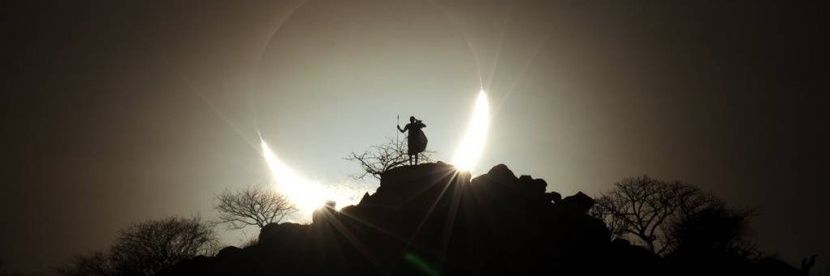
Deputy President of the Republic of South Africa, David Mabuza, today inaugurated the country’s 64-array MeerKAT radio telescope. An image unveiled @ the event reveals this clearest detail yet of the centre of the Milky Way. Learn more https://t.co/d5GGPEgFrv @dstgovza @NRF_News
@blondemedSJW The idea of a traditional career is impossible to imagine because every sector is changing so rapidly that skills you learn at college are useless by the time you graduate. But generating content seems pretty stable in terms of skill set.
Open Reel Ensemble performs a trio piece on the Jigakkyu, a custom folk instrument that generates shimmering analog sounds by bowing magnetic tape stretched across bamboo frames, with playback controlled via reel-to-reel tape recorders, August 2025.
I don't know why women would go on Love is Blind. Increasingly it is clear that the producers choices of men is piss poor. Season after season, these women are just leagues ahead of these men in terms of emotional maturity. It's not making men look good.
@jim8oy66@MarchForRejoin I bought a pair of unbranded wellies. Lasted about 15 years. So I thought that I’d get a pair of Hunters to replace them. They would last all my life, surely? They started leaking after 3 years. Turns out, they are no longer manufactured in Scotland. Chinese co own the brand
South Africa does NOT have a skills problem. It has a SYSTEMS problem. Let me explain.
Every time we discuss inequality and its effects on society, there are some who will say "but there’s a skills mismatch. That's why unemployment is so high."
This is not factual. We have unemployed doctors, teachers, and engineers sitting at home right now while clinics continue to collapse, classrooms overflow and infrastructure fails. That’s not a mismatch. That’s system failure and someone is benefiting from this whole inefficiency and misallocation of resources.
Categorical thinking asks "who is poor?" "who is unemployed?" "who is excluded?" "who is corrupt?"
Don't get me wrong. These are important, pertinent questions but unfortunately they are incomplete. They describe outcomes, not mechanisms.
To fully understand inequality in South Africa, we need systems thinking.
Systems thinking forces us to ask what machinery keeps producing the same outcomes? Why do skills exist alongside unmet social needs? Why does unemployment persist even where demand is obvious?
Let's take healthcare, for example. Hospitals are overcrowded, while doctors and nurses are unemployed. Clearly, the problem here is not training. It is austerity that had led to the freezing of recruitment, headcount ceilings and unfunded posts. Clinics are short-staffed by design, not accident.
The system prefers community service doctors, locums and paying overtime instead of hiring more professionals on a permanent basis. This makes business sense for those who are chasing profit margins because permanent staff are treated as a cost, not productive capacity.
People literally while posts sit frozen.
It is the same modus operandi even when it comes to education. There are hundreds if not thousands of unemployed teachers while classrooms are overcrowded.
This proves yet again that we're not dealing with a skills problem here, but rather rigid post-provisioning norms. Large classes are a budget strategy, not a coincidence.
Teachers sit unemployed while schools lack staff because posts are rationed and placement incentives don’t exist. This is deployment failure, not teacher failure.
It is a disgrace that engineers are sitting unemployed at home while infrastructure continuously decays all around us. Roads, water system and electrical infrastructure are collapsing and/or require constant maintenance due to a lack in executable project pipelines.
Officials avoid making decisions due to Auditor-General risk, fears of litigation and also being held personally liable for any failures that might occur. The safest decision becomes no decision. Infrastructure collapses not from lack of skill, but from administrative paralysis.
Across healthcare, education, and infrastructure, the pattern is the same. Skills exist, demand is visibly there, along with social needs for these things. What fails is the system that connects them.
It is wrong to call the problem a skills mismatch. Doing so attributes the blame to the individuals in society and justifies austerity, while hiding state capacity failure. Such an approach avoids the heart of the problem. It’s not neutral. It’s ideological.
South Africa’s crisis is not a shortage of ability (we have plenty of that). What we are witnessing here is a failure to deploy the ability we already have. When skills sit idle in an environment where social needs are not met, the result is often institutional dysfunction.
If we are serious about reducing inequality, then we must think differently about budgeting, hiring and execution. We already have trained personnel. The system needs to be fixed from inside out so that inequality does not reproduce
MEDICINE: Psychosis, in the form of delusional thinking, 'can emerge in the setting of immersive AI chatbot use' in part due to the 'sycophancy of AI chatbots', according to article published in Innovations in Clinical Neuroscience journal.