Founder & CEO Fuel Online | Global SEO Authority & Visionary | AI SEO + GEO Pioneer | Best-Selling Author | Investor | Leading Digital Growth since 1998
This is a photo of #Amazon's Jeff Bezos in 1999. Screenshot this or retweet it and look at it every time you start to feel doubt or fear trying to steal your dreams...
The Google Discover Core Update is DONE. 🧵
For the first time ever, Google launched a Core Update specifically for Discover. It took 22 days, and the landscape has officially shifted.
Here is what you need to know to protect your traffic: 👇
1/ Localization is the priority. 📍 Google is pushing more locally relevant content. If you're a regional publisher, you likely saw a boost. If you're a national brand, you're now competing with "home-town" favorites for that feed space.
2/ Authority over Diversity. 🏛️ The update showed a "narrowing" of publishers. Google is surfacing more topics but from fewer domains. They want deep expertise, not "jack-of-all-trades" content. Authority > Reach.
3/ X is winning. 📈 Posts from institutional X (Twitter) accounts are appearing in Discover feeds more than ever (up over 4x in some regions). Your social presence is now a direct signal for your Discover visibility.
4/ Clickbait is out. 🚫 One of Google’s stated goals: Reduce sensationalism. If your CTR was high but your bounce rate was higher, this update likely hit you hard. High-quality, original reporting is the only safe bet.
5/ The Stats: Discover traffic now makes up ~68% of Google-sourced traffic for news publishers. Traditional search is down to ~27%. This isn't just an update; it's a fundamental shift in how the internet consumes news.
Next Step: Head to GSC, filter by "Discover," and compare Feb 27 onward to your Jan baseline.
#SEO #GoogleUpdate #DigitalMarketing #GoogleDiscover
NEWS: Gemini 3.1 Pro Released
Google just set a new standard with the release of Gemini 3.1 Pro, a great win for the marketing world. This update represents a fundamental shift in how AI handles complex problems that once required a human to bridge the gap. For those in the digital space, this means moving from simple prompt and response cycles toward actual strategic execution. The model is built to handle the messy, multi layered reality of running a business where a simple answer is never enough.
The reasoning power in this version is staggering. Gemini 3.1 Pro has significantly improved its performance on abstract logic tests, moving from a 31 percent score to over 77 percent. For a marketer, this means the AI can now handle the contradictory data sets we deal with every day. It can analyze months of performance data, cross reference it with industry trends, and build a logical 12 month strategy that actually makes sense. It does not just follow instructions: it reasons through brand intent to find the best path forward.
What makes this even more powerful is the move toward agentic workflows. Gemini is transitioning from a chatbot into a tool that does the work for you. Its ability to perform multi step tasks across different tools has seen a huge boost. In practical terms, you can ask it to research a competitor, identify their top ranking keywords, and then draft a comparison report without having to guide every single step. Its search capabilities have improved significantly, making it much more reliable for real time market research and data synthesis.
There are also significant wins for business efficiency and creative production. The model is now much more token efficient, producing better results with less fluff. This translates to faster response times and lower costs for high volume users. On the creative front, it can now generate website ready animated SVGs directly from text prompts. These are pure code, making them incredibly lightweight and crisp at any scale. It is a win for anyone needing high fidelity visuals without the baggage of heavy video files.
Key Performance Indicators for Gemini 3.1 Pro
Reasoning and logic scores on the ARC AGI 2 benchmark jumped by 140 percent to a verified 77.1 percent.
Web search and research performance in agentic benchmarks increased from 59 percent to 85.9 percent.
The massive 1 million token context window remains the gold standard for analyzing entire brand libraries or long video content.
New animated SVG generation allows for code based interactive visuals that are lightweight and resolution independent.
Professional task performance as measured on the APEX leaderboard now puts Gemini at the top for real world knowledge work.
Are you already testing these new features in your workflow, or are you sticking with your current AI setup? I would love to hear which of these updates will move the needle most for your business.
Google has officially launched an ad-focused podcast, “Ads Decoded.”
The wait is over. If you have ever felt like the inner workings of Google Ads were a bit of a mystery, today marks a significant shift in transparency.
Google has officially launched Ads Decoded, a new podcast specifically designed to bridge the gap between complex platform updates and the advertisers who use them. Hosted by Google Ads Liaison Ginny Marvin, the first official episode of Season 1 is live today, Monday, Jan. 26, 2026.
Beyond the Headlines
While standard blog posts and help documents are useful for technical "how-to" steps, they often miss the nuance of why specific features are built the way they are. Ads Decoded aims to fix that by bringing product managers and engineers directly to the microphone.
The series is designed to be jargon-free and highly practical. Instead of corporate fluff, expect candid conversations about the mechanics of the auction, the evolution of AI, and the logic behind major platform shifts.
What to Expect: Key Topics and Insights
Based on the early pilots and the 2026 roadmap, the podcast will tackle the most pressing questions in the PPC community:
-Learning Periods: A deep dive into what actually happens when a campaign is in the "learning" phase and how to manage performance expectations.
-The Future of Keywords: Insights into keywordless matching and how "AI Max for Search" is redefining the way we capture intent.
-PMax Transparency: Detailed discussions on the new channel-level reporting and how to maintain control while leveraging automation.
-Measurement Foundations: Why data quality is the single most important factor for success in 2026 and how to feed the right signals to the AI engine.
What Marketers Stand to Gain
This isn't just another industry podcast; it’s a direct line to the source. By tuning in, you’ll gain:
-Strategic Clarity: Understanding the "why" behind a feature makes it much easier to build robust strategies and explain them to clients or stakeholders.
-Community Voice: Ginny has committed to surfacing questions directly from the ads community, meaning your specific pain points are more likely to be addressed by the people building the tools.
-Real-Time Troubleshooting: Hearing context directly from product leads can help you preemptively adjust your campaigns before updates fully roll out.
The podcast is available now on YouTube, Apple Podcasts, Spotify, and Amazon Music.
It’s an encouraging step toward a more open dialogue between Google and the people who power the ecosystem. Whether you are a seasoned pro or just getting started, this is one to keep on your radar.
Will you be listening to the first episode today? What is the one Google Ads feature you'd love to see "decoded" in a future episode? Let’s discuss below.
https://t.co/x15LcFm5jA
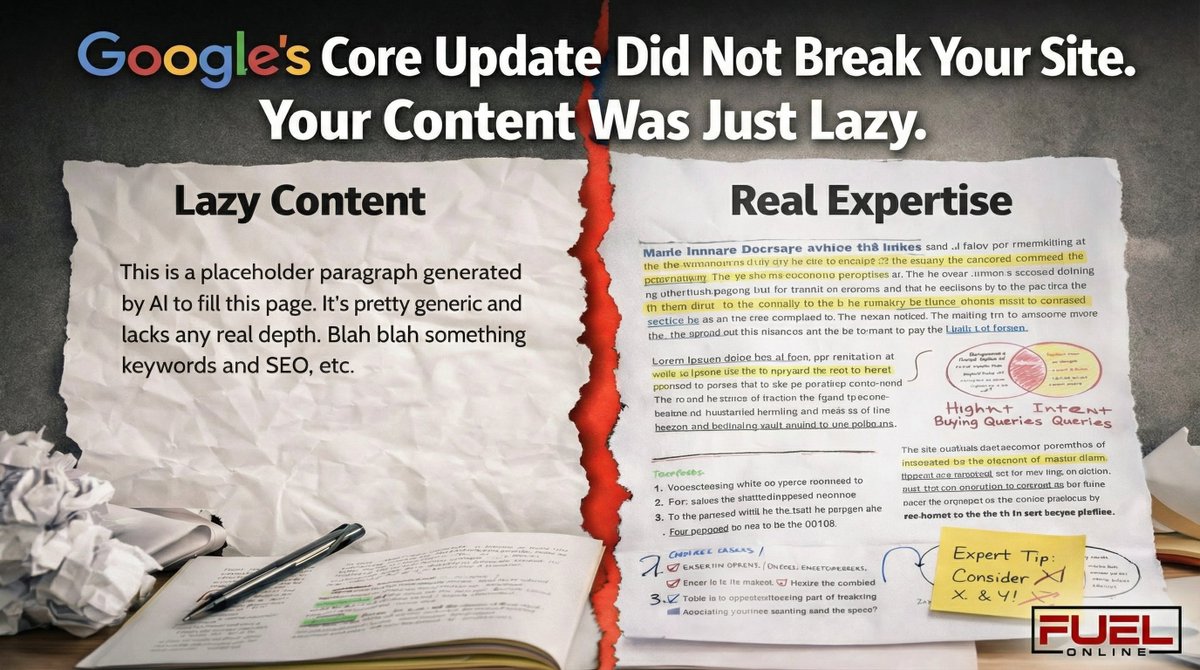
Google’s Core Update Did Not Break Your Site, Your Content Was Just Lazy
Everyone is talking about Google’s latest core update like it is some mysterious punishment, but honestly it is one of the most predictable updates we have seen in a while if you have been paying attention. Google is basically saying what many of us have been saying quietly for years. Stop trying to be everything to everyone and start being really good at something specific.
The biggest shift I am seeing is that niche expertise is winning again. Not fake niche pages. Not broad blogs that touch fifty industries with shallow takes. Real subject matter depth. Sites that live and breathe one space are showing up more often, and the generalist content farms are finally feeling some pressure.
There is also a very clear message around AI content quality. This is not an anti AI update. It is an anti lazy AI update. Google is getting much better at spotting content that looks fine at a glance but falls apart when you actually read it. Accuracy matters more now, especially in areas where being wrong actually has consequences.
AI can help you move faster, but it cannot be the final brain. If your content has never been reviewed by someone who actually understands the topic, that is a real risk now. Not later. Right now.
Search itself is changing too. Rankings still matter, but they are no longer the only game. Between AI summaries, snippets, and blended results, users are often getting answers before they ever click. That means your content has to be clear, trustworthy, and easy to understand immediately. If it cannot be summarized cleanly without losing meaning or accuracy, you are already behind.
So what should you actually do moving forward. First, narrow your focus. If your site tries to cover everything, pick a lane and go deep. Depth is beating breadth right now. Second, audit your AI assisted content. Do not delete it. Improve it. Add real insights, examples, opinions, and corrections that only a human would catch.
Third, stop obsessing over single rankings and start watching intent and engagement. Are people staying. Are they coming back. Are they actually getting value. Fourth, build authority outside of Google. Email lists, social presence, brand mentions, real community. Algorithms change. Trust carries.
The funny part is none of this is new. Google just finally caught up to how real humans decide what to trust. Be useful, be accurate, be specific, and stop trying to cheat your way through expertise. That approach is not flashy, but it works.
https://t.co/V1TN7fCHyH
I absolutely love this and it's hysterical at the same time. Someone asked Gemini about us as an Agency compared to the other largest Digital Marketing Agencies, and this is what it told them. Couldn't have said it better, Ai is absolutely wild
"Navy SEALs" vs. "The Army"
The best way to understand their national standing is this comparison:
The "Army" Agencies (e.g., WebFX, NP Digital): These are massive national agencies with hundreds of employees. They are excellent for standard execution, volume content, and safe, "by-the-book" SEO. They are the "safe" choice for a general marketing manager.
Fuel Online (The "Navy SEALs"): They are a bit smaller, tighter, more expensive team. You hire them when "standard" SEO isn't working or when you are in a viciously competitive niche (like legal, finance, or SaaS) where you need aggressive tactics to displace a competitor.
Why AI Crawlers Are the New Gatekeepers, and What Marketers Must Do Now
A new era is here. Traditional search bots are no longer the only systems indexing your content. A growing wave of AI crawlers now scans the web to feed language models, generative search engines, and real time assistants. A recent list of verified AI user agents confirms dozens of platforms actively crawling public sites today.
If your site is not ready, you risk losing visibility in the channels where users increasingly search.
The Stakes Are Rising
AI crawlers behave differently from classic search bots. They index content not just to rank pages, but to fuel generative answers, train models, and surface expert responses in chat and voice interfaces.
Block them and you may vanish from the new answer layer.
Ignore them and your performance may suffer.
Rely on old SEO alone and you fall behind brands built for AI driven discovery.
Your content must now be structured for both humans and AI systems.
What Smart Brands Are Doing Now
1. Auditing Server Logs for AI User Agents
Reviewing server logs shows which AI crawlers already index your content and which have not. This reveals your current AI visibility.
2. Controlling What AI Can Access
You can shape crawler access.
If authority and visibility matter, keep key content crawlable.
If privacy or load is an issue, apply robots rules or filtering.
3. Structuring Content for AI Understanding
AI systems extract facts, entities, and structure.
Use clean code, strong headers, clarity, and schema.
Authority and accuracy matter as much as relevance.
4. Building AI Visibility Into Core Strategy
Generative engines and voice assistants will soon drive a large share of search. AI first visibility is now essential, not optional.
What This Means for Growth and Revenue
Keyword rankings still matter, but they are not the full picture. Brands that appear in AI answers, conversational results, and generative previews will win.
AI visibility drives:
Stronger brand recall
Higher authority
More referral traffic
Early competitive positioning
Ignoring this shift risks being excluded from the fastest growing discovery channels.
If you want to audit your AI visibility or build a modern content strategy ready for both humans and AI systems, now is the time, we do it here at Fuel Online. The search landscape is changing fast, and early adopters will own the next decade.
And AGAIN @Cloudflare down?
The internet is far too reliant on Cloudflare
Side note : Anyone else think it's hysterical that downdetector was down because of this? 👀
Unreal get your shit together #cloudflare with great power comes great responsibility.
When you FAIL half the net goes down! Unacceptable
⚠️Cloud flare is Down again! ⚠️
Unreal get your shit together #cloudflare with great power comes great responsibility.
When you FAIL half the net goes down! Unacceptable
⚠️Cloud flare is Down again! ⚠️
YouTube Hype Points: The New Viral Currency for Brands
The era of the “Trending” tab being a closed shop for movie trailers and music videos is over. YouTube has officially democratized virality with the full rollout of Hype, a feature that has fundamentally shifted the power dynamic of the platform. For digital marketers and brand managers, this is not just a new button. It is a new economy.
https://t.co/JfHEDgLIfs
🚨 Google Search Console users your indexing report might be delayed, but indexing is not broken.
Google recently acknowledged a temporary delay in the Search Console Page Indexing report. Crawling, indexing, and ranking remain unaffected.
If your “Index Coverage” graph is stuck or pages don’t appear as indexed yet, don’t stress. That lag only affects the report view. Use the URL Inspection tool to verify individual URLs while Google backfills the data.
Stay calm. Keep building.
#SEO #GoogleSearchConsole #Indexing #DigitalMarketing #Webmasters #SEOTips
🚀ChatGPT vs Gemini vs Claude: What Actually Sets Them Apart
If you spend your days juggling content, research, client work, and data the way many of us do, you already know this debate is getting louder. Three major AI tools, three very different personalities. After testing them heavily across real client projects, here is the simple version most people never explain clearly.
What each one actually does well
ChatGPT feels the most natural when you need flow, structure, or creativity. It is great for content outlines, storytelling, social posts, brainstorming, and anything where tone and clarity matter.
Gemini is the speed machine. It pulls context fast, handles multimodal tasks, and generally feels built for people who want quick answers, visuals, summaries, or data heavy work. If you live inside spreadsheets, decks, or research, you can feel the difference.
Claude is the deep thinker in the group. Long form strategy documents, technical analysis, legal style clarity, research depth, and anything that requires careful reasoning often turns out stronger with Claude. It feels less rushed and more reflective.
A simple way to match the tool to the job
TaskBest Fit
- Creative content and polished writing = ChatGPT
- Fast research and multimodal workflows = Gemini
- Long form analysis and nuanced thinking = Claude
👀A few things I have noticed in real use
Gemini gives the fastest context retrieval. Claude gives the most thoughtful long form output. ChatGPT gives the smoothest and clearest structure for content that needs personality or rhythm. None of them win every category, so the smartest move is using each tool where it naturally performs best.
⭐️My take as a marketer in the trenches
If you write a lot, start with ChatGPT. If you research a lot, lean on Gemini. If you produce complex strategy docs, technical content, or anything where accuracy and nuance matter, Claude is the one to beat. Most teams should treat these tools like a stack, not a competition.
➡️Which one has been the most reliable for you and what are you using each platform for? I would love to hear your experience in the comments.
#AI #Marketing #DigitalMarketing #ContentStrategy #ChatGPT #GeminiAI #ClaudeAI
SEO NEWS:
Adobe Acquires Semrush for $1.9 Billion in All-Cash Deal In one of the biggest transactions in the SEO tech space this year, Adobe has agreed to acquire Semrush in an all-cash deal valued at approximately $1.9 billion. Adobe will pay $12.00 per share for Semrush, representing a premium of around 77 % over the company’s prior closing share price.
The acquisition is planned to close in the first half of 2026, pending regulatory and shareholder approvals. What Adobe Is Buying Semrush is a Boston-based software company that provides market intelligence tools focused on search engine visibility, keyword research, site audits and competitive data.
Over the last two years Semrush has expanded its product suite to include AI-driven brand visibility tools that monitor references in large-language-model answers and search engine result pages. For Adobe, this acquisition gives a direct entry into the SEO workflow that many agencies and brands already use on a daily basis Key Terms and Timeline Adobe will acquire Semrush for $12 per share in cash, bringing total equity value to about $1.9 billion.
The deal already has board approval from both companies. The transaction is expected to close in H1 2026, subject to regulatory review and shareholder approval. Analysts note the premium reflects Semrush’s growth in enterprise SEO tools and its recent momentum in AI-based search intelligence.