A note to would-be detractors:
This account was created to promote Fulɓe and their heritage, and to foster deeper understanding between Fulɓe and their neighbors.
There will be zero tolerance for hateful rhetoric, ethnic chauvinism, or historical revisionism.
Be warned!
" Un enfant peul grandira dans une double fidélité: à un véritable code de l’honneur et à un total respect de la volonté maternelle. Le jeune peul, nourri du récit des hauts faits de ses ancêtres devra régler sa conduite d’après un code moral exigeant;
1/10 Thread
🧵 Les grands jihads peuls pour l’expansion de l’islam en Afrique de l’Ouest (fin XVIIe – milieu XIXe s.)
Une série de mouvements de réforme religieuse et de conquêtes menés par des savants et guerriers peuls . Ils ont créé des États musulmans théocratiques majeurs.
If in Bamako I found a plethora of Hausa speakers I will definitely find them in Bobo. All you did was just list countries with a large amount of Fulani population which the language is mostly limited to native speakers. In ki ma shiga kasuwa you wouldn’t be ignorant like this most especially you mention Dakar in da textile trade sa Hausawa is very prominent lolz.
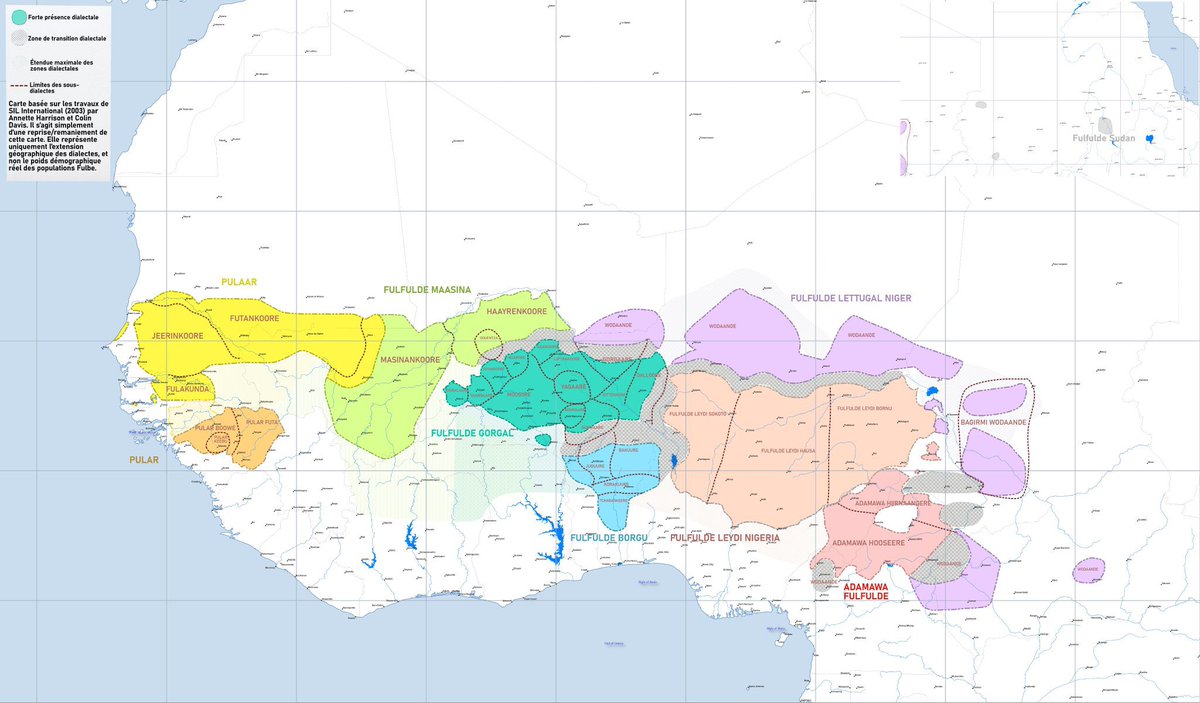
From Baguirmi in Chad through Cameroon, Northern Nigeria, Southern Niger, Liptaako, Borgou, Macina, Wassoulou, and the two Fuutas, Fulfulde operates as a genuine lingua franca with deep local roots.
Hausa is indeed a vital trade language in market centres in Bamako and Bangui—because Hausa people are successful merchants. But it does not have locally embedded speaker communities stretching across regional towns and cities throughout West Africa in the same way as Fulfulde.
The past few days, people have been relegating the influence to NW Nigeria. I intentionally refused to say anything at first, because answering them would mean acknowledging the delusion. Still, I will speak from my own experience and how Hausa shaped it.
Dawanau is the largest grain market in West Africa, and it is located in Kano State. Back when I was 16, in 2022, I started a business supplying grains in Mali, Burkina Faso and Togo. We would buy the grains in Kano, load them into large trucks and deliver them across those countries. Throughout every transaction I didn’t speak a lick of French — and I still don’t. Hausa was what I used to communicate with the farmers, suppliers and merchants in those countries, none of whom were ethnically Hausa. On our way back we would branch to Niger and exchange the CFA franc for naira, and because of the exchange rate we would almost double our profit.
Hausa is the language of merchants anywhere you go in West Africa. For the layman, you wouldn’t understand its usefulness, but we Hausawa have successfully embedded ourselves in the merchant systems of West, Central and North Africa, with parts of the Middle East.
Hausa has been used to sign treaties by non-natives, to communicate by different ethnicities, and even to style themselves with Hausa royal titles. BBC Hausa was the first African-language service ever operated by the BBC. Comparing it to a language like Fulfulde, which only spread because pastoralists speak it, is downright insulting.
Not true. There are Fulani herders in the NE, Cameroon, Chad, Benin, Niger, Ghana, in fact all across West Africa living peacefully alongside other communities. Banditry is a phenomenon unique and localized to the NW and cannot be universalized across the Fula world.
Most written Fulfulde today follows regional orthographies that differ in small but annoying ways. A single agreed Latin system would make books, school materials, and digital content usable across national and cultural borders without constant re-editing.
The strength of the Fulɓe has always been mobility of mind as much as of body. That same openness can help us lead in knowledge, enterprise, and cultural production across the Sahel.
The Fulani culture is exceptionally rich, as shown by the Leppi, an emblematic traditional fabric passed down from generation to generation.
Although Leppi comes in a multitude of colors and styles, the blue variety originating from the Fouta Djallo is the most well known and representative.
There s lightweight Leppi, which can be worn for everyday use as well as during weddings.
There is also heavy Leppi, specifically reserved for major events. During weddings, it’s worn as an orange wrap. It’s also used to cover the bride as she leaves her family home for her in-laws house, to cover a newborn baby, or when a mother carries her baby on her back for the very first time.
Here are a few Fulani outfits, if not to say all Fulani outfits :
Fulɓe of the Nigeria–Cameroon-Benin axis are best positioned to lead on the economic front.
Senegambia–Guinea can drive the educational and scholarly advancements.
Mali–Niger-Burkina Faso, rich in cultural depth and artistic expression, can pioneer a cultural renaissance.
@Fulano_Islamic Senegal and Mauritania Fulani have the best opportunities for educational advancements.
Fulani in both countries should have a collaboration of engineers and scientists that focus on Research and Development.
Le mécanisme de la décitoyennisation des Fulbe
Sous mes publications où je dénonce les exactions contre les Fulbe dans le Sahel, il y a un commentaire qui revient souvent, «il faut conseiller à tes frères de déposer les armes», «il faut parler à tes frères».
Cela vient de gens qui disent «nous n'avons pas de problème d'ethnie, nous ne sommes pas fulbéphobes».
Je suis désolée, mais vous n'êtes pas seulement fulbéphobes, vous exercez une violence extrême sur eux, sur moi et sur tous les Fulbe à qui vous faites cette injonction.
Mais au-delà de ça, ce que vous faites est encore plus grave et révélateur de votre système de pensée.
Ce que vous faites s'appelle, en sociologie, un processus de désindividualisation par l'ethnicisation.
Quand un Pullo commet un mauvais acte, il cesse d'être traité comme un individu, citoyen porteur de droits et de responsabilités personnelles. Il devient instantanément le représentant des Fulbe.
Ce mécanisme ne s'applique pas aux membres des autres ethnies noires, qui, eux, restent des individus.
On peut le voir au niveau du traitement entre Amadou Koufa et Bina Diarra.
C'est précisément là l'asymétrie raciste, l'appartenance ethnique n'est visible que pour les Fulbe.
La responsabilité collective comme substitut à l'État
Quand on interpelle les « leaders fulbe » ou n'importe quel Pullo pour résoudre un conflit impliquant des Fulbe, on fait plusieurs choses à la fois :
On délègue à la communauté une mission qui appartient à l'État, à la police, à la justice, à la médiation nationale.
On reconnaît implicitement que les Fulbe ne sont pas pleinement considérés comme faisant partie du contrat social national.
On traite la communauté fulbe comme une entité étrangère, une sorte d'État dans l'État, qui doit gérer ses propres membres.
Sociologiquement, c'est ce qu'on appelle un traitement différencié de la citoyenneté. Les Fulbe sont citoyens sur le papier, mais ethnicisés dans la pratique.
L'État national s'efface devant la logique communautaire, mais uniquement pour les Fulbe.
#Fulbe #Peul #Sahel #Fulaphobie #Ethnicisation
@Fulano_Islamic Senegal and Mauritania Fulani have the best opportunities for educational advancements.
Fulani in both countries should have a collaboration of engineers and scientists that focus on Research and Development.
Pulaaku teaches us gracefulness, forbearance, good neighbourliness, and dignified, respectful interaction. Let us fully imbibe that spirit going forward.
Fulɓe are not a hateful people, and we must not allow the hostility of others to deter us. Serious issues and differences exist between our communities, but we can still work hand in hand to resolve them and transcend them without compromising our essence or cultural value.
Fulɓe are not a hateful people, and we must not allow the hostility of others to deter us. Serious issues and differences exist between our communities, but we can still work hand in hand to resolve them and transcend them without compromising our essence or cultural value.
A Fulani renaissance is not an exclusionary project. It is about reinfusing the old spirit of harmony and conviviality between Fulɓe and other communities — the same inclusive tradition that has long fostered unity, respect, and coexistence across the Sahel.