Two economists just published a mathematical proof that AI will destroy the economy.
Not might. Not could. Will — if nothing changes.
The paper is called "The AI Layoff Trap." Published March 2, 2026. Wharton School, University of Pennsylvania. Boston University. Peer reviewed. Mathematically modeled.
The conclusion is one sentence.
"At the limit, firms automate their way to boundless productivity and zero demand."
An economy that produces everything. And sells it to nobody.
Here is how you get there.
A company fires 500 workers and replaces them with AI. A competitor fires 700 to keep up. Another fires 1,000. Every company is behaving rationally. Every company is following the incentives correctly. And every company is building a trap for itself.
Because the workers who were fired were also customers.
When they lose their jobs faster than the economy can absorb them, they stop spending. Consumer demand falls. Companies respond by cutting costs — which means automating more workers — which means less spending — which means more falling demand — which means more automation.
The loop has no natural exit.
The researchers tested every proposed solution. Universal basic income. Capital income taxes. Worker equity participation. Upskilling programs. Corporate coordination agreements.
Every single one failed in the model.
The only intervention that worked: a Pigouvian automation tax — a per-task levy charged every time a company replaces a human with AI, forcing them to price in the demand they are destroying before they pull the trigger.
No government has implemented this. No major economy is seriously discussing it.
Meanwhile the numbers are already tracking the curve. 100,000 tech workers laid off in 2025. 92,000 more in the first months of 2026. Jack Dorsey fired half of Block's workforce and said publicly: "Within the next year, the majority of companies will reach the same conclusion."
Nobody is doing anything wrong. Companies are following their incentives perfectly. That is exactly the problem.
Rational behavior. At scale. Simultaneously. With no mechanism to stop it.
Two economists built the math. The math leads to one place.
Source: Falk & Tsoukalas · Wharton School + Boston University ·
Anthropic just showed a 24-minute workshop on how to actually prompt Claude.
Taught by the people who built it.
Free. No signup. No paywall.
I've watched $300 courses that don't cover what they teach in the first 8 minutes.
INSTEAD OF WATCHING NETFLIX TONIGHT.
Spend 1 hour with this.
Claude AI FULL COURSE that teaches you how to BUILD and AUTOMATE anything.
The people who watch this tonight will wake up tomorrow with a new skill.
Watch it and Bookmark it now.
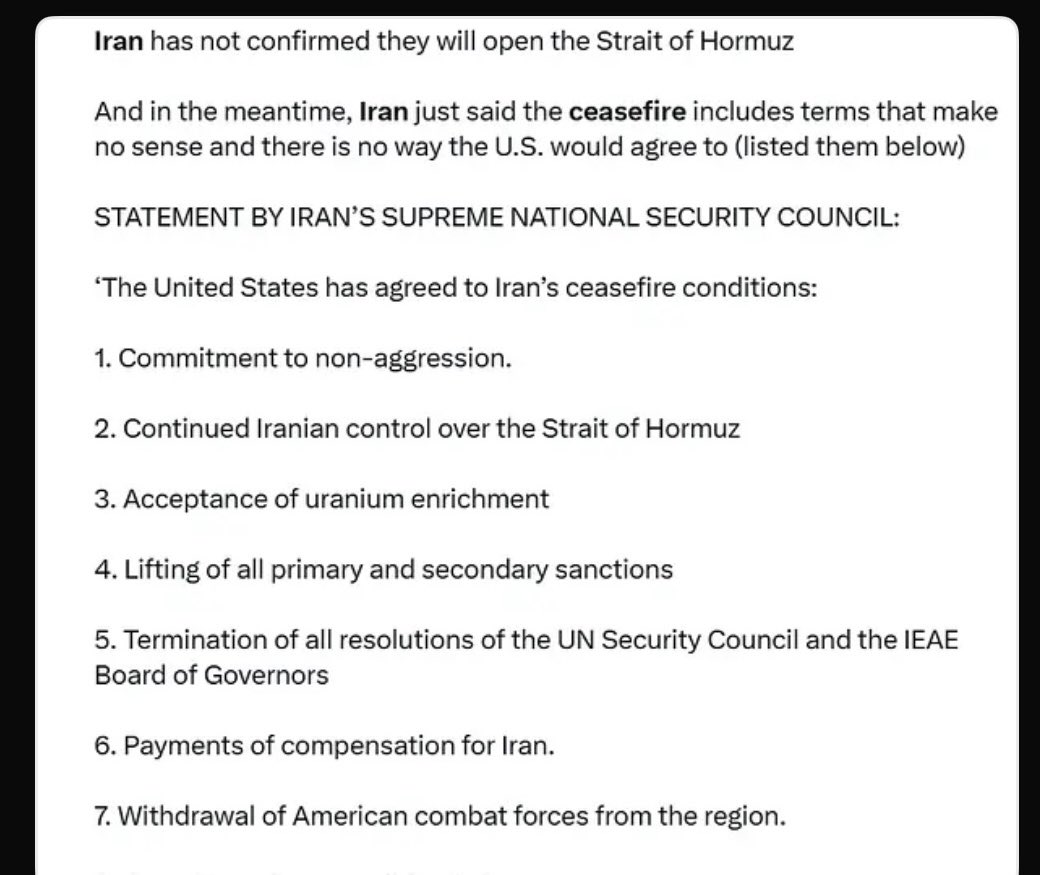
In the best case scenario, Trump struck a deal to reopen a Strait that was open before the pointless war he started, with the IRGC demonstrating its control over the Strait and potentially extracting fees plus sanctions relief. Thousands of innocents - including hundreds of children - dead in Lebanon and Iran for no reason. U.S. troops killed and wounded. U.S. embassies and bases in the Middle East badly damaged. U.S. standing in the world obliterated. U.S. munitions badly depleted. Hundreds of billions spent. Prices up everywhere. More global economic fallout to come. Putin strengthened and enriched. Just a catastrophic situation even in the best of circumstances. A profoundly shameful episode in American history no matter what happens next.
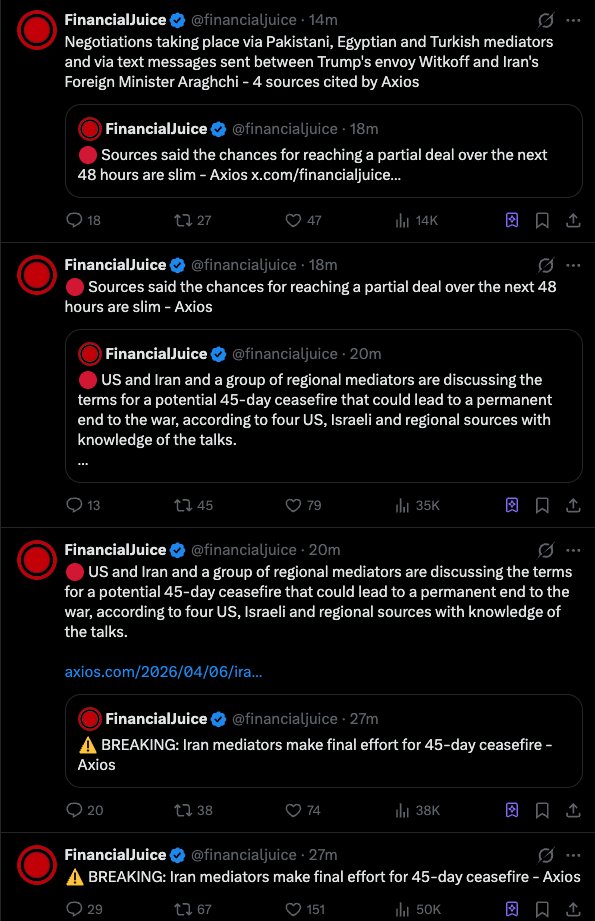
These Axios lies seem to show up only during trading hours... and FinancialJuice seems to be their primary distribution channel.
5 weeks... everyday the same game.... it feels like North Korean media and markets now.
It is quite obvious that the whole idea is to prolong the war to destroy cheap energy and cheap food resources... why don't you guys go nuclear and get it over with... enough of this groundhog day nonsense.
JOB INTERVIEW:
"What are your salary expectations?"
Most candidates say:
"I am looking for somewhere between $120k and $140k, depending on the benefits package."
THE WINNING ANSWER:
Brent crude is at $84.
Gasoline is up 31% in a month.
The Strait of Hormuz is closed. Qatar declared Force Majeure. China stopped exporting diesel. No tanker traffic is moving through the world’s most important oil chokepoint.
And Brent is at $84.
That number is not a crisis price. That number is a delayed reaction price. The market is still using pre-war inventory cushions as its reference point. The actual supply destruction has not hit the price yet because there is a lag between when oil stops flowing and when the absence shows up in the data that traders price against.
Here is what that lag looks like in practice.
The Strait of Hormuz went dark on February 28. Global oil-on-water inventory will not show the drawdown from that closure for another 10 to 15 days at minimum. When it does, the sanctioned crude cushion that has been suppressing prices disappears simultaneously. The market will not see two separate events. It will see one vertical move.
The EIA forecast Brent at $60 for 2026.
That forecast was made before Khamenei was killed, before Qatar shut down, before China halted diesel exports, before a US submarine sank an Iranian frigate in the Indian Ocean, before 85% of Gulf maritime traffic stopped moving.
Every model priced on January assumptions is now a document of historical fiction.
$100 Brent is not a catastrophe scenario. At current trajectory, $100 is the base case if Hormuz stays closed past the 10-day inventory buffer.
$100 Brent breaks the US consumer. It triggers emergency SPR releases. It forces a ceasefire conversation nobody wants to have publicly yet.
Watch $84 carefully.
It is not the ceiling. It is the starting gun.
https://t.co/ULBgEzZ3A8
The bull case for the AI Revolution is abundance.
The “AI will end the world” narrative has gone viral and has quickly become the base case assumption.
However, if you look back at any time in history, innovation has largely yielded a net positive long-term outcome for humanity.
Innovation kills tasks, not people. In the bull case, humans work differently, productivity rises, costs fall, and scarcity declines.
As a result, the world can see less conflict over currently scarce resources, lower poverty rates, and improved living conditions.
A world full of abundance, peace, and efficiency is possible.
Humanity has always prevailed.
Wall Street is cooked.
I spent 100+ hours stress-testing the new Claude Opus 4.6 on live market data.
Most people are using it for basic summaries. They’re missing the point.
Here are 18 prompts that unlock institutional-level financial analysis (for free):
Fed's Williams Still Sees Room For Near-Term Rate Cut
- MonPol Is Modestly Restrictive
- Tariffs Adding 0.5% To 0.75% To Inflation
https://t.co/QtYR8UC5ix