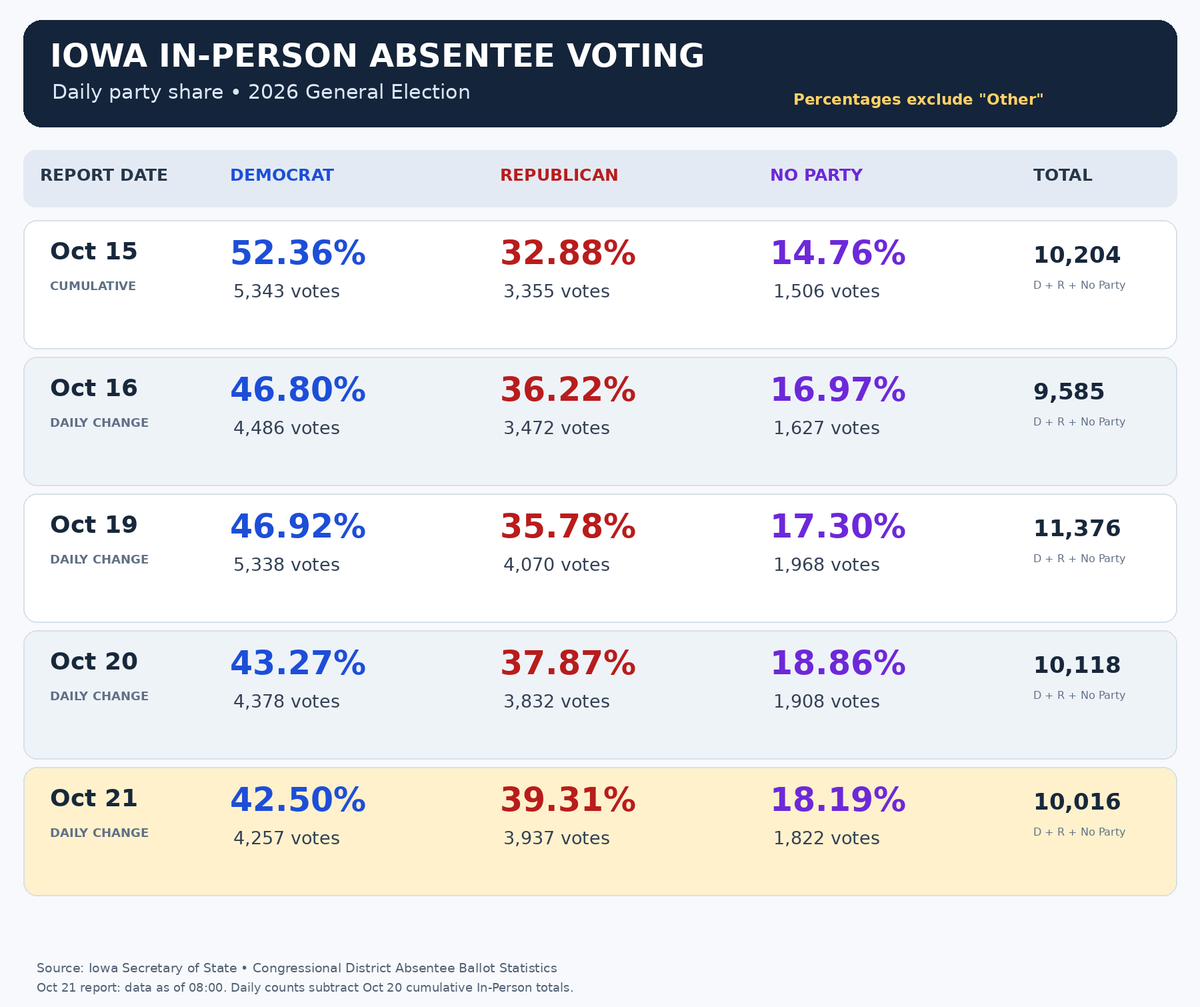
@TonerousHyus That’s great but literally nobody else tracking Iowa early votes has these numbers. And given that yesterday you just made up that a TX Precinct was Trump won when Harris actually won it, it seems like you just make things up anyway.
@bdquinn Talarico gets 13-16 points of persuasion in like, almost every poll. The 2024 electorate would be a toss up, with a colorable argument for Paxton (lean R undecideds, polls missing more rural ads, etc.). One you get past Trump +10 Talarico is clearly favored.
As someone pointed out the issue with Montgomery comparisons is it has very limited EV capacity due to limited sites. So its presidential year turnout ends up depressed in comparison. As you can see, Montgomery 2022–>2024 had a 1.5x EV increase. But every other county, even very small rural ones, was closer to 2x. So especially with its fast population growth, Montgomery has a high floor of EV but artificially depressed 2024 numbers. https://t.co/ATIwwYCOLf
Yeah look at the Montgomery 2022->2024 day 1 change compared to everyone else with a tracker
Montgomery has grown 20% since 2022 but might not get 20% more votes today. Comparing its EV to 2024 will be wishcasting for Rs and comparing it to 2022 will be wishcasting for Ds lol
@TheDataGooroo His point that turnout is down a lot from a Presidential year is really not that insightful. 2022 GA had like, 67% of the turnout of 2024 GA, and way less of the vote was cast early.
Not the greatest comparison because these were incumbents, but in 2016, Trump put up historically good GOP performances in MI, WI, OH, and PA. They all had Senate races in 2018 and they all swung 8-15 points back to Dems. The idea these kinds of shifts are out of bounds is... weird.
@ZhouJaron Also, polls *can* account for early vote by asking if people have already voted. Most pollsters don't model this super heavily, but it wouldn't be hard to model in a state with robust EV reporting.
@ZhouJaron But isn't this an example of how they are over-reactive? One day of EV data is not nearly enough for these kinds of wild swings, especially when the earliest early voters are high-propensity and accounted for in LV screens.
@maxtmcc@Yukongold1898 Easy to memory-hole now, but in 2016 the widespread belief (from everyone except Nate Silver) was that Trump was weaker than Romney because he was a more obviously out of touch rich guy. Educational polarization was only obvious after the fact.
@maxtmcc@Yukongold1898 Since 2012, people have consistently underestimated the degree and frequency of seat-changing shifts. Before 2016 it was conventional wisdom that wealthy suburbanites would quietly stick with Trump. The things like the GA-06 shift were completely shocking.
@bdquinn It’s been completely forgotten this year, as everyone focuses on if there’s a polling error. But pre 2018 the consensus was that the undecideds would break against the unpopular party in power.
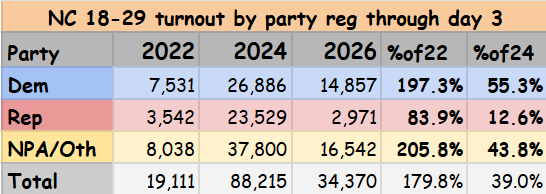
Was able to use the absentee files in NC to compare same day 18-29 turnout by party reg
% of 2022 / % of 2024 by party
D: 197.3% / 55.3%
R: 83.9% / 12.6%
Oth: 205.8% / 43.8%
@bdquinn Party consultants/pundits still likely have too much influence in creating vibes. Even in 2018 a lot of the R ones were swearing that internal numbers showed Comstock in a razor thin race. It was only 2020-onwards when then these people started doing polling too.
@TheDataGooroo That's one of the big questions right now. R optimism about early vote or VBM has basically not survived contact with IPEV in states that have it. Florida is the big test because in 2022/24 Rs put up such good numbers there in early vote.
Dems being up in early IPEV doesn’t mean much other than that they’re reshuffling the chairs on the Titanic given mail is way down and also far redder.
IPEV also tends to redden as the days go on, and E-Day is slated to be redder, even if less compared to the past.
@petebray@JohnRSamuelsen Maybe, but if anything this suggests more front loading/exhaustion from GOP as opposed to Dems. Particularly given how much Dems have increased by in IPEV in other states.
@earlyvotedata@RealSKeshel This chart illustrates this. In GA, Black voters off to a hot start, share of the votes does drop, but it drops in almost the exact same pattern and same scale as 2022/24. So no evidence this is just frontloading/exhaustion.
https://t.co/e8EoN2iTrd
@earlyvotedata@RealSKeshel This interpretation doesn’t make a ton of sense. You still have to compare to 2024/22. If this is just super high propensity Dems coming out en masse, then why didn’t those years have the same breakdown?
This is particularly notable because the states where Republicans like, or are at least neutral, on the data so far are mail-heavy but have not started IPEV yet (MI, WI, NV, FL). Remains to be seen if IPEV blows up this optimism because all mail states with no IPEV (PA, NJ) seem to be much better for Dems than 2024 already.