Homebuyers can't afford it.
Today, the typical American household needs to spend 38% of its gross income on the mortgage costs to buy a house.
That's down slightly from the peak affordability crisis in 2022.
But still near the highest level of the last 40 years.
Such high mortgage cost metrics are due to inflated prices and higher mortgage rates, combined with income growth that hasn't kept pace.
This is why demand to buy is so low today.
Either Americans can't qualify for mortgages, or they don't feel comfortable taking on such high payments.
The key threshold is 30%.
Once the Mortgage Cost/Income Ratio hits that level (through price declines, rate drops, and higher incomes), buyers will come back.
Until then, they will remain on the sidelines.
Lots of regional variation in this metric. Check the data for your city/ZIP on Reventure. https://t.co/50vYuH88dW
If you don’t know who is the best lawyer for your task, ask your network - or ask your network to ask their network. The answer will always be a specialist.*
* not just a “real estate lawyer” - debt, JVs, funds, leases, environmental, construction, zoning, etc etc
I grew up in the Bay Area, and I’ve never seen a housing boom like what’s going on there right now.
California basically forced cities to get their acts together and approve new housing, Builders Remedy was a huge boost, lobby groups joined in, cities began to get sued for not complying - and it’s working.
For 2023–2031, Bay Area cities have to plan for over 440k new housing units, which is almost 2.5x the previous circle.
If you haven’t been to the Bay Area in a few years and take a drive around now, it’s pretty remarkable to see all the new apartment buildings in a region that’s been so anti-housing for so long.
Mountain View, Cupertino, San Jose, Fremont, etc - it’s happening all over the place, lots more is close to breaking ground, and there is no end in sight!
Oh boy:
“The Trump administration on Friday narrowed the definition of an “assistance animal” allowed to live with disabled tenants in housing, a move that could lead to thousands of animals and their owners being evicted.”
https://t.co/RZQD65ygRD
Washington unanimously legalized scissor stairs, a building code reform that frees up to 56% more living space per floor.
Less wasted space means cheaper homes on smaller lots.
Most US states banned this since the 1970s for no good reason.
@damonhemmerding Love this! We've tried all the tips & tricks & still can't remember.
Parents moved to retirement home where everyone wears them & it's awesome.
Also it's fun at a party to have folks make up names they want for their tags.
Most HVAC contractors in America are trying to keep you in the 1990s.
I had $15,000 cash to spend on a cold-climate heat pump.
Nearly every contractor I contacted tried to talk me out of it or over-quote me an outrageous amount to deter me away.
One guy spent 20 minutes explaining why variable-speed heat pumps are a scam. Another literally said he wouldn’t put one in his own house.
Why? My guess:
1) They are ignorant of the latest technology
2) They don’t have the training to install/service the new systems
3) Their pockets get filled from big box old school HVAC manufacturers if they sell them
Unfortunately, a new HVAC for most homeowners is very urgent so these contractors use this time crunch to overcharge or upsell inferior systems.
Luckily, I bought a couple of $130 window AC units to hold me over for 2 weeks while I reached out to 15+ contractors.
I received quotes ranging from $10,000 to over $24,000. Only 2 of the quotes included a modern cold-climate heat pump.
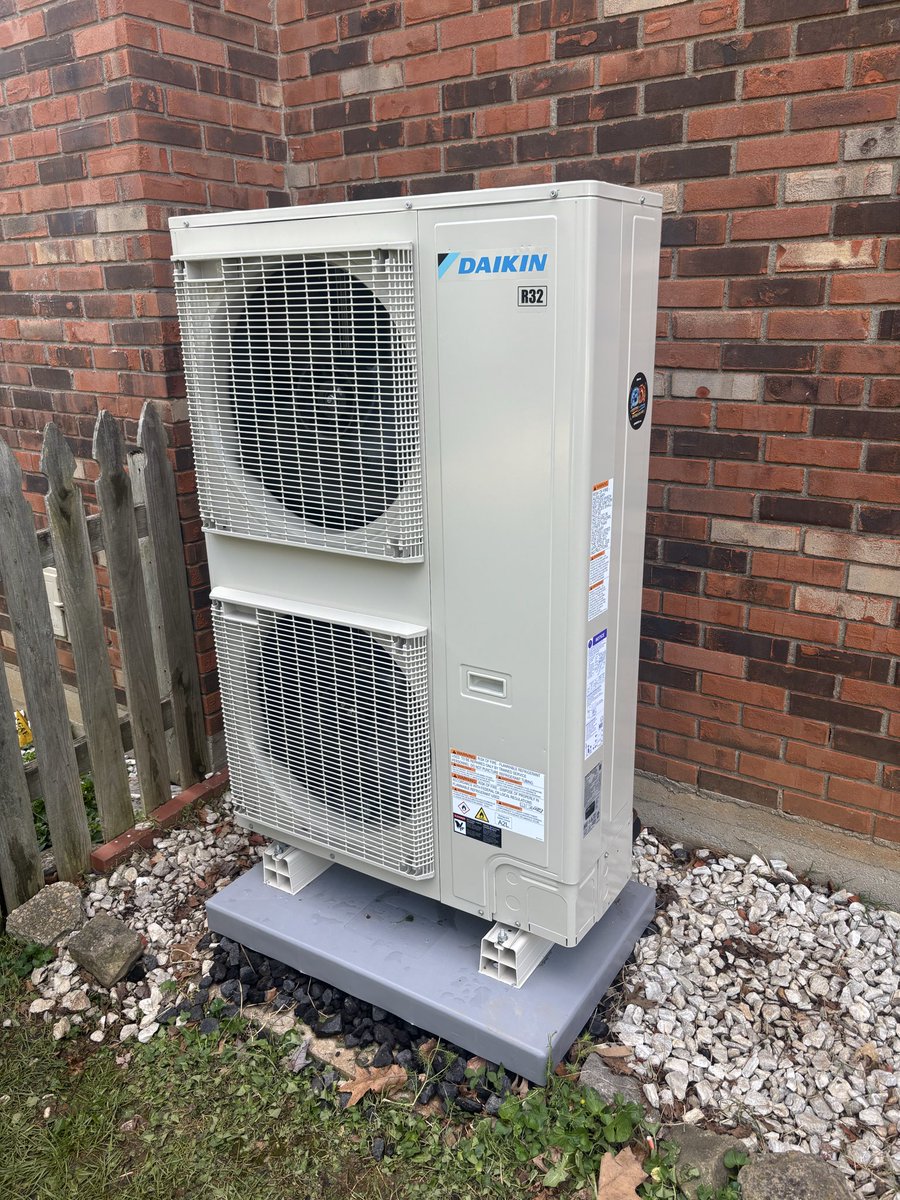
After price matching and negotiations, I ultimately chose a Daikin Aurora Fit cold-climate inverter heat pump + 97% modulating gas furnace (true dual-fuel setup)
Total cost after rebates = $13,000
This system usually goes for around $20,000.
Here are the key takeaways I wish I had known before I started shopping:
1. Always demand a real Manual J load calculation. Don’t settle for a “rule of thumb” or register count. I had 3 different contractors give me 3 different sizes until one actually ran proper software.
2. True variable-speed inverter technology is worth it especially in a multi-level home. It runs longer at lower speeds, gives much better dehumidification, smoother temperatures, and is noticeably quieter.
3. Dual-fuel (heat pump + high-efficiency gas furnace) is often the smartest move in mixed climates (like my home in Louisville). The heat pump handles most of the year efficiently while the furnace only kicks in on the coldest days (if necessary)
4. Shop aggressively and negotiate hard. Buy yourself some time with some temporary/portable units. I got competing quotes and used them to drive the price down significantly.
5. Duct sealing, correct sizing/tonnage, and proper installation matter more than most people realize especially in older homes.
6. Have a detailed checklist to vet each contractor. An extremely helpful guide I had throughout the process was from @energysmartwv
So why did I insist on cold climate heat pump?
• Way better temperature balance upstairs (even without zoning)
• Excellent dehumidification in humid summers
• Significantly quieter operation
• I’m expecting to save $60/month on electricity
• Less reliance on gas and possibly eliminating the need altogether
Modern cold-climate heat pumps are no longer experimental. They’re one of the smartest upgrades most homeowners can make right now.
Do your homework to make sure you are getting the best system possible for your home. Don’t let old school contractors keep you in the past.
Have you installed (or considered) a heat pump in a cold or mixed climate? Were the contractors helpful or did they try to talk you out of it?
Are houses getting smaller or bigger?
Today, builders are delivering new single-family houses around 2,150 SF.
This is down 14% in size from the "McMansion peak" of 2015.
However, it is still above 2009 downturn lows, and about 24% bigger than back in 1987 when the data started being collected.
Back then, according to the US Census Bureau, the typical builder home was 1,725 SF.
There's lots of chatter today about how builders are going 'smaller'.
But in reality, new houses today are still pretty big, especially when contrasted with declining U.S. family formation and population growth.
In cities with assessment limits, which cap how quickly a home's taxable value can grow while the same owner stays put, that value resets to current market levels the moment a sale occurs. The result is a sharp jump in costs for new buyers. In 11 cities, new buyers pay at least double what comparable longtime owners pay, and in 23 markets the gap is at least 25% higher.
Read: https://t.co/GZdJSAj9Xy
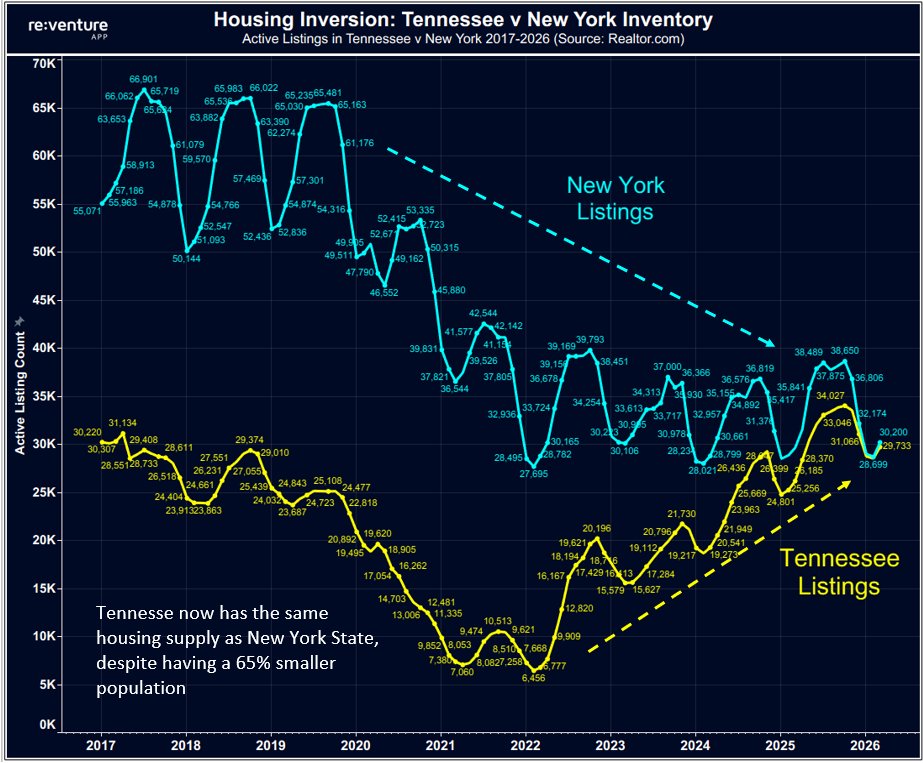
In Tennessee, housing supply is skyrocketing.
In New York, it's contracting.
So much so that both states now have 30,000 listings. (with TN having a 65% smaller population)
This represents a vast change from pre-pandemic norms, when New York had nearly 3x more listings in 2019.
This shift suggests a trend in reverse migration may be occurring, with pandemic boom states losing homebuyers back to legacy markets.
RTO mandates, unaffordable prices in TN, and a lack of construction in NY are the leading causes of this shift.
Check your ZIP code on our app https://t.co/pLvj026xCj
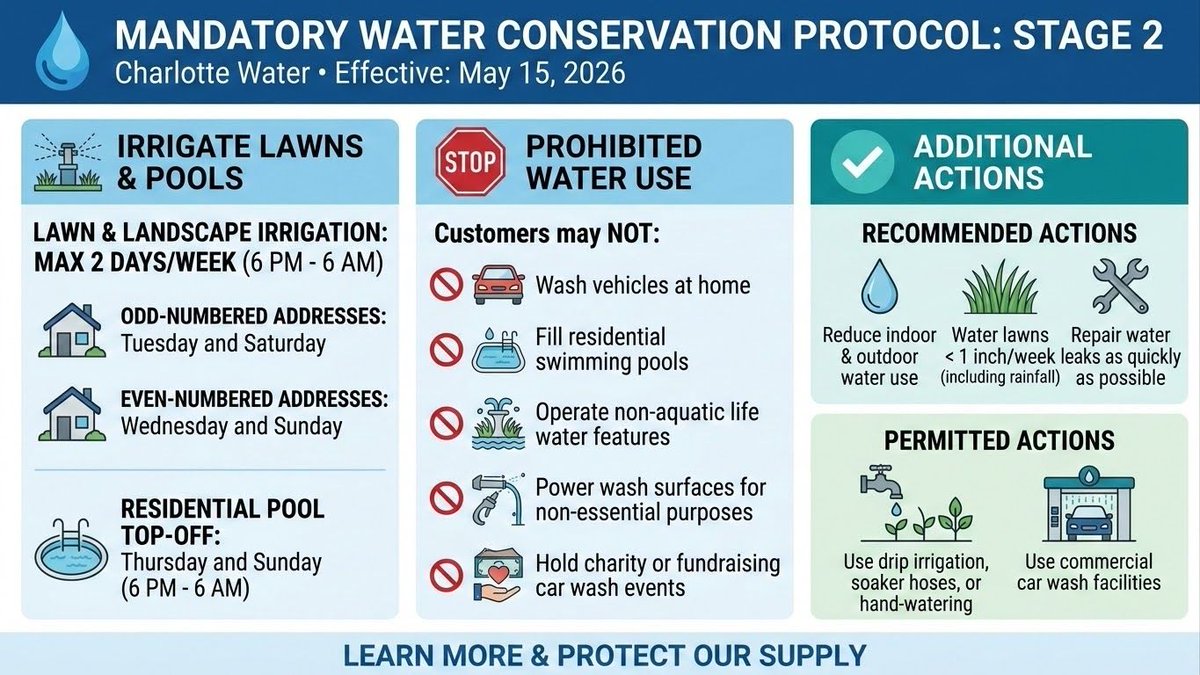
Coming May 15th, mandatory water restrictions will go into effect in #Charlotte due to the #drought.
CHARLOTTE, N.C. — In alignment with regional partners, Charlotte Water will implement Mandatory Water Restrictions (Low Inflow Protocol Stage 2) beginning Friday, May 15, 2026, due to ongoing dry conditions. Customers are asked to reduce non-essential water use to help protect the region’s water supply.
Charlotte Water asks all customers to adhere to the following mandatory conservation actions:
Irrigate lawns and landscapes no more than two days per week, between 6:00 p.m. and 6:00 a.m.
Odd-numbered addresses: Tuesday and Saturday
Even-numbered addresses: Wednesday and Sunday
Residential swimming pools may be topped off only on Thursdays and Sundays, between 6:00 p.m. and 6:00 a.m.
Customers may not: Wash vehicles at home
Fill residential swimming pools
Operate water features that do not support aquatic life
Power wash surfaces for non-essential purposes
Hold charity or fundraising car wash events
Additional recommended actions include:
Reduce indoor and outdoor water use
Water lawns with no more than one inch of water per week (including rainfall)
Identify and repair water leaks as quickly as possible
Charlotte Water customers are permitted to:
Use drip irrigation, soaker hoses, or hand-water plants and landscaping
Use commercial car wash facilities.
For more information, drought updates, and water conservation tips, visit https://t.co/GajalCMOXL, as well as additional information about regional coordination through the Catawba-Wateree Drought Management Advisory Group. #cltwx #ncwx #scwx #wcnc
Charlotte has hit a record supply of townhomes. Now, many are still sitting on the market or selling for less.
👆 Inventory is up 18% from last year
📉 Sales are down nearly 14%, and prices fell ~$8K https://t.co/gQRgNl5KX5